A nappe is a large sheet-like body of rock that has been thrust over other rocks along a low-angle thrust fault, often over great distances; nappes of this kind are also called thrust nappes. Others form as huge folds (see nappe fold structure). Nappes are typical of mountain ranges and are important for understanding continental collision, mountain building, large-scale crustal deformation and the structural geology of orogenic belts.
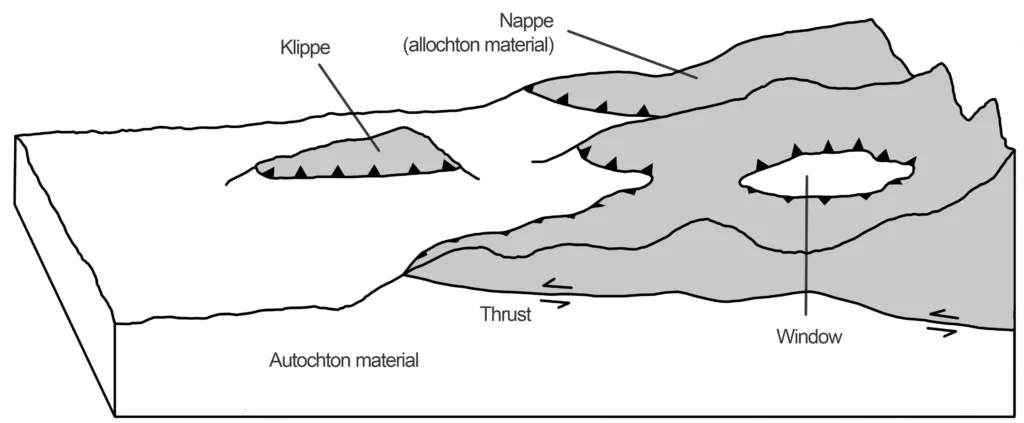
Source Suppe, J. (1985). “Principles of Structural Geology.” Prentice Hall; Price, N. J., & Cosgrove, J. W. (1990). “Analysis of Geological Structures.” Cambridge University Press.