Topic
Glaciology
Glaciology is the study of glaciers, ice sheets and other natural ice: how ice forms and flows, and how it shapes landscapes, climate and sea level.
- Essays
- 4
- Films
- 1
- Key terms
- 12
- Newest
What is glaciology?
Glaciology is the study of ice on land, and more broadly of ice in nature: how snow turns into glacier ice, how ice flows, how glaciers erode and deposit, and how ice sheets respond to climate. Glacial ice covers about 10 percent of Earth’s land today, including the ice sheets of Greenland and Antarctica, and glaciers and ice caps store about 69 percent of the world’s fresh water. If all land ice melted, sea level would rise by about 70 meters.
Glaciers move by deforming under their own weight and, where their base is wet, by sliding over their bed. As they move they pluck and grind the rock beneath, carving cirques, U-shaped valleys and fjords, and when they retreat they leave moraines, drumlins and erratic boulders. Much of northern Europe and North America is a landscape shaped by the ice of the last glacial period.
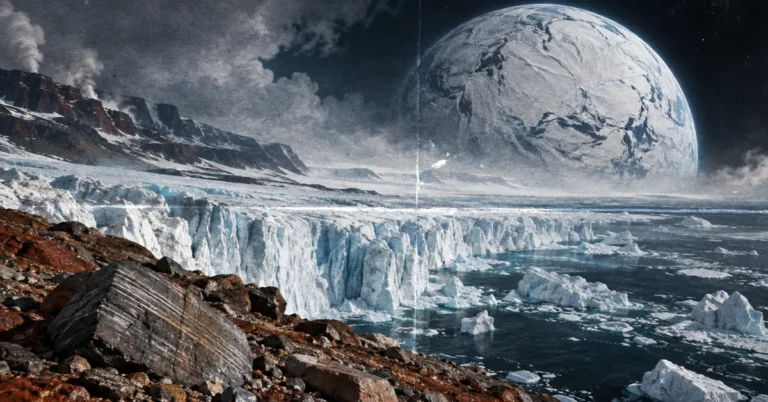
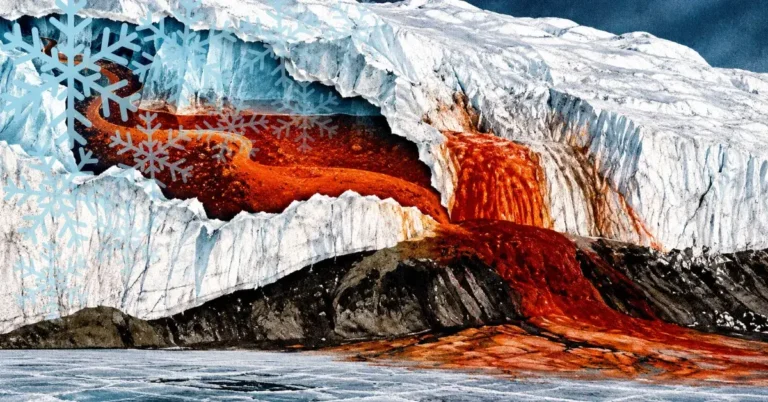
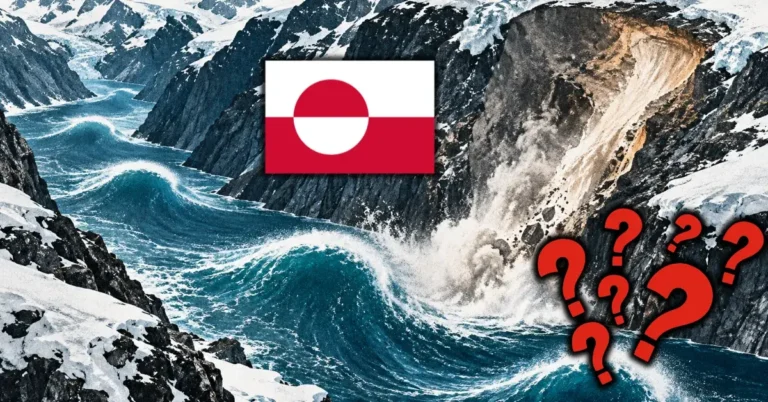
Start with Snowball Earth, the hypothesis that ice once covered nearly the whole planet, then Blood Falls, the red outflow of an Antarctic glacier, and Greenland’s nine-day seismic mystery.
start.here

01 19 min read
Snowball Earth: When the Equator Froze
Paleomagnetism and tropical tillites reveal the Cryogenian Snowball Earth, when glaciers reached the equator and the oceans nearly froze worldwide.
02 21 min read
Blood Falls: Why an Antarctic Glacier Bleeds
Blood Falls is rust-red brine seeping from Antarctica's Taylor Glacier: ancient seawater trapped under the ice, stained by iron and kept liquid by…
03 22 min read
Greenland’s 9-Day Seismic Mystery Explained
A 2023 landslide into Greenland's Dickson Fjord set off a mysterious 9-day seismic hum, the Unidentified Seismic Object. How a sloshing wave explains…
key.concepts
Cryosphere
The cryosphere encompasses all the Earth's frozen water, including glaciers, ice caps, ice sheets, sea ice, snow, and permafrost.
Basal Sliding
Basal sliding refers to the movement of a glacier over its bed, facilitated by the presence of meltwater that reduces friction between the ice and…
Glacial Plucking
Glacial plucking is the process by which a glacier removes large chunks of bedrock as it moves.
Glacial Striation
Glacial striations are grooves or scratches carved into bedrock by rocks embedded in the base of a moving glacier.
U-Shaped Valley
A U-shaped valley is a valley with a characteristic U-shaped cross-section, formed by glacial erosion.
Cirque
A cirque is a bowl-shaped, amphitheater-like depression eroded into a mountain by a glacier.
Fjord
A fjord is a long, narrow, deep inlet of the sea between high cliffs or steep slopes, created by the submergence of a glaciated valley.
Moraine
A moraine is an accumulation of glacial debris (till) formed by the movement of a glacier.
Drumlin
A drumlin is an elongated hill formed by glacial action, composed of till, and shaped like an inverted spoon or half-buried egg, with its long axis…
Esker
An esker is a long, winding ridge of stratified sand and gravel deposited by meltwater streams flowing beneath a glacier.
Erratic (Glacial)
A glacial erratic is a large boulder or rock fragment that has been transported and deposited by a glacier, often far from its original location.
Jökulhlaup
A jökulhlaup is a type of glacial outburst flood that occurs when water trapped by a glacier or within a glacial lake is suddenly released.
watch.films
all.essays
Blood Falls: Why an Antarctic Glacier Bleeds
Blood Falls is rust-red brine seeping from Antarctica's Taylor Glacier: ancient seawater trapped under the ice, stained by iron and kept liquid by…
· 21 min read
Greenland’s 9-Day Seismic Mystery Explained
A 2023 landslide into Greenland's Dickson Fjord set off a mysterious 9-day seismic hum, the Unidentified Seismic Object. How a sloshing wave explains…
· 22 min read
Snowball Earth: When the Equator Froze
Paleomagnetism and tropical tillites reveal the Cryogenian Snowball Earth, when glaciers reached the equator and the oceans nearly froze worldwide.
· 19 min read
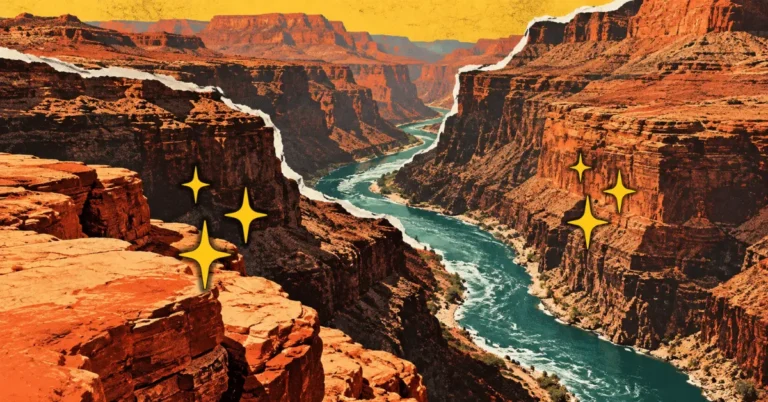
How Rivers Shape Earth’s Dynamic Landscapes
Rivers sculpt Earth’s surface through erosion, sediment transport and deposition, shaping valleys, deltas and floodplains. How the process works.
· 14 min read
common.questions
What is glaciology?
The scientific study of glaciers and, more generally, of ice and the natural processes that involve it. It draws on geology, geophysics, climatology and hydrology.
How do glaciers move?
In two ways. The ice deforms and flows slowly under its own weight, and where the base of the glacier is wet, the whole glacier slides over its bed. Meltwater reaching the bed can make a glacier speed up.
What was Snowball Earth?
A hypothesis that during the Cryogenian period, in two glaciations between about 717 and 635 million years ago, ice covered all or nearly all of the planet’s surface. The Snowball Earth essay explains the evidence.
How much of the world’s fresh water is in glaciers?
About 69 percent, according to the U.S. Geological Survey figure quoted by the National Snow and Ice Data Center. Glacial ice covers about 10 percent of Earth’s land surface.
other.topics
Geochemistry
15 essays · 2 films
Geohazards
18 essays · 1 film
Geomorphology
21 essays · 2 films
Geophysics
25 essays · 2 films
Mineralogy
14 essays
Paleontology
7 essays
Petrology
6 essays · 1 film
Volcanology
13 essays · 1 film