
Introduction
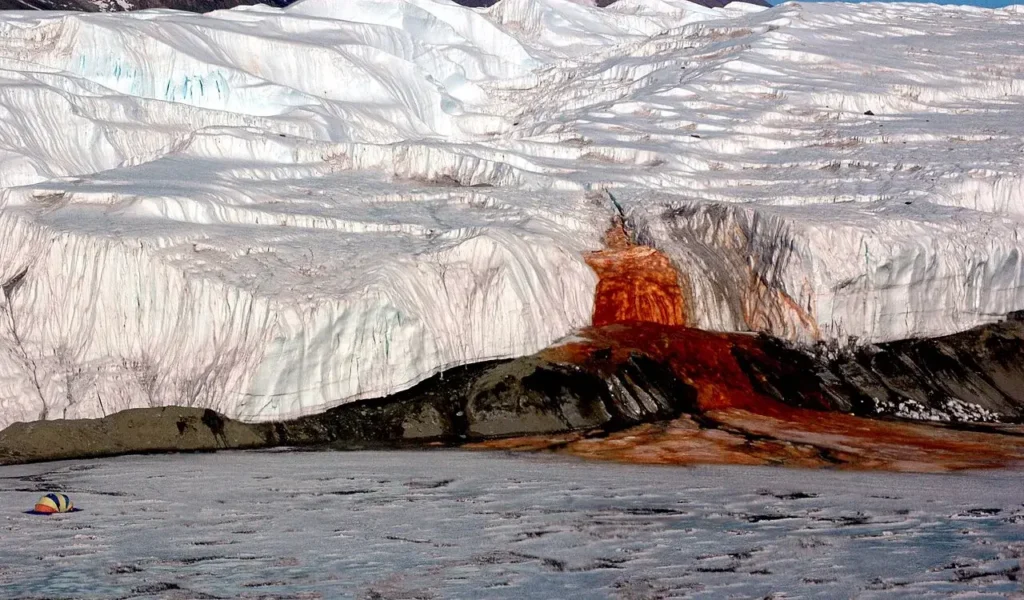
In the summer field season of 1911, a young Australian geologist named Thomas Griffith Taylor rounded the snout of an unnamed glacier on the western edge of an Antarctic valley and stopped cold. Spilling from the white wall of ice was a stain the colour of a fresh wound, a rusty, crimson fan bleeding down onto the frozen lake below. Taylor, a member of Robert Falcon Scott’s doomed Terra Nova Expedition, had no instruments to test it and no obvious explanation. He guessed the colour came from red algae, the kind that tints polar snow elsewhere, jotted the observation in his notebook, and moved on. The glacier would later carry his name, and the seep would acquire one of the most arresting place-names in all of science: Blood Falls.
The truth took a century to assemble. Blood Falls is ancient seawater, sealed under the ice for more than a million years, stained red by iron that rusts the instant it meets the air, and kept alive in total darkness by microbes that breathe iron instead of oxygen. In February 2026, a team led by Louisiana State University finally caught the glacier in the act of bleeding, and showed that each red pulse is the visible symptom of a hidden plumbing system venting beneath hundreds of metres of ice.
This is the story of how a century-old curiosity became one of the most scientifically valuable spots on the planet, a natural laboratory for the chemistry of dead seas, the limits of life, and the search for biospheres on other worlds.
A red stain in the world’s strangest desert
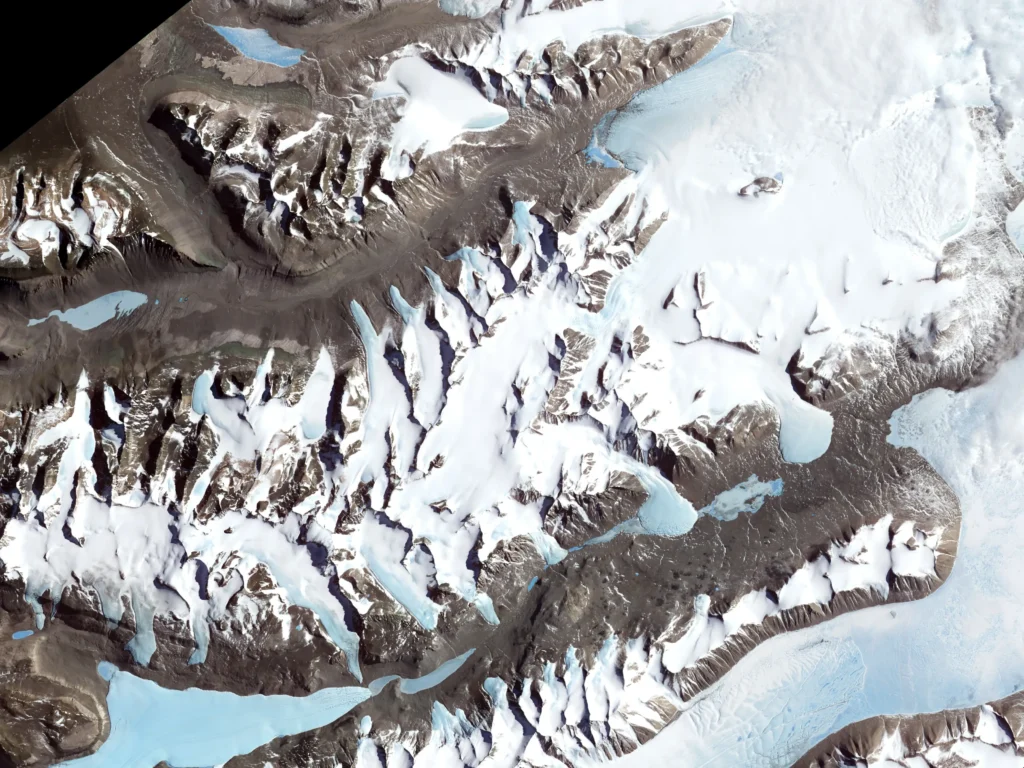
To understand why this glacier appears to bleed, you first have to understand where it sits. Blood Falls flows from the terminus of Taylor Glacier, an outlet of the vast East Antarctic Ice Sheet that creeps eastward off the Victoria Land plateau and noses into Taylor Valley, the southernmost of the McMurdo Dry Valleys in Victoria Land, East Antarctica.
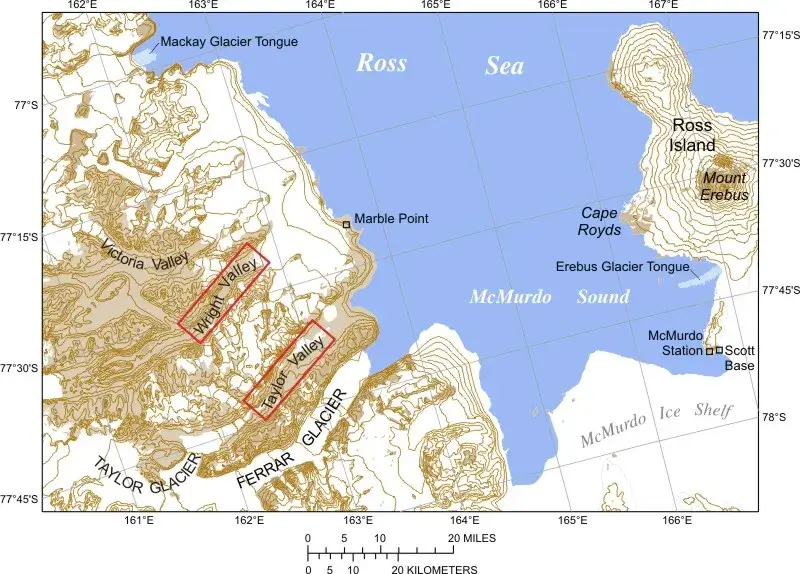
The Dry Valleys are unlike anywhere else on the continent. They are not buried under the kilometres of ice that smother most of Antarctica; instead they are bare rock, gravel and frozen lakes, the largest ice-free region on the continent, covering roughly 4,800 square kilometres (1,850 sq mi). The high wall of the Transantarctic Mountains blocks the inland ice from flooding in, while relentless katabatic winds — cold, dense air sliding downhill off the plateau, strip away almost all the snow before it can settle. According to Obryk and colleagues, writing in the Journal of Geophysical Research: Atmospheres (2020; DOI 10.1029/2019JD032180), the mean air temperature across the valley monitoring network is −20 °C, with valley-floor station means ranging from −15 °C to −30 °C, and annual precipitation amounts to only about 100 millimetres (4 inches) of water equivalent, nearly all of it falling as snow. By the conventional definition, extreme aridity, not heat, this is one of the driest deserts on Earth, and the coldest.
It is also, not coincidentally, the closest analogue we have to the surface of Mars, which is why NASA has flown instruments and sent field teams here for decades. Drop a Mars rover into Taylor Valley and it would feel, climatically, almost at home.
Into this freeze-dried landscape, Taylor Glacier intrudes from the west, terminating in the perennially ice-covered West Lobe of Lake Bonney. The glacier is cold-based, frozen to its bed across most of its length, with basal ice temperatures near −17 °C. Where most glaciers slide on a film of meltwater, Taylor Glacier mostly creeps by deforming internally, an exceptionally slow river of ice. And at its northern margin, against all expectation, liquid water emerges and runs red.
The discovery: a geologist, an expedition, and a wrong guess
The Terra Nova Expedition (1910–1913), formally the British Antarctic Expedition, is best remembered for tragedy: Scott and four companions reached the South Pole in January 1912 only to find Roald Amundsen had beaten them by a month, and all five died on the return march. But the expedition was also a serious scientific enterprise, carrying geologists, biologists and physicists who produced a wealth of data even as the polar party perished.
Thomas Griffith Taylor led the western geological party. While surveying the valley that Scott would later name in his honour, Taylor encountered the vivid outflow at the glacier’s terminus. In his own published account he described a “bright red alga” lending an unusual touch of colour at the snout of the glacier, a reasonable inference for a field scientist in 1911, since red-tinted snow caused by pigmented algae was a known polar phenomenon. He had no way to chemically test the water, and the misattribution stuck for half a century.
The correction came in stages. Beginning in the early 1960s, researchers who finally documented the outflow, Angino and colleagues in 1964, Black and colleagues in 1965, showed through geochemical analysis that the colour came not from biology but from iron oxides. The “blood” was rust. That answer, however, only deepened the mystery. Iron oxides explained the colour. They did not explain where a stream of iron-laden saltwater was coming from in the middle of a frozen desert, or how it stayed liquid, or why it flowed at all.
Why is Blood Falls red? Iron that rusts on contact with air
Start with the colour, because it is the most direct question and the one most people ask first.
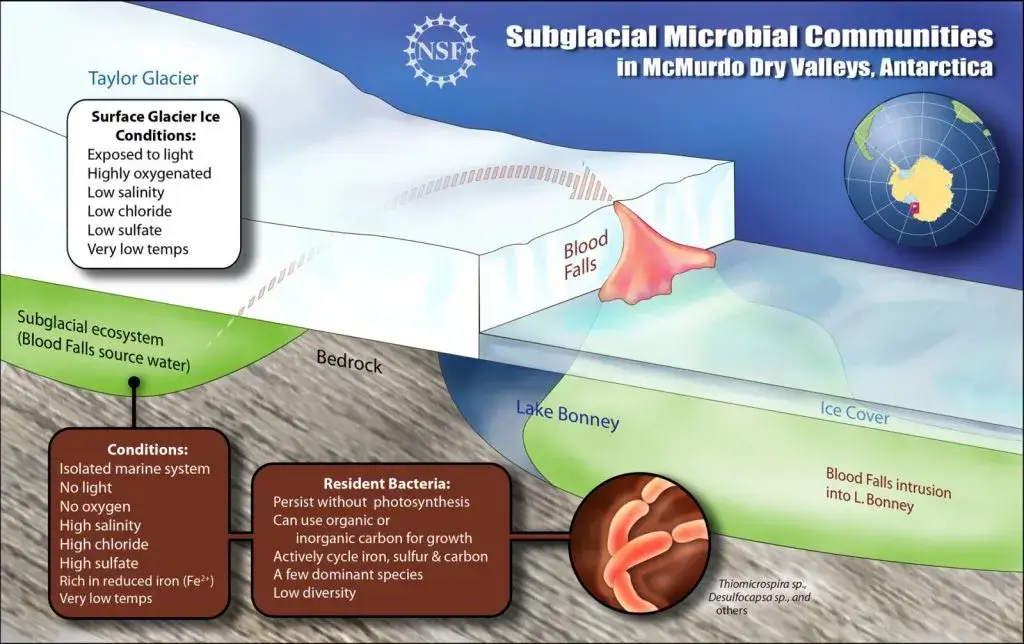
The water that emerges at Blood Falls is a brine, hypersaline water, several times saltier than the ocean, and it is loaded with dissolved ferrous iron, the reduced Fe(II) form that stays in solution as long as oxygen is absent. Underground, sealed beneath the glacier, this brine is clear. It has been cut off from the atmosphere for an immense span of time, and in that oxygen-free environment the iron remains invisible and dissolved.
The instant the brine reaches the glacier’s surface and meets the Antarctic air, that changes. Oxygen attacks the dissolved Fe(II) and oxidises it to Fe(III), which is essentially insoluble and precipitates out as hydrous ferric oxides, the same chemistry that turns an old nail orange. The reaction is fast, and it paints the ice and the morainal soil along the lake’s edge a deep rust-red. The brine, in other words, does not arrive red. It rusts in front of your eyes.
A 2023 mineralogical study from Johns Hopkins University, led by research scientist Ken Livi, refined the picture further: much of the iron is carried not as conventional crystalline minerals but as iron-rich nanospheres, particles roughly a hundred times smaller than a human red blood cell, that oxidise and redden on exposure. The detail matters beyond Blood Falls. As Livi noted, instruments on Mars rovers, tuned to detect crystalline minerals, might roll straight over such nanoscale, non-crystalline material without registering it, a caution about how we hunt for chemical signatures on other planets.
So the first half of Taylor’s puzzle resolves cleanly. The red is oxidised iron, deposited where ancient brine meets modern air.
Where Blood Falls comes from: a freeze-dried sea trapped under Taylor Glacier
The harder question is the source. Why is there a reservoir of iron-rich brine buried beneath a cold Antarctic glacier in the first place?
The most durable explanation traces back to a team led by W. Berry Lyons of Ohio State University’s Byrd Polar Research Center, who studied the outflow for a decade and presented their conclusions at the Geological Society of America meeting in 2003. Their reconstruction reads like deep-time geology. Several million years ago, during the Miocene, by most reconstructions around five million years ago — when global sea levels were higher, the ocean reached far inland, and Taylor Valley resembled a Scandinavian fjord flooded by seawater. As climate cooled and the sea retreated, a salty lake was left stranded in the valley. Iron-bearing salts settled into its bed.
Then the glacier advanced. As Taylor Glacier crept forward over the stranded lake, it smothered and sealed the briny water beneath hundreds of metres of ice, scooping up and trapping the iron-rich deposits. Cut off from the atmosphere, the trapped seawater underwent cryoconcentration: as pure ice crystallised out of the body of water, it expelled dissolved salts into the remaining liquid, concentrating the brine to two or three times the salinity of normal seawater. The chemistry of the modern outflow still bears a marine fingerprint, its sodium-to-chloride and chloride-to-bromide ratios resemble seawater, but with telltale alterations from millions of years of weathering against the underlying rock.
The reservoir is not small or shallow. The brine source is overlain by roughly 400 metres (1,300 feet) of ice and sits several kilometres upstream of the tiny outlet where Blood Falls emerges. In 2015, Jill Mikucki and colleagues, flying an airborne electromagnetic sensor over the valley with the Danish geophysics firm SkyTEM, detected extensive briny groundwater extending far beneath the Dry Valleys, reported in Nature Communications (2015; DOI 10.1038/ncomms7831). Blood Falls, in this view, is not an isolated oddity but the visible leak from a vast, hidden, salty plumbing network.
Why does Blood Falls stay liquid at −17 °C? Salt, and a thermal sleight of hand
This is the part that sounds like it should be impossible. Taylor Glacier is cold-based, with basal and near-terminus ice hovering around −17 °C. Liquid water has no business flowing through ice that cold. And yet the brine threads its way from the deep reservoir, up through the glacier, and out at the surface.
The first half of the answer is salinity. Salt depresses the freezing point of water, the same reason we spread it on icy roads. But salt alone is not enough. The brine’s salt content lowers its freezing point by roughly 7 °C, leaving a stubborn gap of about 10 °C between that and the −17 °C ice it has to travel through. Something else has to be warming the system.
That something is the latent heat of freezing, and the mechanism was worked out in an elegant 2017 study published in the Journal of Glaciology (vol. 63, no. 239, pp. 387–400; DOI 10.1017/jog.2017.16). The lead author was Jessica A. Badgeley, then an undergraduate at Colorado College, working with University of Alaska Fairbanks glaciologist Erin C. Pettit and the MIDGE Science Team. Using radio-echo sounding, bouncing radar pulses through the ice, the team imaged a subhorizontal zone of brine within the glacier, elongated along the flow direction and feeding the surface. They estimated a volumetric brine content exceeding 13% within two metres of the central axis of this zone, with even higher concentrations at its core, and traced subglacial pathways carrying brine toward both the centre and south side of the terminus, in addition to the Blood Falls outlet itself.
The thermodynamic insight is the counterintuitive bit. When water freezes, it does not simply vanish into ice; it releases heat, the latent heat of fusion. Inside the glacier, as some of the migrating brine partially freezes, the heat it sheds warms the surrounding ice. That self-generated warmth is enough to bridge the remaining temperature gap and keep an open, liquid pathway threaded through ice that is otherwise far too cold to permit flow. The brine, in effect, heats its own escape route. As Pettit put it in the accompanying University of Alaska Fairbanks announcement, “Taylor Glacier is now the coldest known glacier to have persistently flowing water.” The broader implication, the authors noted, is that cold glaciers elsewhere could sustain liquid hydrologic systems through localised latent-heat warming alone, a finding the authors framed as cold glaciers being able to support freshwater hydrologic systems through localised warming by latent heat alone — reaching well beyond a single red waterfall.
What lives in Blood Falls: an ecosystem that breathes iron
If the geology and physics of Blood Falls are remarkable, the biology is what made it world-famous.
In 2009, geomicrobiologist Jill A. Mikucki and an international roster of co-authors published a landmark paper in Science, “A Contemporary Microbially Maintained Subglacial Ferrous ‘Ocean'” (vol. 324, no. 5925, pp. 397–400; DOI 10.1126/science.1167350). They had analysed brine sampled, fortuitously, through a crack in the ice. What they found rewrote the assumptions about where life can persist.
The water was effectively oxygen-free, anoxic, yet teeming. Mikucki’s team identified a community of microbes that had been sealed in cold darkness for an immense span of time. In a 2009 interview on NPR’s Science Friday, Mikucki described the early census: “from initial characterizations it looks like there’s about 17 unique types of organisms. And that estimate is probably low and that there’s probably more like 30.” With no sunlight and no oxygen, these organisms cannot photosynthesise or respire the way most life on Earth does. Instead, they exploit the chemistry of their prison.
The metabolic puzzle the team solved is strange. The brine is rich in both sulfate, a chemical fingerprint of its marine origin — and dissolved ferrous iron. Crucially, it contains essentially no sulfide, the product you would normally expect when microbes reduce sulfate. That absence is the clue. Mikucki’s analysis, drawing on genetic sequencing and sulfur- and oxygen-isotope measurements, indicated that the microbes use sulfate as a kind of catalyst to “breathe” with ferric iron, using Fe(III) as the terminal electron acceptor in place of oxygen, while metabolising trace organic matter trapped alongside them. The iron-and-sulfur cycles are intertwined in a way that keeps regenerating the reactants rather than building up sulfide. It is respiration without air, powered by rust.
According to Mikucki and colleagues, the subglacial pool was sealed off 1.5 to 2 million years ago, isolating this microbial population for long enough to evolve, in their words, as a kind of biological “time capsule.” Few places on Earth offer a sample of a community that has run, unbroken and undisturbed, in the dark for that long.
Drilling in: the IceMole and a probe built for another world
For years, scientists could only sample what leaked out at the surface, brine already altered by its journey and its contact with air. To understand the source, they needed to reach the brine inside the glacier, cleanly, without contaminating a pristine ecosystem.
That opportunity arrived in December 2014, through one of the more unusual instruments ever deployed on the ice. The EnEx-IceMole, developed by a German consortium under the Enceladus Explorer (EnEx) project, is a steerable, thermoelectric melting probe, a long box with a heated copper head and an ice screw that lets it melt curved trajectories through a glacier rather than simply boring straight down. Working in cooperation with the U.S. National Science Foundation–funded MIDGE project (Minimally Invasive Direct Glacial Exploration), led on the science side by Mikucki and Pettit, the team used the IceMole to melt about 17 metres along an oblique path into Taylor Glacier and tap a brine-filled conduit feeding Blood Falls, the first direct, clean sample of the source.
The numbers from that sample sharpened the picture of the brine before it reaches the air: cold, at about −7 °C (19 °F); iron-rich, around 3.4 millimolar; and roughly 8% sodium chloride by content, well over twice the salinity of seawater. From the recovered material, researchers isolated and characterised a cold-loving (psychrophilic), salt-loving (halophilic), heterotrophic bacterium assigned to the genus Marinobacter, along with other taxa. DNA analysis flagged gene clusters tied to secondary metabolism, including some producing antioxidant pigments that may help shield the cells from reactive oxygen, useful armour for a microbe that periodically gets flushed toward the surface.
The choice of instrument was no accident. The IceMole was conceived as a terrestrial dress rehearsal for a mission to Enceladus, Saturn’s geyser-spouting ice moon, where a subsurface ocean vents through cracks called “tiger stripes.” Blood Falls, where subglacial liquid is forced to the surface and can be sampled without deep drilling, is one of the only places on Earth to practise the exact problem of accessing an alien subglacial sea. We will return to that.
What pushes it out: the 2026 study that caught the glacier bleeding
For more than a century, the most basic behavioural question about Blood Falls went unanswered. The outflow is not constant; it pulses, sporadically, sometimes years apart. Why does it bleed when it bleeds? What turns the tap?
The answer came in February 2026, in a short but consequential paper in Antarctic Science, Doran, P.T., Siegfried, M.R., Dugan, H.A., Hubbard, K.A. & Lawrence, J.P., “Glacier surface lowering and subglacial outflow coincide with Blood Falls discharge in the McMurdo Dry Valleys” (vol. 38, pp. 101–103; DOI 10.1017/S0954102025100527, open access under CC BY 4.0). The lead author, Peter T. Doran, is a geoscientist at Louisiana State University; his co-authors span the Colorado School of Mines, the University of Wisconsin–Madison and the University of Colorado Boulder.
The breakthrough was, by the authors’ own description, a “serendipitous alignment” of three independent instruments that happened to be recording at the same time in September 2018. A continuous GPS station, designated TYLG and installed on Taylor Glacier in 2017 at 77.7256° S, 162.2653° E, was tracking the glacier’s surface position. A time-lapse camera was pointed at Blood Falls, snapping one image a day. And a thermistor string was logging water temperature at ten depths in West Lake Bonney, roughly 150 metres from the glacier terminus, accurate to two-thousandths of a degree. The field team, Doran credits Thomas Nylen for first noticing the anomaly in the data, found that all three told the same story at once.
The GPS recorded a vertical drop of about 15 millimetres (0.6 inches) in the glacier surface between 10 September and 22 October 2018, a clear reversal against the gradual elevation gain (about 60 mm over the three-year record) seen in adjacent periods. Over the same window, the glacier’s horizontal velocity slowed by nearly 10%, from about 5.0 to 4.6 metres per year. The time-lapse camera showed a flow event beginning on 10 September, with new discharge visible daily from 19 September through the end of the month and intermittent flow into mid-October, the rust stain expanding steadily. And the lake thermistors recorded multiple cold anomalies of up to about −1.5 °C (2.7 °F) relative to the seasonal mean at the 17.89-metre depth, with the largest negative anomalies on 23 September and 16 October 2018, at exactly the depth where dense subglacial brine, sinking into the lake, would match the surrounding water’s density and spread out sideways.
Read together, the three records resolve the century-old mechanism. The paper’s central conclusion, in the authors’ words: “an extended brine discharge event, characterized by episodic pulses of brine sourced from beneath Taylor Glacier over ~1 month, reduces subglacial water pressure, which lowers the surface and reduces ice velocity.” In plain terms: pressure builds in the trapped brine as the heavy, creeping glacier squeezes it. When that pressure forces open a pathway, the brine vents, some onto the surface as the red cascade, some directly into the lake along the glacier front. As the reservoir drains, the water pressure beneath the ice falls, the glacier’s surface sags by those few telltale millimetres, and, with less pressurised water to lubricate and buoy it, the ice briefly slows. Blood Falls turning red is the symptom; the cause is a subglacial drainage pulse releasing pent-up pressure. The bleeding is a pressure-relief valve.
The authors are careful about the limits of a single coincidence. The signal came from one GPS station, one camera and one thermistor string, and the post-event velocity may have settled about 0.2 m/yr slower than before, but a longer record is needed to know whether that is a lasting change. They argue, persuasively, that expanded high-frequency monitoring is now essential: only a denser, longer dataset can reveal whether the frequency or magnitude of these discharge events is shifting as the climate changes. The data and processing code are archived openly at Zenodo (DOI 10.5281/zenodo.17298618), and the work was supported by NSF grants OPP-2224760 and 2145407.
A refuge during Snowball Earth
Blood Falls is captivating on its own terms. But its scientific weight comes from what it stands in for.
Several times in the deep past, most dramatically during the Cryogenian period of the Neoproterozoic, roughly 720 to 635 million years ago, Earth may have frozen over almost entirely, ice reaching from the poles to the tropics. This is the Snowball Earth hypothesis, and it raises a stark biological problem. If the oceans were capped by thick ice and the surface was lethally cold and dark, how did life survive to repopulate the planet afterward? Complex life clearly did make it through; the molecular and fossil records show lineages threading across the glacial intervals.
Blood Falls offers a working model of one possible answer. Here is a community that has persisted in cold, sunless, oxygen-free, salty water for more than a million years, drawing energy not from the sun but from rock-derived chemistry. If life can run indefinitely in a sealed pocket of brine beneath a cold glacier today, then ice-covered seas and subglacial brines could have served as refugia during the global glaciations, sheltered reservoirs where microbial ecosystems waited out the freeze. Mikucki has made the connection explicitly: even thick ice does not extinguish life, because there is plenty of chemical energy available beneath it. Blood Falls does not prove the Snowball Earth refugium scenario, but it demonstrates its plausibility with a living example.
A rehearsal for Europa, Enceladus and Mars
The second reason scientists care reaches off the planet entirely.
Some of the most promising places to look for life beyond Earth are not warm and sunlit but cold and buried. Europa, a moon of Jupiter, and Enceladus, a moon of Saturn, both hide liquid-water oceans beneath thick ice shells, kept liquid by tidal heating and, in places, in contact with rock. Enceladus actively sprays ocean water into space through fractures at its south pole. On Mars, today’s surface is frozen and bone-dry, but the planet has polar ice, a deep history of water, and the kind of cold, salty, subsurface conditions where any surviving microbes would most plausibly hide.
Every one of those environments, cold, dark, salty, sealed under ice, energised by chemistry rather than light, is described almost exactly by the ecosystem beneath Taylor Glacier. That is why Blood Falls has become a terrestrial analogue and a technology proving ground. The IceMole was built to rehearse the engineering of melting cleanly into an alien ice shell. The microbes show what kind of metabolism, chemosynthesis on iron and sulfur, no sunlight required, a subglacial alien biosphere might run on. And the Johns Hopkins nanosphere work delivers a sobering operational lesson: the chemical signatures of such life can be so fine-grained and non-crystalline that current rover instruments might miss them, even while parked on top of them. If we want to recognise life on an ocean world, Blood Falls is teaching us what to look for and how easily we could overlook it.
The same red stain that fooled a geologist in 1911 into thinking he saw algae is now helping engineers design the instruments that may one day sample the ocean of an ice moon hundreds of millions of kilometres away.
Frequently asked questions
Why is Blood Falls red?
Because of iron. The water emerging from Taylor Glacier is an ancient, oxygen-free brine carrying dissolved ferrous iron, Fe(II), which is colourless in solution. The moment it reaches the surface and meets the air, oxygen converts the iron to insoluble ferric oxides, rust, which stain the ice and soil deep red within minutes. A 2023 Johns Hopkins study found much of the iron travels as tiny iron-rich nanospheres. Red algae, the original 1911 guess, has nothing to do with it.
Is Blood Falls really blood?
No. Despite the name and the alarming appearance, there is no blood and no organic pigment involved. The colour is purely chemical, oxidised iron, the same process that rusts metal. The “blood” name comes from Thomas Griffith Taylor’s vivid first impression in 1911, not from its composition.
What lives beneath Taylor Glacier?
A community of microbes sealed off from the outside world for an estimated 1.5 to 2 million years. In the 2009 Science study, Jill Mikucki’s team described an anoxic ecosystem of at least 17 microbial types that survive without sunlight or oxygen by using sulfate to help “breathe” with ferric iron, using iron as their terminal electron acceptor. Direct sampling in 2014 with the IceMole probe recovered a cold (−7 °C), iron-rich, roughly 8%-salt brine and isolated bacteria of the genus Marinobacter.
Could Blood Falls tell us about life on Mars?
Quite possibly. Blood Falls is one of Earth’s best analogues for the cold, dark, salty, ice-covered environments thought to exist on Mars and on the ocean moons Europa and Enceladus. Its microbes show that chemosynthetic life can persist beneath ice without sunlight, and the German-built IceMole probe used here was designed as a rehearsal for sampling an alien subglacial ocean. Mineralogical work on the iron nanospheres has even warned that Mars rovers might fail to detect such life signatures with current instruments.
The waterfall that keeps giving
For more than a hundred years, Blood Falls has yielded its secrets slowly and out of order, the colour first, then the buried sea, the improbable liquid water, the life, and finally, in 2026, the rhythm of the bleeding itself. That last answer is to a question Taylor could not even have known to ask: not what the red is, or where it comes from, but what turns the tap.
What began as a misidentified smear of “algae” is now a window into the chemistry of dead seas and the stubbornness of life in the dark — and a field manual for how the biosphere survives planetary catastrophe, and how we might find life elsewhere. Few features on Earth so small have taught us so much. And with new monitoring networks going in, the next time Taylor Glacier bleeds, we will be watching.