Introduction
Sometime in the small hours of the second day, a young man lay face down on a wooden bed in a back room of a public hall in Herculaneum. The building was the Collegium Augustalium, a shrine to the cult of the deified emperor Augustus, two streets up from the waterfront. He was about twenty years old. He was probably the caretaker of the place, the man who slept in the modest chamber built beside the sanctuary so that someone was always there. Outside, Vesuvius had been throwing ash and pumice into the sky since early afternoon, turning the day dark and dropping a fine gray snow over the Bay of Naples. The wind was carrying most of that fallout toward Pompeii, southeast of the crater, so Herculaneum, on the volcano’s western flank, had so far been spared the worst of the rain of stone.
Then the eruption column collapsed, and the first ground-hugging cloud of ash and gas came down the mountain and over the town. In the space of a breath the room reached a temperature no living tissue survives. The young man died where he lay. His body and the bed beneath him were transformed. And inside his skull something happened that, so far as anyone has ever documented, has never happened to another human being: fragments of his brain turned to glass.
Nearly two thousand years later those black, shiny shards became one of the strangest objects in the study of ancient disasters, and the center of a scientific argument that is still not settled. The claim, first published in January 2020, has been attacked in print, defended with new measurements in 2025, and attacked again. Some of the world’s leading specialists on glass and on preserved ancient brains do not believe it. The researchers who found the shards are certain.
The mountain that had stopped looking like a threat
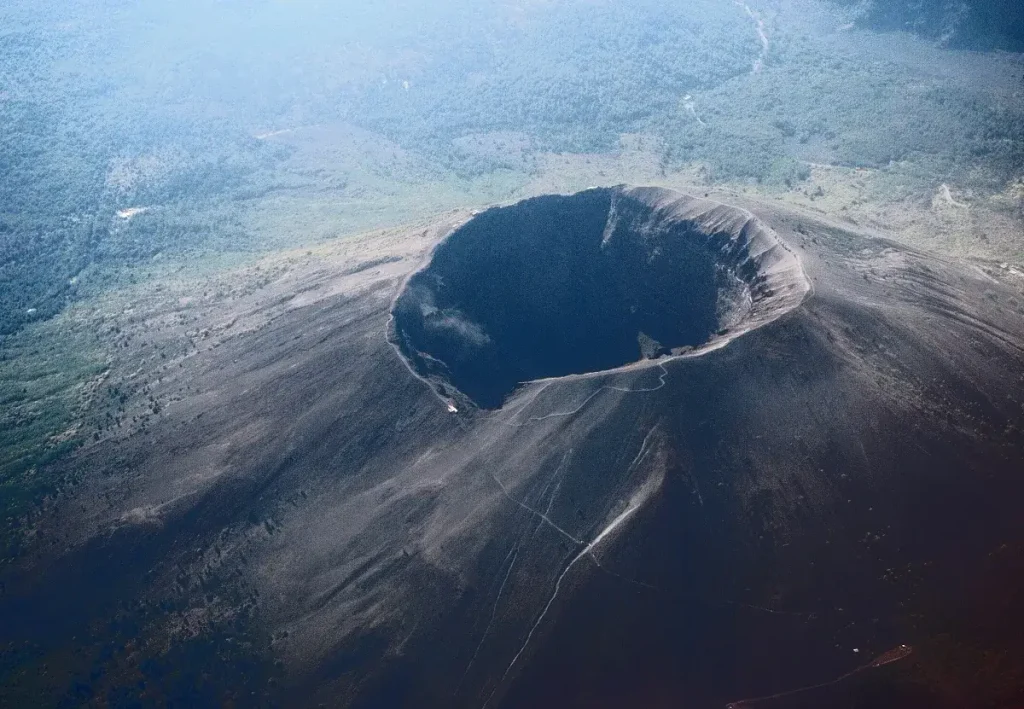
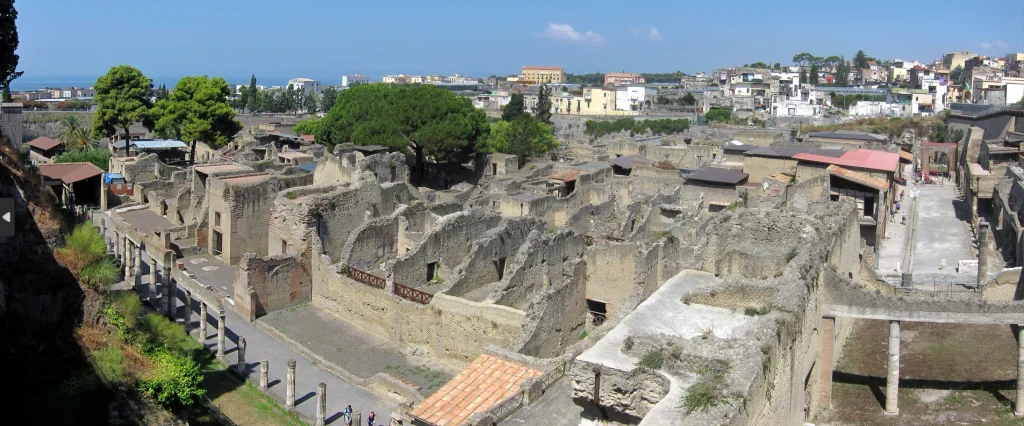
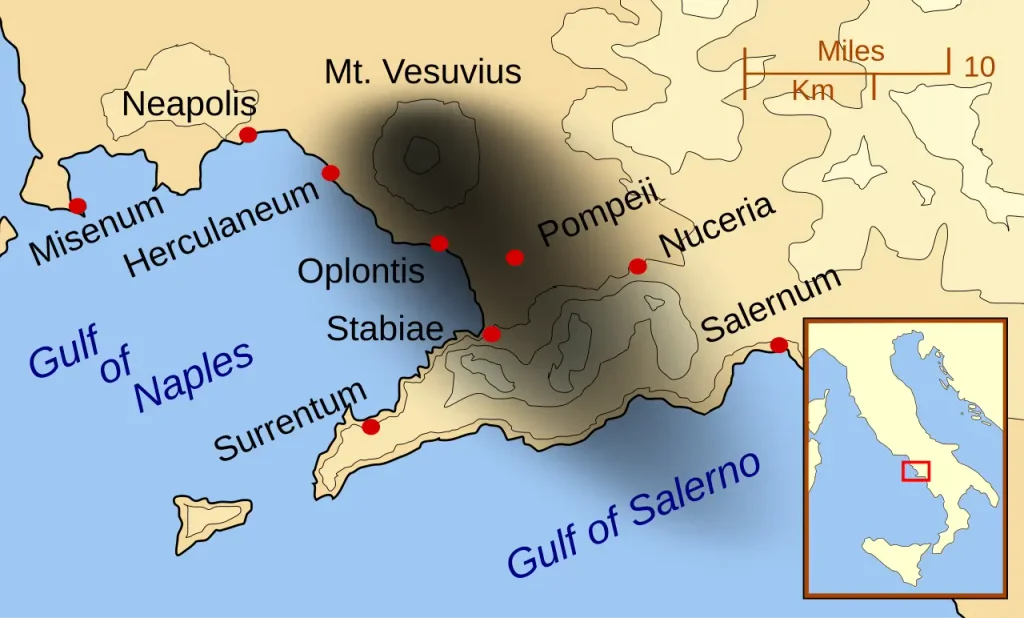
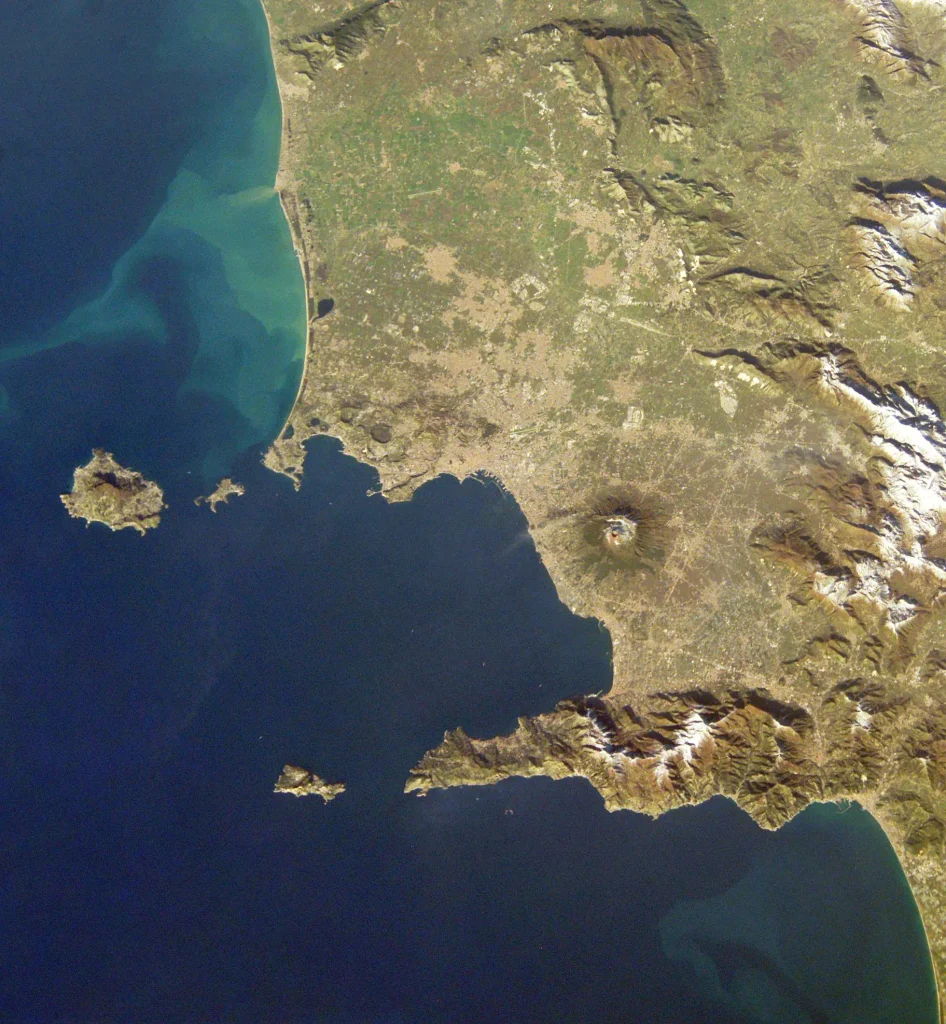
By the first century CE, Vesuvius did not read as a volcano to the people who lived beneath it. Its last major eruption lay so far in the past that no one alive had seen the mountain do anything violent. Its lower slopes were terraced with vineyards. Towns and villas crowded the fertile coast. Herculaneum, named, according to tradition, for the hero Herakles and later absorbed into the Roman world, was a compact seaside town of perhaps four to five thousand people, laid out on a grid, with a theater, bath complexes, multistory houses and a row of luxurious villas looking out over the water. It was smaller than Pompeii and wealthier, a resort for Roman families who could afford a view of the bay. Pompeii, larger and busier, sat on the far side of the mountain, about ten kilometers from the crater and some thirteen from Herculaneum.
A strong earthquake in 62 CE had damaged both towns, and seventeen years later repairs were still underway. Whether anyone connected those tremors to the mountain is unclear. What is clear is that on the day the eruption began the two towns went about ordinary business until a column of ash and pumice climbed tens of kilometers into the sky.
Pliny’s letters, and the birth of a word
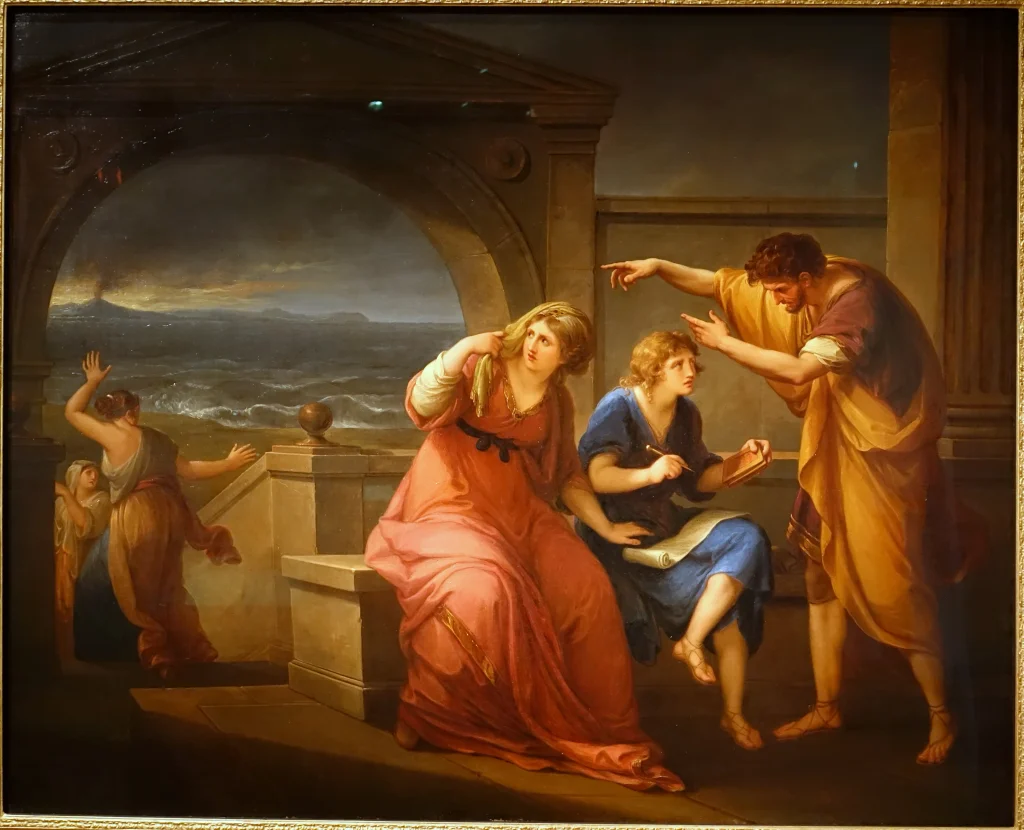
That column was described by an eyewitness. Pliny the Younger, seventeen years old and staying with his mother at his uncle’s villa at Misenum, across the bay from the volcano, watched the cloud rise and years later wrote two letters about it to the historian Tacitus, who had asked for an account of the uncle’s death. Pliny compared the shape of the cloud to an umbrella pine, the tall Mediterranean tree with a long bare trunk and a flat spreading crown: a column of ash rising vertically, then branching out at the top where it lost its momentum and the wind took over. Volcanologists later borrowed his name for the entire category. A Plinian eruption is one that drives a tall, sustained column of gas and fragmented rock into the stratosphere, and the 79 CE eruption of Vesuvius is the type example.
Pliny’s uncle, Pliny the Elder, was the commander of the Roman fleet stationed at Misenum and one of the most famous naturalists of the age, the author of the encyclopedic Natural History. He ordered ships across the bay, partly to observe the phenomenon and partly to rescue people trapped along the coast. He died in the attempt, most likely of the fumes, on the beach at Stabiae. His nephew stayed behind, survived, and left the account that has been mined ever since for clues: the darkness, the repeated earthquakes, the sea drawing back from the shore, the ash falling like snow, the flames on the mountainside seen through the night.
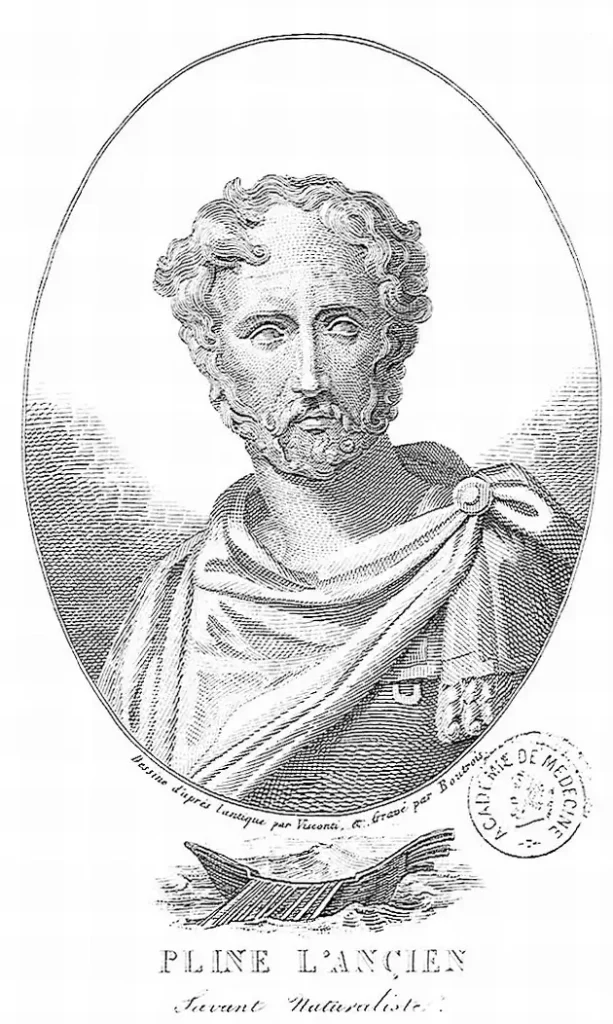
The Natural History has one small, strange relevance to this story. Among its chapters on stones, Pliny the Elder described a dark glassy material found in Ethiopia and brought to Rome by a man named Obsius. The stone took the man’s name. It is the word we still use for volcanic glass, obsidian, and the naturalist who recorded it died in the same eruption that would, according to one group of scientists, produce the first known glass ever made from a human brain.
What happened, hour by hour
The date of the eruption is itself a small scholarly fight. The manuscripts of Pliny’s letters have long been read as giving August 24, and that date sat in every textbook for centuries. Evidence from the ground points to autumn: pomegranates and walnuts in the ruins, braziers in use, victims in heavier clothing, and, since 2018, a charcoal scribble on a wall at Pompeii that appears to give a date in the second half of October. Many archaeologists now favor October 24. For the physics of what followed, the month does not matter. The sequence does.
The eruption opened around midday with a modest explosion and then, within an hour or so, the full Plinian column. For roughly eighteen hours the column stood over the mountain, rising to a height on the order of 30 kilometers, and its fallout drifted southeast on the wind. Pompeii lay directly under that plume. Pumice, first white then gray, rained on the city at a rate that buried streets and loaded roofs until they gave way. People fled or sheltered. Estimates of the mass ejected run to something like 1.5 million tons per second at the peak, and the total thermal energy has been compared, in an often repeated calculation, to roughly 100,000 Hiroshima-sized bombs. Those figures are ways of conveying scale, and they should be read as such. The point is that this was a sustained explosive event. Lava creeping down a hillside had nothing to do with it.
Late in the night the column began to fail. A Plinian column stays aloft only as long as the mixture of hot gas and rock leaving the vent is buoyant. When the vent widens or the gas content of the mixture drops, parts of the column lose their lift and collapse under their own weight, spilling down the flanks as pyroclastic density currents: hot avalanches of gas, ash and rock that hug the ground and move at highway speeds or faster. The first of these reached Herculaneum, about seven kilometers from the vent on the western side of the mountain, hours before any reached Pompeii. Six such currents, in sequence, buried the town. By the morning of the second day, when the surges finally crossed the ten kilometers to Pompeii, Herculaneum had been sealed under a mass of ash and rock that would eventually reach roughly 20 meters thick.
Pliny, at Misenum, described the second day as darker than night, the ash falling so heavily that people had to keep shaking it off to avoid being buried where they stood. By that afternoon the light returned, yellowish through the haze, and the eruption was over. Two towns, a handful of villages and villas, and somewhere between a few thousand and perhaps sixteen thousand people were gone.
How did people in Herculaneum die? Herculaneum versus Pompeii
One geographic accident explains everything that follows. Pompeii and Herculaneum were destroyed by the same eruption, and they were killed by different parts of it. That difference explains why the two sites look so unlike each other today, why their dead are preserved in such different ways, and why only Herculaneum could have produced a glass brain.
Pompeii: eighteen hours of falling stone
Pompeii sat downwind. For most of a day it was pelted by tephra, the pumice and ash raining out of the eruption column, which accumulated at a rate of roughly 15 centimeters an hour and eventually stood two to three meters deep in the streets. This phase killed people mainly by collapse: roofs and upper floors gave way under the weight. It also gave people time. The pumice is light, and for hours it was possible to wade through it, cover your head and leave. Most of Pompeii’s residents seem to have done exactly that. The ones who stayed, or could not go, or came back for something, were still in the city when the surges arrived the next morning.
Those surges had crossed ten kilometers of countryside by the time they reached the walls, and they had cooled and thinned as they went. A 2010 study in PLOS ONE led by the volcanologist Giuseppe Mastrolorenzo and the forensic anthropologist Pier Paolo Petrone estimated from the condition of the victims’ bones that people at Pompeii were exposed to temperatures of roughly 250 to 300 degrees Celsius: lethal within moments, but far below what the deposits record closer to the volcano. The cause of death at Pompeii is still argued over. Mastrolorenzo and Petrone read the bones and the body postures as evidence that heat killed people almost instantly. A 2023 chemical and anthropological study of casts from the Porta Nola area, also in PLOS ONE, concluded that asphyxiation in the ash-laden air remains the more likely explanation for the victims it examined. Both may be true for different people in different parts of the city.
Nobody disputes how Pompeii’s dead were preserved. Fine ash from the surges packed around the bodies and hardened. As the soft tissue decayed it left cavities in the rock, body-shaped voids that held the outline of a face, the curl of a hand. In the 1860s the archaeologist Giuseppe Fiorelli began pouring liquid plaster into those voids before removing the surrounding ash, and the casts he produced, frozen in their final postures, became the most famous images of the disaster. A 2024 study in Current Biology that extracted ancient DNA from bone fragments inside several casts found that some long-standing readings of those figures, such as a supposed mother holding her child, do not survive contact with the genetic evidence. The casts have always been interpretations as much as records.
Herculaneum: the column comes down
Herculaneum’s experience was the mirror image. Because it sat upwind of the plume it received only a light dusting of pumice during the fallout phase. Its roofs stayed on. Its residents watched the column and felt the tremors. Then they made their decisions. Many left early, on foot or by sea. Several hundred gathered at the shore, where the town’s waterfront was lined with a row of vaulted stone chambers used to store boats, apparently waiting to be taken off by water.
Then the column collapsed, and the first current reached the town while it was still dark. Herculaneum was roughly seven kilometers from the vent, and the currents that hit it were far hotter than anything Pompeii would see. The temperature estimates from bones, charcoal, roof tiles and other materials at Herculaneum cluster around 500 degrees Celsius for the first arrival, with later flows in the range of roughly 315 to 465 degrees. Wood carbonized through. Soft tissue was destroyed in seconds, with no time to decay slowly inside a mold of ash. The town then vanished under one current after another, six in all, until the deposits stood some 20 meters deep and had pushed the coastline hundreds of meters out to sea. The Roman beach is now well inland, with the modern town of Ercolano built on the volcanic rock above it.
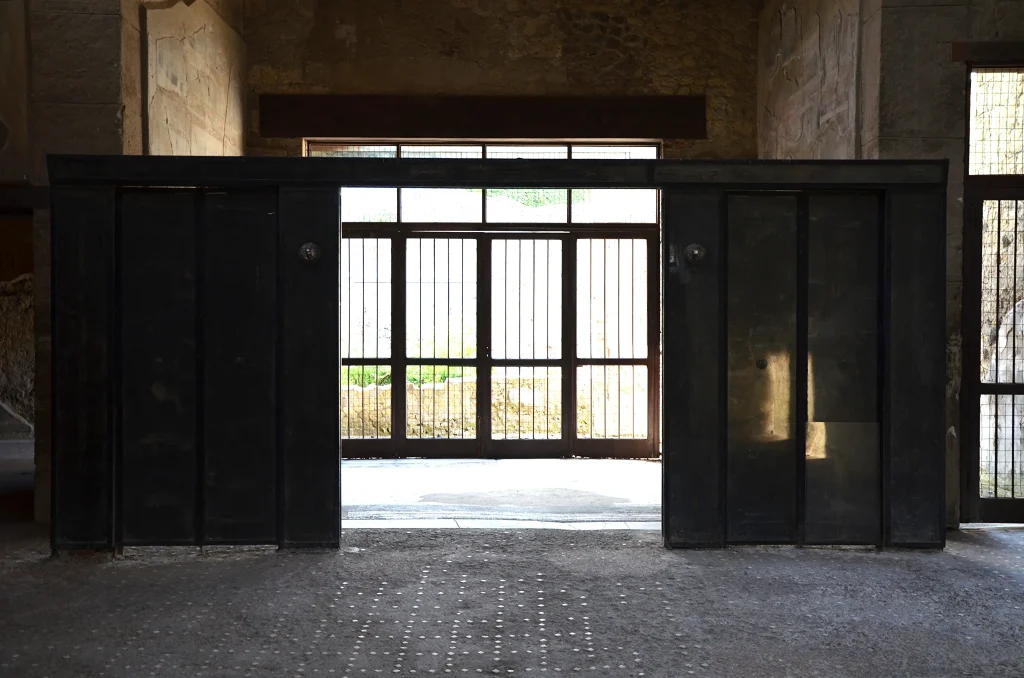
The consequences for preservation were paradoxical. Extreme heat destroyed every body. The same heat, combined with the speed and depth of the burial, carbonized wood and organic material in an oxygen-starved mass and sealed it so completely that Herculaneum kept things Pompeii lost: wooden doors that still slide in their tracks, beds, cradles, roof beams, a rope, loaves of bread, and the only intact library to survive from the ancient world, a collection of more than 1,800 papyrus scrolls in a villa at the edge of town, charred black and rolled into brittle cylinders. What happened to the scrolls is the ordinary fate of organic matter in a pyroclastic current; the guardian’s brain, if the discovery team is right, escaped it.
The people on the beach
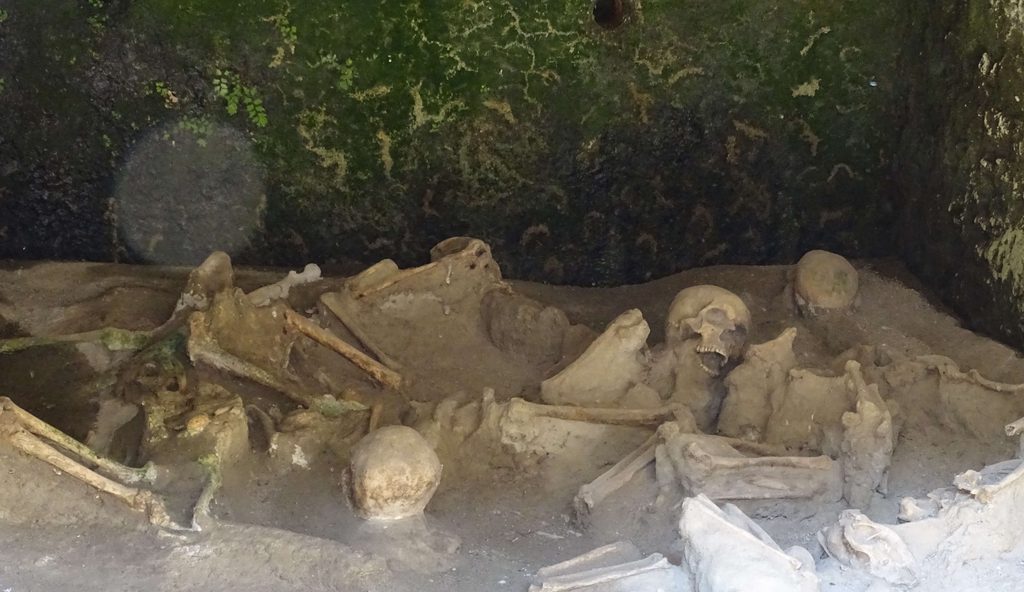
For a long time it was assumed that the people of Herculaneum had mostly escaped, because so few bodies turned up in the town itself. That assumption collapsed in the early 1980s, when excavation reached the ancient shoreline. Along the waterfront, inside the vaulted boat houses and on the beach in front of them, the excavators found skeletons: dozens, then hundreds, huddled together in the chambers, lying where they had fallen on the sand, one man beside an overturned boat. In all, the remains of at least 300 people have been recovered from the shore. The chambers had been the last refuge of a crowd that expected rescue by sea and got a wall of hot ash instead.
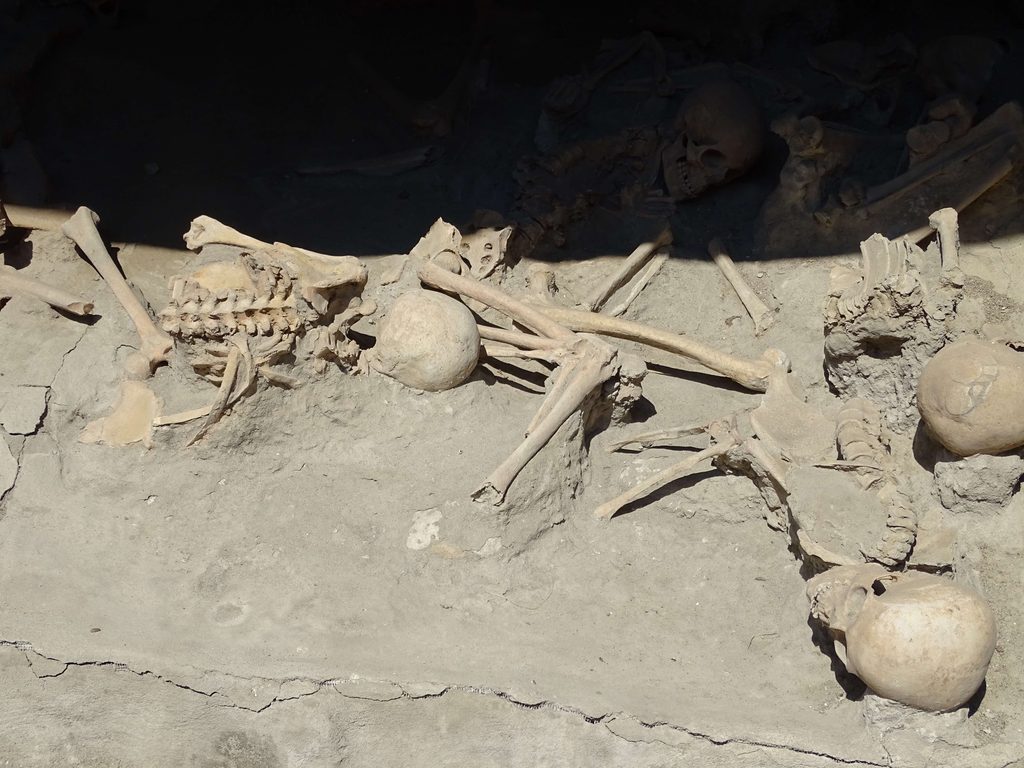
The most cited study of those victims appeared in the journal Nature in 2001, by Mastrolorenzo, Petrone and colleagues. They described the excavation of 80 of the roughly 300 people who had crowded into 12 of the chambers, all of them lying in the deposit of the first surge, and they estimated that the current that killed them arrived at about 500 degrees Celsius. The posture of the dead is what struck them. Bodies exposed to fire usually contract into what forensic scientists call the pugilistic attitude, a boxer’s crouch produced as heated muscles shorten and pull the limbs in. Herculaneum’s dead show only the beginnings of it, or none at all. Many lie in what the researchers called lifelike positions, as if they had been switched off. Petrone and his colleagues read this as evidence of death so fast that no reflex and no protective gesture had time to occur.
Later work by the same group went further. A 2018 paper in PLOS ONE reported reddish and black mineral residues on skulls and bones, rich in iron, which the authors interpreted as the leftovers of vaporized blood and tissue, and they proposed that the heat had been intense enough to boil body fluids and crack skulls from the inside. That interpretation drew criticism. Skulls in cremations, at far higher temperatures, do not burst, and a 2020 study in the journal Antiquity, led by Rachelle Martyn, argued from bone crystallinity and collagen preservation in the boat-house skeletons that the chamber walls and the victims’ own soft tissue buffered the heat, so that people sheltering there may have died more slowly than the vaporization scenario implies, closer to asphyxiation in the ash-laden air than to a flash. So the manner of death at Herculaneum has its own open questions. What no one contests is that heat was the killer and that the town received a far more violent thermal blow than Pompeii.
Why this matters for the brain
Herculaneum’s currents were hot enough to carbonize wood and skeletonize bodies in seconds. They were not, on the face of it, hot enough to make glass out of anything organic, and they certainly did not cool quickly: 20 meters of hot deposit stays warm for a long time. A glass brain needs both extreme heat and extreme speed of cooling. The eruption, as reconstructed from the deposits, seemed to offer plenty of the first and none of the second.
How hot is a pyroclastic flow? Flows, surges and the temperature of the cloud
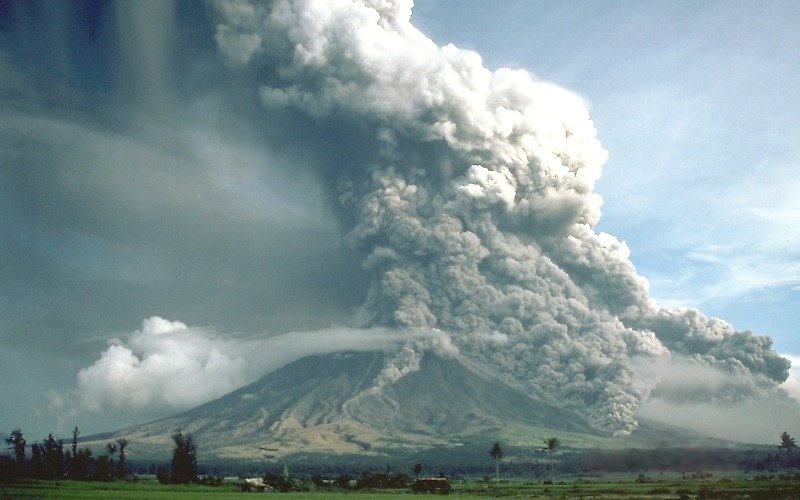
A pyroclastic flow is a dense, fast, ground-hugging avalanche of volcanic gas, ash and rock. It moves at speeds that routinely exceed 100 kilometers per hour and follows valleys the way water does, with internal temperatures of several hundred degrees Celsius. A pyroclastic surge is its dilute, turbulent relative: a lower-density cloud of hot gas and suspended ash that can separate from the dense flow, ride above it and ahead of it, spill over ridges and walls that stop the flow, and reach places the flow never touches. Volcanologists group both under the term pyroclastic density current, often shortened to PDC. The press uses the words loosely; the 2025 explanation for the glass brain depends entirely on the distinction.
Temperatures inside these currents are not measured directly, for obvious reasons, and they are not uniform. Near the vent, the interior of a dense flow can run well above 500 degrees. A few kilometers out, 300 degrees is more typical. A dilute surge loses heat faster than a dense flow because it mixes with the air it is moving through, which is why the far edge of a surge can be survivable while its core is not. The 1991 eruption of Unzen in Japan, which killed 43 people including the volcanologists Katia and Maurice Krafft, and the 2018 eruption of Fuego in Guatemala are the modern reference points. At both, the killing was done by the dilute outer parts of currents that overran ground the dense flow did not reach.
Reading a temperature that no one measured
Ancient eruptions leave thermometers of a kind. Bone changes color and structure in a predictable sequence as it heats, which is why forensic anthropologists can estimate the temperature of a fire from what it did to a skeleton. Wood exposed to heat converts to charcoal, and the reflectance of that charcoal under a microscope, a technique borrowed from coal petrology, records the maximum temperature the wood experienced. Roof tiles and rock fragments swept up by a current acquire a magnetic signature when they cool, which can be read to estimate the temperature at which they were deposited. Each proxy has its own blind spots. Charcoal reflectance, for instance, records a peak and says little about how long the peak lasted.
At Herculaneum, all of these proxies were brought to bear, and they converge. The first current that entered the town, from the evidence of the bones on the beach, was around 500 degrees. A 2023 study in Scientific Reports by Alessandra Pensa, Guido Giordano, Sveva Corrado and Petrone, working from charcoal reflectance across the site, narrowed the first arrival to a band of roughly 495 to 555 degrees, and found that the later currents which actually buried the town were cooler: one group between about 390 and 465 degrees, another between about 315 and 350.
The same study reached a conclusion that would become the foundation of the glass-brain explanation two years later. The first current, the hottest one, left only a few decimeters of ash on the ground. It was a short-lived, dilute ash cloud surge that had detached from a much denser current channeled down the valleys above the town, swept through the streets and killed everyone still there, then dissipated, leaving the dense flows to arrive afterward and do the burying.
That reconstruction is not universally accepted in every detail, and the 2020 Antiquity study mentioned above suggests the beach chambers may have moderated the heat for those inside. But the picture of an early, brief, exceptionally hot cloud followed by cooler, heavier currents is the current best reading of the deposits, and it is the stage on which the guardian’s death has to be understood.
Who was the guardian? The Collegium Augustalium and the man on the bed
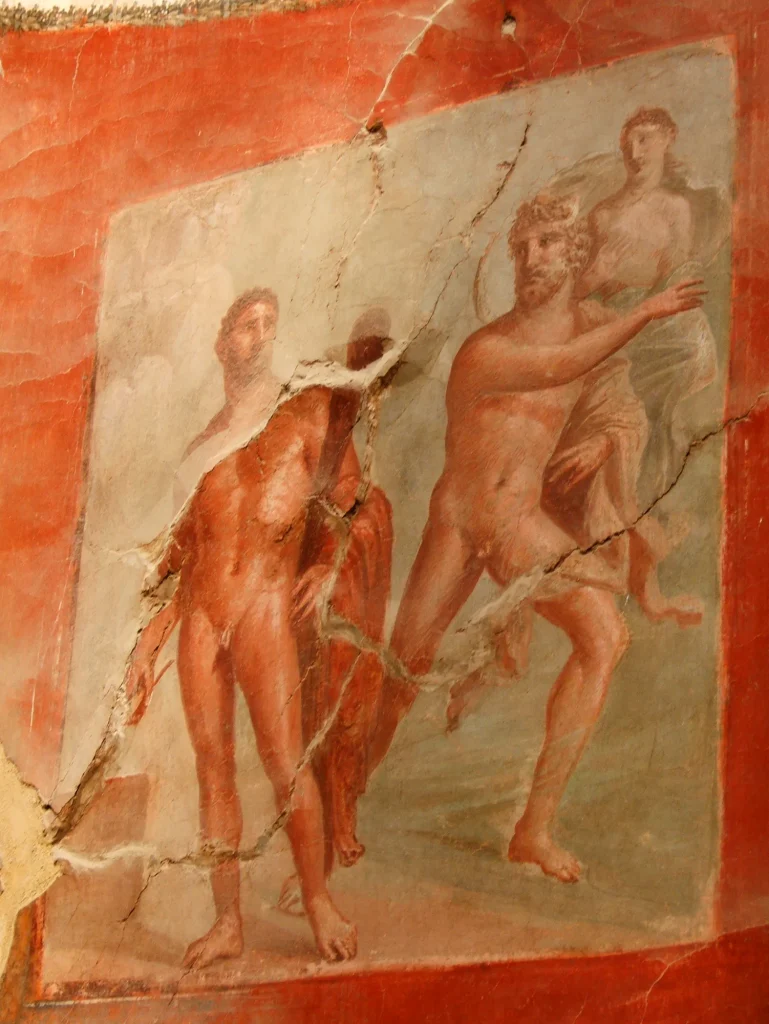
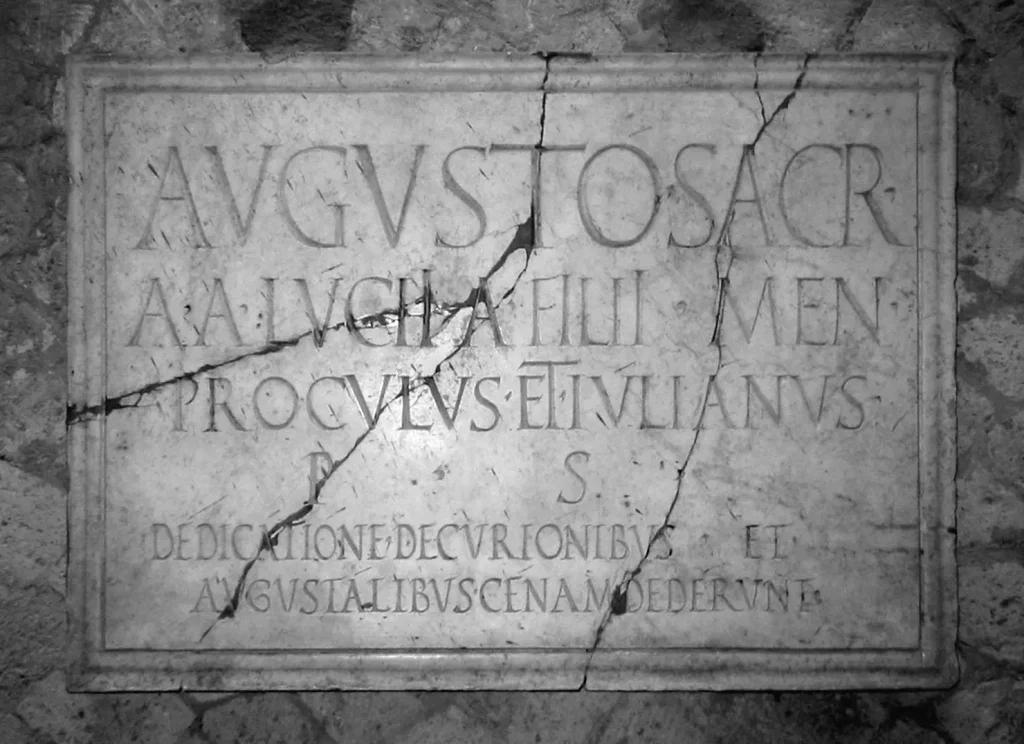
The Collegium Augustalium, also called the Sede degli Augustali or the Hall of the Augustales, stands near the center of the excavated town, at the corner of the Decumanus Maximus, the main street, and Cardo III, with an entrance on each. It was the seat of the Augustales, an order that managed the cult of the deified Augustus in towns across the Roman world and whose members were mostly successful freedmen, former slaves who had made money and wanted the public standing that a priesthood conferred. The building is a square hall whose roof was carried on four columns, with a shrine at the back whose walls are painted with scenes of Hercules, the town’s namesake: Hercules received among the gods with Juno and Minerva, Hercules facing the river god Achelous over Deianira. A marble inscription records that two brothers, Aulus Lucius Proculus and Aulus Lucius Iulianus, paid for the building and celebrated its dedication with a banquet for the town council and the Augustales.
The building had been located by the Bourbon tunnelers in the 1740s, who stripped it of statues and marble floor and drew a first plan. It was fully uncovered only between 1960 and 1962 under Amedeo Maiuri, the archaeologist who had reopened the site as an open-air excavation in 1927 and directed it for decades. Beside the shrine, to the right, a small room had been partitioned off after the earthquake of 62 CE and furnished with a bed that was part wood, part masonry. This was the custodian’s quarters, a place for the person who kept the hall.
The man on the bed
On that bed Maiuri’s team found a charred skeleton lying face down. The individual was identified as male and about twenty years old. Because of where he lay, he was dubbed the custodian, or guardian, of the Augustales. He is one of a few dozen victims found inside the town during Maiuri’s excavations; the great majority of Herculaneum’s dead lay on the shore. The 2025 paper that reexamined him gives his findspot with the precision of a survey mark, at 40 degrees 48 minutes 24 seconds north, 14 degrees 20 minutes 52 seconds east, and describes him as a man of about twenty believed to have been the guardian of the Collegium.
Nobody knows his name or what he was doing at the moment the cloud came. He may have been the caretaker asleep in his room, in which case he probably never knew what happened. He may have been someone else entirely who ran into the hall in the dark and lay down in the nearest sheltered place, the way people in a fire end up in rooms they do not know. Forensic archaeologists who have looked at the case have pointed out that a body on a bed tells you where someone died and very little about why he was there. What is distinctive is that he was indoors, under a roof and behind walls, while most of the town’s dead were down on the open beach. Being inside the building, shielded from the direct blast, may be part of why his remains recorded something no one else’s did.
The discovery: black glass in a skull
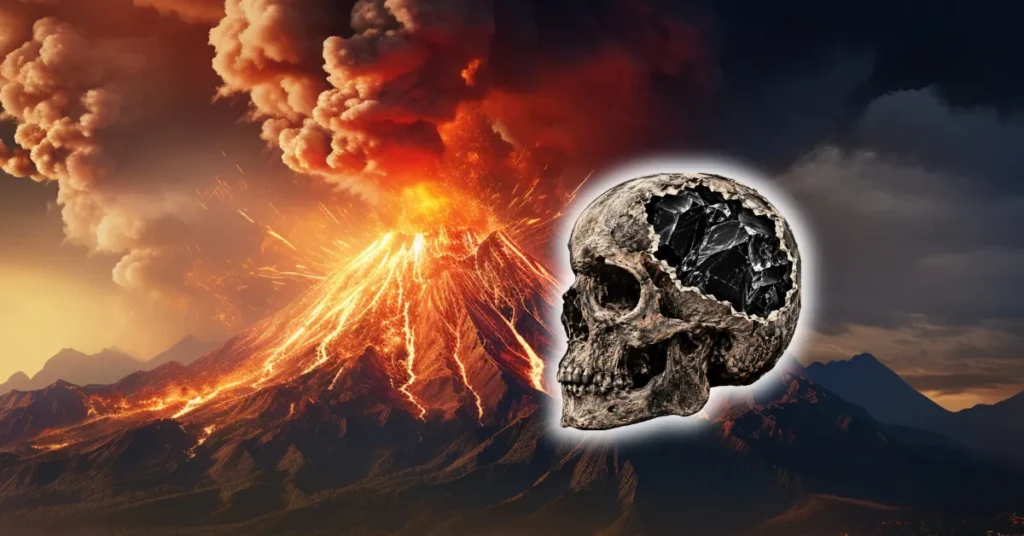
Petrone has worked on Herculaneum’s dead since the late 1990s, when he directed the excavation of dozens of the boat-house victims. He heads the laboratory of human osteobiology and forensic anthropology at the University of Naples Federico II, a few kilometers up the coast from the site. He has said that he noticed the material in the guardian’s skull years after the remains were recovered, when something glinted in the cranial cavity: dark, angular fragments with a glassy shine that looked like nothing so much as chips of obsidian, sitting where he expected either nothing at all or the waxy, soapy residue that decomposed brain tissue usually becomes.
That soapy residue has a name. When body fat and brain tissue break down under the right conditions, the triglycerides convert into a mixture of glycerol and fatty acid salts, which is to say into soap, through a process called saponification. It is the same chemistry that produces adipocere, the pale grave wax found on bodies buried in wet ground. Preserved ancient brains, when they are found, are usually saponified or otherwise altered, shrunken and darkened but recognizably soft-tissue remains. These fragments were nothing like that. They were hard and glassy, and they had also formed a crust on the inside of the skull and a spongy, solidified mass around the chest.
In January 2020 Petrone and a team including Giordano, a volcanologist at Roma Tre University in Rome, published a short letter in the New England Journal of Medicine under the title Heat-Induced Brain Vitrification from the Vesuvius Eruption in c.e. 79. The letter reported that inside the victim’s skull the team had found apparent brain remains that were, in the authors’ words, “vitrified instead of saponified”. It described the fragments, reported that charred wood from the Collegium carried features indicating a maximum temperature of about 520 degrees Celsius, and argued that a sudden pulse of radiant heat had ignited body fat and vaporized soft tissue, followed by a rapid drop in temperature. Proteins expressed in the human brain had been detected in the glassy material, along with fatty acids of the kind found in human hair. The authors framed the find as the first documented case of ancient human brain tissue preserved as glass by heat.
The full biological case came in October 2020, in a longer paper in PLOS ONE, Preservation of neurons in an AD 79 vitrified human brain. Using scanning electron microscopy and computer-assisted image analysis, the authors reported that within the glass they could make out structures they identified as neurons and axons, with the layered banding of myelin, the fatty sheath that insulates nerve fibers, and they reported comparable material from the victim’s spinal cord. Proteins whose genes are expressed in the human brain and spinal cord were listed as further support. The conclusion was that the delicate architecture of the tissue had survived precisely because vitrification had locked it in place, the way amber locks an insect.
What the shards look like
The best known photograph of the fragments belongs to Petrone and the Herculaneum archaeological park, and the 2025 paper carries a Creative Commons license that forbids commercial reuse and derivatives (CC BY-NC-ND 4.0), so its images do not appear on this page. In words: the fragments are small, most of them well under a centimeter across, black to dark gray, angular, between half a millimeter and five millimeters across, and shiny under any light. Under the electron microscope they show the smooth, curved fracture surfaces and knife-sharp edges characteristic of a glass, the same conchoidal fracture that made obsidian the blade material of choice for most of human prehistory. Readers who want to see them can do so in the open-access 2025 paper in Scientific Reports, where the fragments are photographed at several scales alongside the calorimetry that is the subject of the argument below.
What is vitrification? The glass transition in plain language
To follow the argument you need to know what a glass is, and it is not what most people assume. A glass is defined by how it forms, whatever it is made of and whether or not you can see through it. It is an amorphous solid: a material with the disordered, jumbled molecular arrangement of a liquid and the rigidity of a solid. It gets into that state through a process called the glass transition, and the glass transition is fundamentally about cooling.
Cooling faster than crystals can grow
When a liquid cools, at some temperature it would prefer to crystallize. Its atoms or molecules, given enough time, settle into an ordered, repeating lattice, and the result is a crystalline solid. Water becomes ice. Molten rock, cooled over centuries underground, grows the interlocking crystals of granite. Crystallization takes time, though, because the building blocks have to find their places in the lattice, and the more complex the molecules and the more viscous the melt, the longer they need. Cool a liquid fast enough and you can cheat the process. As the temperature drops the liquid grows thicker and thicker, its molecules move more and more sluggishly, and at some point they simply run out of time to organize themselves before the whole mass seizes into a rigid solid. The molecules are frozen in a disordered, liquid-like arrangement. That freezing-in is the glass transition. The temperature at which it happens is the glass transition temperature, usually written as a T with a subscript g.
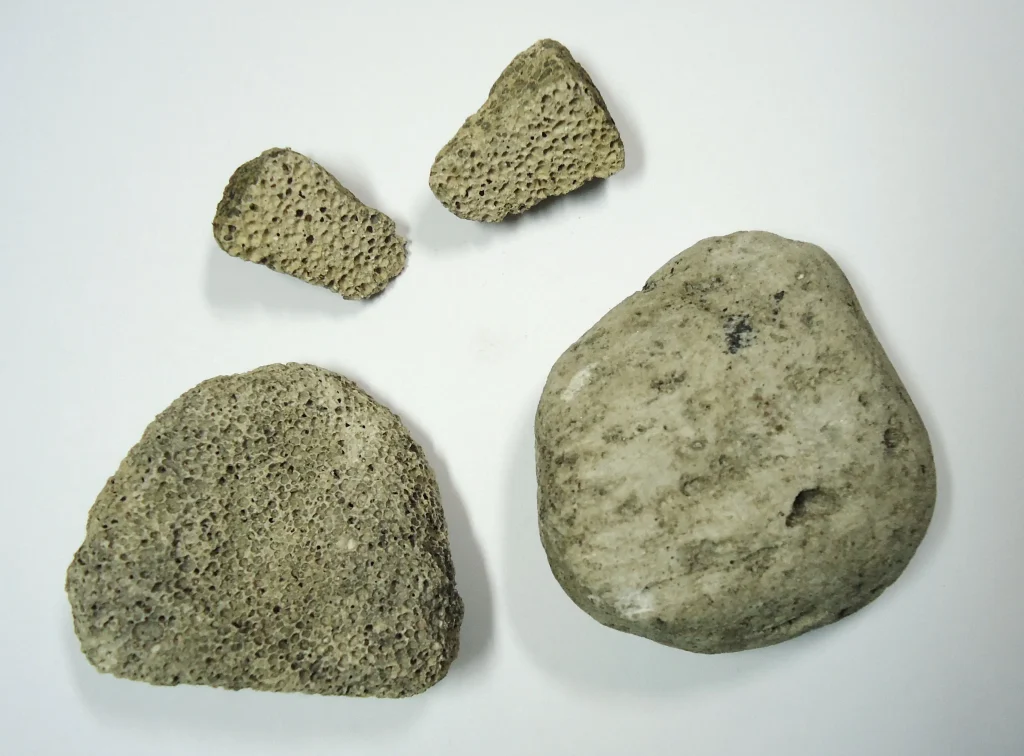
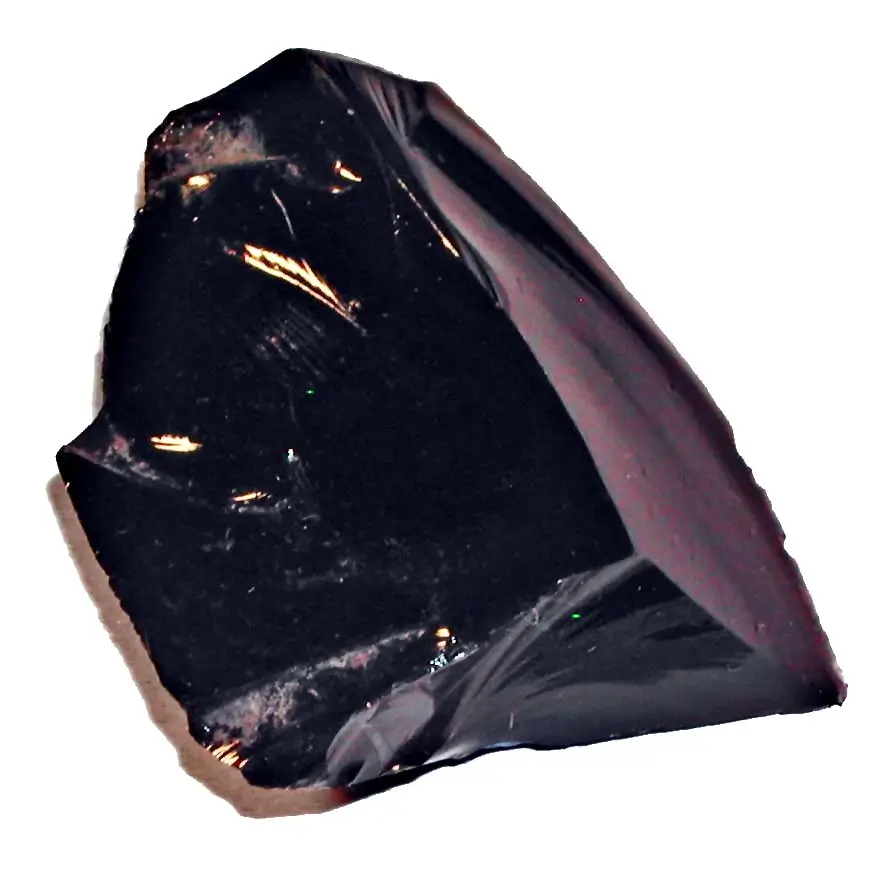
Volcanic rock makes the point vividly. The same silica-rich magma can end up as granite if it cools slowly at depth, as a fine-grained rhyolite if it cools faster at the surface, or as obsidian, a true glass, if it is quenched quickly enough to grow no crystals at all. Pumice is the same glass frothed with gas bubbles, which is why it floats. The rain of pumice that buried Pompeii was, in the strict sense, a rain of volcanic glass.
Why the transition temperature moves
Two features of the glass transition carry most of the weight in the Herculaneum debate. The first is the one just described: glass is made by fast cooling. Heating alone does not make glass. Heat organic tissue and hold it hot and it will dry out and char, and if the heat continues it burns away. To get a glass you need something that has become liquid, or liquid enough, and then cools so fast that it skips crystallization on the way down. Giordano put it plainly to reporters in 2025 when he said that the transformation of anything liquid into glass is “the fast cooling, not the fast heating”.
The second feature is subtler. The glass transition temperature is not a fixed property of a material the way a melting point is. It depends on how fast the material was cooled. Cool the same liquid faster and it falls out of equilibrium sooner, at a higher temperature, so the glass you make records a higher transition temperature. Cool it slowly and the molecules have time to relax toward a denser arrangement before they lock, and the transition temperature is lower. Glass scientists describe this with the idea of a fictive temperature, the temperature at which the liquid’s structure was effectively frozen in, and they have known since the 1970s how to relate it to cooling rate.
The 2025 paper turns this relationship around. If you can measure the glass transition temperature of a natural glass in the laboratory, and if you can calibrate how that temperature shifts with cooling rate, you can estimate both the temperature at which the glass formed and how quickly it cooled. A glass, in this sense, remembers its own thermal history, and it gives that history up when you reheat it.
Can heat turn your brain to glass?
There is a familiar way to turn living tissue into glass, and it works at the opposite end of the thermometer. In cryopreservation, cells, embryos, eggs and small pieces of tissue are cooled so rapidly, usually with the help of chemicals that suppress ice formation, that the water inside them vitrifies rather than freezing into crystals that would shred the cell structures. Warm the tissue back up and it returns to its soft, watery state. That is the ordinary way organic material becomes glass: extreme cold applied extremely fast, and the process reverses on warming. It is also, as the 2025 paper itself notes, the reason no one expected to find organic glass inside a volcanic deposit that had been heated to several hundred degrees. Warm, wet tissue does not have a glass transition temperature anywhere near that range.
So the short answer to the question is that under ordinary circumstances heat does not turn a brain to glass. Heat dries it and carbonizes it, which is exactly what happened to the wood and the scrolls at Herculaneum. For the guardian’s brain to have become a true glass, something out of the ordinary would have had to occur: the tissue would have needed to reach a state, at high temperature, in which it behaved as a viscous liquid, and then to cool through its glass transition at a rate so fast that it never had a chance to crystallize or to burn. Whether the eruption could have provided those conditions is the entire content of the scientific fight.
Obsidian, fulgurite and the family of natural glass
Natural glasses are common. The rare thing is finding one inside a body. The most familiar natural glass is obsidian, which forms when silica-rich lava cools too fast, often on contact with air or water at the edge of a flow, to grow crystals. Chemically it is close to granite and rhyolite; structurally it is a disordered melt frozen in place, which is why geologists file it as a mineraloid rather than a mineral. It breaks with the smooth, curved fractures and vicious edges that made it the blade material of choice from the Paleolithic to the Aztecs, and it is the comparison the discovery team reached for from the beginning. In interviews Giordano has described obsidian forming where lava enters water and quenches, and proposed that the guardian’s brain vitrified by the same physical principle, with an organic liquid in place of molten silicate.
The family is larger than obsidian. Lightning strikes fuse sand and soil into hollow, branching glass tubes, the fulgurites that lightning leaves behind, at temperatures well above anything a pyroclastic current reaches. Meteorite impacts melt and quench target rock into tektites and impact glasses, among them the pale yellow Libyan Desert Glass of the Sahara, one piece of which was carved into the scarab at the center of a pectoral found in the tomb of Tutankhamun. Volcanic eruptions spin molten droplets into the glass threads and teardrops that Hawaiians named for the goddess Pele.
Every one of these forms the same way in principle: melt something, then cool it fast enough that it cannot organize. Reading formation history out of the structure of a rock is the everyday business of geology, and Geoscopy’s guide to how Earth’s rocks reveal deep time covers the general logic. The same logic applies whether the material is a rhyolite dome, a fulgurite, or the impact glass at the centre of Tutankhamun’s pectoral.
The difference between all of those glasses and a brain is water. Obsidian, fulgurite, tektite and pumice are silicate materials with glass transition temperatures in the hundreds of degrees, stable as glass at room temperature for millions of years. A brain is roughly three quarters water, with the rest mostly fat and protein. Getting that to behave like obsidian is the trick nobody had ever documented, and the reason a great many eyebrows went up in 2020.
Is the Herculaneum glass brain real? Round one: the 2020 dissent
A rebuttal was submitted within a month of the January letter and published that September. In the journal Science and Technology of Archaeological Research, Alexandra Morton-Hayward, then a master’s student at UCL’s Institute of Archaeology who was already compiling a global archive of preserved brains, published with seven co-authors, among them the palaeoproteomics specialist Matthew Collins, a commentary with a pointed title: A conscious rethink: Why is brain tissue commonly preserved in the archaeological record? Its argument ran along several lines, and each of them is worth laying out, because together they form the backbone of the skeptical case and most of it still stands.
The first line was about framing. Petrone’s team had presented ancient brain tissue as a great rarity, and that rarity was what made vitrified brain tissue seem like a once-in-history event. Morton-Hayward and her co-authors argued that the premise was wrong. Brain tissue, they wrote, turns up all over the archaeological record. Independent teams had repeatedly reported dark, glossy, resin-like brain remains from sites around the world, and describing each one as a unique marvel had discouraged anyone from asking the more interesting question of why brains survive at all. A shiny black mass inside an ancient skull, in this reading, was the expected finding, and nothing to marvel at.
The second line was about the evidence for heat. The 520-degree figure rested on a single charred fragment. The letter said it came from the Collegium; the commentary says it came from a workshop on the third Cardo nearby, not from the building where the body lay, and that the figure also leaned on the vitrified look of that charcoal, which experimental work had shown is not a reliable sign of high temperature. Earlier charcoal analysis at Herculaneum had put the burning of wooden structures at 240 to 370 degrees. The letter’s supplementary appendix, which describes the skull and postcranial bones as exploded and charred, cut the other way: forensic specialists dispute that skulls burst from heat, and charring means organic matter survived in the bone, a sign of low- to medium-intensity burning. The fatty acids the letter relied on, the commentary added, are volatile and unstable at the temperatures claimed. Cooling rates were not part of the 2020 argument; that came later.
The third line was the one that has lasted longest. Morton-Hayward and her colleagues noted that the discovery team, in the commentary’s words, “have not made their raw data available”, and that no detailed laboratory methodology had been offered. They recalled the early years of biomolecular archaeology, when contamination and over-interpretation produced a string of dramatic claims that later fell apart, and argued that the field had learned from that period to share raw proteomic data as a matter of routine so that spectacular results could be checked. Their verdict was blunt: nothing in the letter, they argued, demonstrated that heat had vitrified human brain tissue.
Morton-Hayward’s skepticism was not idle. Four years later she and colleagues published in the Proceedings of the Royal Society B the result of a long survey: an archive of 4,405 preserved human brains recovered from archaeological contexts across the world, the oldest of them roughly 12,000 years old. More than 1,300 of those brains had survived in skeletons that had otherwise lost every trace of soft tissue, which suggests a preservation mechanism specific to the brain itself and not yet understood. Some had been dehydrated, some frozen, some saponified, some tanned in bogs. A large number were dark and shrunken, with a glossy surface. The whole thrust of that work was that preserved brains are ordinary, and it cut directly against the rhetorical foundation of the glass-brain claim.
Round two: the 2025 confirmation and the superheated cloud
Five years after the letter, the discovery team came back with the paper meant to answer the physics objection head on. On February 27, 2025, Giordano, Pensa, Alessandro Vona, Danilo Di Genova and colleagues, with Petrone among the authors, published Unique formation of organic glass from a human brain in the Vesuvius eruption of 79 CE in Scientific Reports. It is open access, and its abstract states the problem in the dissenters’ own terms before answering it: organic tissue is normally vitrified only by cryopreservation at very low temperature, it reverts to a soft state when warmed, and one would therefore not expect to find organic glass inside a deposit that had reached several hundred degrees. Having said that, the authors go on to argue that the material in the guardian’s skull is exactly such a glass, and that it is, in their words, “the only such occurrence on Earth”.
Reading thermal history out of a glass
The method was calorimetry. A differential scanning calorimeter heats a tiny sample at a controlled rate and records how much heat it absorbs as its temperature climbs. When a glass passes back through its glass transition on heating, its heat capacity changes abruptly, and the temperature at which that step occurs, together with its shape, records the conditions under which the glass originally formed. This is the fictive-temperature reasoning described above, applied in reverse. The onset of that transition showed up at 420 degrees when a fragment was heated slowly and at 510 degrees when another was heated at a thousand degrees per second. The authors say plainly that the standard way of reading a cooling rate out of a glass, matched heating and cooling cycles calibrated against the material’s viscosity, was not possible here, because nobody knows how molten brain flows. They chose the upper value by elimination: the deposits that entombed the body reached up to 465 degrees, so a glass with a transition near 420 would have softened and disintegrated inside them. That leaves 510 degrees and a cooling rate comparable to their fastest experiment, on the order of a thousand degrees per second, as the paper’s estimate, and the paper calls them its closest approximations rather than measurements.
Those two numbers created a problem that the paper had to solve, and the solution is its real contribution. The dense flows that entombed Herculaneum, according to the 2023 charcoal study by the same group, peaked at about 465 degrees, well short of the transition temperature the calorimetry demanded. And a body buried in 20 meters of hot rock cools over days, at a tiny fraction of a thousand degrees per second. The deposits that actually buried the guardian, in other words, could not have made the glass. Something hotter and much briefer had to have come first, and then vanished.
A cloud that lasted minutes
The proposed culprit is the detached ash cloud surge identified in 2023: the dilute, superheated cloud that peeled away from the dense currents in the valleys above the town, swept through the streets ahead of everything else, and dissipated. In the 2025 reconstruction that cloud was above 510 degrees, perhaps as hot as 600, when it passed through the Collegium. It killed the guardian instantly and heated the tissue of his brain past its transition. Then, because a dilute cloud holds very little mass and mixes rapidly with the surrounding air, it was gone. Comparison with ash clouds observed at modern eruptions suggests such a cloud dissipates within minutes.
As it did, the temperature in the room fell back toward ambient almost immediately, and the paper argues that this collapse in temperature, from more than 500 degrees to ordinary air in a matter of moments, produced cooling rates on the order of the thousand degrees per second measured in the laboratory. The glass formed in that instant. The dense flows that arrived later, hot but far cooler than the cloud, buried the room without remelting what the cloud had made. The deposit left by the cloud itself is thin, a few centimeters in the 2025 paper’s description and a few decimeters in the 2023 study, consistent with a fast-moving cloud rather than a heavy, heat-retaining flow.
Several details fill out the picture. The paper’s own explanation for why this brain and no other is that the thick bones of the skull and spine shielded the tissue from direct contact with the cloud, so that parts of it survived the peak long enough to be caught by the rapid cooling. That he was indoors is a plausible extra factor, but it is not one the paper argues. The fact that the brain had broken into small pieces would have helped, because small fragments cool faster than a whole organ. And the 2023 charcoal study had already found that wood fragments at the site record more than one heating event, and the highest temperatures they record belong to the early cloud, with cooler episodes afterward. Giordano has summarized the whole sequence for reporters as a cloud at roughly 510 to 600 degrees that killed everyone it touched in an instant and then, within minutes, was gone.
On the biology, the 2025 paper reopened part of the question and left the rest closed. It presented new electron micrographs of what it identifies as axons and other neural structures, and new Raman spectra whose paired D and G bands confirm the material is carbonaceous and organic; the electron-probe chemistry came back as almost pure carbon and oxygen. But for the identification of that organic material specifically as brain, it relied entirely on the 2020 protein and fatty-acid work. From the discovery team’s side, the case now had two legs, a biological argument that the material is brain and a physical mechanism that could plausibly have made brain into glass, and the authors described the preservation as unprecedented for tissue of any human or animal.
The scrolls that charred instead
It helps to set the guardian beside the most famous organic survivors of the same eruption. The Villa of the Papyri, on the western edge of Herculaneum, held a library of more than 1,800 papyrus rolls, and every one of them carbonized, blackened and converted to a fragile carbon solid by the heat of the currents, in a room starved of oxygen, before the deposits sealed them in. They have been read, with enormous difficulty, ever since the tunnelers found them in the 1750s. In 2023 and 2024 a public competition applied X-ray tomography and machine learning to rolls that had never been opened and recovered whole passages of Greek text from inside them, and in 2024 a separate project led by a papyrologist at the University of Pisa, using infrared and hyperspectral imaging on a scroll of Philodemus that had been physically unrolled long ago, recovered new text giving the location of Plato’s grave.
Carbonization is what the currents did to organic matter at Herculaneum. It is what they did to the wood of the guardian’s own bed and to the beams of the hall he lay in. The 2025 argument is that a brain, uniquely, could take a different path if it was heated past a critical point and then cooled fast enough, and that the only place in the town where that combination occurred was inside one skull in one sheltered room. The objections that follow turn on whether that is physical reasoning or a special explanation built around one specimen.
Round three: the doubts that remain
The 2025 paper answered one specific complaint, the argument that the deposits were neither hot enough nor fast-cooling enough, with a plausible mechanism. It did not settle the deeper doubts, and it drew a fresh round of skepticism from researchers outside the group as soon as it appeared.
The physics objection
John Mauro, a materials scientist at Pennsylvania State University who has spent his career on the physics of the glassy state, told National Geographic in March 2025 that he found the claims “rather questionable”. His objection is mechanistic and it is hard to wave away. If the tissue really was heated beyond about 500 degrees Celsius, it should have suffered irreversible chemical and structural damage: proteins denature and break down at far lower temperatures, and lipids oxidize and decompose. In Mauro’s reading, a claim of near-perfect preservation of cellular structure cannot coexist with a claim of heating to more than 500 degrees, because the heating necessarily rewrites the microstructure. One of the two claims has to give.
Morton-Hayward turned the 2025 paper’s own logic against it. Her position, expressed to several outlets, is that the authors do an excellent job of explaining why vitrification of soft tissue at high temperature should be impossible, and then ask the reader to accept a single exception. Organic tissue, being mostly water, forms glass by rapid cooling to very low temperatures and by no other known route. She is not persuaded that the guardian is the one exception in the history of the planet.
The protein objection
The identification of the material as brain rests in part on proteins, and the protein evidence is thin by the standards of the field. The 2020 letter’s supplementary table listed exactly seven proteins from two samples, as the 2020 commentary pointed out, and none of them was among the 881 proteins recovered from the Iron Age Heslington brain. Morton-Hayward’s response is quantitative. Preserved ancient brains, in her experience, typically yield more than a thousand proteins, so a list of seven is a very small basis for a positive identification. Worse, the proteins in question are expressed in hundreds of cell types throughout the body, so their presence does not point specifically at the brain. And proteins in general do not survive the temperatures the 2025 mechanism requires. If the tissue reached 510 degrees, the proteins that were used to identify it as brain should not be there to find.
The data objection
Behind the specific disputes sits the methodological one that has never gone away. Matthew Collins, the Cambridge and Copenhagen palaeoproteomics specialist who had co-signed the 2020 commentary, drew the parallel to the early years of ancient DNA research, when the discipline discovered that it could not move forward until everyone released their raw data for others to check. Ancient protein data are complex and easily contaminated, and independent access to both the raw spectra and the physical samples is how extraordinary claims in this field get validated or falsified. As of the 2025 exchange, Morton-Hayward was still asking to see the underlying protein analysis, and no independent examination of the fragments had been reported. Until that changes, the claim remains, in the careful wording that several outlets have settled on, extraordinary and still debated.
What each side actually holds
The public version of the disagreement collapses several separate questions into one. Almost no one disputes that there is a hard, glassy material in the guardian’s skull, or that Herculaneum was hit by a lethal pulse of heat. Few dispute that the material is organic in origin. Giordano has argued, reasonably, that a compositionally organic material filling a human skull is most simply explained as the brain that was in it, and asked what else it could be.
The dissenters do not deny that the material is organic. Morton-Hayward does dispute that it is brain: she told CNN she was not persuaded the glassy substance was brain tissue at all. What they contest is narrower and sharper. First, whether the specific evidence offered, a small set of non-specific proteins and electron micrographs of structures interpreted as cells, establishes that the material is brain tissue with preserved cellular architecture. Second, whether a heat-then-quench route to a stable organic glass is physically coherent with that preserved architecture, or whether the two claims cancel each other. Third, whether any of it can be checked, given that the raw data and the samples have stayed with one group. And underneath all of these, whether the rarity that made the find seem miraculous was ever real. They have different answers, and much of the confusion in the press comes from running them together.
Has a human brain turned to glass anywhere else?
No. The 2025 paper calls the guardian the only such occurrence on Earth, and the skeptics, while doubting the interpretation, agree that nothing comparable has been reported from any other eruption, fire or burial. A one-off would be a scientific treasure, a natural experiment no laboratory could ethically run. A one-off is also unverifiable in the ordinary sense, because there is no second specimen against which to test the method, and claims of the only case in the world have a poor track record in the history of science. The very thing that makes the find valuable is the thing that makes some researchers uneasy about it.
It is important not to confuse this narrow claim with the broader, well-supported finding that preserved ancient brains in general are common. Morton-Hayward’s archive establishes that brain tissue survives in the archaeological record far more often than anyone assumed, in bogs and deserts and permafrost and ordinary graves, sometimes as the only soft tissue left in a skeleton. Those brains are shrunken and chemically transformed, and many of them are dark and glossy enough that an excavator might describe them, loosely, as glassy. None of them is a glass in the physical sense, with a measurable glass transition. The Herculaneum claim is that the guardian’s is. That is a far more specific assertion, and it stands alone.
Why the argument matters: Vesuvius, hazard science and three million neighbors
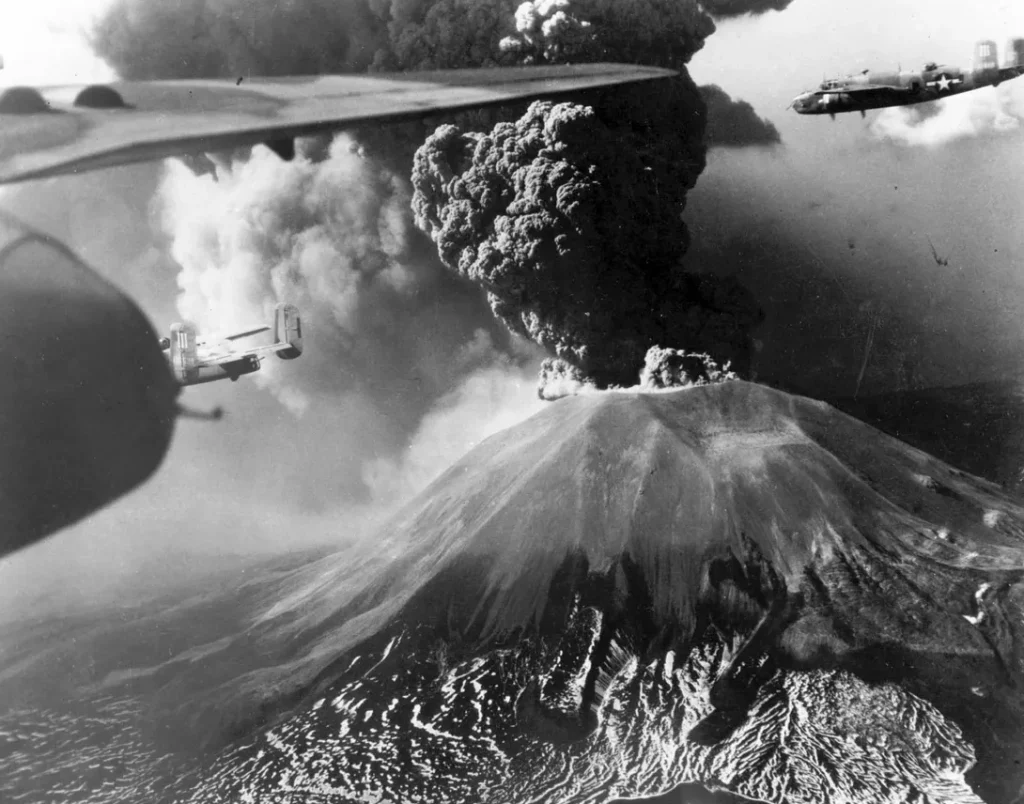
Strip away the macabre novelty and the glass brain is an argument about how one particular volcanic hazard behaves, and that argument has consequences for a great many living people. Vesuvius is a dormant volcano, and dormant is a temporary condition. It erupted violently in 1631, killing thousands, and it has erupted dozens of times since, most recently in March 1944, when lava buried the villages of San Sebastiano al Vesuvio and Massa di Somma and ash and tephra wrecked some eighty B-25 bombers of the U.S. 340th Bombardment Group at their airfield near Pompeii. The world’s oldest volcano observatory, founded on the mountain’s flank in 1841, has watched it ever since, and it has been quiet for more than eighty years. Around three million people now live in the metropolitan area at its foot. Roughly 600,000 to 700,000 of them live inside the official red zone, the ring of towns that civil protection planners expect to have to evacuate before the next eruption begins.
A hazard that leaves almost no trace
The scientific payoff that the discovery team emphasizes is the recognition of the detached ash cloud surge as a distinct, early and exceptionally deadly hazard. If the 2023 and 2025 reconstructions are right, the first thing to kill the people of Herculaneum arrived well before the dense flow that buried them: a brief, dilute, very hot cloud that came ahead of everything else, killed in seconds and vanished within minutes, leaving a deposit only a few centimeters thick. That profile is unsettling for a planner. A hazard that can be lethal in seconds is bad enough. A hazard that leaves so little deposit that its passage can be missed entirely in the geological record of past eruptions is the kind of thing that gets left out of a risk map, because the evidence that it happened is a layer of ash the thickness of a finger, easily eroded and easily overlooked, and because it reaches and overtops places the dense flows never touch.
Pensa has framed the practical stakes in terms of building design: understanding these conditions can inform shelters able to withstand very high temperatures for the short time it takes a cloud to pass, giving people who could not evacuate somewhere to survive until rescue or until the next current, which may be cooler. A shelter engineered to survive the crushing weight of a dense flow, or to buy time against slower hazards, may do nothing against a flash of heat above 500 degrees.
This lesson does not depend on whether the shards are brain. The temperature and dynamics of the currents at Herculaneum are supported by several independent lines of evidence: the skeletons on the beach, the charcoal reflectance, the mineral residues on the bones, the behavior of the deposits themselves. The brain is the vivid, headline-grabbing exhibit, and it may or may not survive scrutiny, but the hazard science underneath it stands on broader ground. Modern disasters confirm it. The people killed at Unzen in 1991 and at Fuego in 2018 were, for the most part, caught by the dilute margins of currents, in places that the dense flows did not reach.
What the argument teaches about method
The other reason the case matters is the one the dissenters have pressed hardest. Spectacular, singular claims in the historical sciences need open data and independent replication precisely because they are spectacular and singular. The glass brain has become a small case study in how that plays out in practice: a striking finding, a well-argued rebuttal within months, a technically sophisticated follow-up five years later, and a stubborn residue of doubt that persists because the material remains hard for outsiders to examine. Whichever way it eventually breaks, the argument over one young man’s skull is a fair sample of how slowly science settles a claim when a single laboratory holds the only sample.
Can you see the glass brain today?
The Archaeological Park of Herculaneum, in Ercolano just southeast of Naples and a short walk downhill from the Ercolano Scavi station of the Circumvesuviana railway, is open to visitors year round. The Collegium Augustalium, with its painted shrine and the small room beside it where the guardian was found, is on the visitor route, though individual buildings are periodically closed for conservation work. You can look down from the modern ground level, which is the top of the 79 CE deposits, and grasp in one view how deep the town was buried. The boat houses on the ancient shoreline, with their skeletons, are also part of the site and can be viewed from the walkway that runs along the old beach. Many of the finest objects recovered from the town, including bronzes from the Villa of the Papyri and the carbonized scrolls, are held in Naples, at the National Archaeological Museum and the National Library.
The vitrified fragments themselves are delicate research specimens under active study, and they are not on public display. The widely circulated photograph of them is copyrighted to Petrone and the park. To see the actual shards, and the electron microscope images of what the discovery team identifies as neurons, the open-access 2025 paper in Scientific Reports and the 2020 paper in PLOS ONE are the places to look, and both are free to read.
A death, reconstructed
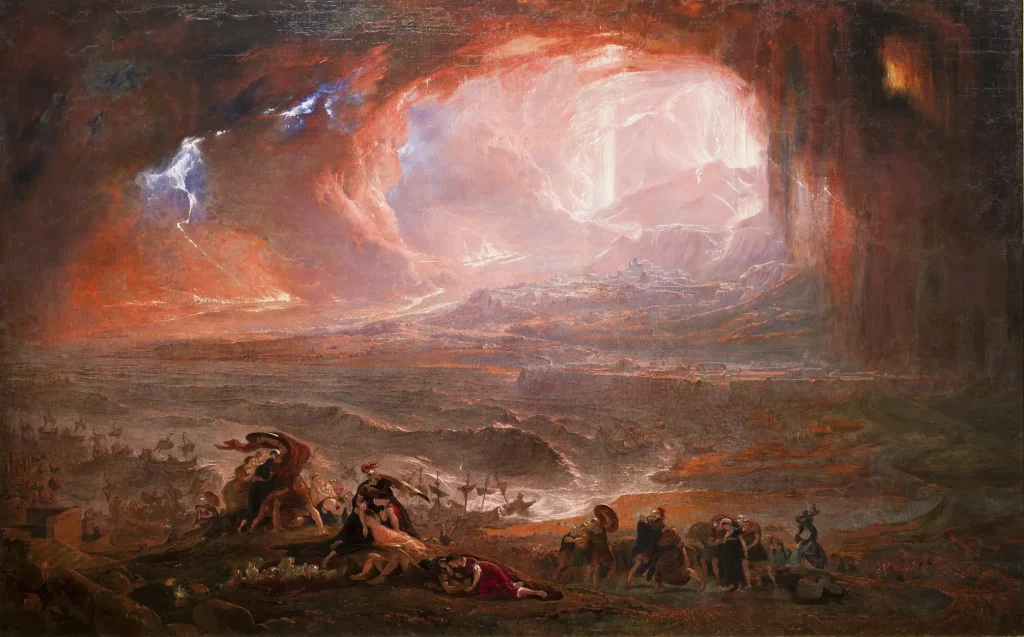
Back in the room. Whatever the shards turn out to be, the sequence the evidence points to is harrowing. A young man is indoors, alone, in the dark, half a day into an eruption that has already turned afternoon to night and shaken the ground for hours. The town he could see from the doorway looks, for the moment, intact; the killing pumice fell on Pompeii, across the mountain.
Then the column above Vesuvius, which has stood for the better part of a day, loses its footing and comes down. A cloud races over the town faster than anyone could run, faster than the people on the beach, who see it coming across the water, could even turn around. There is no slow suffocation and no long burning. In the space of a breath the room fills with heat on the order of 500 degrees, and he is gone, his body fixed in place on the bed, his brain, if the discovery team is right, flashed to glass in the seconds it took the cloud to arrive and vanish. Hours later the heavier flows come and fill the room to the ceiling, and the ceiling, and the street outside, and the town.
Everything after that is inference, drawn from calorimetry curves, protein fragments, charcoal reflectance and the postures of the dead. The glass brain of Herculaneum sits at the exact point where forensic anthropology, volcanology, materials science and the physics of the glassy state meet, and where, right now, they do not fully agree. The guardian, whoever he was, waited nineteen centuries for anyone to argue about him. Whether the shards are a glass, and whether the glass was ever a brain, will be settled by whoever next gets to put them in a calorimeter.
Frequently asked questions
Is the Herculaneum glass brain real?
There is undisputed hard, glassy, organic material inside the skull of a young man who died at Herculaneum in 79 CE. Whether it is vitrified brain tissue with preserved cells, and whether it formed by the heat-then-rapid-cooling mechanism proposed in 2025, is contested. The discovery team led by Pier Paolo Petrone and Guido Giordano argues yes, citing structures interpreted as neurons and axons, brain-associated proteins, fatty acids, and calorimetry indicating a glass transition near 510 degrees Celsius. Independent experts, including Alexandra Morton-Hayward of Oxford and the glass physicist John Mauro of Penn State, remain unconvinced, in part because the raw data and samples have not been available for independent testing. The fair summary is a striking, plausible claim that has not yet been independently verified.
How hot was the ash cloud that hit Herculaneum?
The 2025 study in Scientific Reports places the glass transition of the fragments at about 510 degrees Celsius, implying a brief cloud somewhat hotter than that, possibly in the range of 510 to 600 degrees, which then cooled almost instantly. Independent estimates for the first current at Herculaneum agree on roughly 500 degrees: the 2001 Nature study of the beach victims put it at about 500, and the 2023 charcoal study refined the first arrival to about 495 to 555 degrees. The dense flows that buried the town were cooler, peaking near 465 degrees, which is why the researchers invoked a hotter, short-lived ash cloud.
What is vitrification?
Vitrification is the conversion of a material into glass. A glass is an amorphous solid: it has the disordered molecular arrangement of a liquid locked into a rigid state. It forms when a liquid cools fast enough to skip crystallization, freezing its molecules in place before they can organize into a lattice. The temperature at which that freezing-in happens is the glass transition temperature, and it rises when cooling is faster. Rapid cooling is what makes glass.
Why did Herculaneum’s victims die differently from Pompeii’s?
Pompeii sat downwind and was buried by roughly eighteen hours of falling pumice and ash, which collapsed roofs and gave most residents time to flee; those who stayed were killed the next morning by cooler surges, around 250 to 300 degrees Celsius, whether by heat or by asphyxiation is still argued, and were preserved as body-shaped voids that became the famous plaster casts. Herculaneum sat upwind and received little pumice; it was struck first by a far hotter current, around 500 degrees, that carbonized wood and reduced bodies to skeletons in seconds but left only a thin layer of ash; the cooler, heavier currents that followed buried the town under about 20 meters of deposits.
Has a human brain ever turned to glass anywhere else?
No. The Herculaneum guardian is described as the only known case on Earth. Preserved ancient brains in general are not rare, and Morton-Hayward’s archive documents 4,405 of them spanning roughly 12,000 years, but those are shrunken or chemically altered tissue, with no glass transition to measure. None besides the Herculaneum specimen has been reported as vitrified.
Can you see the glass brain today, and where?
You can visit the Archaeological Park of Herculaneum near Naples and see the Collegium Augustalium, where the guardian was found, as well as the boat houses with their skeletons on the ancient shoreline. The vitrified fragments themselves are research specimens and are not exhibited, and the photograph of them is copyrighted. The open-access 2025 paper in Scientific Reports and the 2020 paper in PLOS ONE contain images of the actual shards.