
Introduction
In the summer of 1996, on a sandy military reservation near Starke, Florida, a bolt of lightning hit the ground and left a flag-marked burn. What happened next took weeks. A team from the University of Florida, working at the Camp Blanding lightning research facility, began to dig. They were not after the strike point at the surface but after what the current had done below it. A fulgurite, the glassy tube that lightning forms as it tears through soil, had grown downward from the impact in a branching, root-like cast of the bolt’s own path. Pulling it out intact was less like excavation and more like paleontology.
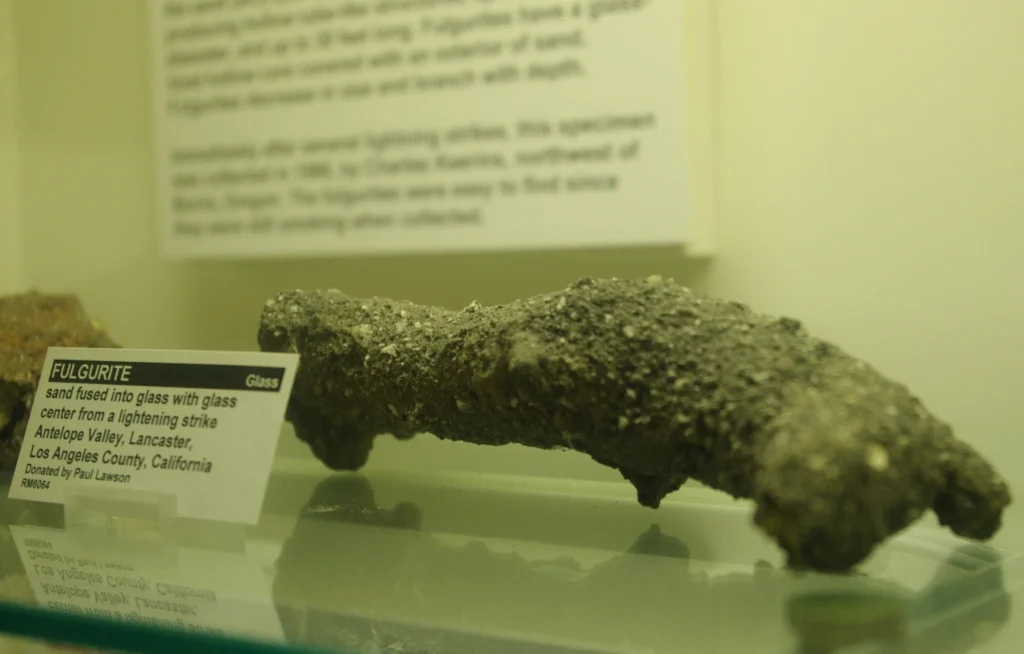
A fulgurite specimen on display at the Rice Northwest Museum of Rocks and Minerals in Hillsboro, Oregon. The rough, sand-coated tube is glass fused in place by a lightning strike. Photo: M.O. Stevens, CC BY-SA 3.0, via Wikimedia Commons.
Daniel Cordier, who had worked on fossil digs, supervised the work alongside Mike Stapleton, using the same patient tools and the same plastic field jackets that protect bones. Each fragile section was wrapped, measured, labeled, and set aside for reassembly. Martin Uman, who has led the University of Florida’s lightning research for decades, was blunt about the difficulty: an untrained person trying to pull one of these from the ground would simply shatter it. The final result, confirmed by Guinness World Records as the longest excavated fulgurite, had two branches descending from the strike point, one about 5.2 metres (17 feet) and the other about 4.9 metres (16 feet) long. It stopped where the water table began, because once the current reached groundwater it could spread out instead of boring deeper.
That single object captures almost everything strange and useful about petrified lightning. It is a record of an event that lasted a fraction of a second, frozen in a material that did not exist a moment before the strike. The thing is fragile to the point of being almost impossible to recover whole. And over the past two decades researchers have found it to be something stranger still: a tiny chemical reactor that can lock away clues about ancient climates and even about the chemistry that may have preceded life.
What a fulgurite actually is
A fulgurite is natural glass formed when lightning discharges into the ground and fuses whatever it passes through. The name comes from the Latin fulgur, meaning lightning, and the rocks have collected the folk names “petrified lightning” and “fossilized lightning” because they preserve the shape of the bolt’s underground path. In loose sand the classic form is a hollow tube, often branching, with a glassy interior and an outer surface crusted with partly melted grains. The hollow center is not decorative. It marks where the material was vaporized and where gases blew outward through the molten walls before everything cooled.
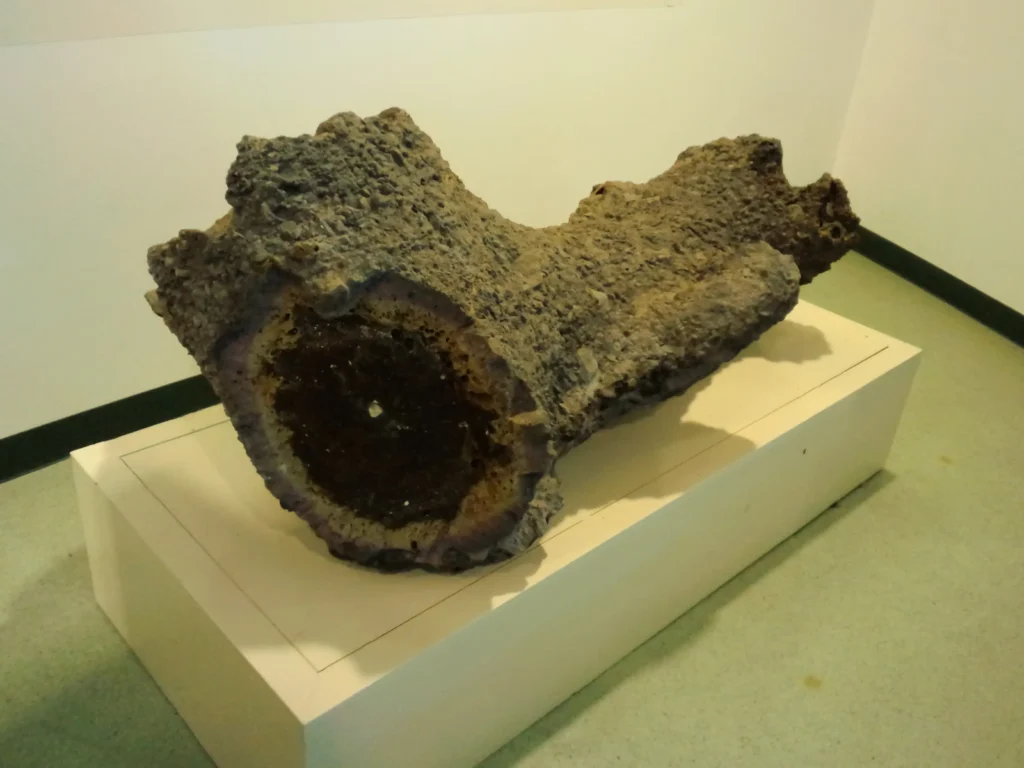
The glass at the heart of a typical sand fulgurite is a mineraloid called lechatelierite, an amorphous form of silica, SiO2, with the same chemistry as quartz but none of its crystalline order. It is named after the French chemist Henry Louis Le Chatelier, and the term was coined by the French mineralogist Alfred Lacroix in 1915. Lechatelierite is what you get when nearly pure silica is melted and then cooled too fast to organize itself back into a crystal lattice. It is the same material that forms in meteorite-impact glasses and that appeared in the desert sand fused beneath the first nuclear test. Because it requires nearly pure silica to form, not every fulgurite is made of lechatelierite; the composition of a fulgurite is dictated entirely by what the lightning happened to strike.
Most fulgurites are not chemically uniform. They typically contain at least two components: a nearly pure silica glass, the lechatelierite, and a surrounding groundmass of more mixed composition that reflects the iron, aluminum, calcium, and other elements present in the original soil or rock. Color follows chemistry. Specimens range from translucent white and pale tan through gray, green, and black, with the darker shades usually coming from iron and other impurities.
The five types of fulgurite
The most widely used classification comes from Matthew Pasek of the University of South Florida and his colleagues Kristin Block and Virginia Pasek, in a 2012 paper in Contributions to Mineralogy and Petrology. They sorted fulgurites into four main types plus a minor fifth, based on the material that was struck and the resulting structure.
Type I are sand fulgurites, the familiar hollow tubes with thin glass walls, formed in clean quartz-rich sand. Type II are clay fulgurites, formed in soils with more clay, sand, and small rock fragments; they have thicker, melt-rich walls and tend to be wider than Type I. Type III are caliche fulgurites, formed in the calcium-carbonate hardpan of arid regions; here silica glass is a minor phase, often less than a tenth of the material, and the glassy grains are bonded by calcite. Type IV are rock fulgurites, formed when lightning strikes solid rock, leaving glassy crusts and narrow channels surrounded by unmelted host rock. The fifth, droplet or exogenic fulgurites, are morphologically different from the rest and form as splashes or beads of melt thrown onto a surface, compositionally related to the clay or rock types.
From the shape and wall thickness of these structures, Pasek and colleagues worked backward to the physics. They estimated that fulgurite-forming strikes deliver something on the order of 1 to 30 megajoules of energy per metre of fulgurite produced, that the ground heats at rates of roughly 1,000 kelvin per second, and that the conducting channel through the sand is only about a millimetre across. A bolt that looks like a blinding ribbon in the sky does its underground glassmaking through a filament thinner than a pencil lead.
The physics of the strike: why sand becomes glass
Lightning is one of the most violent everyday events on the planet’s surface. In a typical negative cloud-to-ground flash, a faint, branching “stepped leader” of negative charge works its way down from the cloud in rapid jumps. As it nears the ground, positively charged streamers reach up from trees, poles, and high points. When a leader and a streamer connect, a return stroke surges back up the established channel; the NOAA National Severe Storms Laboratory describes that return stroke as traveling about 60,000 miles per second back toward the cloud, roughly a third of the speed of light, and it is that return stroke that produces the brilliant flash we see. A single negative cloud-to-ground flash, NOAA notes, consists of one or perhaps as many as 20 return strokes along the same path, which is why lightning often appears to flicker.
The temperatures involved are extreme. NASA describes the return stroke as reaching on the order of 30,000 degrees Celsius, and the NOAA National Severe Storms Laboratory puts the figure at around 50,000 degrees Fahrenheit, roughly five times hotter than the visible surface of the Sun. That heat is deposited in microseconds, faster than the surrounding air can move, which is what generates the shock wave we hear as thunder. The visible channel itself is narrow: NOAA puts the actual current-carrying channel at one to two inches in diameter, wrapped in a wider sheath of charged air.
When that current enters the ground, the relevant number for glassmaking is not just peak temperature but how long the current keeps flowing. Lightning current peaks are usually in the tens of kiloamperes, occasionally exceeding 100 kiloamperes, but the brief peak is not what builds a long tube. The “continuing current,” a longer-lasting flow of tens to hundreds of amperes, is what researchers credit with melting sand into fulgurites. The current follows the path of least resistance through damp, slightly conductive sand, heating a narrow filament well past the melting point of silica.
That melting point is what matters. Pure silica melts at roughly 1,700 degrees Celsius, with quartz softening near 1,710 degrees; in natural sand the figure ranges higher, very roughly 1,600 to 2,000 degrees depending on moisture and impurities. A lightning channel blows past those numbers with ease. The grains along the channel melt into a thin, glassy liquid, water and air trapped in the sand flash to vapor and blow outward, and the molten silica is then quenched almost instantly as the current shuts off and the surrounding cool sand draws away the heat. There is no time for crystals to grow, so the silica freezes as glass. The hollow, often frothy tube that results is a cast of the vaporized channel, its bubbly walls a record of escaping gas.
This is also why fulgurites are so fragile and so rarely preserved. The walls are thin, the glass is brittle, and most fulgurites form in shifting sand or thin rock crusts that weather and break quickly. Only about a third of a thunderstorm’s lightning reaches the ground at all, and only a fraction of those strikes hit the right material under the right conditions to leave a durable glass tube. The ones that survive long enough to be found are the exception.
Where fulgurites form, and how to recognize them
The easiest place to find petrified lightning is exactly where you would expect: clean, dry, quartz-rich sand. Beaches, coastal dunes, and deserts are the classic settings. The shores of Lake Michigan and the Atlantic coast are long-known sources of sand fulgurites, and dune fields in the Sahara and the Australian outback have yielded large numbers in recent decades, partly because human activity has made remote sand seas more accessible. In a dune field, wind periodically uncovers buried tubes, and collectors comb the freshly exposed sand for the slightly darker, glassy fragments that stand out against loose grains.
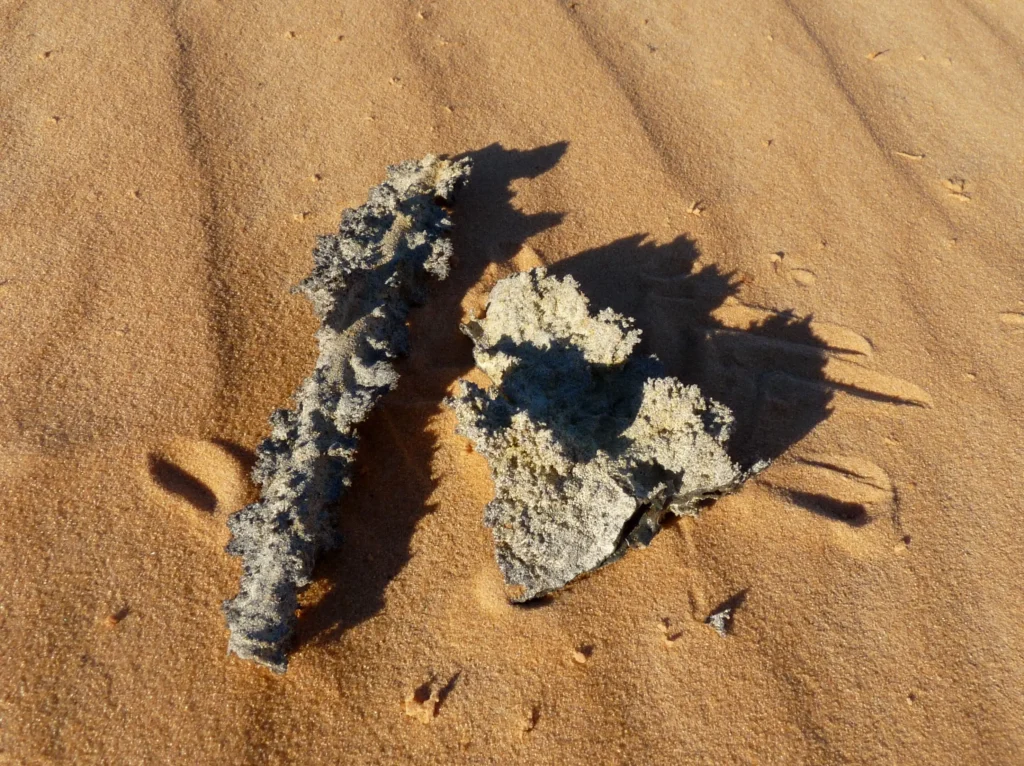
Recognizing a sand fulgurite in the field takes a careful eye. The exterior is usually a rough, sandy crust the same color as the surrounding ground, so the tubes camouflage themselves. What gives them away is the glassy interior glimpsed at a broken end, and the branching, downward-tapering shape that no ordinary pebble shares. On the Outer Banks of North Carolina, where sand and summer storms are abundant, finders describe fulgurite as only slightly darker than the beach, with most of the structure still buried where the bolt drove it.
Rock fulgurites form differently. When lightning strikes bare rock, especially on exposed summits, it leaves thin glassy crusts and narrow glass-lined channels rather than long tubes. Mountaintops are notorious for them. Nineteenth-century naturalists noted abundant rock fulgurites on the summit of Little Ararat, and modern catalogs list classic sites such as Mount Thielsen in Oregon, a peak struck so often it has been nicknamed the lightning rod of the Cascades. Alexander von Humboldt described fused rock high on the Nevado de Toluca in Mexico.
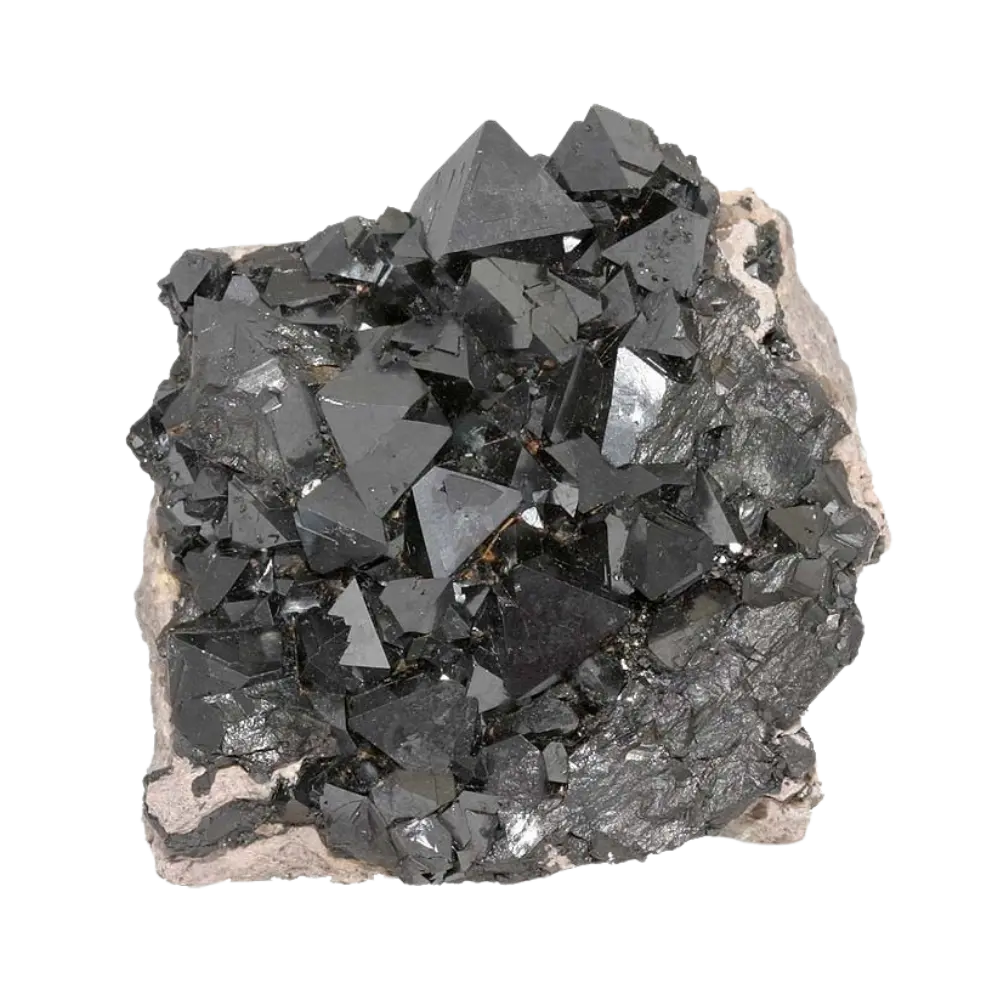
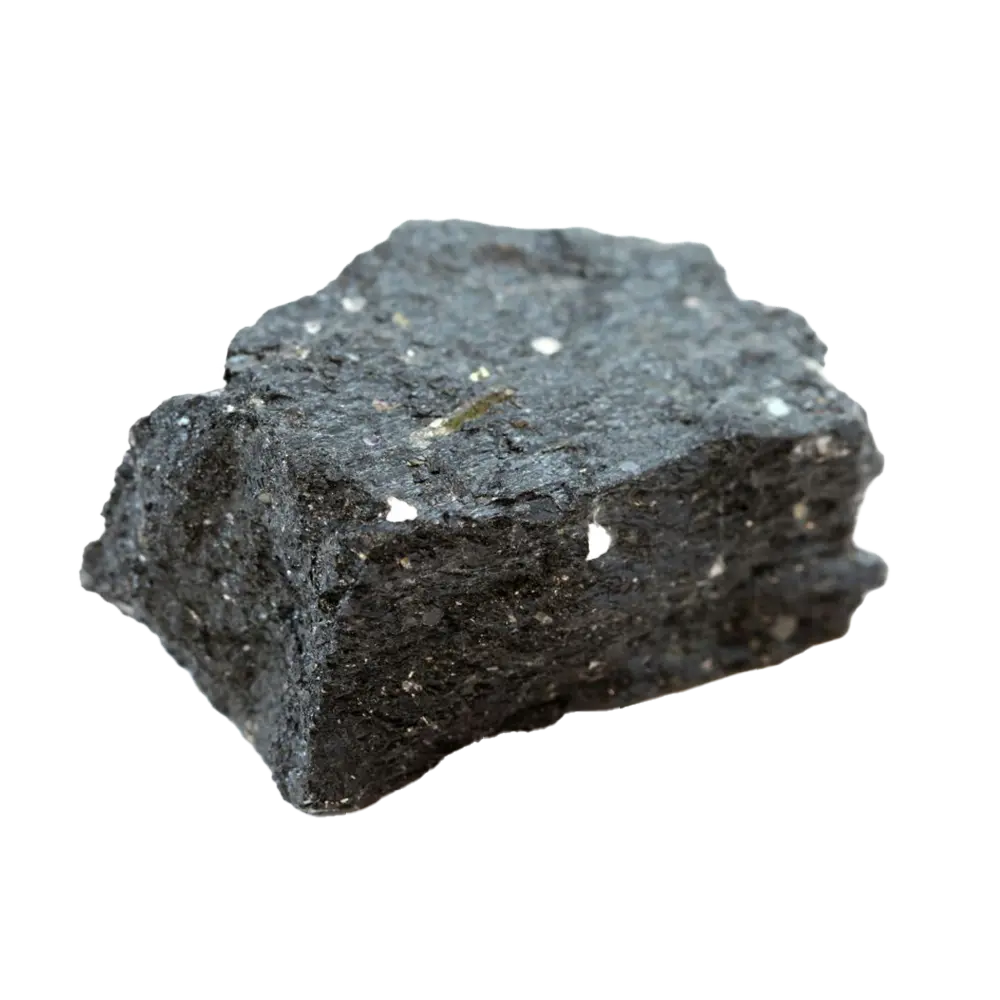
The Alps provide a well-studied example. On the summit of Cornone di Blumone in the Adamello massif of the western Italian Alps, Rodney Grapes and Heidi Müller-Sigmund documented lightning that fused gabbro, an iron-rich igneous rock, into a magnetite-bearing fulgurite. In that 2010 study, the lightning melted magnetite, hornblende, and calcic plagioclase into an iron-rich, low-silica glass whose skeletal, branching magnetite crystals record extreme supercooling, the signature of a melt quenched almost instantly. This is petrified lightning with barely any lechatelierite in it, a reminder that the term describes a process, not a fixed recipe.
The most dramatic recent rock-fulgurite work comes from Kinmen Island, Taiwan, where Li-Wei Kuo, Steven Smith, and colleagues published a 2021 study in Scientific Reports. Kinmen is built largely of granitic gneiss, and during a single storm on 7 May 2018 the island recorded more than 3,000 lightning events, the strongest carrying about 162 kiloamperes to ground on its highest peak. The researchers found fulgurite not only as a fresh crust on the surface but, for the first time documented anywhere, inside fractures running several metres below the surface. By comparing strike-affected rock with reference granite from a borehole 138 metres deep, they identified microstructures that record both intense heat and intense pressure: glass, a phase transformation in potassium feldspar, and residual stresses preserved in mineral grains as high as about 1.5 gigapascals. They concluded that cloud-to-ground lightning can drive temperatures above 1,700 degrees Celsius and gigapascal-scale pressures, not only at the surface but along fractures deep underground, and that the current density inside a fracture as far as 40 metres from the strike point can rival that at the surface. They drew on an earlier numerical model, published by Chien-Chih Chen and colleagues in 2017, that suggested lightning hitting bare rock can momentarily generate local pressures above 7 gigapascals and temperatures over 2,000 kelvin, producing a kind of shock wave. Some of the resulting features resemble the low-level shock metamorphism geologists associate with meteorite impacts, which means lightning scars and impact scars can be confused if you are not careful.
Fulgurites as time capsules
Because a fulgurite forms in an instant and then traps a sample of its surroundings in glass, it can preserve information about the moment of the strike. The clearest demonstration comes from the Libyan Desert. In a 2007 paper in Geology, Rafael Navarro-González and an international team, including the U.S. Geological Survey luminescence specialist Shannon Mahan, analyzed gases trapped in the glassy bubbles of a fulgurite from the eastern Sahara.
The bubbles held carbon dioxide, carbon monoxide, and nitric oxide that had been sealed in when the glass quenched. From their composition the researchers reconstructed the ground chemistry at the time of formation: about 0.1 percent organic carbon, a carbon-to-nitrogen ratio of 10 to 15, and a carbon isotope value indicating vegetation dominated by C4 plants, the kind of grasses that thrive in semi-arid grassland today. In other words, the spot where the bolt struck was once covered not by bare dune but by Sahel-type savanna. Thermoluminescence dating placed the strike at roughly 15,000 years ago. The implication is striking: the semi-arid Sahel belt, which now sits near 17 degrees north, must have reached at least to 24 degrees north at the end of the last ice age, when the “green Sahara” was real. The team argued that fulgurite gases combined with luminescence dating can serve as a genuine tool for quantitative paleoecology, reading vanished landscapes out of glass.
The dating angle matters more broadly. A fulgurite starts a geological clock the instant it forms, because the heat resets the luminescence signal in its mineral grains. The presence and age of fulgurites in a region can also be used to estimate how often lightning struck there in the past, feeding into the young field of paleolightning, the study of ancient electrical activity through the marks it leaves in rock.
The origin-of-life twist: phosphorus from the sky
The most surprising chapter in fulgurite science concerns the chemistry of phosphorus, an element essential to all known life. Phosphorus sits at the core of DNA, RNA, cell membranes, and the energy-carrying molecule ATP. On the early Earth, though, phosphorus posed a problem. It was locked mostly in phosphate minerals like apatite that dissolve poorly in water, making it hard for prebiotic chemistry to get at. One favored solution has been meteorites, which carry the iron-nickel phosphide mineral schreibersite, (Fe,Ni)3P. When schreibersite reacts with water it releases reactive, water-soluble forms of phosphorus that can build the molecules life needs.
Fulgurites enter this story because lightning, like a meteorite impact, is a high-energy event that can chemically reduce phosphate. In 2009, Matthew Pasek and Kristin Block reported in Nature Geoscience that fulgurites from North America, Africa, and Australia contained phosphorus in reduced oxidation states, the partially oxidized forms phosphite and hypophosphite that many microorganisms can use. It was among the first times reduced phosphorus had been found in a modern terrestrial rock, and it suggested that cloud-to-ground lightning increases the local bioavailability of an otherwise stubborn nutrient.
The idea gained a vivid specimen in 2016, when lightning struck a property in Glen Ellyn, Illinois, and produced an unusually large, well-preserved fulgurite. The homeowners donated it to nearby Wheaton College, where an undergraduate named Benjamin Hess began studying it. Working with Sandra Piazolo and Jason Harvey at the University of Leeds, Hess found that the Glen Ellyn fulgurite contained a large amount of schreibersite, the same phosphide mineral usually associated with meteorites. Their results appeared in Nature Communications in 2021.
The numbers are concrete. The roughly 30-kilogram fulgurite contained on the order of 0.1 kilogram of schreibersite, a large amount for a single terrestrial rock. Scaling that up, they argued that lightning on the early Earth could have produced between 10 and 1,000 kilograms of phosphide and between 100 and 10,000 kilograms of phosphite and hypophosphite annually during the Hadean and early Archean, a window running from about 4.5 to 3.5 billion years ago. Their model assumed a far stormier young planet, with on the order of 1 to 5 billion lightning flashes per year. (For comparison, the modern rate is debated: the Hess team used roughly 560 million flashes per year as their baseline, while NASA’s space-based Optical Transient Detector put global lightning at about 44 flashes per second, or nearly 1.4 billion per year. The authors framed their early-Earth figures as order-of-magnitude estimates, not precise totals.)
The conceptual payoff is the part worth dwelling on. Meteorite delivery of phosphorus dropped off sharply as the early bombardment faded; as Harvey put it, the heavy delivery of phosphorus from impacts is a once-in-a-solar-system event. Lightning is not. As long as a planet has an atmosphere that makes storms, lightning keeps supplying reactive phosphorus, year after year. The team estimated that on Earth, phosphorus from lightning would have overtaken the meteorite supply after about 3.5 billion years ago, and they noted the same mechanism could operate on other Earth-like worlds long after their bombardment ended.
In 2023, Luca Bindi of the University of Florence, Tian Feng, and Pasek pushed the chemistry further in a paper in Communications Earth & Environment. Studying a fulgurite found at New Port Richey, Florida, in 2012, which had formed when lightning fused sand around a tree root, they identified a calcium phosphite material, ideally CaHPO3, inside spherules made largely of iron silicides. In this compound, phosphorus sits in the +3 oxidation state, intermediate between the +5 of ordinary phosphate and the negative states of phosphide. The authors described it as, to their knowledge, the first fulgurite-hosted crystalline material in which phosphorus is not fully oxidized phosphate, and suggested it could represent a new mineral group. Pasek and Bindi indicated they planned further study to determine whether the material qualifies for formal recognition as a mineral. The finding implies that phosphate can be reduced along more than one chemical pathway during high-energy events, and that phosphite-bearing solids like this may be part of how reduced phosphorus enters the broader phosphorus cycle.
A note on scale is in order here. These are gram-level quantities in individual rocks and order-of-magnitude extrapolations across geological time. The work does not claim that lightning made life. It argues, carefully, that lightning is a plausible and continuous source of the reactive phosphorus that prebiotic chemistry would have needed, an alternative or complement to the meteorite hypothesis rather than a replacement for the whole problem of life’s origin.
A short history of fulgurite science
People have been puzzling over petrified lightning for a long time, usually getting it wrong before getting it right. Early modern descriptions treated the glassy tubes as products of underground fire, and some writers attributed curative powers to them; the German author Leonhard David Hermann described them in his 1711 work Maslographia. Some historians trace fulgurite references back further still, to the lapidary of the thirteenth-century Castilian king Alfonso X.
The naming belongs to the early nineteenth century. The word “fulgurite” entered English in the 1820s, with the Oxford English Dictionary citing the crystallographer Henry James Brooke in 1823, and the German form “Fulgurit” was introduced by the mineralogist Karl Gustav Fiedler in Annalen der Physik. The famous British example came from Drigg, in Cumberland, where tubes were discovered in 1812; three separate fulgurites were found close together, interpreted as different forks of one bolt, their glassy channels running for metres through the sand. These specimens became well known among naturalists, and accounts circulated of tubes traced extraordinary distances into the ground.
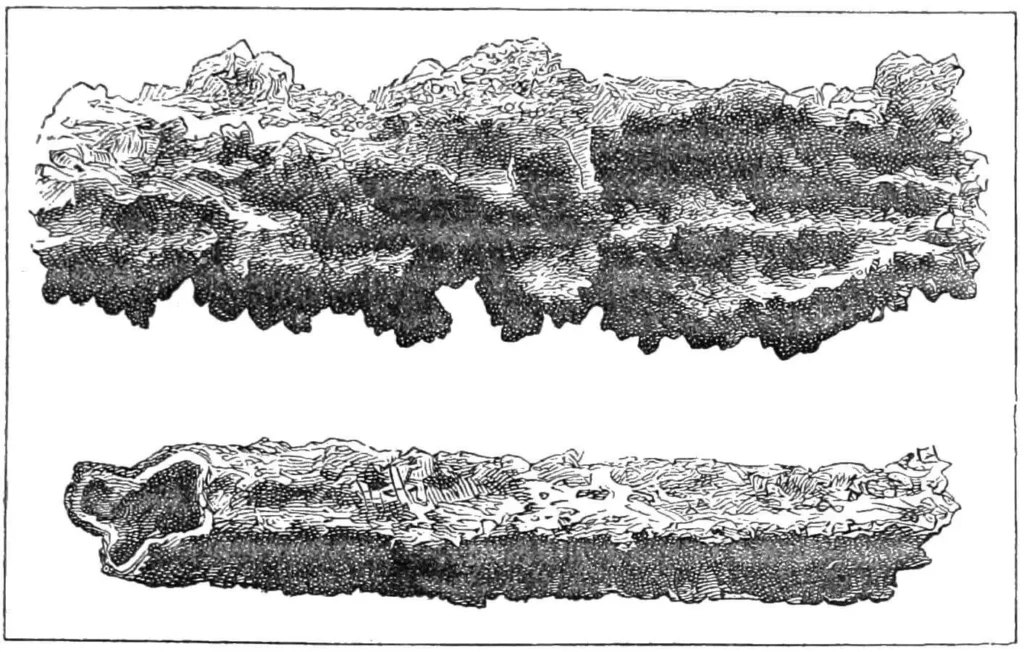
Charles Darwin was among those who paid attention. In The Voyage of the Beagle, he described finding a group of vitrified siliceous tubes in the sand hillocks near Maldonado, on the coast of what is now Uruguay, formed by lightning entering loose sand. He noted that they resembled “in every particular” the tubes from Drigg in Cumberland described in the Geological Transactions, and that by working with his hands he traced one tube about two feet down, with fragments adding up to more than five feet. Darwin understood that the tubes recorded the “bore” of the lightning, and he referenced earlier laboratory experiments in Paris in which strong electrical discharges through powdered material produced similar glass. Among the early naturalists who examined fulgurites, including Humboldt and Horace-Bénédict de Saussure, Darwin was notable for connecting them firmly to lightning rather than to some subterranean fire.
Museums became the natural home for the better specimens. The Yale Peabody Museum displays one of the longest preserved fulgurites, a sand tube about 13 feet (4 metres) long. The museum dates its formation to a 1949 lightning strike at Miller’s Beach, on the Connecticut shore of the Congamond Lakes. The Oxford University Museum of Natural History holds the historic Drigg material. And the Camp Blanding record-holder, once it was finally pieced together, went looking for a museum large enough to display it.
Making lightning on purpose
One reason the Camp Blanding work is so well documented is that the researchers there do not always wait for nature. The International Center for Lightning Research and Testing triggers lightning deliberately, using the rocket-and-wire technique: a small rocket trailing a thin grounded wire is fired into a charged storm cloud, providing a conducting path that coaxes a discharge down to a chosen spot. Over the long run the center has triggered lightning at a steady clip, averaging roughly 30 triggered flashes a year, the majority of them containing return strokes, with some busy summers reaching as many as 35. The facility was originally built to understand how lightning damages power systems, and triggered strikes there have been documented melting through buried cables and forming fulgurites right against them.
Laboratories have also begun to manufacture fulgurites from scratch. In a 2023 study in Scientific Reports, A. Zeynep Çalışkanoğlu, Donald Dingwell, and colleagues at Ludwig-Maximilians-Universität in Munich generated fulgurites from Laacher See volcanic ash using a high-voltage setup with a DC source and a trigger-pulse circuit, delivering a short, high-current impulse followed by a longer continuing current, deliberately mimicking the two-part structure of a real strike. The experimental fulgurites closely resembled natural ones in texture and state, which lets researchers vary the conditions and watch how melting, gas escape, and quenching unfold, watch how the melt forms, vents gas, and freezes: a sequence impossible to schedule with real lightning. Related experiments by the same group reproduced reactive phosphorus chemistry, reinforcing the link between lightning and prebiotic phosphorus.
Why fulgurites are worth the trouble
For something that forms in under a second and usually crumbles before anyone notices, the fulgurite carries an unusual amount of information. It is a direct physical record of a lightning strike, preserving in glass the diameter and branching and downward reach of the channel itself. It traps gases that can reconstruct a landscape that vanished thousands of years ago. It runs a flash of extreme chemistry that turns stubborn phosphate into the reactive phosphorus that life depends on, and it does so often enough, over enough of geological time, that researchers now treat it as a serious candidate for one of the routes by which the ingredients of life became available. The same glass that confused eighteenth-century collectors into talk of underground fires and healing powers turns out to be a recording device and a clock and a small crucible all at once.
So the next time a storm passes over a dune field or a sandy beach, some of those bolts are not merely discharging into the ground. A few of them are leaving behind glass that may sit unnoticed for fifteen thousand years, holding the shape of a single instant and the chemistry of a much older world.