











A storm with no cloud
On the night of 15 January 2022, a string of radio antennas scattered across the South Pacific began registering something that should not have been possible. An undersea volcano in the Kingdom of Tonga, Hunga Tonga–Hunga Ha’apai, had blasted a column of ash, gas and vaporized seawater out of the ocean and into the mesosphere. Inside that column, lightning was firing at a rate of 2,615 flashes per minute. No thunderstorm ever recorded by global lightning networks had come close.
This is volcanic lightning, the phenomenon old enough that a Roman teenager witnessed it while his uncle died sailing toward it, and strange enough that researchers are still arguing about exactly how it works.
What is volcanic lightning?
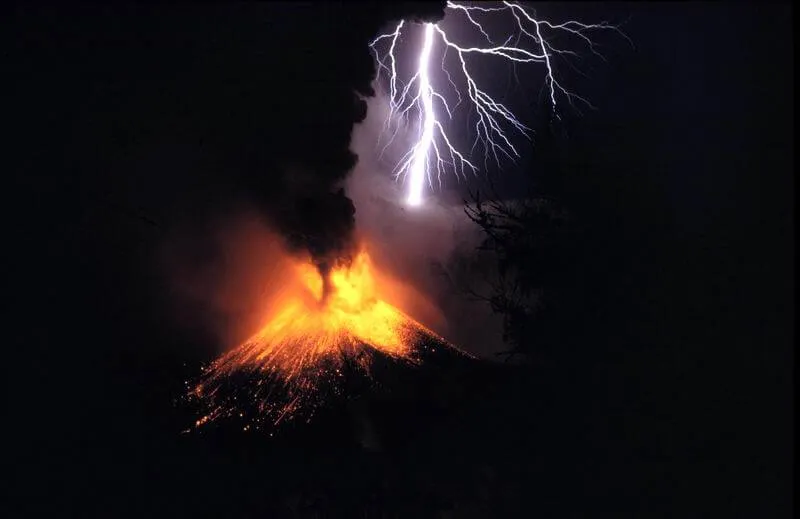
Volcanic lightning is an electrical discharge produced inside or around the plume of an erupting volcano, rather than inside an ordinary rain cloud. Because the charge builds up in a cloud of ash instead of a cloud of water droplets, the phenomenon picked up the nickname “dirty thunderstorm.”
The basic physics is the same as in ordinary lightning. Particles in a turbulent cloud acquire opposite electrical charges, those charges get separated into distinct regions, and when the voltage difference grows large enough the air breaks down and a spark jumps. What differs is the cargo. A thundercloud is full of water and ice. A volcanic plume is full of pulverized rock, and that changes which charging processes matter.
The history: from Pliny the Younger to the Vesuvius Observatory
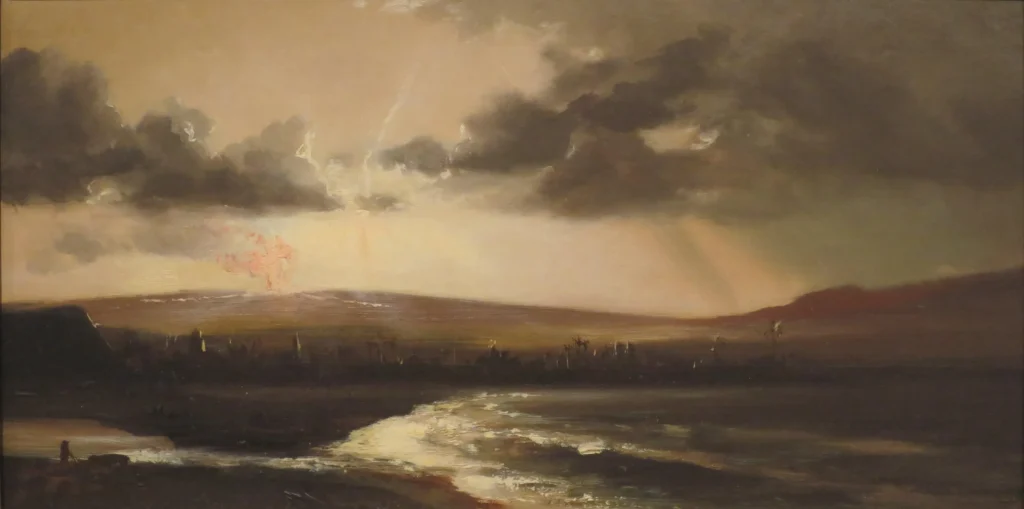
The earliest surviving written record comes from Pliny the Younger, who watched the AD 79 eruption of Vesuvius from across the bay at Misenum and later wrote of “a most intense darkness rendered more appalling by the fitful gleam of torches at intervals obscured by the transient blaze of lightning.” His uncle, Pliny the Elder, sailed toward the eruption and died.
For centuries afterward, volcanic lightning stayed in the category of eyewitness curiosity. The first attempt to study it systematically came from Luigi Palmieri, who ran the Vesuvius Observatory and recorded electrical activity during the eruptions of 1858, 1861, 1868 and 1872. Vesuvius obliged him repeatedly. The phenomenon has now been observed at hundreds of eruptions around the world.
What causes volcanic lightning? The three charging mechanisms
There are several ways to put charge on the particles in a volcanic plume, and they do not all operate in the same place.
Fractoemission (fragmentation charging)
When magma is torn apart in the conduit and shattered into ash, the fracturing of rock and glass ejects electrons and ions. This process, called fractoemission, charges particles right at the source, before the ash has even left the vent. For plumes rich in solid silicate particles, fractoemission is probably the dominant source of the initial charge.
Triboelectric (collisional) charging
Once ash is airborne, particles rub against and collide with each other in the turbulent jet, swapping charge the way a balloon does against hair. This frictional or collisional process is called triboelectric charging. Corrado Cimarelli, an experimental volcanologist at Ludwig Maximilian University of Munich, has described a volcanic plume as a perfect environment for friction, with a perfect environment for friction: a dense, turbulent jet where particles collide constantly. In a 2014 paper in Geology, Cimarelli and colleagues generated volcanic lightning in the laboratory by firing gas-and-particle mixtures through a nozzle, and found that the discharges were controlled by the dynamics of the particle-laden jet and by the abundance of fine ash.
Ice-based “dirty thunderstorm” charging
Higher up, a third mechanism takes over. If a plume rises above the atmospheric freezing level, water vapor condenses and freezes, producing ice crystals, supercooled water and soft hail. Collisions among these particles generate charge the same way an ordinary thunderstorm does. This is the ice-charging mechanism, and it becomes important once the plume reaches sub-freezing altitudes.
Which mechanism dominates, and where
Which mechanism dominates depends mostly on altitude. Near the vent and in low plumes, silicate charging through fragmentation and collision dominates. Higher up, once a plume climbs past the freezing level, ice charging takes over. A 2020 USGS study of the Bogoslof eruption put it directly: “the plumes did not produce detectable lightning until they rose higher than the atmospheric freezing level,” approximated by the −20 °C level, where ice formed in the upper plume. McNutt and Williams found that observed plume heights cluster in two bands. As they reported in 2010, “ash plume heights (142 observations) show a bimodal distribution with main peaks at 7–12 km and 1–4 km,” consistent with two different regimes operating at different altitudes.
The three lightning regimes
Lightning mapping arrays, which pinpoint discharges in three dimensions using radio signals, have shown that electrical activity passes through distinct phases over the course of an eruption.
Vent discharges
At the very start of an explosion, the gas-thrust region right above the vent fills with tiny sparks. These vent discharges are small, on the order of meters to tens of meters, and they fire in rapid bursts, producing a characteristic continual radio frequency signal. At Augustine in 2006, researchers interpreted these as small sparks 10 to 100 metres long, firing at rates of thousands to tens of thousands per second. Later measurements at Sakurajima showed the individual impulses are even smaller, streamer-like discharges only metres long, rather than miniature lightning. Their presence tells you ash is being charged at or before the moment it leaves the vent.
Near-vent lightning
Seconds later, larger flashes develop in the lower eruption column, climbing upward from the cone. These near-vent flashes range from roughly 1 to 7 km in length and last a fraction of a second, and some connect to the ground. They are tied to the fragmentation and collision processes happening in the dense lower plume. The 2016 study by Cimarelli and colleagues at Sakurajima in Japan used synchronized high-speed video, magnetotelluric measurements and infrasound to capture exactly these near-vent discharges, and tied their occurrence to the dynamics and height of the plume.
Plume lightning
Minutes after the explosion, lightning develops in the convective, drifting part of the plume and the spreading umbrella cloud. This plume lightning most closely resembles ordinary thunderstorm lightning, can span many kilometres, and is where water and ice play their biggest role. The largest flashes tend to come late, as the plume’s charge structure organizes into broad horizontal layers.
Volcanic glass beads: the fossil evidence in ashfall
Volcanic lightning leaves a physical fingerprint. In 2015, Kimberly Genareau and colleagues described lightning-induced volcanic spherules, or LIVS, in a paper in Geology. When a discharge rips through a plume, the heat of the channel melts nearby ash particles, and surface tension pulls the melt into tiny glass spheres before they cool. These spherules average around 50 microns across and are smaller than 100 microns, regardless of the ash composition.
The team found them in ashfall from two eruptions where lightning had been well documented, the 2009 eruption of Mount Redoubt in Alaska and the 2010 eruption of Eyjafjallajökull in Iceland. The discovery matters because it lets researchers infer that lightning occurred during ancient eruptions where nobody was watching, simply by sieving the deposits for glass beads.
Where and when volcanic lightning happens
Volcanic lightning is not guaranteed. It favors big, ash-rich, explosive eruptions. In their global database, Stephen McNutt and Earle Williams documented lightning at 80 volcanoes across 212 eruptions, and an updated review raised the count to lightning “at 87 volcanoes in association with 236 eruptions.” The Volcanic Explosivity Index could be determined for 177 of the eruptions, and the pattern was clear. As the authors wrote, “Eight percent of VEI = 3–5 eruptions have reported lightning, and 10% of VEI = 6, but less than 2% of those with VEI = 1–2”, strong evidence that the largest, most explosive eruptions are the ones that crackle.
A more recent study tightened the picture using continuous global data. Published in Terrestrial, Atmospheric and Oceanic Sciences in 2025, it combined World Wide Lightning Location Network detections with Smithsonian Global Volcanism Program eruption records for April 2009 through February 2022. Of the 490 eruptions across 170 volcanoes in that window, “308 eruptions from 131 volcanoes were found to be associated with volcanic lightning”, roughly three in five eruptions in the modern, well-monitored record.
The Hunga Tonga lightning record
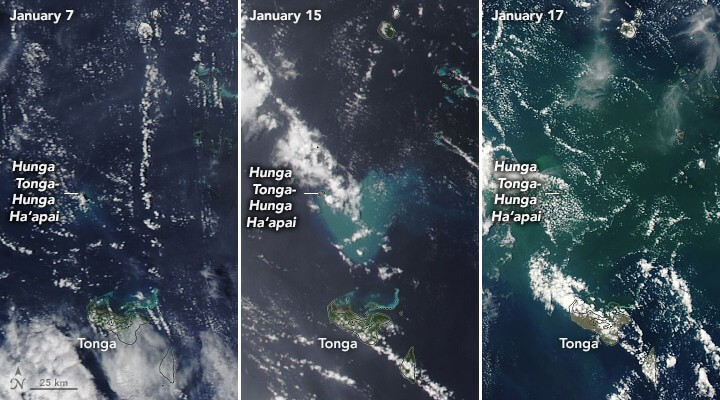
The 15 January 2022 eruption of Hunga Tonga–Hunga Ha’apai is the most extreme volcanic lightning event ever measured, and the study that documented it is Van Eaton and colleagues, published in Geophysical Research Letters in 2023. The submarine vent sat below the ocean surface, deep enough that erupting magma flash-boiled enormous volumes of seawater, shallow enough that the ocean did not smother the blast. The plume rose at least 58 km, into the mesosphere.
Combining four lightning data sources never before used together, the team counted just over 192,000 flashes, nearly 500,000 individual electrical pulses over an eruption that lasted at least 11 hours, peaking at 2,615 flashes per minute, the most intense electrical storm ever detected by global networks. The lead author, USGS volcanologist Alexa Van Eaton, called it “a supercharged thunderstorm, the likes of which we’ve never seen.” For comparison, the second most intense electrical storm on record, a 1999 thunderstorm over the southern United States, peaked at 993 flashes per minute.
Two features stood out. First, some flashes reached altitudes of 20 to 30 km above sea level, the highest-altitude lightning ever measured. Second, the flashes arranged themselves into enormous concentric rings centered on the vent. These lightning rings expanded outward, with the largest reaching a radius of roughly 140 km, a structure some 280 km (about 175 miles) across, what Van Eaton described as a “280-kilometer-diameter donut of electrical discharges.” The team showed that the rings rode internal gravity waves traveling faster than 80 metres per second through the umbrella cloud, generated by the buoyant oscillation of the plume’s overshooting top.
The submarine setting is the key. By vaporizing seawater, the eruption injected an extraordinary amount of water into the stratosphere, fueling the ice-based charging that ordinary thunderstorms run on and pushing it to an unprecedented scale.
How scientists use volcanic lightning to monitor eruptions
Detecting an explosive eruption quickly is a safety problem, because ash clouds are deadly to jet engines and the world has far more dangerous volcanoes than it has seismometers. Lightning detection offers a way to spot and track eruptions in near real time, from thousands of kilometres away, day or night.
Two systems do most of the work. The World Wide Lightning Location Network, a ground-based array of radio receivers run by a collaboration of universities, detects the strongest flashes anywhere on Earth. From space, the Geostationary Lightning Mapper aboard the GOES-R series satellites maps total lightning continuously across the Western Hemisphere with a near-uniform spatial resolution of roughly 10 km.
The approach proved itself during the 2016–2017 eruption of Bogoslof in the Aleutians. According to Van Eaton and colleagues, “only 32 out of the 70 explosive events produced detectable lightning,” and more than 4,550 lightning strokes were logged over nine months by WWLLN and Vaisala’s GLD360. Those detections were delivered to the USGS in near real time, the first operational use of volcanic lightning in eruption monitoring in the United States. Van Eaton’s Hunga Tonga work made the same case at a larger scale: lightning data let scientists reconstruct phases of the eruption that the opaque ash cloud had hidden from satellite view.
What scientists still do not agree on
The broad outline is settled, but important details are not. The balance between silicate charging and ice charging remains debated, and it appears to vary from eruption to eruption. During the 2010 Eyjafjallajökull eruption, analysis of flash morphology suggested silicate-based charging dominated, and some researchers found no compelling evidence linking lightning onset to ice-forming temperatures. At Bogoslof and Redoubt, by contrast, external water, from the ocean and from a summit glacier, seems to have been important for ice charging. As Los Alamos scientist Sonja Behnke has put it, “It seems to be important to have external water to have the ice-charging mechanism.”
How much ice is needed, and exactly when ice charging takes over from silicate charging, are open questions. The honest summary is that charging operates on a continuum, dominated by silicate processes near the vent and by ice processes high in tall, wet plumes, with the crossover point depending on how much water a given eruption carries.
Frequently asked questions
What causes volcanic lightning?
Charged particles in a volcanic plume. Rock fragmenting into ash ejects charge (fractoemission), colliding ash particles swap charge (triboelectric charging), and high in tall plumes ice particles charge as they do in thunderstorms. Turbulence separates the charges until a spark jumps.
Is volcanic lightning the same as regular lightning?
The discharge itself is the same physics. The difference is the source of charge: ash and rock rather than water and ice. Volcanic lightning can occur even when there is no ice in the cloud, which ordinary lightning cannot.
Why is it called a dirty thunderstorm?
Because the charge builds up in a cloud full of “dirty” volcanic ash instead of a clean water cloud.
How strong was the Hunga Tonga lightning?
It peaked at 2,615 flashes per minute and produced more than 192,000 flashes, the most intense electrical storm ever detected by global networks, with some flashes reaching 20 to 30 km altitude.
Can volcanic lightning be used to predict eruptions?
It is used to detect and track eruptions in progress rather than to predict them ahead of time, giving rapid warning of ash clouds that threaten aircraft.
Does volcanic lightning leave any trace?
Yes. It melts ash into tiny glass beads called lightning-induced volcanic spherules, which can be found in ashfall deposits.
Which volcanoes get the most lightning?
Big, ash-rich explosive eruptions, especially those at VEI 3 and above. Sakurajima, Redoubt, Eyjafjallajökull, Calbuco, Bogoslof and Hunga Tonga are all well-documented examples.