
Introduction
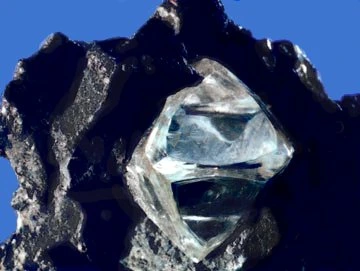
In a laboratory in Vienna, in the spring of 2009, a Durham University graduate student named John McNeill was working his way through a film canister of ugly diamonds. His supervisor, the geochemist Graham Pearson, then at Durham, soon to move to the University of Alberta, had bought them for next to nothing. These were not the stones of a jeweler’s window. They were “ultradeep” diamonds panned from river gravels near Juína, in the Brazilian state of Mato Grosso, battered and cloudy brown, the kind that cutters throw back. Pearson’s team had picked them up for pocket change; the stone that mattered cost about $20. McNeill was not hunting for a headline. He was trying to work out how to date the diamonds, and he was aiming a beam of light at inclusion after inclusion, reading the spectrum each one scattered back.
One tiny speck, buried inside the diamond and invisible to the naked eye, gave back a signal nobody expected from a rock sitting on a lab bench. It was ringwoodite, a high-pressure form of the common mineral olivine that, until that moment, had only ever been found in meteorites and squeezed into existence inside laboratory presses. Two years later, after Pearson had moved his lab to the University of Alberta, an infrared measurement of the same invisible speck delivered a second surprise: the crystal was wet. Wet here means that water, in the form of hydroxyl bound into the crystal structure, made up more than one percent of its weight.

That $20 stone became the physical proof behind one of the strangest-sounding claims in modern geology: that hundreds of kilometres beneath your feet, sealed inside solid rock, there may be as much water as in all the oceans on the surface, or several times more. A discarded diamond and a continent-wide wall of seismometers built the case for water inside the Earth. Scientists still argue, hard, about how much is really down there.
Is there really an ocean inside the Earth?
There is no cavern of sloshing seawater beneath the crust, no sunless sea waiting for Jules Verne’s explorers. Frank Brenker, a geoscientist at Goethe University in Frankfurt who has worked on several of the key diamonds, puts the correction bluntly: the water down there is bound in rock that “would neither feel wet nor drip water.” The “ocean inside the Earth” is a figure of speech about mass.
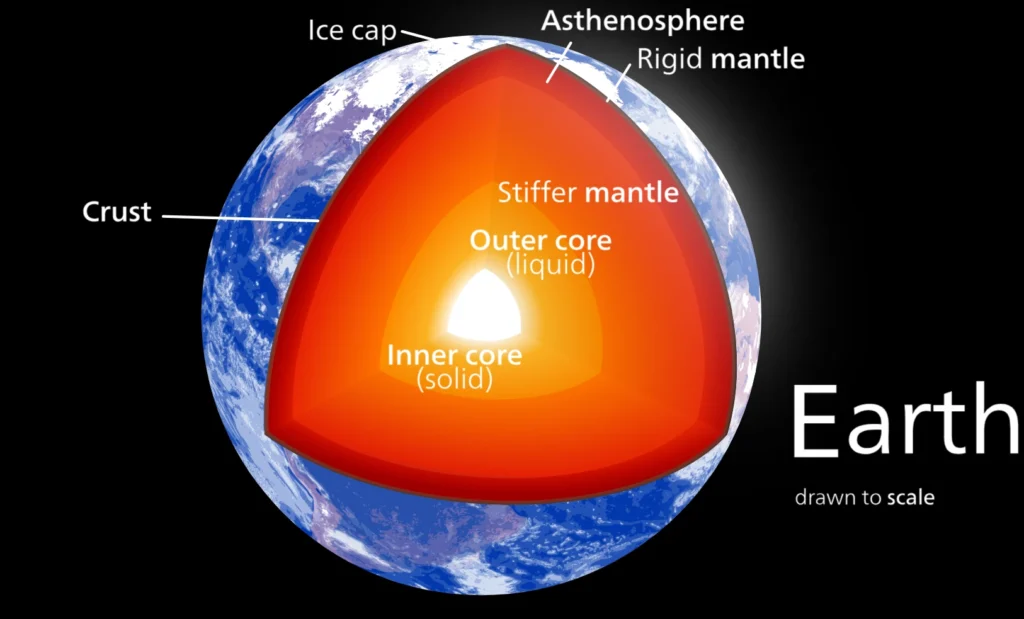
What is real is stranger and, in some ways, more consequential. Between about 410 and 660 kilometres depth sits a layer geologists call the mantle transition zone. It separates the upper mantle from the lower mantle, and it is defined by two abrupt jumps in the speed of seismic waves, at 410 km and at 660 km, that mark where minerals rearrange into denser forms under rising pressure. The minerals that dominate that zone happen to have an unusual talent. They can hold water inside their crystal lattices in quantities that the rock above and below them cannot. If even a modest fraction of the transition zone is hydrated, the bound water there, converted to an equivalent surface volume, rivals or exceeds the oceans. The “ocean,” in other words, is a reservoir of hydrogen and oxygen, stored as hydroxyl, spread through an enormous volume of rock.
The transition zone is unreachable. The deepest hole humanity has ever drilled, the Kola Superdeep Borehole in northwestern Russia, bottomed out at 12.26 kilometres, not even three percent of the way to the top of the transition zone. Pressures at 410 km exceed 13 gigapascals; at 660 km they reach about 23.5 GPa, with temperatures climbing from roughly 1,400 toward 1,650 degrees Celsius at its base. No drill will ever sample this layer. Everything we know about it comes from three indirect windows: seismic waves that pass through it, laboratory experiments that recreate its pressures, and the rare mineral messengers, diamonds, that survive the journey up.
What is ringwoodite?
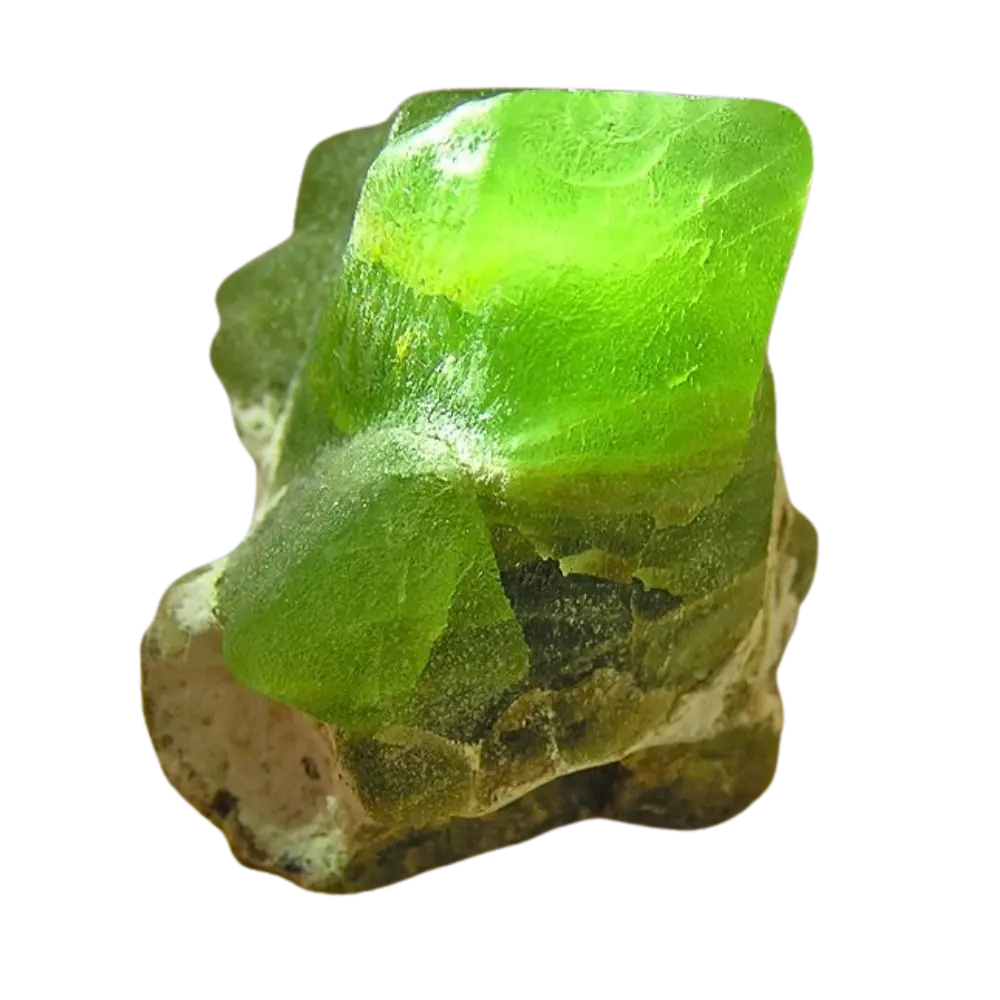
Olivine is the green mineral that makes up the bulk of the upper mantle. As a gemstone it is called peridot. Push it deep enough and its atoms cannot keep their loose, low-pressure arrangement; they collapse into tighter packings. Around 410 km, olivine converts to a denser phase called wadsleyite. Deeper still, near 520 km, wadsleyite reorganizes again into ringwoodite, which holds its structure down to about 660 km. There the pressure forces one last, dramatic breakdown: ringwoodite dissociates into bridgmanite and ferropericlase, the minerals of the lower mantle, and the 660 km seismic discontinuity marks that transformation.
Ringwoodite carries its name from Ted Ringwood, the Australian geochemist who spent his career working out how mantle minerals rearrange under pressure. He predicted such high-pressure phases before anyone had a terrestrial sample in hand. The mineral was first identified in 1969 in the Tenham meteorite, a stone that fell in Queensland, Australia, in 1879 and had been shock-compressed hard enough to forge ringwoodite from its olivine. For 45 years after that, every ringwoodite anyone had ever touched came from a meteorite or a laboratory anvil.
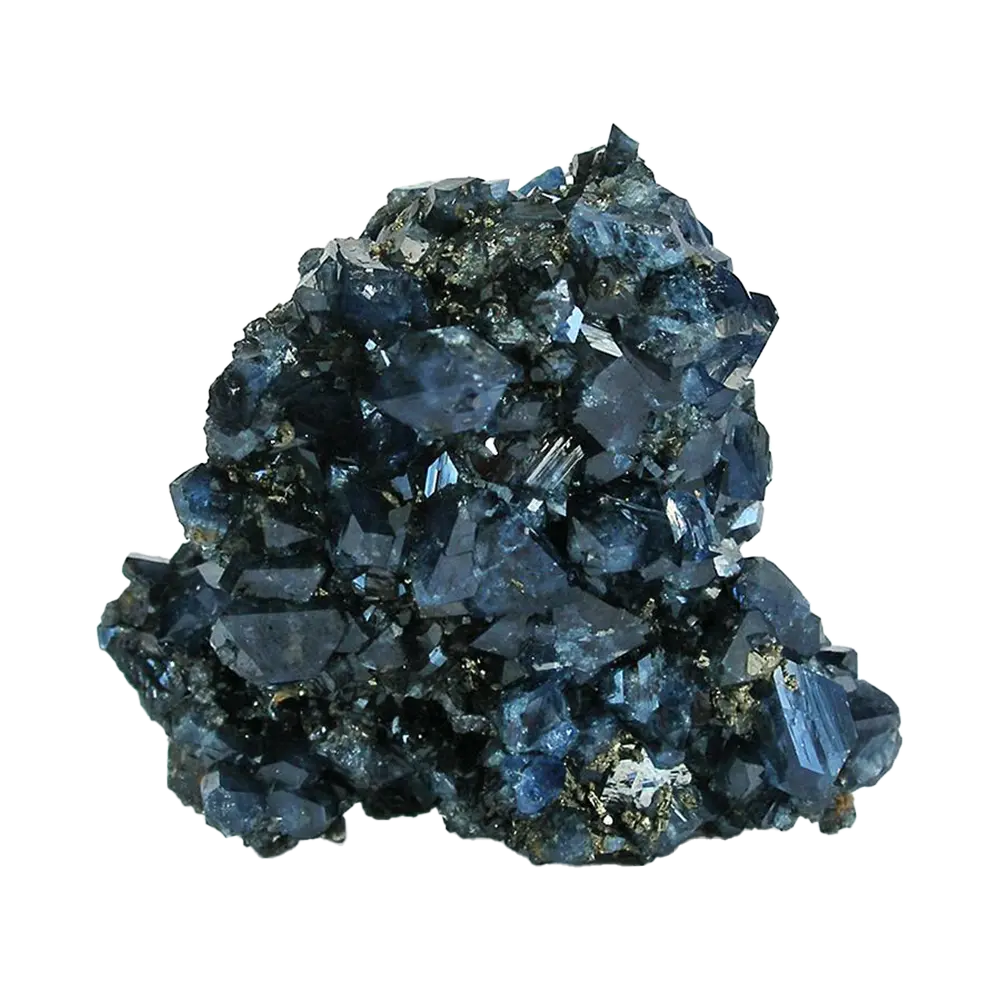
What makes ringwoodite matter for water is a quirk of its crystal structure. The spinel-type lattice has room to swap hydroxyl groups in for some of its magnesium and oxygen, so it can incorporate hydrogen far more readily than olivine can. Laboratory work by Thomas and colleagues, published in Frontiers in Earth Science, measured water contents of up to 1.7 weight percent in synthetic ringwoodites, with one sample reaching 2.5 weight percent by SIMS calibration, figures far beyond anything the ordinary upper mantle or the lower mantle can manage. Steve Jacobsen, the Northwestern University geophysicist who has grown sapphire-blue hydrous ringwoodite in his lab for years, describes the behaviour simply: “The ringwoodite is like a sponge, soaking up water. There is something very special about the crystal structure of ringwoodite that allows it to attract hydrogen and trap water.”
High capacity is not the same as high content, and that distinction sits at the centre of the whole debate. A sponge can be bone dry. The question the Juína diamond forced open was whether the transition zone’s sponge is actually wet.
How did a diamond prove it?
Diamonds are the only couriers that can bring a transition-zone mineral to the surface intact. A grain of ringwoodite carried up in ordinary magma would decompress and warm on the way up, reverting to olivine long before daylight, which is exactly why every earlier attempt to catch one in the act had failed. But a diamond is a rigid, near-incompressible cage. An inclusion trapped inside one is held at something close to its original pressure, insulated from the reversion that would otherwise erase it. The rough, “superdeep” diamonds from Juína are among the very few known to originate from transition-zone depths; Pearson’s verdict on his own stone was that it looked like it had “been to hell and back.”
The stone McNeill was studying had been unearthed in 2008 by artisanal miners from shallow river gravels, brought up originally in kimberlite, the most deeply sourced of all volcanic rocks. It was three millimetres across and commercially worthless. After McNeill flagged the ringwoodite signal in 2009, the team spent years confirming it, combining X-ray diffraction, Raman spectroscopy and infrared spectroscopy to nail down both the mineral’s identity and its water content. The result was published in Nature in March 2014: the first terrestrial ringwoodite ever found, and direct evidence that the transition zone is, “at least locally,” hydrous “to about 1 weight per cent.”
“It’s actually the confirmation that there is a very, very large amount of water that’s trapped in a really distinct layer in in the deep Earth,” Pearson said. A later recalibration of that same inclusion’s infrared spectrum, published by a team including Jacobsen, put the figure at 1.43 ± 0.27 weight percent H₂O, near the maximum the mineral can hold, and a tighter number than the original estimate.
Two cautions travelled with the discovery from the start. First, this was a single grain from a single diamond, one data point, however striking, that says the transition zone is wet “at least locally” and cannot by itself prove the whole layer is soaked. Second, superdeep diamonds themselves are rare, perhaps one percent of all diamonds, and diamonds tend to form where fluids are present, so they may sample the wetter neighbourhoods rather than the average. The 2014 paper opened the door to a decade of argument about what stood on the other side.
How much water is actually down there?
The popular headline and the scientific literature part ways on the amount. The number most people have heard, “three times the oceans”, is a real quote, but it is a conditional one. It traces to the second major 2014 study, when Jacobsen and the seismologist Brandon Schmandt combined lab experiments with seismic data. The framing was explicit about the “if”: if just one percent of the transition zone’s rock weight were water, that alone would equal nearly three times the surface oceans. That is an extrapolation from a storage scenario; no one has measured a global inventory.
A different framing, associated with Brenker and the Goethe University group, describes the ceiling rather than the fill line: the dense minerals wadsleyite and ringwoodite could, in principle, “absorb six times the amount of water in our oceans.” That is a capacity, the theoretical maximum if the zone were fully saturated. Whether it is anywhere near saturated is the open question.
Actual estimates of the real water content run across a wide range, and they disagree by more than an order of magnitude depending on the method:
- The dry end. Huiqian Zhang, Gary Egbert and Qinghua Huang, writing in Science Advances in 2022, used geomagnetic diurnal variations to infer the mantle’s electrical conductivity and concluded that both the upper mantle and the transition zone are “nearly dry, with 0.015 and 0.03 wt % water, respectively”, well under a single ocean’s worth. Even their loosened upper bound reached only about 0.15 weight percent, “with lower values preferred,” and they cautioned that their observatories are “biased toward Europe, Asia, and North America.” On that reading, the mantle plays only a small part in Earth’s water circulation.
- The wet end. Fei and colleagues, also in Science Advances, inferred water from the viscosity contrast between ringwoodite and bridgmanite and concluded that “the mantle transition zone contains 1 to 2 weight % water,” leaving it, in the authors’ words, “nearly water-saturated globally”.
- The middle. An analysis by Wenzhong Wang and colleagues that blends seismic tomography with the topography of the 660 km discontinuity lands near about 0.2 weight percent on average in the lower transition zone, with strong regional variation, and concludes the whole transition zone holds roughly one ocean mass of water. A broad review of geophysical estimates places the upper mantle near 0.04 oceans, the transition zone at 0.2 to 1 ocean, and the lower mantle at under 2 oceans.
The regional variation may itself be the answer. As summarized in Eos, the work of Munch and colleagues found the transition zone “beneath Europe is consistent with a relatively dry transition zone with less than 0.05 weight percent (wt%) H₂O,” while “beneath North America” it shows “enrichment to approximately 0.3 wt% H₂O.” Electrical-conductivity and seismic studies repeatedly find the transition zone wettest beneath active subduction, the western Pacific, parts of North America and China, and comparatively dry beneath Europe. In other words, the “ocean inside the Earth” is patchy, concentrated where cold slabs of former seafloor have plunged in and stalled, thin where they have not. No single global number captures it.
The deep water cycle: how the water gets down there
Where would transition-zone water even come from? The leading answer is the surface. At subduction zones, slabs of oceanic crust, waterlogged by their long life under the sea, carrying hydrous minerals and wet sediments, slide beneath neighbouring plates and sink. Most of that water is wrung out at shallow depths and returns quickly through arc volcanoes. But some rides deeper. Global subduction modelling by van Keken and colleagues suggests that a meaningful fraction, on the order of a third of the water trapped in slabs, is carried past the shallow filters, beyond 240 kilometres depth and on toward the transition zone, where wadsleyite and ringwoodite are waiting to lock it away.
This makes the transition zone behave like a hydrological trap over geological time. Water rides down with cold slabs and accumulates in the high-capacity minerals. Because the minerals just below 660 km, bridgmanite and ferropericlase, can barely hold any water, the boundary acts as a lid: material crossing it downward is forced to shed its water. The framing that the transition zone is “not a dry sponge” but a reservoir is Brenker’s, and it is the version that his group’s later diamond work was designed to test.
Melting at the edge: the seismic evidence
Three months after the Juína ringwoodite paper, Schmandt and Jacobsen published a second line of evidence in Science, and this one was continental in scale. Schmandt worked with data from USArray, the Transportable Array component of EarthScope, a rolling grid of 400 portable broadband seismographs at roughly 70 km spacing that would, between 2004 and 2015, occupy nearly 1,700 temporary station sites across the conterminous United States. He was searching for what happens where mantle rock flows downward across the 660 km boundary. Jacobsen’s laboratory supplied the mechanism: when hydrous ringwoodite is pushed past that depth and transforms into bridgmanite plus ferropericlase, the new minerals cannot accept the water, so it is expelled. If the ringwoodite was wet, the expelled water should trigger small amounts of melting.
That process is called dehydration melting, and it should leave a seismic fingerprint, because even about one percent of partial melt slows seismic waves detectably. Beneath the array, Schmandt found exactly that: abrupt drops in seismic velocity near the top of the lower mantle, across much of the interior United States, in the places where mantle circulation models say material is sinking. “The melting we see appears to be driven by subduction, the downwelling of mantle material from the surface,” Schmandt said. The lab and the seismic data converged on the same conclusion: the transition zone acts as a large reservoir of water, and dehydration melting at its lower edge helps trap the water there.
The seismic signal maps the release of water rather than its total amount, but it is strong evidence that the transition zone holds significant water in these regions. This is also the study behind the “three times the oceans” line, which was only ever offered as a conditional.
Ice in a diamond: the 2018 find
The next twist swapped bound hydroxyl for something closer to water itself. In 2018, a team led by Oliver Tschauner at the University of Nevada, Las Vegas reported inclusions of ice-VII, a high-pressure crystalline form of water, stable above about 2.4 GPa, trapped inside natural diamonds. Writing in Science, they interpreted the ice as the frozen residue of aqueous fluid that had been present when the diamonds grew, sealed in and kept under pressure during the ride to the surface. It was the first time water ice from the deep mantle had been recognized as a natural mineral; the International Mineralogical Association approved ice-VII as a mineral shortly before publication, on the strength of these very inclusions.
The diamonds came from several continents, sources in Africa and Asia among them, which the team read as a sign that this is a global phenomenon rather than a local oddity. The inclusions point to fluid-rich pockets in the upper transition zone and around the 660 km boundary, forming where chemically bound water is released as rock cycles through the region. Where the ringwoodite proved that transition-zone minerals hold water, the ice-VII suggested that free aqueous fluid exists there too, at least in pockets.
The Botswana diamond and the 660 km boundary
The single-data-point problem from 2014 nagged at the field. That first inclusion was too small to pin down its full chemistry, so it was hard to know whether it represented ordinary mantle or some unusual wet corner. In 2022, a team including Brenker and led by Tingting Gu, then at the Gemological Institute of America, addressed exactly that gap with a diamond from the Karowe mine in Botswana, published in Nature Geoscience.
This stone carried a polyphase inclusion, ringwoodite alongside ferropericlase and low-nickel enstatite, plus hydrous phases, whose mineral assemblage could only have formed at about 23.5 GPa and roughly 1,650 degrees Celsius. That pins its origin to the 660 km discontinuity, the very floor of the transition zone, deeper than the 2014 sample and right at the boundary with the lower mantle. This time the team could measure the inclusion’s bulk chemistry, and it matched ordinary mantle rock found in basalts worldwide. This was ordinary mantle, and it was water-saturated.
The petrology also recorded a process: ringwoodite breaking down into bridgmanite and ferropericlase in a water-saturated environment, exactly the dehydration reaction Jacobsen had run in the lab. The authors concluded that hydrous conditions “extend at least across the transition zone and into the lower mantle”, a more broadly hydrated picture than a single diamond could support. Brenker’s summary tied it back to the old fantasy: “This also brings us one step closer to Jules Verne’s idea of an ocean inside the Earth,” with the standing caveat that the ‘ocean’ is hydrous rock.
Fingerprinting the source: potassium isotopes
By the 2020s the question had shifted from “is there water?” to “where did it come from, and can we prove the surface-to-mantle link directly?” In 2024, a team led by Kai-Chen Xing published a chemical tracer approach in Nature Geoscience, using potassium isotopes in Cenozoic volcanic rocks from Northeast Asia. Potassium is abundant in seawater and in altered oceanic crust, and its isotopes are fractionated by the processes that hydrate the seafloor, so a distinctive potassium-isotope signature can act as a fingerprint for water that once sat at the surface.
The signature the team found in mantle-sourced magmas pointed to water in the transition zone beneath the region that had been introduced from the surface by the subducted Pacific slab. That closes a loop the earlier studies could only infer: not only is the transition zone hydrous, but at least some of its water is recycled surface water, delivered by subduction, rather than primordial water left over from the planet’s formation. It is a targeted result for one region, but it strengthens the deep-water-cycle picture with independent chemistry.
So, is it an ocean?
A heavily qualified yes. The evidence that the mantle transition zone holds water is now multi-stranded and hard to dismiss: a terrestrial ringwoodite crystal carrying 1.43 weight percent water; continental-scale seismic signatures of dehydration melting; ice-VII inclusions from several continents; a water-saturated, chemically ordinary diamond from the 660 km boundary; and a potassium-isotope fingerprint tying transition-zone water to the subducting seafloor. The water down there is real: bound in rock, and in places abundant.
What remains unsettled is the amount. Credible, peer-reviewed estimates span from a nearly dry transition zone at around 0.03 weight percent, a small player in Earth’s water budget, up to a nearly saturated one at 1 to 2 weight percent, which would hold multiple oceans. The most defensible reading of the whole body of work is that the transition zone holds somewhere on the order of one ocean’s mass of water on average, distributed unevenly, wetter beneath active subduction and drier elsewhere. The widely quoted “three times” figure is a conditional extrapolation; “six times” is a theoretical ceiling. Quoting either as an established measurement overstates the evidence.
That uncertainty is the interesting part. It means the deep water cycle, how much water Earth stores inside itself and how the exchange between surface and interior has kept the oceans roughly stable over billions of years, is still being measured, one improbable diamond and one seismic anomaly at a time. Like the arguments over the age of the Grand Canyon or the origin of banded iron formations, this is a live scientific dispute where the data are still arriving. The $20 diamond started a better conversation than the one it was bought to settle.
Frequently asked questions
Is there really an ocean of water inside the Earth?
No, there is no liquid ocean or underground sea inside the Earth. What exists is water bound chemically, as hydroxyl, inside minerals in the mantle transition zone between about 410 and 660 km depth. Added up across that enormous volume, the water may equal or exceed the mass of the surface oceans, which is why it gets called an “ocean inside the Earth”, but it is locked in solid rock that would neither feel wet nor drip.
What is ringwoodite and why does it matter?
Ringwoodite is a high-pressure form of olivine that forms in the transition zone, roughly 520 to 660 km down. Its crystal structure can hold water: laboratory-grown crystals have been measured at up to about 2.5 percent water by weight. Because ringwoodite and the related mineral wadsleyite can store far more water than the minerals above or below them, they make the transition zone a potential deep-water reservoir. It was spotted inside a diamond in 2009 and confirmed as the first terrestrial sample in 2014.
How do scientists know there is water so deep if no one can drill there?
Three ways. Rare “superdeep” diamonds carry transition-zone minerals to the surface intact, preserving their water. Seismometer networks such as USArray detect zones of partial melting that indicate water being released deep in the mantle. And laboratory presses recreate transition-zone pressures to measure how much water the minerals can hold. The deepest borehole ever drilled, Kola, reached only 12.26 km, nowhere near the transition zone.
How much water is in Earth’s mantle, exactly?
No one knows precisely, and estimates conflict. Some studies put the transition zone near 0.03 weight percent water (well under one ocean), others at 1 to 2 weight percent (several oceans). Many analyses land near one ocean’s mass on average, spread unevenly. The widely quoted “three times the oceans” is a conditional extrapolation from 2014, not a measurement.
Did the mantle’s water come from the surface or from Earth’s formation?
Probably both, but there is now direct evidence for surface recycling. A 2024 potassium-isotope study tied water in the transition zone beneath Northeast Asia to the subducted Pacific slab, showing that surface water is carried down into the deep mantle by plate tectonics over geological time.