Opens in a new tab
Geoscopy
Geology, explained.
Generic selectors
Exact matches only
Search in title
Search in content
Post Type Selectors

Rocks

An atlas of rocks and minerals: each one a record of the conditions that made it.

Glossary

Filter - Radio

Sort by

M

Marine Transgression

A marine transgression occurs when sea level rises relative to the land,.. more →
M

Mass Extinction

A mass extinction is an event in which a significant percentage of.. more →
M

Mass Wasting

Mass wasting is the movement of soil, rock, and debris downslope under.. more →
M

Massif

A massif is a large, stable block of the Earth's crust that.. more →
M

Mélange

A mélange is a chaotic mixture of rocks of different types and.. more →
M

Metallogenesis

Metallogenesis is the process by which mineral deposits, particularly metal ores, form.. more →
M

Metamorphic Aureole

A metamorphic aureole is a zone of metamorphic rock that forms around.. more →
M

Metamorphic Core Complex

A metamorphic core complex is a large, dome-shaped structure composed of high-grade.. more →
M

Metamorphic Differentiation

Metamorphic differentiation is the process by which compositional banding and mineral segregation.. more →
M

Metamorphic Facies

Metamorphic facies are groups of mineral assemblages that form under similar pressures.. more →
M

Metamorphic Grade

Metamorphic grade refers to the degree of metamorphism that a rock has.. more →
M

Metamorphism

Metamorphism is the process by which rocks undergo physical and chemical changes.. more →
M

Metasomatic Alteration

Metasomatic alteration refers to the process by which a rock's mineral composition.. more →
M

Metasomatism

Metasomatism is the process by which a rock's chemical composition is altered.. more →
M

Mid-Ocean Ridge

A mid-ocean ridge is an underwater mountain range formed by plate tectonics.. more →
M

Monocline

A monocline is a type of fold in rock layers where the.. more →
M

Monogenetic Volcano

A monogenetic volcano is a type of volcano that erupts only once,.. more →
M

Moraine

A moraine is an accumulation of glacial debris (till) formed by the.. more →
M

Mud Breccia

Mud breccia is a sedimentary rock composed of angular fragments of mudstone.. more →
M

Mud Crack

Mud cracks are fractures that form in drying mud as it contracts... more →
M

Mud Volcano 

A mud volcano is a geological formation created by the expulsion of.. more →
M

Mudstone

Mudstone is a fine-grained sedimentary rock composed primarily of clay and silt-sized.. more →
M

Mylonite 

Mylonite is a fine-grained, foliated rock that forms in fault zones due.. more →
N

Nappe

A nappe is a large sheet-like body of rock that has been.. more →
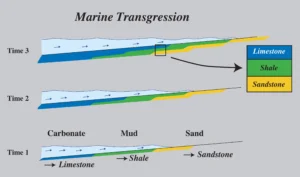
Marine transgression showing limestone, shale, and sandstone layers.

MMarine Transgression

A marine transgression occurs when sea level rises relative to the land, resulting in the flooding of coastal areas and the deposition of marine sediments over terrestrial sediments. Transgressions are significant in understanding changes in sea level, sedimentary environments, and the stratigraphic record. 

Reference: Catuneanu, O. (2006). “Principles of Sequence Stratigraphy.” Elsevier.
Share 

Open entry →
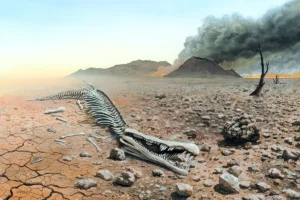
Dinosaur skeleton in a burning desert landscape (mass extinction)

MMass Extinction

A mass extinction is an event in which a significant percentage of all life on Earth becomes extinct over a relatively short geological time period. Mass extinctions are critical for understanding the history of life on Earth, the factors that can lead to widespread species loss, and the subsequent recovery and evolution of ecosystems. 

Reference: Raup, D. M., & Sepkoski, J. J. (1982). “Mass Extinctions in the Marine Fossil Record.” Science, 215(4539), 1501-1503. 

Share 

Open entry →
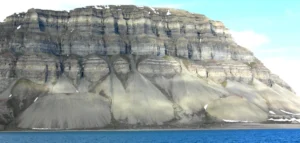
Layered cliffside mountain above blue Arctic water (Mass Wasting)

MMass Wasting

Mass wasting is the movement of soil, rock, and debris downslope under the influence of gravity. It includes processes such as landslides, rockfalls, and soil creep. Mass wasting is significant in shaping landscapes, influencing erosion rates, and contributing to the development of valleys and other landforms. 

Reference: Selby, M. J. (1993). “Hillslope Materials and Processes.” Oxford University Press.

Share 

Open entry →
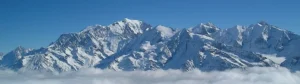
Snow-covered mountain peaks above clouds (Massif)

MMassif

A massif is a large, stable block of the Earth’s crust that is bounded by faults or flexures. Massifs are resistant to deformation and often form the core of mountain ranges. Studying massifs is important for understanding tectonic stability, the formation of mountain ranges, and the geological history of a region. 

Reference: Twiss, R. J., & Moores, E. M. (2007). “Structural Geology.” W. H. Freeman. 

Share 

Open entry →
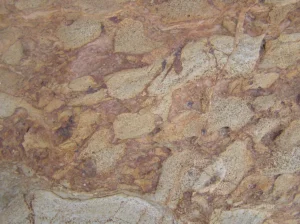
Close-up of textured sedimentary rock surface (Mélange)

MMélange

A mélange is a chaotic mixture of rocks of different types and ages, often found in subduction zones and formed by the mixing of sediments, oceanic crust, and mantle material during tectonic processes. Mélanges are important in understanding the processes of subduction, accretion, and tectonic mixing. 

Reference: Cowan, D. S. (1985). “Structural Styles in Mesozoic and Cenozoic Mélanges in the Western Cordillera of North America.” Geological Society of America Bulletin, 96(4), 451-462. 

Share 

Open entry →
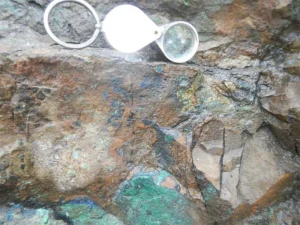
Mineral rock sample with magnifying glass (Metallogenesis)

MMetallogenesis

Metallogenesis is the process by which mineral deposits, particularly metal ores, form in the Earth’s crust. This process involves the concentration of metals through various geological processes, such as magmatic, hydrothermal, and sedimentary. Understanding metallogenesis is crucial for mineral exploration and the extraction of valuable resources. 

Reference: Sawkins, F. J. (1990). “Metal Deposits in Relation to Plate Tectonics.” Springer.

Share 

Open entry →
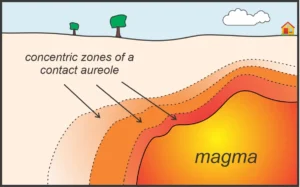
Diagram showing magma and contact aureole zones (Metamorphic Aureole)

MMetamorphic Aureole

A metamorphic aureole is a zone of metamorphic rock that forms around an igneous intrusion due to the heat and fluids emanating from the intrusion. The study of aureoles helps geologists understand the conditions of contact metamorphism and the interactions between igneous and surrounding rocks. 

Reference: Yardley, B. W. D. (1989). “An Introduction to Metamorphic Petrology.” Longman. 

Share 

Open entry →
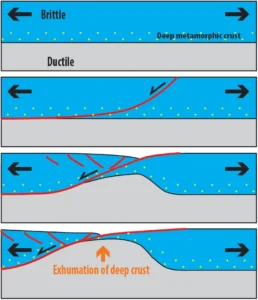
Diagram showing exhumation of deep metamorphic crust (Metamorphic Core Complex).

MMetamorphic Core Complex

A metamorphic core complex is a large, dome-shaped structure composed of high-grade metamorphic rocks that have been exposed at the Earth’s surface through extension and thinning of the crust. These complexes provide insights into the processes of crustal extension, exhumation of deep-seated rocks, and the evolution of mountain belts. 

Reference: Crittenden, M. D., Coney, P. J., & Davis, G. H. (1980). “Cordilleran Metamorphic Core Complexes.” Geological Society of America Memoir 153. 

Share 

Open entry →
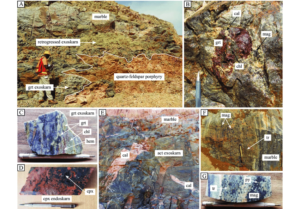
Field and hand samples of skarn rock formations (Metamorphic Differentiation)

MMetamorphic Differentiation

Metamorphic differentiation is the process by which compositional banding and mineral segregation occur in a rock during metamorphism. This process is important for understanding the development of gneissic textures, the formation of mineral deposits, and the metamorphic evolution of rocks. 

Reference: Ashworth, J. R. (1985). “Migmatites.” Chapman and Hall.

Share 

Open entry →
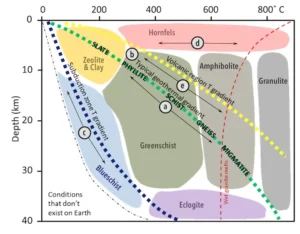
Metamorphic facies diagram showing temperature and depth gradients

MMetamorphic Facies

Metamorphic facies are groups of mineral assemblages that form under similar pressures and temperatures during metamorphism. Each facies corresponds to specific tectonic settings and helps geologists interpret the metamorphic conditions and the tectonic history of a region. 

Reference: Bucher, K., & Grapes, R. (2011). “Petrogenesis of Metamorphic Rocks.” Springer.

Share 

Open entry →
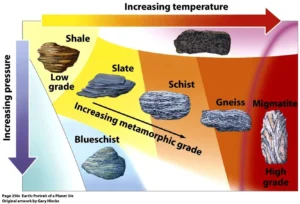
Metamorphic rock progression with increasing temperature and pressure (metamorphic grade)

MMetamorphic Grade

Metamorphic grade refers to the degree of metamorphism that a rock has undergone, typically indicated by the presence of specific mineral assemblages that form under particular temperature and pressure conditions. The concept of metamorphic grade is essential for understanding the thermal history and tectonic setting of metamorphic rocks. 

Reference: Bucher, K., & Grapes, R. (2011). “Petrogenesis of Metamorphic Rocks.” Springer. 

Share 

Open entry →
Diagram showing types of metamorphism in Earth's crust.

MMetamorphism

Metamorphism is the process by which rocks undergo physical and chemical changes due to variations in temperature, pressure, and the presence of chemically active fluids, without melting. This process forms metamorphic rocks and is significant in understanding the Earth’s crust’s evolution and tectonic activity. 

Reference: Yardley, B. W. D. (1989). “An Introduction to Metamorphic Petrology.” Longman. 

Share 

Open entry →
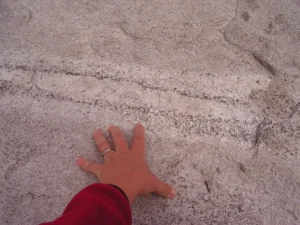
Hand touching ancient fossilized footprints on rock surface (Metasomatic Alteration)

MMetasomatic Alteration

Metasomatic alteration refers to the process by which a rock’s mineral composition is altered due to the introduction of new chemical components through fluid interactions. This alteration can lead to the formation of economically important mineral deposits and is key to understanding hydrothermal systems. 

Reference: Dale, J. (2011). “Fluid-Rock Interactions during Metasomatism.” Elements, 7(5), 315-320. 

Share 

Open entry →
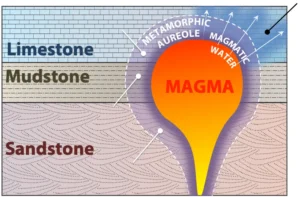
Magma heating limestone, mudstone, and sandstone layers diagram (Metasomatism).

MMetasomatism

Metasomatism is the process by which a rock’s chemical composition is altered through the introduction or removal of fluids. This process can lead to significant changes in mineralogy and texture and is important in the formation of ore deposits and the evolution of the Earth’s crust. 

Reference: Dale, J. (2011). “Fluid-Rock Interactions during Metasomatism.” Elements, 7(5), 315-320. 

Share 

Open entry →
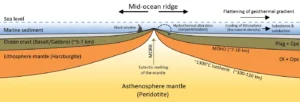
Mid-ocean ridge cross-section showing mantle and crust layers

MMid-Ocean Ridge

A mid-ocean ridge is an underwater mountain range formed by plate tectonics where new oceanic crust is created by volcanic activity as tectonic plates diverge. These ridges are key features of the ocean floor and are crucial in understanding seafloor spreading, plate tectonics, and the Earth’s geodynamics. 

Reference: Macdonald, K. C. (1982). “Mid-Ocean Ridges: Fine Scale Tectonic, Volcanic and Hydrothermal Processes within the Plate Boundary Zone.” Annual Review of Earth and Planetary Sciences, 10(1), 155-190. 

Share 

Open entry →
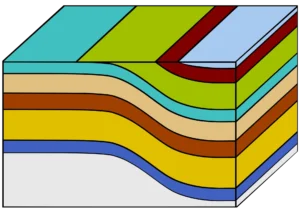
3D geological layers cross section diagram (monocline)

MMonocline

A monocline is a type of fold in rock layers where the strata are inclined in one direction, creating a step-like structure. Monoclines are often associated with faulting and are important in understanding structural geology, the formation of basins, and the tectonic history of an area. 

Reference: Stewart, J. H., Poole, F. G., & Wilson, R. F. (1972). “Stratigraphy and Origin of the Chinle Formation and Related Upper Triassic Strata in the Colorado Plateau Region.” USGS Professional Paper 690. 

Share 

Open entry →
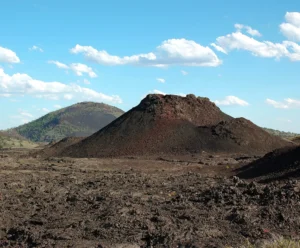
Volcanic cinder cone with surrounding lava field (Monogenetic Volcano)

MMonogenetic Volcano

A monogenetic volcano is a type of volcano that erupts only once, producing a small volcanic edifice such as a cinder cone, maar, or tuff ring. These volcanoes are important for understanding volcanic processes, the hazards they pose, and the nature of magma sources in various tectonic settings. 

Reference: Valentine, G. A., & Gregg, T. K. P. (2008). “Continental Basaltic Volcanoes—Processes and Problems.” Journal of Volcanology and Geothermal Research, 177(4), 857-873. 

Share 

Open entry →
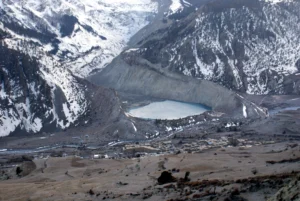
Frozen lake surrounded by snow-covered mountains (moraine)

MMoraine

A moraine is an accumulation of glacial debris (till) formed by the movement of a glacier. Moraines can be found in various forms, such as lateral, medial, and terminal, depending on their position relative to the glacier. They are important indicators of past glacial activity and are used to reconstruct the history of glaciation. 

Reference: Benn, D. I., & Evans, D. J. A. (2010). “Glaciers and Glaciation.” Routledge.

Share 

Open entry →
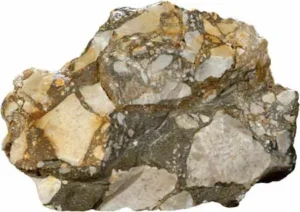
Close-up of a mud breccia sedimentary rock sample

MMud Breccia

Mud breccia is a sedimentary rock composed of angular fragments of mudstone or shale cemented together. It typically forms in tectonically active regions where mud is fractured and re-cemented due to faulting or other forms of deformation. Mud breccia provides insights into the geological history of deformation and sedimentation in an area. 

Reference: Potter, P. E., Maynard, J. B., & Depetris, P. J. (2005). “Mud and Mudstones: Introduction and Overview.” Springer. 

Share 

Open entry →
Cracked dry earth showing severe drought conditions (mud crack)

MMud Crack

Mud cracks are fractures that form in drying mud as it contracts. These features are preserved in sedimentary rocks and provide important evidence of past environmental conditions, such as periodic drying in wetland or shallow marine environments. They are often found in association with evaporite deposits. 

Reference: Boggs, S. (2009). “Petrology of Sedimentary Rocks.” Cambridge University Press. 

Share 

Open entry →
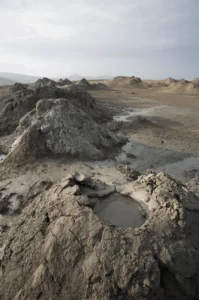
Small mud volcanoes in a barren landscape

MMud Volcano 

A mud volcano is a geological formation created by the expulsion of mud, water, and gases from the Earth’s subsurface, typically in areas of tectonic activity. Mud volcanoes are important for understanding the release of subsurface fluids, the dynamics of gas migration, and their potential as indicators of hydrocarbon reservoirs. 

Reference: Mazzini, A., & Etiope, G. (2017). “Mud Volcanoes as a Source of Energy: From Tectonics to Hydrocarbons.” Geoscience Frontiers, 8(6), 1477-1489. 

Share 

Open entry →
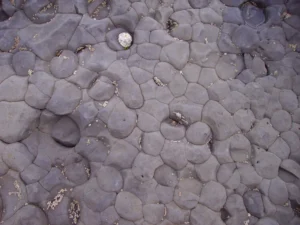
Smooth dark shoreline rocks scattered with barnacles (mudstone formation)

MMudstone

Mudstone is a fine-grained sedimentary rock composed primarily of clay and silt-sized particles. It is often formed in low-energy environments such as deep marine basins, lakes, and floodplains. Mudstone is significant in understanding depositional environments, the preservation of fossils, and the geochemical cycles of elements. 

Reference: Potter, P. E., Maynard, J. B., & Depetris, P. J. (2005). “Mud and Mudstones: Introduction and Overview.” Springer. 

Share 

Open entry →
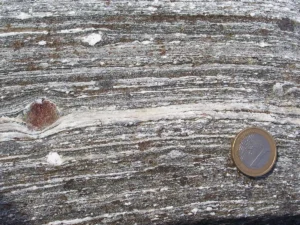
Banded gneiss rock with coin for scale (Mylonite)

MMylonite 

Mylonite is a fine-grained, foliated rock that forms in fault zones due to intense shearing and deformation. The study of mylonites is important in understanding the mechanics of faulting, the conditions of deformation in the Earth’s crust, and the evolution of tectonic boundaries. 

Reference: Passchier, C. W., & Trouw, R. A. J. (2005). “Microtectonics.” Springer. 

Share 

Open entry →
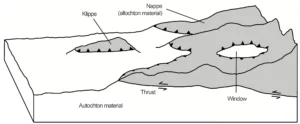
Geological diagram showing nappe, thrust, klippe, and window.

NNappe

A nappe is a large sheet-like body of rock that has been thrust over other rocks on a low-angle fault, often over great distances. Nappes are typically found in mountain ranges and are important in understanding the processes of continental collision, mountain building, and the structural geology of orogenic belts.

Reference: Suppe, J. (1985). “Principles of Structural Geology.” Prentice Hall.

Share 

Open entry →

join.me

Geology made clear, in your inbox.

Get clear, visual explainers on rocks, minerals, deep time, and the most fascinating parts of Earth science from Geoscopy.
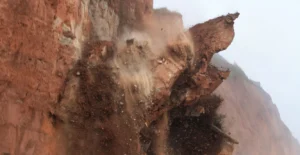
Large cliff collapsing during landslide

LArchives: Glossary

A landslide is the movement of rock, soil, or debris down a slope due to gravity. Landslides can be triggered by factors such as heavy rainfall, earthquakes, volcanic activity, or human activities. They are significant in understanding slope stability, erosion, and the risks associated with mountainous regions. 

Reference: Cruden, D. M., & Varnes, D. J. (1996). “Landslide Types and Processes.” In: Turner, A. K., & Schuster, R. L. (Eds.), Landslides: Investigation and Mitigation. Transportation Research Board Special Report 247. 

Share 

Open entry →