
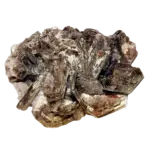
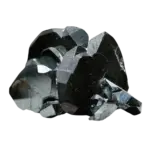
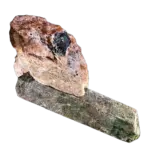
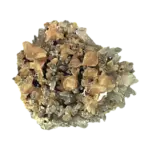
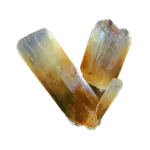

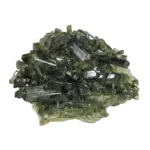
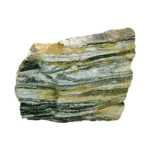
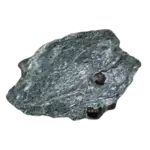
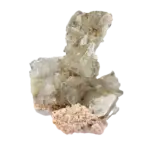

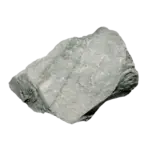
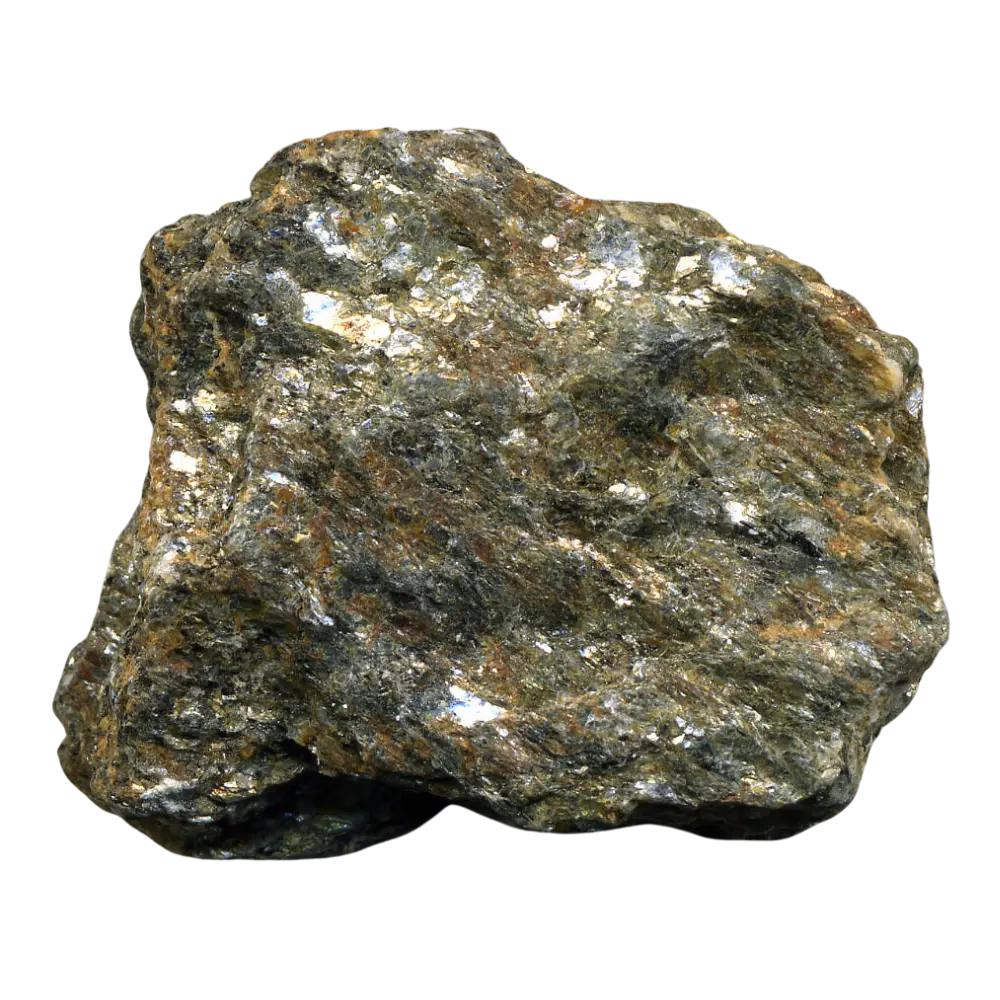
The Mica That Splits Into Sheets Thinner Than Paper
One of the earliest English descriptions of muscovite is written in verse. In 1568 George Turberville, secretary to Queen Elizabeth’s ambassador Thomas Randolph, was in Russia writing rhymed letters to friends in London, and he did not care for the place. The houses were built of logs chinked with moss, and a stove burned in every room. One detail impressed him anyway. The windows held no English glass. They were made, he wrote, “of slices of a rocke” that the Russians called sluda, cut thin and sewn together with thread like panes, and he conceded that no glass gave a better light.
Sluda is still the Russian word for mica. The rock in those windows came at first from Karelia, on the White Sea coast, where the monks of the Solovetsky Monastery ran some of the earliest workings, and by the sixteenth century it was leaving Russia as an export. English buyers called it Muscovy glass. Panes of it, cut into triangles and held in tinned iron strips for what was probably a ship’s lantern, have been excavated at Jamestown, Virginia. The modern mineral name is that trade name with a mineralogist’s ending attached.
Four and a half centuries later the same mineral lies under atomic force microscopes as one of the flattest surfaces a laboratory can buy. They also figure in an argument about what Earth’s crust looked like more than four billion years ago. This profile covers what muscovite is, how it is built, where it forms, how to recognise it, and what researchers still dispute.
What is muscovite?
Muscovite, often sold as muscovite mica, is the most common light-coloured mica: a potassium aluminium sheet silicate with the formula KAl₂(Si₃Al)O₁₀(OH)₂. It splits along a single perfect cleavage into thin, elastic sheets and scratches at about 2.5 on the Mohs scale. It occurs worldwide in granite, pegmatite, schist and gneiss.
Formally, muscovite is a dioctahedral true mica, and both adjectives have defined meanings. In 1998 the mica subcommittee of the International Mineralogical Association, chaired by Milan Rieder of Charles University in Prague, set out the rules. A mica counts as true when at least half of its interlayer cations carry a single positive charge, and as dioctahedral when fewer than 2.5 octahedral cations occupy each formula unit. The same report fixed the end-member composition, KAl₂(Si₃Al)O₁₀(OH)₂, which Mindat brackets as KAl₂(AlSi₃O₁₀)(OH)₂. The species is far older than the rulebook. Mindat lists it as approved and grandfathered, the status given to minerals that were already described before 1959, and records no type locality for it.
Mindat’s compilation of early usage lists Muscovy glass, cat silver, glimmer and the Latin lapis specularis, or mirror stone, among the older terms. The stand-alone word muscovite appears as early as 1794, in Johann Gottfried Schmeisser’s System of Mineralogy. Isinglass, the name stove-makers preferred, is recorded for the mineral from 1747. That word was borrowed from a gelatin prepared out of sturgeon bladders, which says something about how the sheets looked to people who had never heard of a silicate.
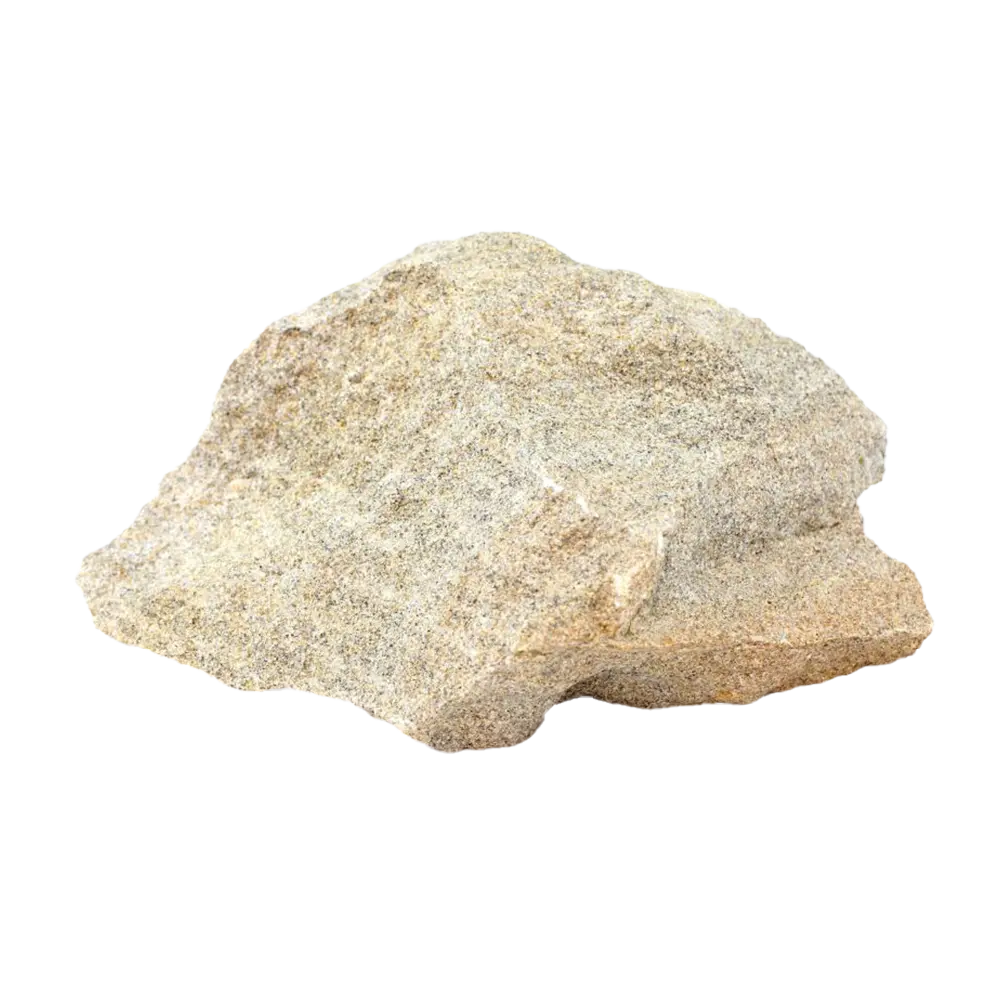
Field geologists often write white mica in their notebooks instead of a species name, and the caution is justified. Paragonite, the sodium counterpart, looks identical in a hand lens. So does phengite, the silica-rich relative that takes over in high-pressure rocks. Fine-grained sericite cannot be assigned to a species without an instrument. Muscovite is simply the most probable answer, because Mindat ranks it as the most common of all the micas. The U.S. Geological Survey counts 37 minerals in the group and singles out two of them, muscovite and phlogopite, as the ones of commercial importance.
Muscovite chemistry and crystal structure
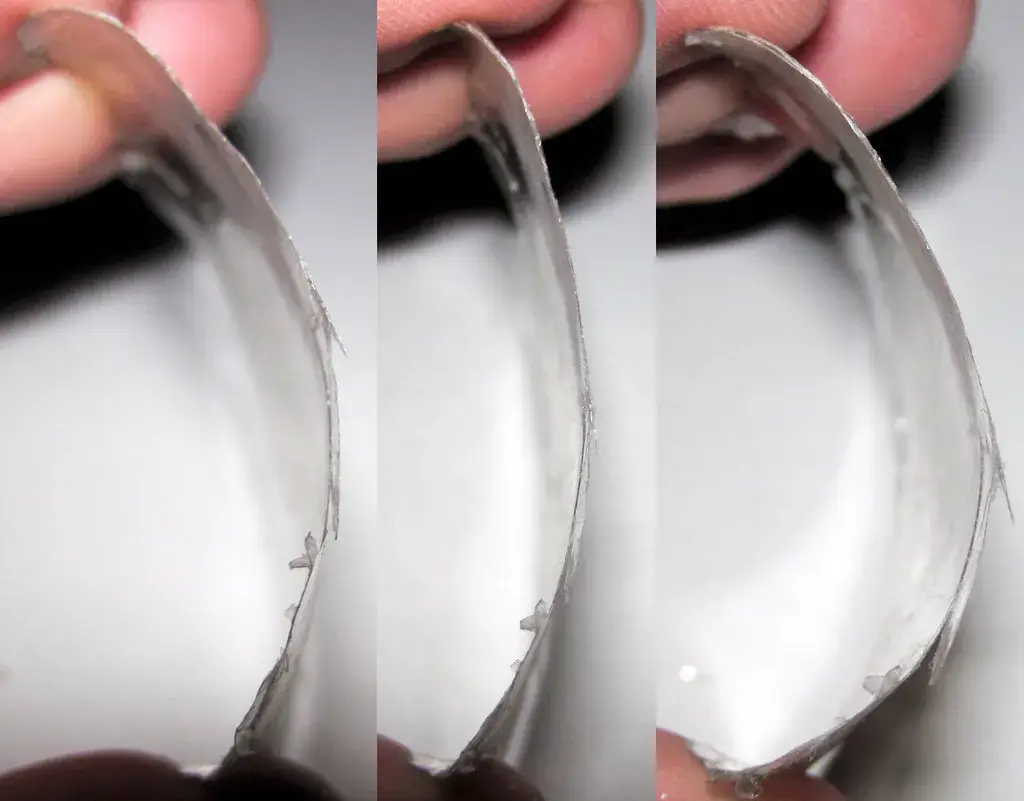
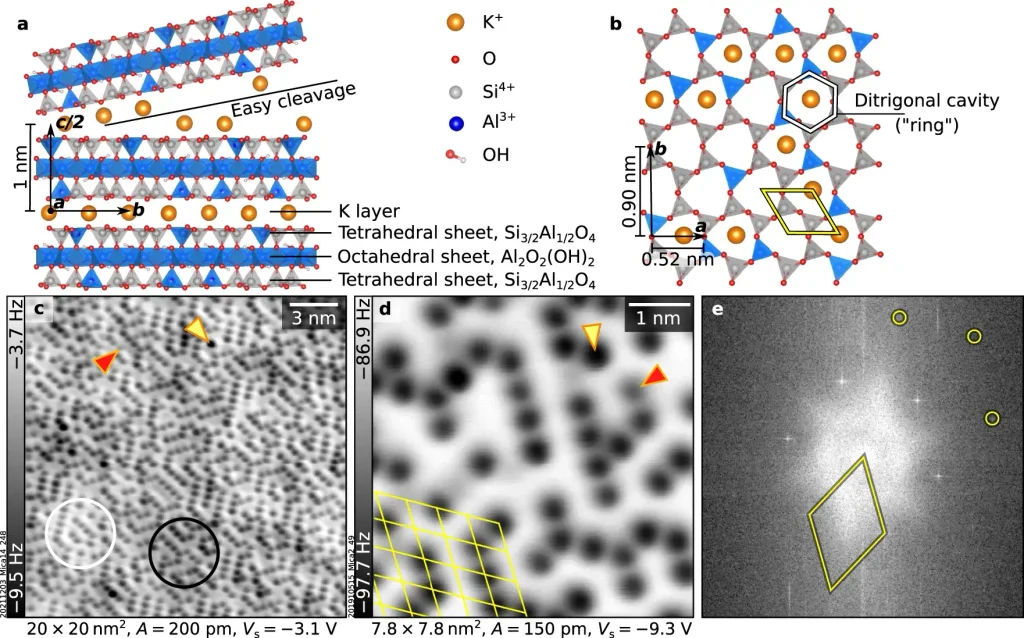
Picture a ream of paper in which every page is tough and the glue between pages is weak. That is muscovite at the atomic scale. Each page is an aluminosilicate layer less than a nanometre thick, built from silicon, aluminium, oxygen and hydroxyl joined by strong bonds. Between neighbouring pages lies a single plane of potassium ions, and the potassium holds on far more loosely than the bonds inside the layers do. Push a knife blade into the edge of a crystal and it finds a potassium plane every time. The crystal parts there, leaving half of the potassium on each new face, which keeps both surfaces electrically neutral.
The interlayer ion also controls how the sheets behave once they are free. The USGS notes that in the true micas, where the interlayer cation carries a single charge, cleavage sheets are tough and flexible. In the brittle micas the cation is divalent, usually calcium, and the stronger bonds across the interlayer make the sheets stiff enough to snap. Margarite belongs to that second family, which is why elasticity appears in every identification key for muscovite.
In crystallographic terms every layer is a T-O-T sandwich: two tetrahedral sheets facing each other across one octahedral sheet. In the tetrahedral sheets three quarters of the sites hold silicon and one quarter hold aluminium, the (Si₃Al) of the formula. Each tetrahedron shares three of its corners with its neighbours, which produces a mesh of six-membered rings that are slightly distorted from hexagonal and are described as ditrigonal. The octahedral sheet between them contains aluminium coordinated by oxygen and hydroxyl, with two of every three octahedral positions filled and the third left vacant. That vacancy is what dioctahedral means. Replacing one silicon in four with aluminium leaves each layer with a net negative charge, and one K⁺ ion seated in each ring cavity balances it. The IMA report gives the potassium a nominal twelve-fold coordination. The common form is monoclinic, point group 2/m, space group C2/c, with a = 5.19 Å, b = 9.04 Å, c = 20.08 Å, β = 95°30′ and four formula units in the cell. One of its two strongest X-ray powder lines sits at 10.0 Å, the repeat distance of one layer plus its potassium plane.
Linus Pauling worked out this architecture in 1930. Writing from the Gates Chemical Laboratory at Caltech in the Proceedings of the National Academy of Sciences, he proposed the layered arrangement for the micas and tied their cleavage to it. Later refinements changed details and left the scheme standing.
The layers can be stacked in more than one way, because each one may be rotated relative to the layer below it. The resulting polytypes share a composition and differ in symmetry. The two-layer monoclinic form, written 2M₁, is the most common. Mindat also records a one-layer monoclinic form, 1M, and a three-layer trigonal form, 3T. The Handbook of Mineralogy lists 1M too, and labels its three-layer polytype 3A. The IMA report allows the symbol to be added as a suffix once the stacking has been determined, as in muscovite-3T.
Natural crystals never match the ideal formula exactly: For example an analysis of muscovite from Blue Mountain in Methuen Township, Ontario, beside the theoretical composition. The ideal mineral holds 45.26 weight per cent SiO₂, 38.40 per cent Al₂O₃, 11.82 per cent K₂O and 4.52 per cent H₂O. The Ontario sample carries 10.08 per cent K₂O, with 0.64 per cent Na₂O making up part of the difference and 0.10 per cent MgO sitting in the octahedral sheet. Sodium in the interlayer moves the composition toward paragonite. Magnesium or iron in the octahedral sheet, balanced by extra silicon in the tetrahedra, moves it toward phengite. Chromium or vanadium replacing octahedral aluminium turns the crystal green. Fluorine can take the place of hydroxyl, which is why the Handbook writes the anion group as (OH,F)₂. Rubidium, caesium, barium and lithium all enter in rare-metal pegmatites, and the IMA allows a modifier such as rubidian once an element fills more than a tenth of its site. Ammonium can replace potassium as well. Vincent Busigny and colleagues showed in Chemical Geology in 2003 that infrared spectroscopy can measure it, which matters to anyone tracing nitrogen through metamorphic rocks.
One question about the structure stayed open for decades: how the aluminium is distributed among the tetrahedral sites. X-rays scatter from aluminium and silicon almost identically, so diffraction cannot tell them apart. In 2023 Giada Franceschi and colleagues in Ulrike Diebold’s group at TU Wien approached the problem from the surface. They cleaved muscovite in ultra-high vacuum and cooled it to 4.7 K. Then they imaged the potassium ions left behind with a non-contact atomic force microscope. The ions sat on a lattice with a spacing of 0.52 nm and covered 47.8 per cent of the available sites, close to the expected half. They were neither random nor fully ordered. They formed short alternating rows averaging about 3.5 ions in length, often joined by 120° kinks. Density functional calculations and Monte Carlo simulations showed that the pattern follows the aluminium in the sheet beneath, since a K⁺ ion prefers a ring that contains two aluminium atoms. The cleaved face therefore records the ordering of the sheet beneath it.
Physical properties of muscovite
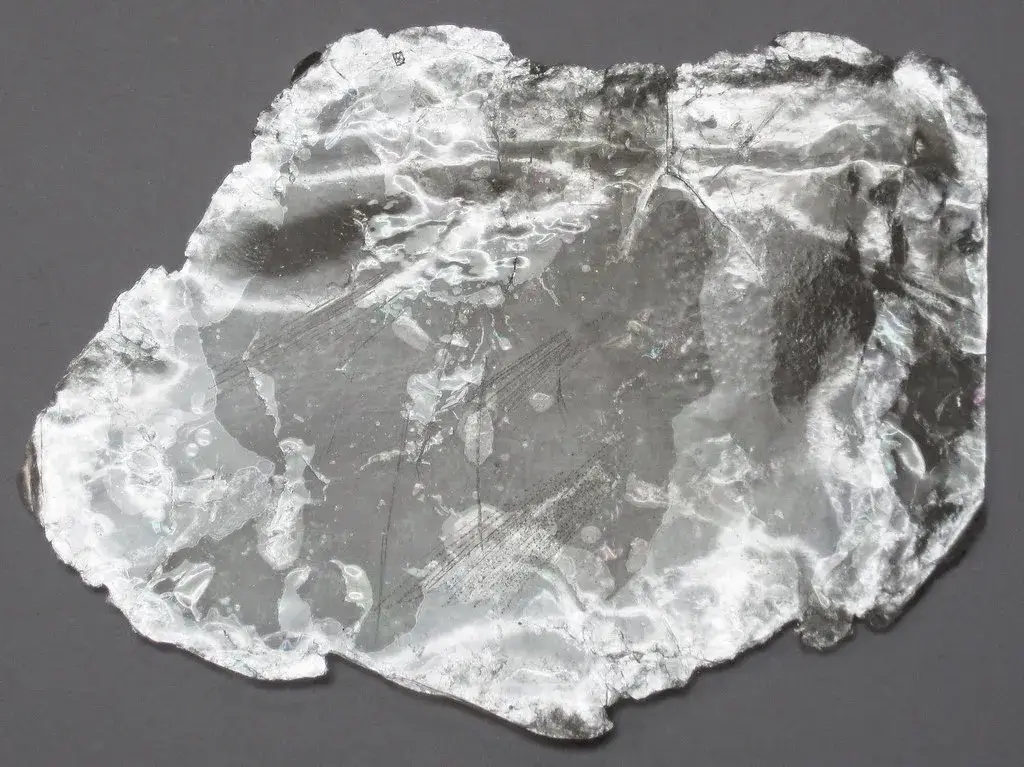
Hardness depends on direction. The two extremes are 2.5 and 4. The low value is the one met on the cleavage face, where a fingernail sits right at the threshold, and the high value is met across the edges of the sheets. Measured specific gravity runs from 2.77 to 2.88, against a calculated density of 2.83 g/cm³. Cleavage on {001} is perfect, with partings on {110} and {010}, and the laminae are flexible, elastic and tough. A bent sheet returns to flat, a behaviour that chlorite and the brittle micas do not share.
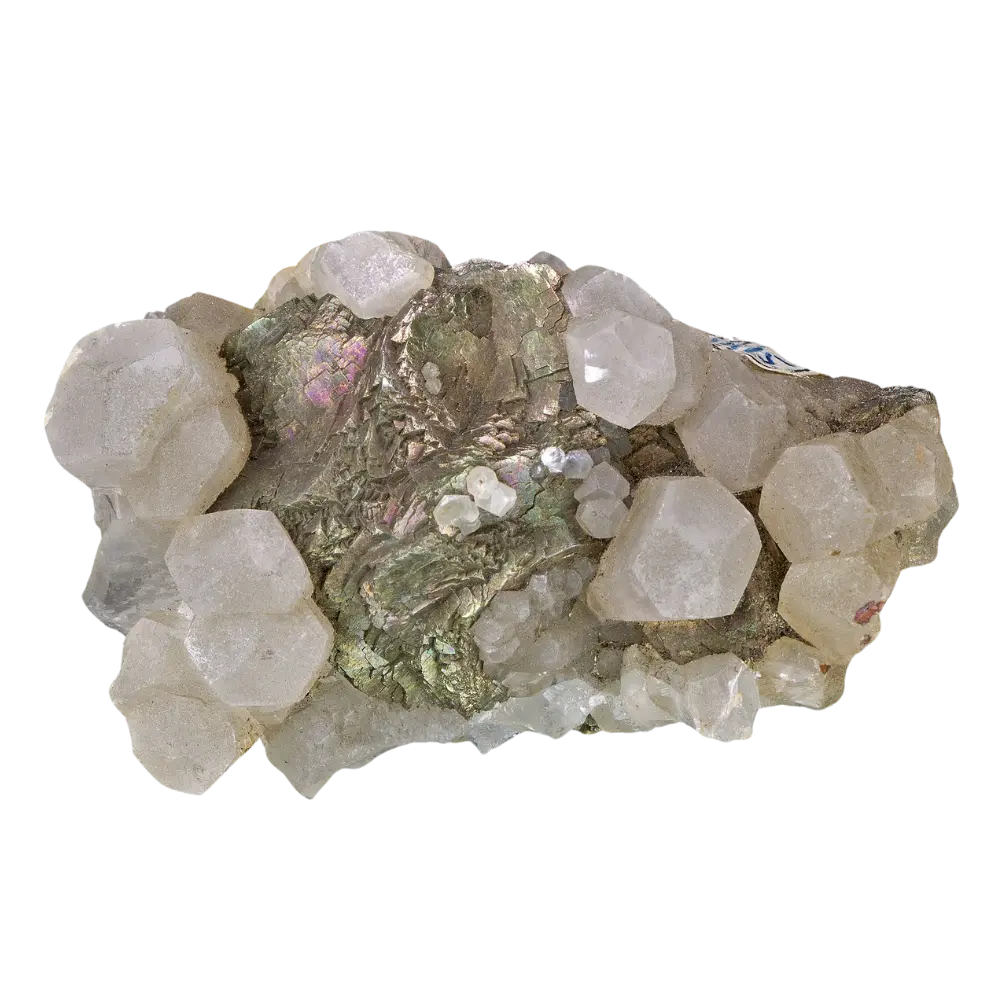
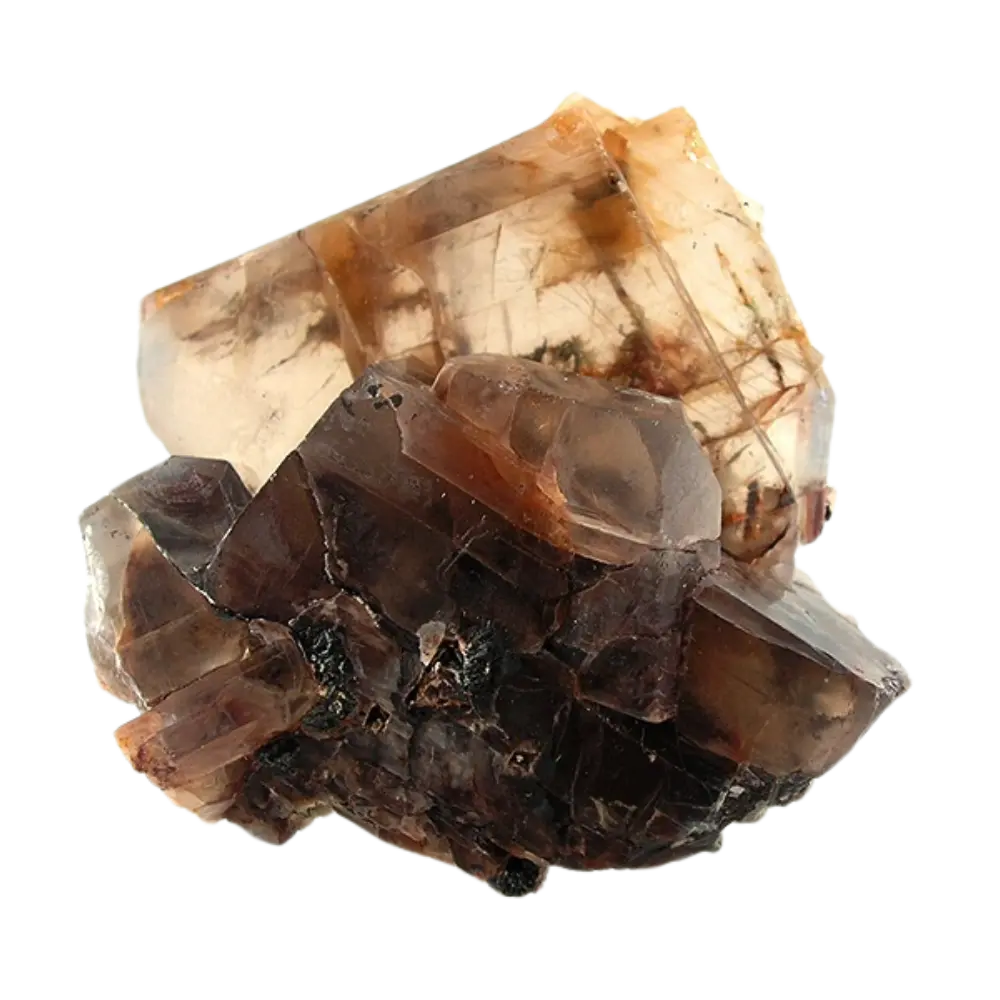
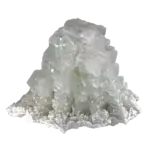
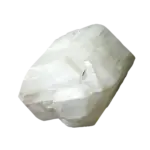
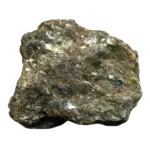
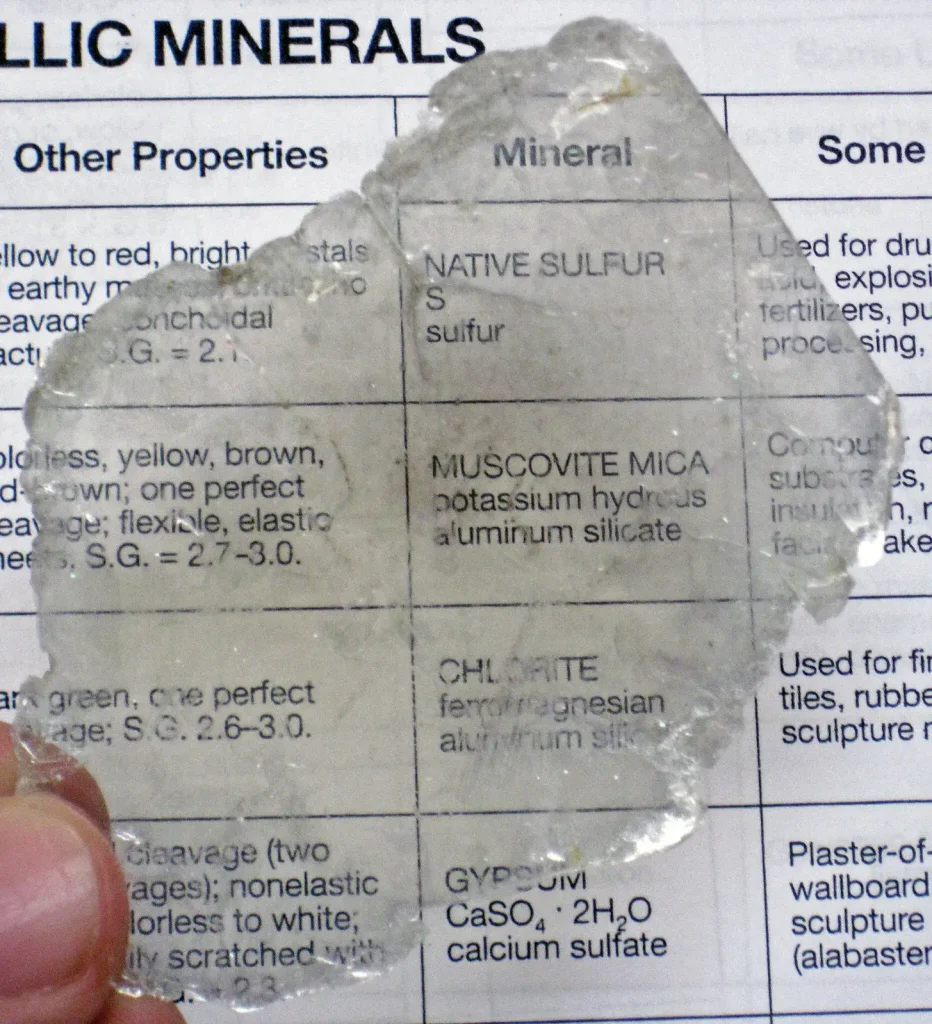
Lustre is vitreous on fresh crystal faces and turns pearly or silky on cleavage surfaces. The streak is white. Thin sheets are transparent and colourless, while thicker books look silvery, grey, pale brown, green, yellow or rose-red. Where the cause of colour has been pinned down it is a trace metal in the octahedral sheet. Mindat attributes the green of fuchsite to trivalent chromium replacing aluminium and notes that trivalent vanadium can produce green as well. George Rossman’s mineral spectroscopy pages at Caltech assign the red of Brazilian muscovite to manganese in the 3+ state. Crystals are tabular to columnar with a diamond-shaped or pseudohexagonal outline, and some sources record examples to 4.5 m and 77 tonnes. Far more often the mineral forms scaly, plumose, granular or compact masses. Twinning on the mica law, with {001} as the composition plane and [310] as the twin axis, produces star-shaped groups, which some sources describe as six-pointed.
Under the microscope muscovite is biaxial negative. Refractive indices are α = 1.552 to 1.576 and β = 1.582 to 1.615. The third index, γ, runs from 1.587 to 1.618, and the measured 2V lies between 30° and 47°. That gives a maximum birefringence of 0.035 to 0.042. In a standard 30 µm section that is enough for bright second-order interference colours. Grains are colourless in plane-polarised light, and only tinted varieties show weak pleochroism. Extinction is close to parallel with the cleavage traces, and it comes with a speckled, shimmering texture that petrographers call bird’s-eye extinction.
Two further properties explain most of the industrial demand. The first is thermal stability. Stephen Guggenheim and colleagues at the University of Illinois at Chicago heated single crystals from the Diamond mine in South Dakota on a diffractometer and reported in 1987 that the lattice expanded smoothly up to about 850 °C. Only near that temperature did the structure lose its hydroxyl and convert to a dehydroxylated phase. The second is electrical. The TU Wien group cites a band gap of 7.85 eV for muscovite, which places it among the wide-gap insulators. The USGS summary of the commodity describes mica sheets as dielectric, chemically inert, lightweight and hydrophilic, and as stable when exposed to electricity, light, moisture and extreme temperatures.
| Property | Muscovite |
|---|---|
| Formula (IMA end-member) | KAl₂(Si₃Al)O₁₀(OH)₂ |
| Classification | Phyllosilicate, mica group, dioctahedral true mica; Nickel-Strunz 9.EC |
| Crystal system and space group | Monoclinic, 2/m, C2/c (2M₁ polytype); 1M and 3T polytypes known |
| Unit cell (2M₁) | a 5.19 Å, b 9.04 Å, c 20.08 Å, β 95°30′, Z = 4 |
| Mohs hardness | 2.5 on the cleavage face, about 4 across the sheet edges |
| Specific gravity | 2.77 to 2.88 measured; 2.83 g/cm³ calculated |
| Cleavage and tenacity | Perfect on {001}; sheets flexible and elastic |
| Lustre and streak | Vitreous to pearly or silky; white streak |
| Colour | Colourless, silvery, grey, brown, green, yellow, rose-red |
| Optics | Biaxial (−); α 1.552 to 1.576, β 1.582 to 1.615, γ 1.587 to 1.618; 2V 30° to 47°; δ 0.035 to 0.042 |
How muscovite forms
The Handbook of Mineralogy compresses the occurrence of muscovite into two sentences. It is a common rock-forming mineral in phyllites, schists and gneisses, and in granites, granite pegmatites and aplites. It also forms from other minerals under hydrothermal conditions, and it may be detrital or authigenic in sediments. Few silicates occur in so many settings. What the settings share is available potassium and water, together with more aluminium than the feldspars can take up.
In metamorphic rocks
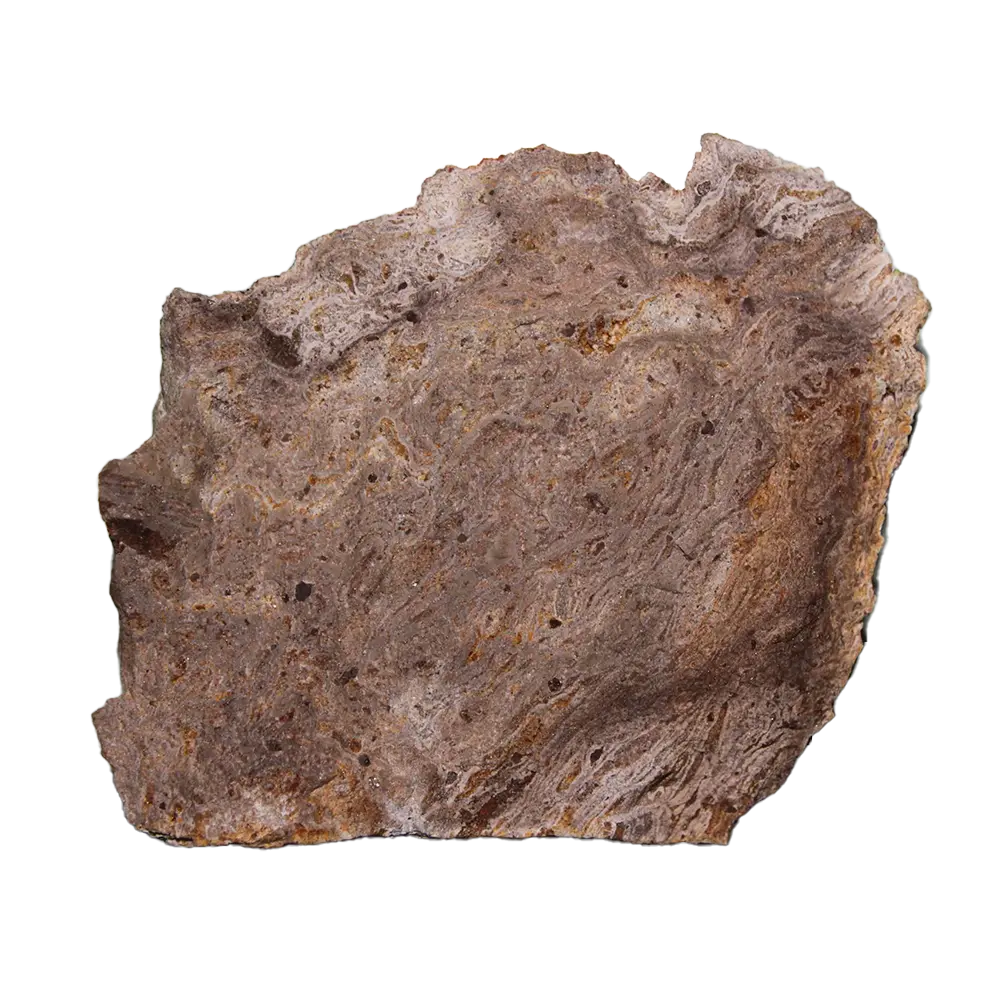
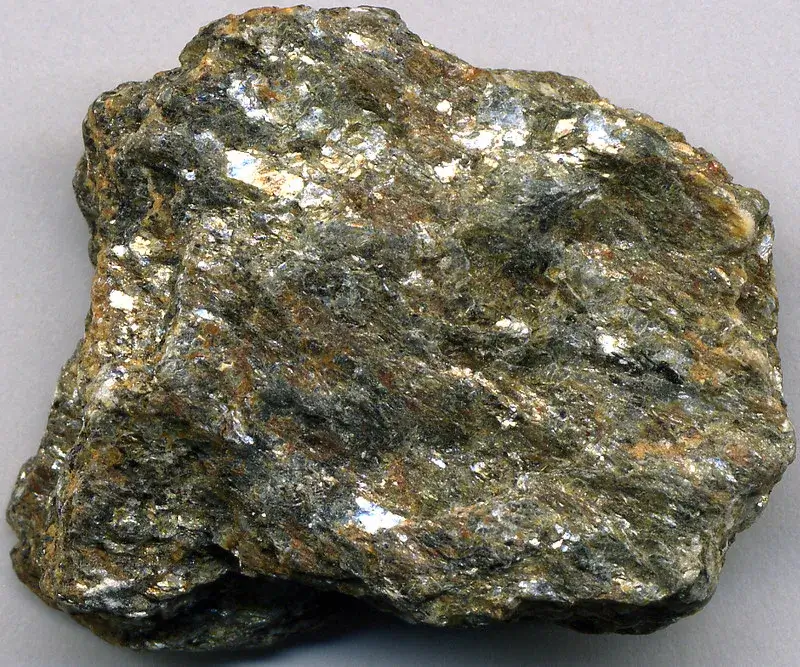
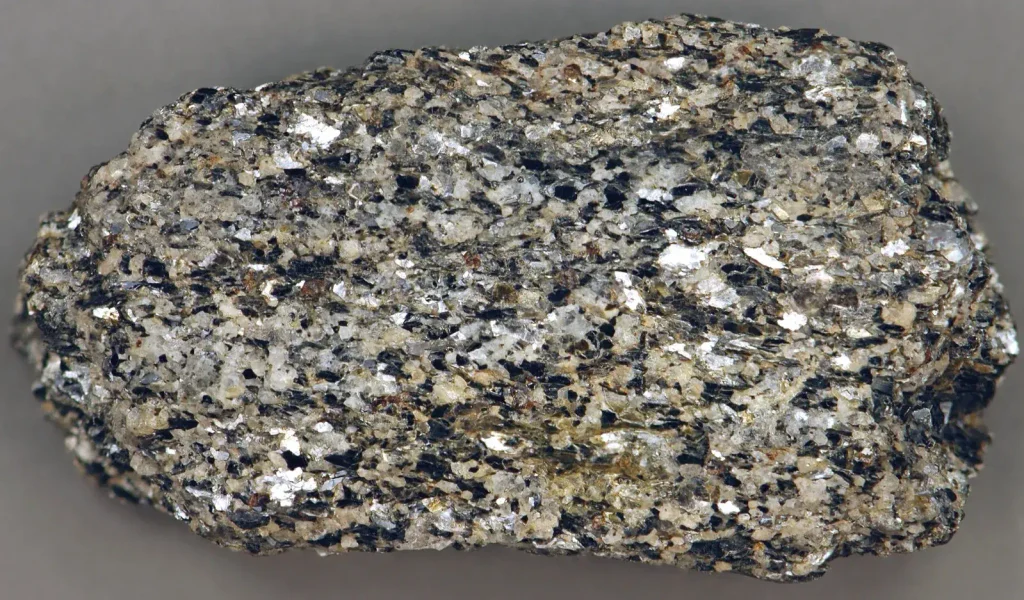
Much of the muscovite in the crust began as clay. When mud is buried and heated, its illite and other fine aluminous clays recrystallise step by step into larger, better ordered flakes of mica. The rock passes from shale through slate and phyllite to schist as the flakes coarsen, and the sheen on a phyllite surface is the first sign of the new mica that is visible without a lens. By the time the rock is a schist the flakes are millimetres across and aligned, which gives the rock its foliation and its glitter in sunlight.
In the classic Barrovian sequence of the Scottish Highlands, white mica is present in every zone from chlorite to sillimanite, which makes it one of the longest-lived minerals in the history of a metamorphosed mudstone. Its composition shifts along the way. High-pressure experiments show the silicon-rich celadonite component falling as temperature rises, so the mica of a high-grade schist lies closer to the ideal formula than the mica of a slate.
Muscovite has an upper limit, and petrologists use it as a marker. In quartz-bearing rocks it reacts with quartz to produce K-feldspar and an aluminosilicate such as sillimanite, releasing water as it does so. Niranjan Chatterjee and Wilhelm Johannes calibrated the thermal stability of synthetic 2M₁ muscovite in a 1974 study in Contributions to Mineralogy and Petrology that is still a basis for the thermodynamic data on this reaction. Most calibrations place it between roughly 600 and 700 °C across the pressure range of the middle crust. The isograd it defines in the field, where muscovite disappears and K-feldspar joins sillimanite, marks the transition into the highest grades of regional metamorphism. Sodium-rich white mica breaks down earlier. Chatterjee’s 1970 experiments put the breakdown of paragonite at 530 to 550 °C at 1 kbar (0.1 GPa) and at 650 to 670 °C at 7 kbar (0.7 GPa), and he pointed out that this lower limit explains why paragonite is missing from many high-grade rocks in which muscovite survives.
When no free water is present, the breakdown of muscovite produces melt instead of vapour. Alberto Patiño Douce of the University of Georgia and Nigel Harris of the Open University tested this in 1998 on the rocks most likely to have fed the Himalayan leucogranites: a muscovite schist and a two-mica schist from the hanging wall of the Main Central Thrust. They ran experiments at pressures from 6 to 10 kbar and temperatures between 700 and 900 °C. Dehydration melting began at 750 to 800 °C, and the melts it produced were nearly identical in composition to the natural granites. The authors concluded that the Himalayan magmas formed at 6 to 8 kbar (0.6 to 0.8 GPa) and 750 to 770 °C as the rocks decompressed. Their solidus for muscovite schist had a gentler pressure-temperature slope than the one for biotite schist, so a muscovite-rich rock rising through the crust melts more readily. The pale granites along the crest of the Himalaya are, in large part, what the local muscovite turned into.
In granites and pegmatites
Igneous muscovite is a chemical indicator. Calvin Miller and colleagues wrote in The Canadian Mineralogist in 1981 that white mica is the most common mineralogical indicator of a strongly peraluminous magma, one holding more aluminium than its feldspars can absorb. Such magmas usually come from melted sediments, and the granites they produce commonly carry muscovite and biotite side by side. Miller’s group also addressed how deep a granite must crystallise for muscovite to grow directly from the melt. Experiments had led to a commonly quoted minimum of about 3 kbar (0.3 GPa), equivalent to roughly 11 km, and the paper examined plutons that seemed to have crystallised at shallower levels than that. Its lasting contribution was chemical. Primary muscovite that grew from melt is richer in titanium and sodium than secondary muscovite that replaced feldspar after the granite had solidified. It also holds more aluminium and less magnesium and silicon. Petrographers still use that contrast alongside texture when they decide which of the two they are looking at.
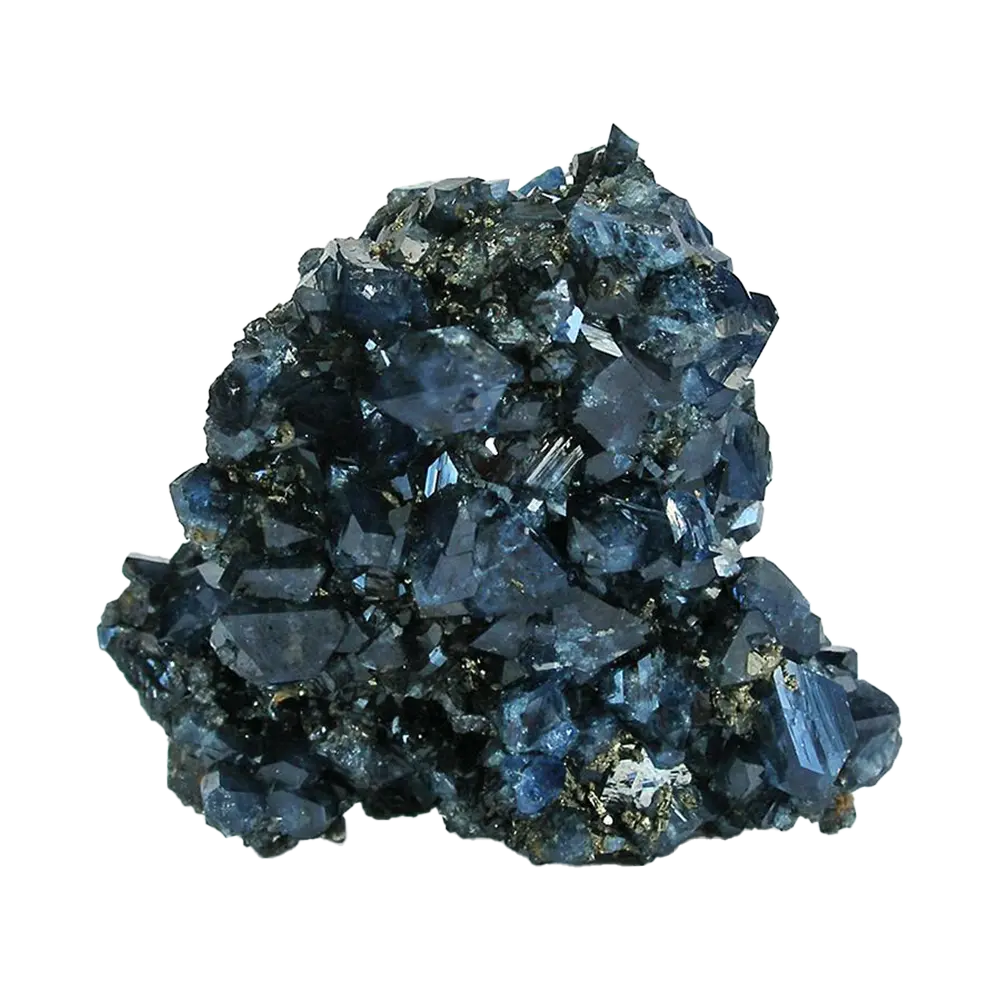
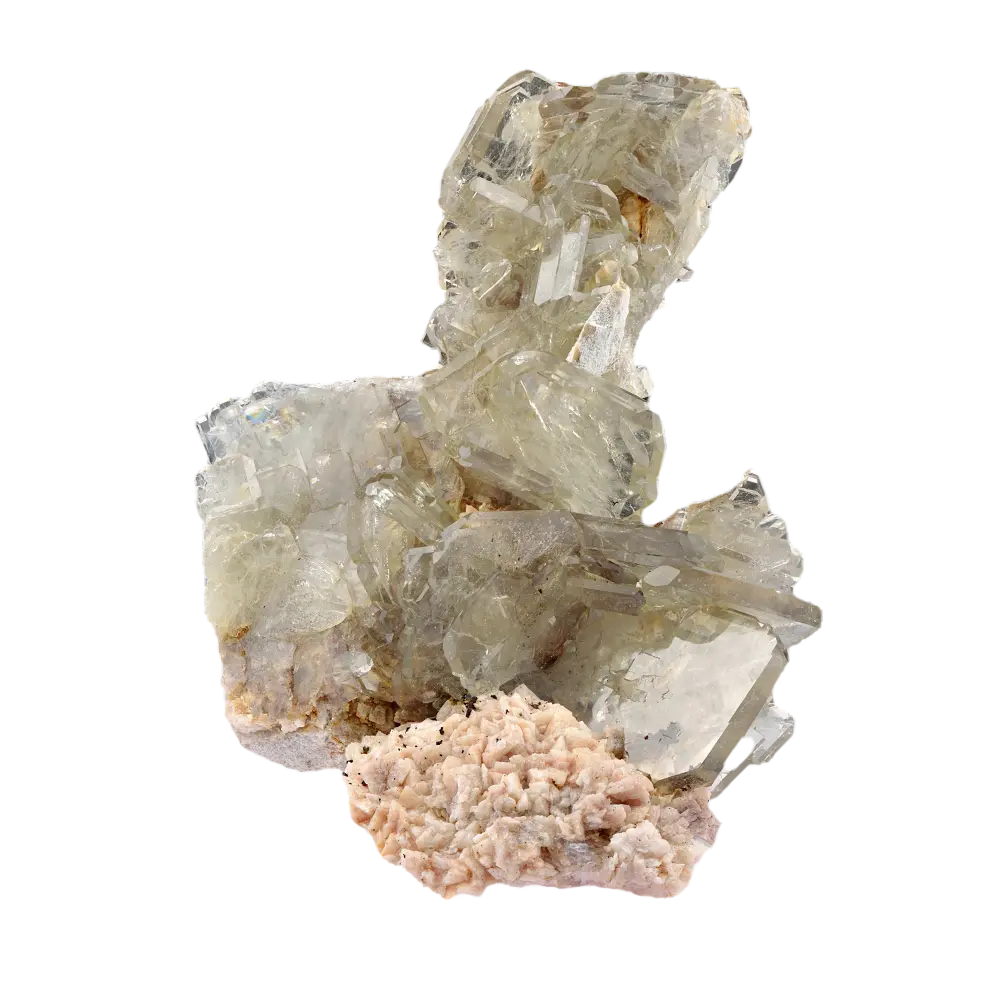
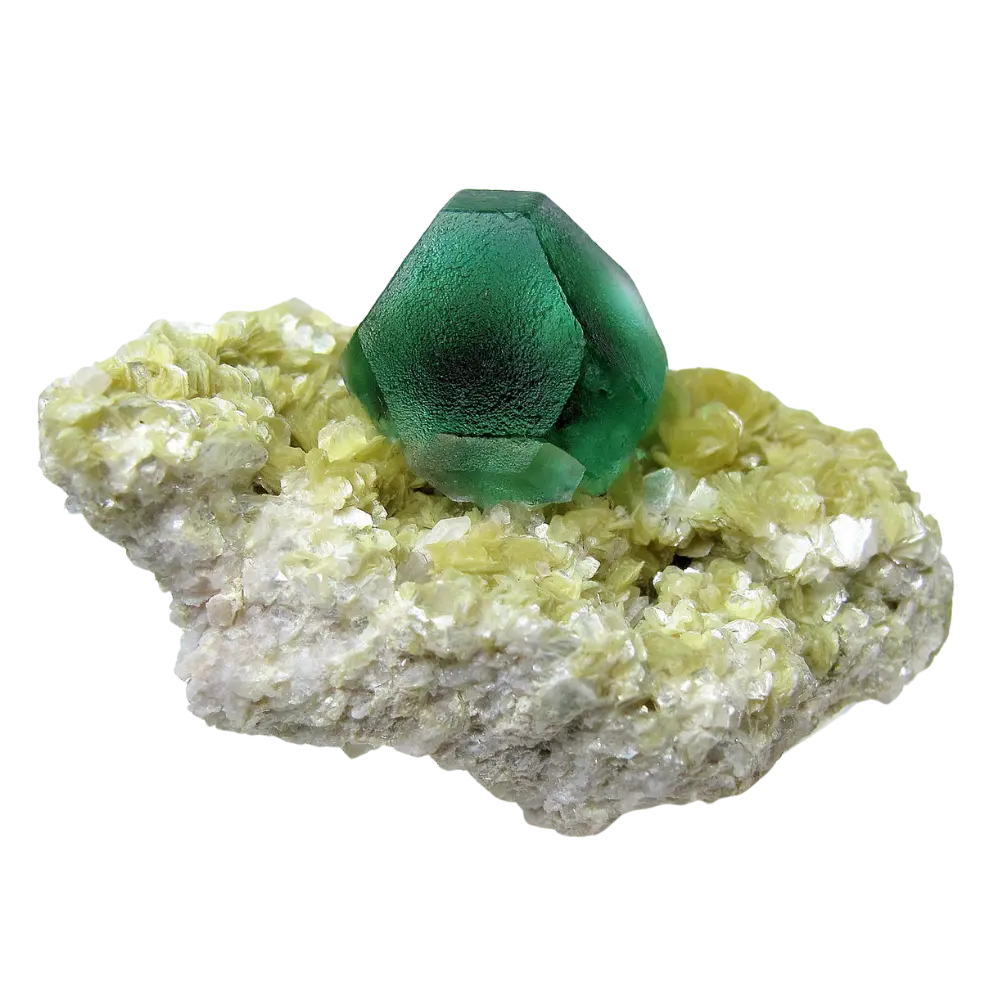
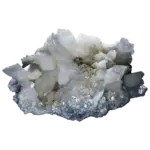
Pegmatites are where muscovite grows large. These coarse bodies crystallise from the last water-rich fractions of granitic melt, and their mica comes in thick pseudohexagonal crystals that miners call books. The largest reported example came from the Inikurti mine near Nellore in Andhra Pradesh, India. Peter Rickwood’s 1981 survey of record crystals in American Mineralogist gives its dimensions as 4.57 m by 3.05 m and credits it with 85 tons of muscovite, about 77 tonnes. Rickwood also recorded a crystal found by Justin Purdy in Ontario in 1943 that yielded clear sheets more than 2.4 m long, one of which went to the Royal Ontario Museum in Toronto. He cited Tom Barth’s reports of mica flakes 2 to 3 m across in the pegmatites around Evje and Iveland in southern Norway. The usual companions are quartz, plagioclase, potassic feldspar, biotite, tourmaline and topaz. Mindat’s photo database shows the collector’s view of the same association: muscovite appears most often with quartz and albite, and then with aquamarine, fluorite, fluorapatite and spessartine.
Muscovite also records how far a pegmatite melt has evolved. Rubidium follows potassium into the mica, and the K/Rb ratio falls as crystallisation proceeds. Lithium and caesium rise over the same interval. Exploration geologists now read those trends as a guide to which pegmatites might carry lithium ore.
From hydrothermal fluids and in sediments
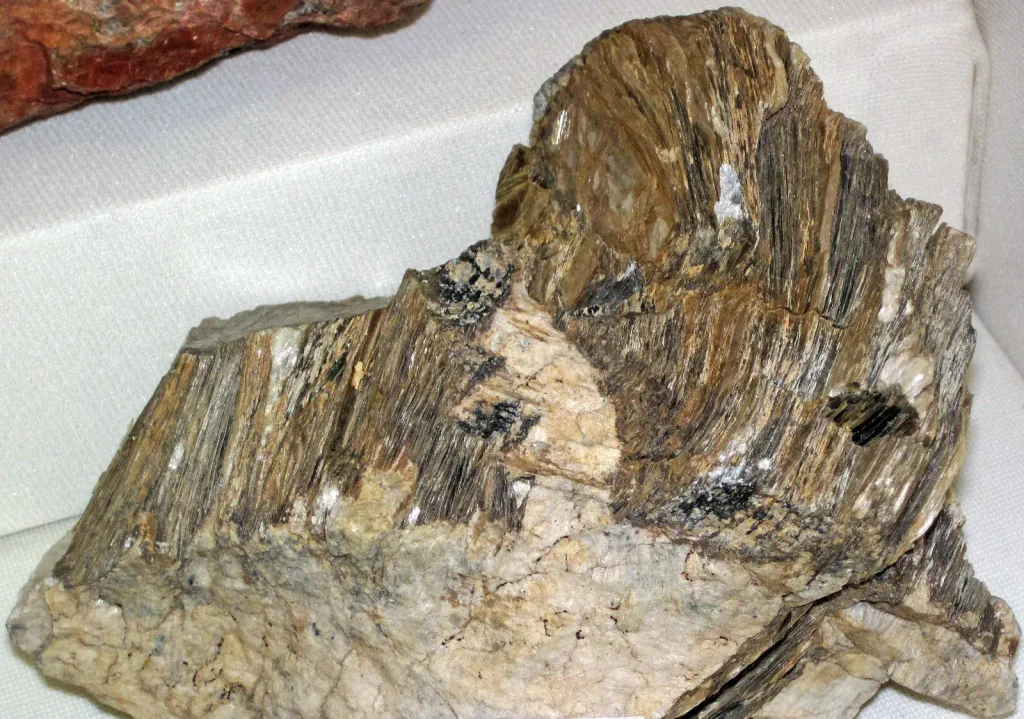
Hot, slightly acidic water turns feldspar into fine-grained muscovite. The product is usually called sericite, which Mindat defines as a fine-grained white to pale green mica that is mainly muscovite and only rarely paragonite. The replacement can be complete. Mindat’s list of varieties includes a miner’s term, pig’s egg, for sericite that has taken the shape of an orthoclase crystal in kaolinised granite, along with liebenerite for muscovite that has replaced nepheline. Sericite-rich rock has economic uses of its own. The USGS reports that American scrap mica is recovered mainly from mica and sericite schist, and as a by-product of feldspar and kaolin production.
Hydrothermal white mica can be mapped from a distance because of the way it absorbs infrared light. The USGS spectral library entry for a muscovite from Effingham Township, Ontario, records hydroxyl absorption bands at 1.4 µm and between 2.2 and 2.6 µm. Field spectrometers and airborne imaging spectrometers work at those wavelengths, and that is the basis for mapping altered ground by its mica.
At the surface muscovite outlasts most of the minerals it formed with. Flakes weathered out of granite and schist travel with sand and silt and settle flat on bedding planes, where they give many sandstones and siltstones a faint sparkle. The Handbook’s phrase for this is that muscovite may be detrital or authigenic: carried in as grains in the first case and grown in place during burial in the second. Either way the mica in a sediment is the raw material for the next metamorphic cycle.
In subduction zones
Under high pressure muscovite changes composition. Magnesium and iron enter the octahedral sheet, and silicon rises above three atoms per formula unit to keep the charges balanced. The IMA report of 1998 made phengite the series name for these solid solutions, which run from muscovite toward the celadonite minerals, and Mindat draws the line at more than 3.1 silicon atoms per formula unit. The silicon content turned out to be a pressure gauge. Building on Bruce Velde’s work of 1965, Hans-Joachim Massonne and Werner Schreyer of the Ruhr University Bochum synthesised white micas together with K-feldspar, phlogopite, quartz and excess water at fluid pressures up to 24 kbar (2.4 GPa). They reported in 1987 that silicon climbs almost linearly with pressure and falls only moderately with temperature. The most siliceous phengite they grew, near 3.8 silicon atoms per formula unit, became stable close to 20 kbar. Much of the phengite barometry applied to blueschists and eclogites since then builds on that calibration.
The same mineral carries water and potassium far into the mantle. The ideal formula holds 4.52 weight per cent water as hydroxyl, about 45 kg in every tonne of mica, and that water stays in the structure until the mica breaks down. Max Schmidt, now at ETH Zurich, ran experiments on subducted basalt and sediment compositions and published the results in Science in 1996. Phengite proved to be the principal host of potassium below the solidus, and it stayed stable to depths of about 300 km. Along the way it can release potassium-rich fluids or melts, which Schmidt proposed as one of the main agents that modify the mantle source of arc magmas. Some of the potassium in an andesite may have been carried down inside a white mica.
Notable muscovite localities
Muscovite has no type locality, and Mindat holds records of it from more than 25,000 places. The Handbook of Mineralogy remarks that good euhedral crystals are nonetheless uncommon. The localities that matter fall into two groups: the pegmatite districts that supplied sheet mica to industry, and the smaller number of sites that produce fine crystals for collectors.
India leads the first group. The pegmatites around Nellore in Andhra Pradesh, source of the Inikurti crystal, are described in in literature as commercial deposits that may contain huge crystals. In Russia some literature cite Slyudyanka, near the southern end of Lake Baikal in Siberia, and Mursinka in the Ural Mountains. The Karpinsky Russian Geological Research Institute in St Petersburg traces the older history. Mica was used for windows in Russia from the fifteenth century and was first worked in Karelia on the White Sea coast. Deposits in several parts of Siberia were found in the middle of the seventeenth century. The institute’s museum displays a mica window from a seventeenth-century chapel. In southern Norway literature names Kragerø and Bamble.
North America has a long list. In Canada some sources gives Methuen and Calvin Townships in Ontario, and Rickwood’s record sheet came from the Purdy mica mines in the same province. In the United States the entries are Mount Mica near Paris in Oxford County, Maine; Pennsbury in Chester County, Pennsylvania, known for large crystals; Amelia in Virginia; and Shelby in Cleveland County, North Carolina, known for fine ones. The Handbook adds the Black Hills of South Dakota, where it names three separate counties, and the Harding mine near Dixon in Taos County, New Mexico. Mindat’s short list of significant localities includes Spruce Pine in Mitchell County, North Carolina, and Keystone in the Black Hills, together with the Connecticut pegmatites at Branchville and at the Strickland quarry in Portland. The Ruggles mine at Grafton, New Hampshire, began as a muscovite mine in the early nineteenth century and later operated as a tourist site. The geologist James St. John, whose photographs illustrate much of this article, describes its pegmatite as Devonian and as one of several in the Grafton field.
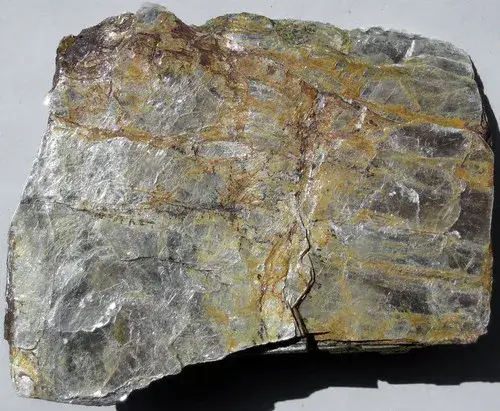
Brazil supplies most of the specimens in display cabinets. The Handbook cites Minas Gerais and names the Taquaral mine at Itinga and the José Pinto pegmatite at Jaguaraçu, near Coronel Fabriciano. Mindat adds that especially fine star muscovite, in which the crystals form star-shaped groups, comes from pegmatites in the Jenipapo district of the same state. In Switzerland, Mindat’s significant localities include Mont Chemin above Martigny in Valais. The Panasqueira tungsten mine in Portugal supplied one of the crystals that Guggenheim’s group heated in their 1987 study.
The ages recorded from these places span most of Earth history. Mindat’s table of dated muscovite runs from 2,890 Ma at the Wodgina tantalite mine in Western Australia, measured by the rubidium-strontium method, to between 15.2 and 13.4 Ma at Jas Roux in the Hautes-Alpes of France, measured by potassium-argon. The microscopic muscovite grains enclosed in detrital zircons from the Jack Hills of Western Australia may be older still, if they are as old as the zircons around them. That is disputed.
Muscovite varieties and relatives: fuchsite, sericite, phengite
Mindat lists more than thirty named varieties of muscovite. Most are nineteenth-century labels for a particular colour or texture, and none of them has species status. A handful remain in daily use, and the boundary between muscovite and its nearest relatives deserves as much attention as the varieties do.
Fuchsite and the green micas
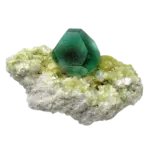
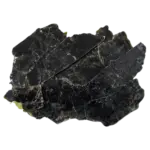
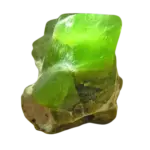
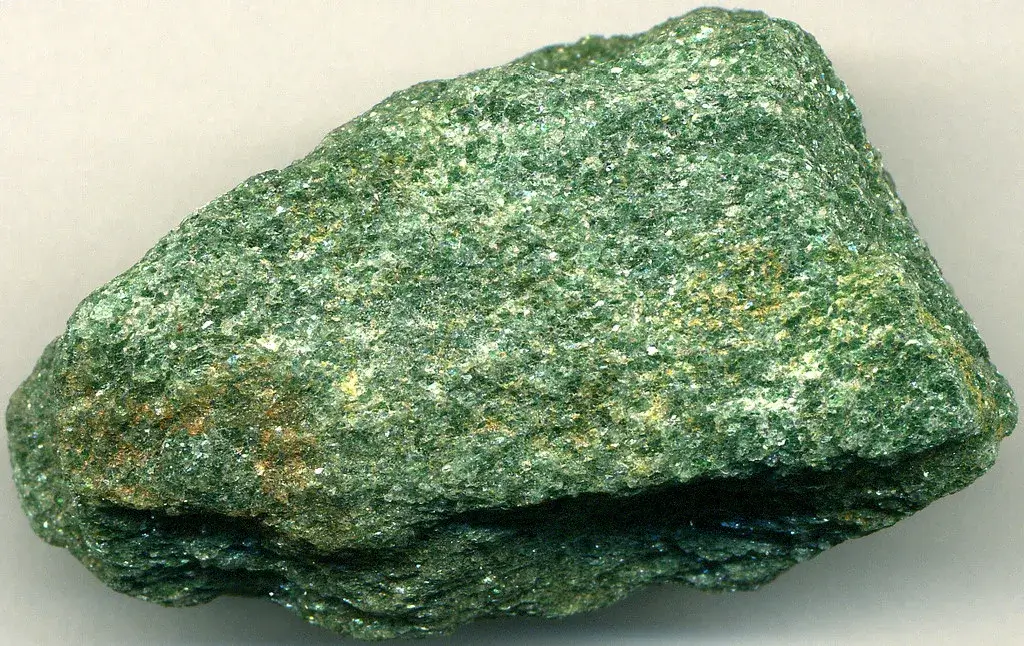
Fuchsite is the emerald-green variety, coloured by trivalent chromium in the octahedral sheet. It ranks as a variety because aluminium still outnumbers chromium on that site. Where chromium takes the majority the mineral becomes chromphyllite, and where vanadium does so it becomes roscoelite. Both appear in Mindat’s roster of the mica group as species in their own right. Fuchsite usually occurs as fine flakes scattered through quartzite or schist, and even a modest amount of it turns the whole rock green. Mindat records verdite as a trade name for an ornamental stone made largely of impure fuchsite, first described from the North Kaap River in South Africa.
Sericite and the fine-grained forms
Sericite is a grain-size term. It covers white mica too fine to identify by eye, and in most rocks that mica is muscovite. Damourite is an older name for very fine, compact muscovite with a greasy feel. Gilbertite is another, first described from Stenagwyn in Cornwall. These names persist mostly on old museum labels. Sericite alone remains in everyday use, because petrographers need a word for the felted mica that replaces feldspar in altered granite.
Pink and red muscovite
Rose muscovite occurs in some lithium-bearing pegmatites, and the Harding pegmatite in the Picuris Mountains of New Mexico is a well-known American source. Schernikite is a pink variety that the mineralogist Herbert Bowman described in 1902, and Mindat records it from Haddam Neck in Connecticut and from Topsham in Maine. Alurgite is a manganese-bearing purple to red mica that August Breithaupt named in 1865. Later work placed it between muscovite and aluminoceladonite in composition, which puts it partway toward phengite. Caltech’s George Rossman attributes the red of Brazilian muscovite to manganese in the 3+ state, and manganese is the likely cause in the other pink varieties as well.
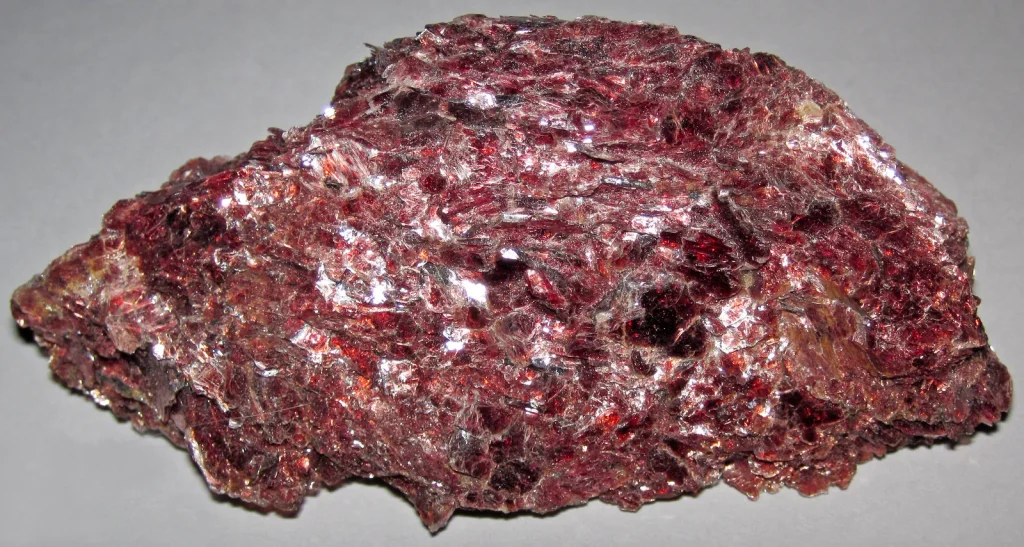
Chemical varieties from rare-metal pegmatites
Late-stage pegmatite melts load muscovite with elements that fit nowhere else. Mindat defines rubidian muscovite as material holding at least 1 weight per cent Rb₂O and calls it a usual rock-forming mineral in the late stages of many rare-metal pegmatites. Lithian muscovite, in the sense of Alfred Levinson, carries 3 to 4 per cent Li₂O. Oellacherite is a barium-bearing variety that lies partway to the brittle micas. A zinc-bearing muscovite is known from Nežilovo in North Macedonia.
Phengite, illite, paragonite and the other neighbours
Four relatives cause most of the confusion. Phengite is muscovite with extra silicon and some magnesium or iron, and since 1998 it has been a series name and no longer a species. Illite sits on the other side. It is the potassium-deficient white mica of mudrocks and soils, for which Mindat gives a representative formula with only 0.65 potassium per formula unit. The IMA report treats it as a series name as well, and it sets the dividing line for dioctahedral micas at an interlayer charge of 0.85. Paragonite is the sodium analogue of muscovite, and the two are separated by a miscibility gap, so a rock can contain both as distinct grains. Lepidolite, the lilac lithium mica, is now treated by Mindat as a name for the series between polylithionite and trilithionite. Mindat warns that muscovite may also be confused with margarite, a calcium-bearing brittle mica, and with several of the lithium micas.
Biotite is the easiest relative to tell apart. It is the dark, iron- and magnesium-bearing mica in which all three octahedral sites are filled, and its colour gives it away in hand specimen. The two minerals grow together in many granites and schists, and the pairing is informative: rocks that carry both are usually richer in aluminium than rocks that carry biotite alone.
What is muscovite used for?
People valued muscovite long before anyone wrote down a formula for it. In the Scioto Valley of Ohio, communities of the Hopewell culture were cutting sheet mica into effigies about 2,000 years ago. The U.S. National Park Service describes a raptor’s talon and a human hand among the shapes recovered. Mound 13 at the Mound City Group near Chillicothe is known as the Mica Mound. Archaeologists working there in the 1920s uncovered a clay basin lined with mica sheets 6 to 16 inches (15 to 41 cm) across, on which the cremated remains of four people had been laid. Ohio’s bedrock holds no sheet mica. The Park Service places the source in the Blue Ridge of western North Carolina, more than 400 miles (640 km) from the mounds, in the same pegmatite country that American industry would mine two millennia later.
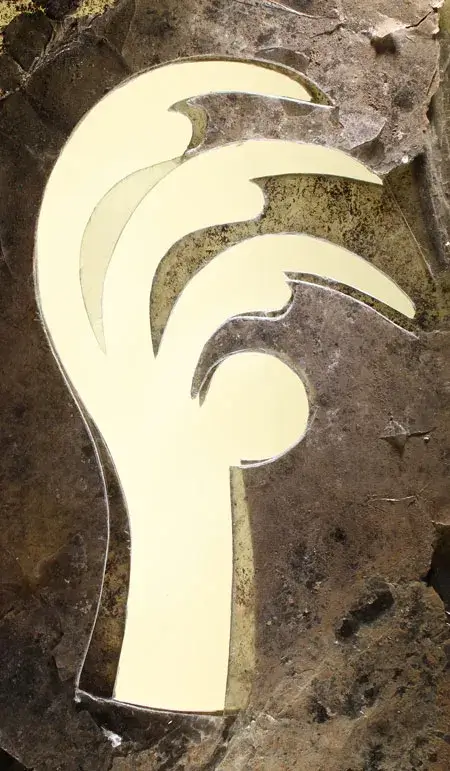
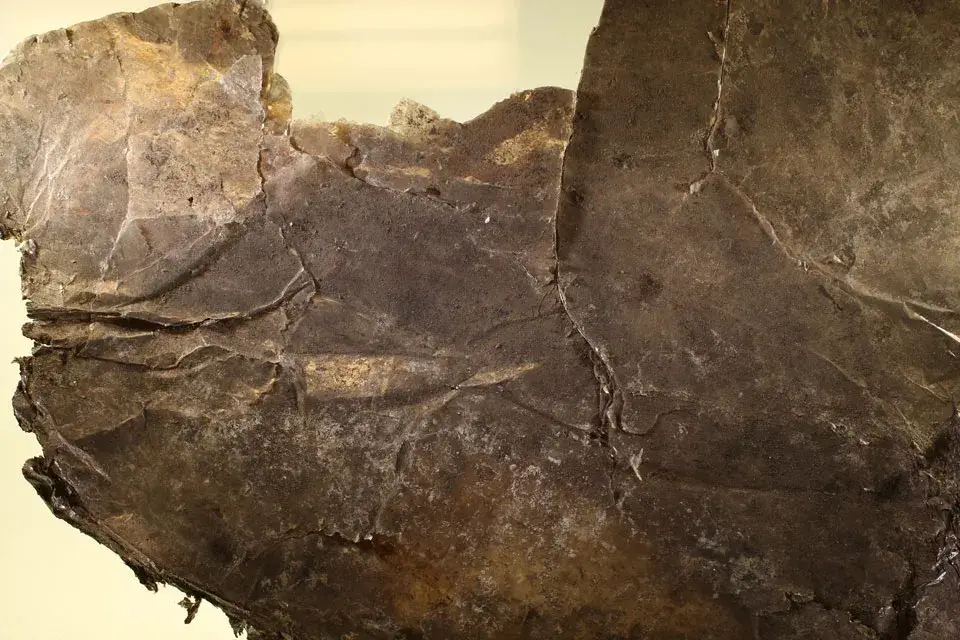
The Russian window trade came next. Muscovy glass let light into houses and lanterns from the fifteenth century onward, and it had one advantage that window glass never matched: it tolerates heat. That property carried it into the iron stoves of the nineteenth century as isinglass windows. The museum conservators who maintain the CAMEO materials database in Boston note that it served for many years in the viewing windows of kitchen ovens.
The Jamestown panes show how far the trade reached. Jamestown Rediscovery holds three of them, and its curators point out that both English and Dutch merchants were dealing with Russia in the colony’s first years. Mica suited a ship’s lantern for practical reasons. It does not crack when a flame heats it, and it stood up to conditions at sea better than the glass of the period. Muscovy stayed in English use as a name for Russia until the Russian Empire was proclaimed in 1721.
Electricity turned a window material into a strategic one. Muscovite is an electrical insulator that withstands several hundred degrees, and it can be split into sheets of uniform thickness. Early electrical engineering could get that combination from no other material. The modern market divides into two commodities that have little in common. Sheet mica is hand-split from pegmatite books and fabricated into parts for electrical and electronic equipment. Scrap and flake mica is ground to powder for bulk uses, and the USGS lists the main ones as joint compound, oil-well drilling additives, paint, roofing and rubber products. The National Park Service adds the uses most people actually meet, which are the shimmer in cosmetics and the sparkle in some toothpaste.
The figures for 2025 come from the USGS Mineral Commodity Summaries published in February 2026, and they cover natural mica as a whole, which means muscovite together with phlogopite. World production of scrap and flake mica was an estimated 350,000 tonnes, down from 376,000 tonnes in 2024. China led with 85,000 tonnes. Madagascar followed with 70,000 tonnes and Finland with 57,000. The United States produced 26,000 tonnes worth 3.8 million dollars, all of it from Georgia and North Carolina, and eight companies ground 59,000 tonnes of domestic and imported material worth about 20 million dollars. Sheet mica is a far smaller business. India is the only country with a sheet-mica figure in the table, about 1,000 tonnes, and the survey cautions that reliable data for several other major producers were unavailable. The United States relied on imports for all of its sheet mica, and China supplied 73 per cent of those imports between 2021 and 2024. The survey explains why in one sentence: American deposits are subeconomic because of the cost of the hand labour needed to mine and split sheet mica from pegmatites.
Prices reflect the difference between the two trades. Scrap and flake mica sold for about 130 dollars a tonne in the United States in 2025, and ground mica for 320 to 350 dollars. Sheet-mica splittings averaged 1.80 dollars a kilogram, more than ten times the price of scrap by weight. Substitutes exist for most uses. The USGS lists synthetic fluorophlogopite as a replacement for ground natural mica where thermal and electrical performance matters, and mica paper made from scrap as a stand-in for sheet. For filler applications it names lightweight aggregates such as perlite and vermiculite.
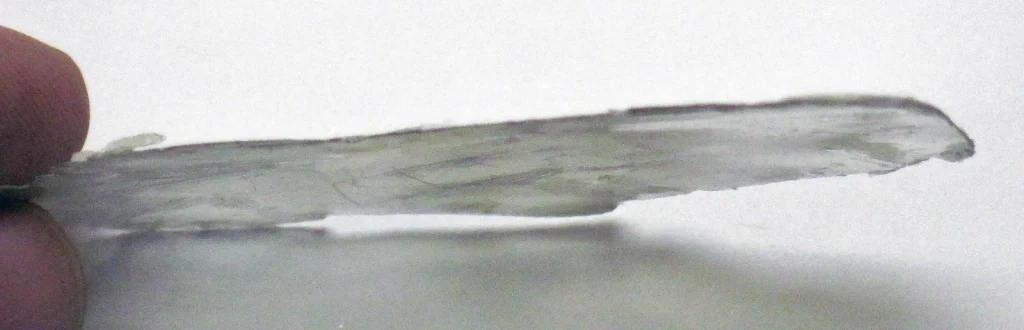
A freshly cleaved face of muscovite is flat at the atomic scale over distances that no polished surface can match, a point that Wester de Poel and colleagues made in 2014 in a paper titled “Muscovite mica: flatter than a pancake”. It became the standard support for atomic force microscopy soon after the instrument was invented. In 1992 Helen Hansma and colleagues at the University of California, Santa Barbara, published images in Science of plasmid DNA lying on mica under liquid, and structural biologists have used the same preparation ever since. The TU Wien team describes muscovite as the test surface of choice for new scanning-probe methods for the same reason.
Geologists use muscovite as a clock. The mineral is rich in potassium and rubidium, and it retains the argon and strontium that their decay produces. In 2009 Mark Harrison and colleagues measured the diffusion of radiogenic argon in muscovite experimentally and found the mineral to be considerably more retentive than had been assumed. For a grain 100 µm in radius cooling at 10 °C per million years under a pressure of 10 kbar (1 GPa) they calculated a closure temperature of 425 °C. In a rock that was once hotter, a potassium-argon or argon-argon age on muscovite records when it cooled through that temperature, which is the information needed to time the uplift of a mountain belt. The rubidium-strontium pair can now be measured in place with a laser. Chao Huang and colleagues at the Chinese Academy of Sciences described in 2023 how a tandem mass spectrometer with a reaction cell resolves ⁸⁷Rb from ⁸⁷Sr during laser ablation, which allows single mica grains to be dated inside a thin section without dissolving them.
Mindat’s list of dated samples shows how widely these methods have been applied to ore deposits, where hydrothermal muscovite grows at the same time as the metals. Argon-argon dating of muscovite from the Golden Mile at Kalgoorlie in Western Australia gave 2,629 ± 9 Ma. Potassium-argon work on the mineralisation at Cligga Head in Cornwall gave 275 ± 6 Ma, and muscovite from the Round Mountain gold district in Nevada returned Late Cretaceous ages close to 80 Ma. Each number ties a stage of mineralisation to the wider tectonic history of its region.
How to identify muscovite
Few minerals are as easy to identify in hand specimen. Three observations settle most cases.
- One perfect cleavage, and elastic sheets. Slide a knife point or a fingernail under the edge of a crystal and lift. A thin, transparent sheet comes away. Bend that sheet and let go, and it springs back flat. Chlorite sheets bend and stay bent. Sheets of margarite and the other brittle micas snap. Talc feels greasy and can be scratched with almost no pressure.
- Pale colour with a pearly lustre. Muscovite is colourless to silvery, sometimes with a faint tint, and the cleavage surface has a soft, pearly shine. Biotite and phlogopite are brown to black. A lilac tint suggests lepidolite, and a vivid green points to fuchsite.
- Low hardness on the flat face. The cleavage surface scratches at about 2.5, so a copper coin marks it and a fingernail very nearly does. The edges of a thick book are harder, close to 4, and resist a fingernail completely.
None of these tests separates muscovite from paragonite or from phengite. Those distinctions need an electron microprobe or an X-ray diffractometer, and the honest field name for an untested sample is white mica.
Outside the mica family the one common look-alike is selenite, the clear variety of gypsum, which also cleaves into transparent plates. Its flakes bend without springing back, and at a hardness of 2 they scratch more easily than mica does. Gypsum is also far more soluble, so its cleavage plates rarely survive as loose flakes in a stream bed the way mica does.
In thin section the diagnosis is just as quick. Look for colourless flakes of moderate relief with one set of sharp cleavage traces. Between crossed polars they show second-order interference colours, brighter than anything the neighbouring quartz or feldspar can produce. Extinction is parallel to the cleavage and has the speckled bird’s-eye texture that all micas share. Biotite is coloured and strongly pleochroic. Where a colourless mica is in doubt, the optic axial angle helps: teaching notes from the University of Notre Dame give 30° to 47° for muscovite and 0° to 25° for biotite. Grains cut parallel to the cleavage are the exception to all of this. They show no cleavage traces and only weak birefringence, and beginners regularly mistake them for something else.
What remains uncertain: current research on muscovite
Five questions about muscovite are still open. The first concerns the oldest muscovite ever reported.
Hadean inclusions. The Jack Hills of Western Australia yield detrital zircons as old as 4.4 Ga, the only solid remnants of Earth’s first half-billion years. In 2008 Michelle Hopkins, working with Mark Harrison and Craig Manning at UCLA, reported in Nature that the inclusions inside more than 400 of these zircons are dominated by quartz and muscovite. They applied phengite barometry to the white mica in grains dated between 4.02 and 4.19 Ga and combined the pressures with crystallisation temperatures. The result implied a heat flow far lower than expected for the early Earth, which they read as evidence of a subduction-like setting. In 2011 Birger Rasmussen and colleagues answered in Geology. They dated monazite and xenotime inclusions in zircons between 4.25 and 3.35 Ga old and found that those phosphates had formed during metamorphism long after the zircons were deposited. They argued that primary apatite had dissolved out of the zircons and that metamorphic minerals matching the surrounding rock, muscovite among them, had filled the voids. An exchange of comment and reply followed in 2012. The UCLA group pointed to two distinct populations of silicon content in the mica, at 3.10 to 3.26 and near 3.45 atoms per formula unit, and noted that the micas Rasmussen’s group had classed as metamorphic fell between 3.06 and 3.20, below the second population. Rasmussen’s group replied that many of the analysed inclusions were smaller than 5 µm and questioned the quality of the analyses. The question remains open, and a good part of what is claimed about Hadean tectonics depends on how it is answered.
Order in the tetrahedral sheet. The 2023 TU Wien study narrowed the possible arrangements of aluminium in muscovite and stopped short of a unique answer. The authors state that different aluminium patterns could reproduce the potassium rows they imaged while remaining consistent with earlier nuclear magnetic resonance data. They also suggest that the mica substrate has more influence on the ordering of hydrated ions in solution than earlier work allowed, which bears on how water and ice organise themselves on mineral surfaces.
Muscovite as a lithium pathfinder. Demand for lithium has revived an old idea: that the trace elements in common pegmatite minerals indicate whether a body carries ore. In 2024 Michael Wise of the Smithsonian Institution, with Adam Curry and Russell Harmon of North Carolina State University, compiled more than 1,190 published analyses of muscovite from 224 pegmatite localities. Lithium in the mica ranged from 10 to about 20,000 ppm. Muscovite from barren, common pegmatites showed K/Rb ratios between 618 and 25 with lithium generally under 200 ppm, while moderately evolved bodies enriched in beryllium, niobium, tantalum and phosphorus mostly fell between 45 and 7. A follow-up in Economic Geology in 2025 applied mineral chemistry, muscovite included, to the Carolina tin-spodumene belt and proposed it as a way to separate spodumene-bearing pegmatites from barren ones. The same team has tested handheld laser-induced breakdown spectroscopy on muscovite, which would let an explorer read K/Rb and lithium on the outcrop. How well thresholds drawn from one belt transfer to another is unresolved.
Old mica as a particle detector. A particle that strikes an atomic nucleus in a crystal sends the nucleus recoiling, and the recoil leaves a trail of damage some tens of nanometres long, and muscovite can preserve such trails for hundreds of millions of years. In 1995 Daniel Snowden-Ifft and colleagues in Buford Price’s group at the University of California, Berkeley, etched cleaved muscovite about half a billion years old and scanned 80,720 µm² of it with an atomic force microscope. They found no recoil tracks attributable to dark matter and published a limit. A 2023 white paper led by Sebastian Baum revived the approach under the name paleo-detectors and singled out muscovite’s cleavage as a practical advantage, since a large mass can be read out sheet by sheet. In the same year Javier Acevedo and colleagues reused the Berkeley data to constrain other dark matter models. Whether natural radioactive backgrounds in real mica can be held low enough for the method to compete is still an open question.
A setting for the origin of life. Helen Hansma proposed in the Journal of Theoretical Biology in 2010 that life may have begun in the spaces between mica sheets, and she developed the idea further in 2013. The argument rests on confinement and on the potassium-rich environment between the layers. Hansma also pointed to the mechanical energy available as sheets open and close with changes in temperature or water flow. The hypothesis has not been tested experimentally at the scale it requires. Surface scientists continue to cite it as one motive for studying how biomolecules behave on mica.
Turberville’s friends in London learned that a rock could serve as window glass, and little else. The same mineral has since been used to date mountain belts and to gauge pressures deep inside subduction zones. They also gave biologists the surface on which plasmid DNA was imaged under liquid in 1992. Whether it also recorded the Hadean crust, or the passage of dark matter, is still being tested.