
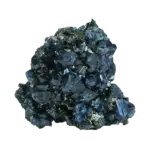
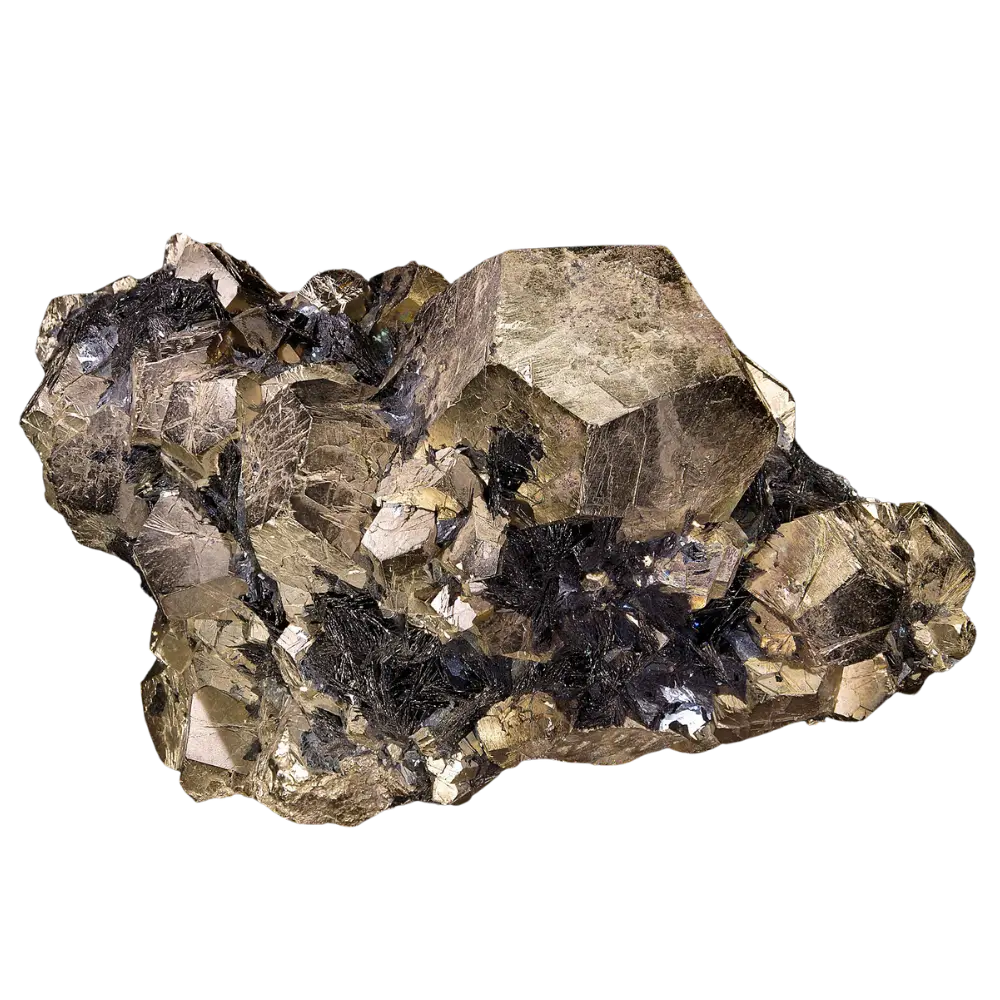
Galena: The Lead Sulfide That Built Antiquity
Galena is the lead sulfide mineral (PbS) and the world’s primary lead ore. Humans have smelted it for more than eight thousand years, and it still supplies most of the world’s lead.
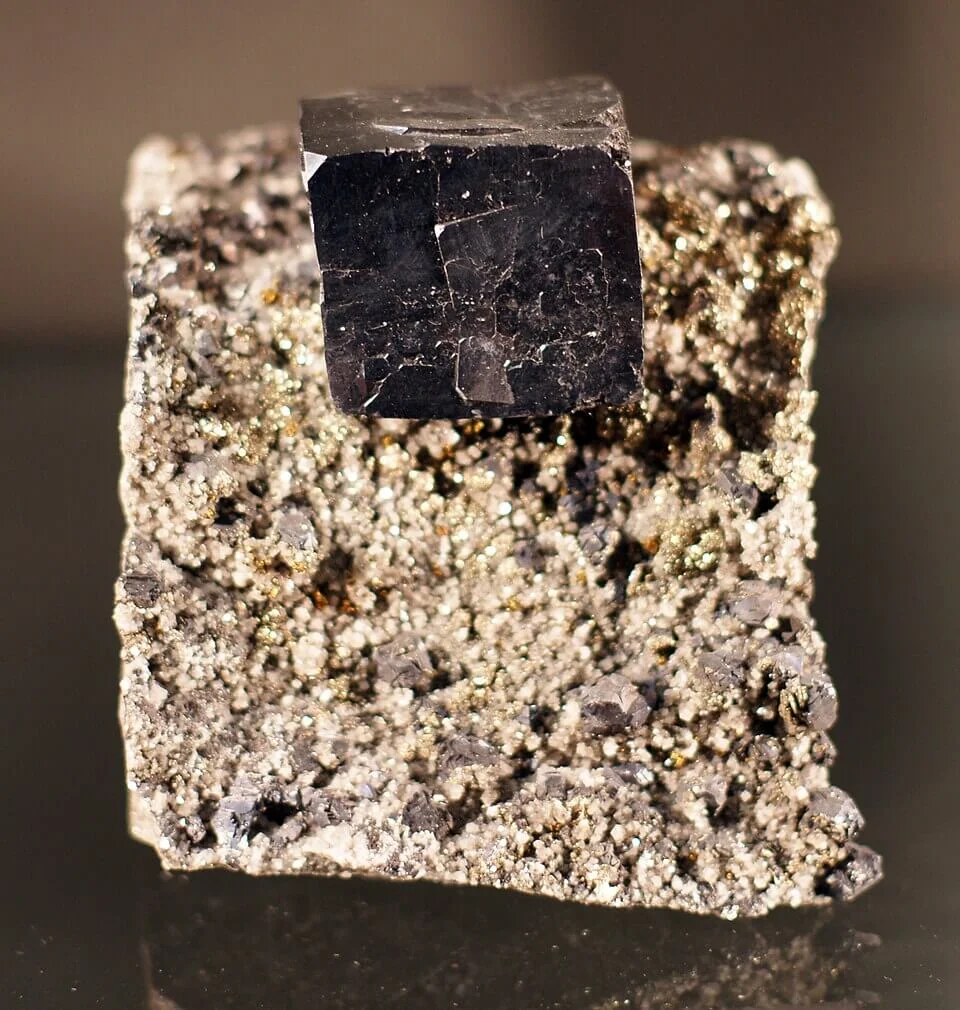
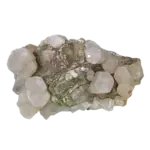
Three hundred metres below the Ozark hills of southeastern Missouri, the wall of a Viburnum Trend drift sweats brine at 18 °C. A headlamp picks out silvery cubes set into dolomite, edges sharp enough to nick a fingernail. A fist-sized lump of the stuff weighs as much as a small dumbbell. This is galena, the lead sulfide that has been smelted since the Bronze Age and still supplies most of the world’s lead.
What is Galena?
Galena is the natural mineral form of lead(II) sulfide, PbS. It belongs to the sulfide class, is the type mineral of the galena group, and supplies most of the world’s primary lead. It crystallises in the cubic system, has a hardness of 2.5 on the Mohs scale, and a specific gravity near 7.58, about three times that of quartz, which is its single most diagnostic field property.
The International Mineralogical Association recognises galena as a valid species with the symbol Gn, but the name predates the IMA by nearly two thousand years. Pliny the Elder used the word in his Naturalis Historia (c. 77 CE) for both the lead ore and the dross skimmed off molten lead at Roman smelting hearths. Modern usage applies it only to the ore.
Chemistry and Crystal Structure
Stoichiometric galena is 86.60 wt% lead and 13.40 wt% sulfur, but natural specimens almost always carry traces of silver, bismuth, antimony, selenium, and other elements: either substituting into the lattice or sitting in submicroscopic sulfosalt inclusions. The impurities matter economically: silver in particular often determines whether a deposit is mined for lead or for silver with lead as the by-product.
Structurally, galena is the canonical halite-structure sulfide. Space group Fm-3m (No. 225), unit-cell edge a = 5.936 Å, with four PbS formula units per cell (Z = 4). Lead and sulfur alternate on two interpenetrating face-centred cubic sublattices, each Pb²⁺ bonded octahedrally to six S²⁻ and vice versa. Bonding is mixed ionic–covalent, and the electronic structure gives galena a narrow band gap of roughly 0.4 eV, making it a natural semiconductor.
Trace-element work by Luke George, Nigel Cook, Cristiana Ciobanu and Benjamin Wade (2015, American Mineralogist 100, 548–569) used laser-ablation ICP-MS on galena from twelve deposit types and showed that Ag, Bi, Sb, Tl, Se, and Te commonly enter the lattice in coupled substitution for Pb and S, while Cu, Zn, and Au tend to sit in discrete sub-micrometre inclusions. Silver matters most economically: typical argentiferous galena carries a few tenths of a percent Ag, and in some ore bodies, Santa Eulalia in Chihuahua, mapped systematically by Virgil Lueth and colleagues (Economic Geology, 2000), the silver by-product outearns the lead.
Physical Properties and How to Recognise It
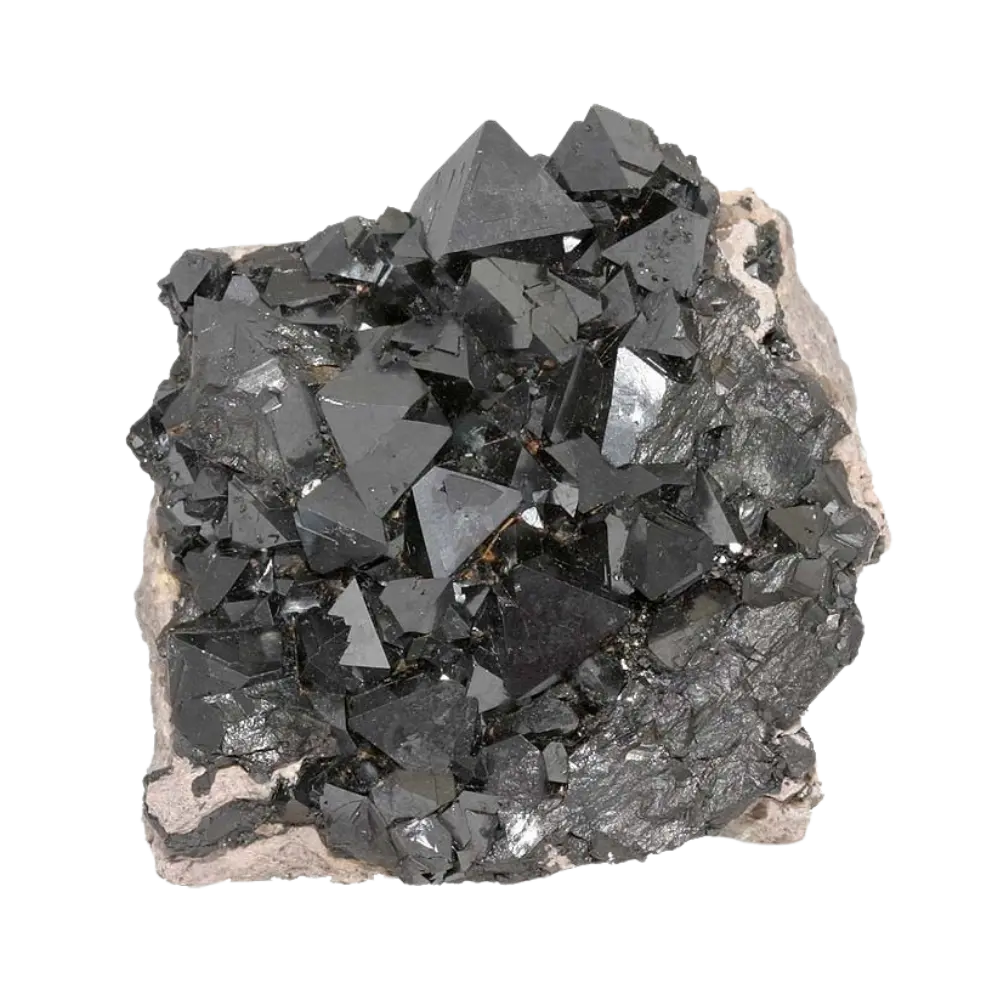
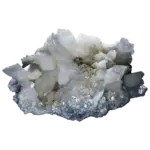
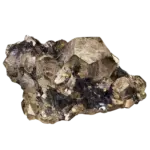
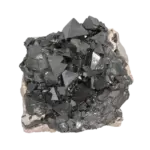
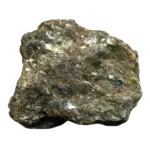
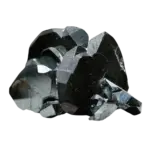
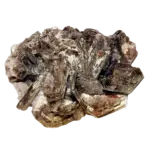
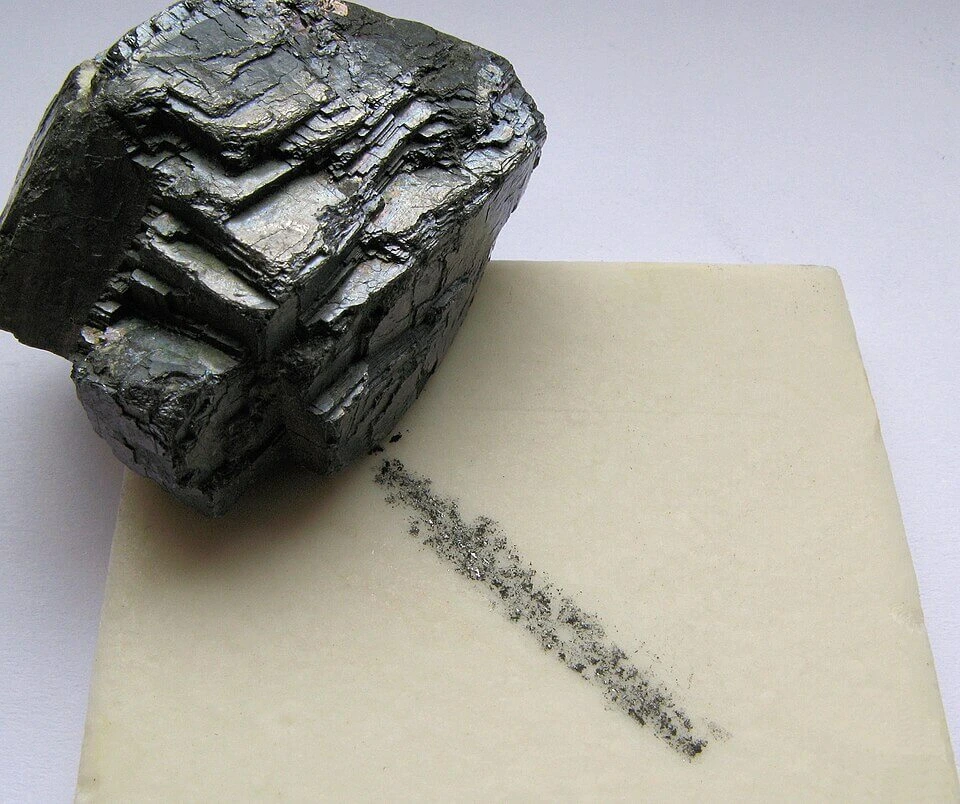
Galena is one of the easiest sulfides to recognise. A measured specific gravity of 7.58 g/cm³ (Handbook of Mineralogy) puts it among the heaviest common minerals: a hand specimen feels startlingly dense for its size. Cleavage is perfect on {001} in three mutually perpendicular directions, producing the characteristic stair-stepped cube fragments when the mineral is struck. Fresh surfaces show a bright lead-grey metallic sheen, dulling to sooty grey with exposure. The streak is grey to grey-black on unglazed porcelain. Galena is opaque, brittle, and so soft that a steel pocket-knife scratches it without effort.
Crystals are mostly cubes or cubo-octahedra; pure octahedra and twinned penetration crystals on {111} (spinel-law twins) also occur. One of the largest documented single crystals, a 25 cm composite cubo-octahedron from the Great Laxey Mine, Isle of Man, is held by the Natural History Museum, London.
| Property | Value |
|---|---|
| Formula | PbS |
| IMA symbol | Gn (grandfathered) |
| Crystal system | Cubic (isometric) |
| Space group | Fm-3m, a = 5.936 Å, Z = 4 |
| Mohs hardness | 2.5 (range 2.5–2.75) |
| Specific gravity | 7.58 (measured); 7.57 (calculated) |
| Cleavage | Perfect on {001}, three directions at 90° |
| Fracture | Subconchoidal; brittle |
| Lustre | Metallic on fresh surfaces |
| Colour | Lead-grey, tarnishing to dull grey-black |
| Streak | Lead-grey to grey-black |
| Band gap | ≈0.4 eV (semiconductor) |
How Galena Forms
Galena precipitates from hydrothermal solutions across a broad span of geological settings, and the deposit type tends to control crystal size, silver content, and associated minerals.
Mississippi Valley-type (MVT) deposits
MVT deposits are one of the major sediment-hosted styles of galena mineralisation. Sediment-hosted Pb-Zn systems as a whole contain the world’s greatest lead and zinc resources, with SEDEX deposits holding the larger share of global reserves and MVT districts including some of the classic and largest North American lead producers. They are stratabound, carbonate-hosted lead-zinc bodies that precipitate from saline basinal brines at 75–200 °C: a model established by Leach and Sangster (1993) and refined in Leach and colleagues’ 2005 synthesis. The brines are 10–30 wt% NaCl-equivalent, often co-migrating with hydrocarbons, and they precipitate galena plus sphalerite where they encounter reduced sulfur in dolostone or limestone hosts. The Viburnum Trend in southeast Missouri is the largest single MVT district on Earth; Pine Point in the Northwest Territories, Polaris in the Canadian Arctic, the Upper Mississippi Valley (Wisconsin–Iowa–Illinois), and the Tri-State district (Missouri–Kansas–Oklahoma) are the type examples.
SEDEX, VMS, skarn, and vein deposits
Sedimentary-exhalative (SEDEX) deposits, Broken Hill and Mount Isa in Australia, Sullivan in British Columbia, Red Dog in Alaska, formed where metalliferous brines vented onto a Proterozoic or early Phanerozoic seafloor, precipitating stratiform Pb-Zn-Ag sulfides at higher temperatures than MVT systems. In volcanogenic massive sulfide (VMS) deposits along submarine volcanic arcs, galena is a subordinate phase to copper-zinc ores. Skarns, formed where granitic intrusions react with carbonate country rock, produce high-grade but volumetrically small bodies; Santa Eulalia and Naica in Chihuahua are the type examples. Polymetallic veins around granitic plutons (Freiberg in Saxony, Příbram in Bohemia, Cornwall) have supplied European metal markets for nearly a thousand years.
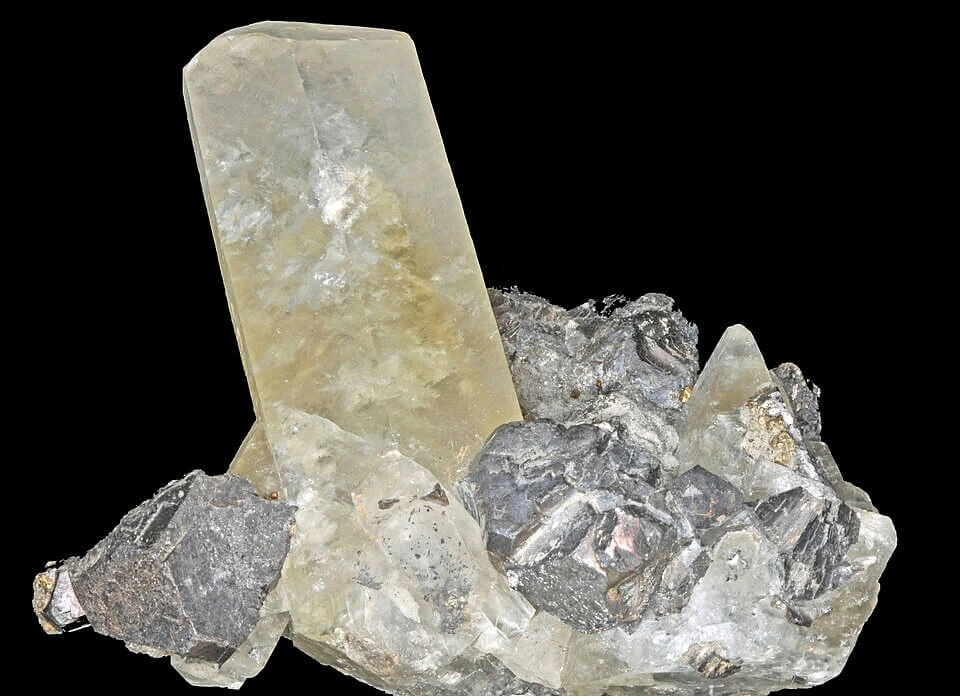
Common associates across all these settings include sphalerite, pyrite, chalcopyrite, marcasite, tetrahedrite-tennantite, fluorite, barite, quartz, calcite, and dolomite.
Weathering and alteration
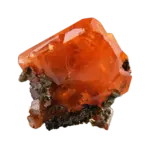
Where galena meets oxygenated groundwater near the surface, it weathers to cerussite (PbCO3) and anglesite (PbSO4); pyromorphite, mimetite, and wulfenite form in more chemically complex oxidation zones. Acid mine drainage accelerates the process. Galena surface oxidation kinetics in mine tailings are now a standard topic in the environmental geochemistry of legacy lead contamination, with implications for site remediation and drinking-water risk in old mining districts.
Notable Localities
Galena is one of the most widely distributed sulfide minerals on Earth, with classic and currently productive localities on every continent except Antarctica.
In the United States, the Viburnum Trend of southeast Missouri, a roughly 65 km north-south alignment of carbonate-hosted ore bodies through Reynolds and Iron counties, is one of the largest lead districts ever worked, and the Sweetwater Mine has produced some of the world’s finest cubic crystal specimens. The Tri-State district around Joplin, Missouri, Picher, Oklahoma, and Galena, Kansas was a dominant world producer from the 1850s through the 1950s. The Upper Mississippi Valley district straddling Wisconsin, Iowa, and Illinois gave the town of Galena, Illinois its name and produced the “Badger State” nickname for Wisconsin: early lead miners overwintered in hillside dugouts and were compared to badgers. The Coeur d’Alene district of Shoshone County, Idaho, and within it the Bunker Hill Mine, remains an important silver-bearing galena producer. Leadville, Colorado is another historic centre.
Australia hosts two of the great twentieth-century lead-zinc-silver bodies: Broken Hill in New South Wales (discovered 1876) and Mount Isa in Queensland (1923). Together they made Australia the world’s largest lead miner for much of the modern era. Canada contributes the Sullivan Mine in British Columbia and the Pine Point district. In Mexico, Naica and Santa Eulalia in Chihuahua are both world-class. Peru supplies Cerro de Pasco and the Huanzala district.
In Europe, Freiberg in Saxony, the cradle of modern mineralogy, has yielded galena for nearly a thousand years. Příbram in the Czech Republic, the Harz Mountains in Germany, Cornwall and Derbyshire in England, Wanlockhead in Scotland, the Mogul mine at Silvermines in Ireland, the Madan district in the Bulgarian Rhodopes, Trepča in Kosovo, and the ancient mines of Sardinia all carry long working histories. The Laurion mines south of Athens, worked from the Late Neolithic and intensively expanded in the fifth century BCE, produced the silver, cupelled from argentiferous galena, that paid for the Athenian trireme fleet at Salamis in 480 BCE. Russia’s Dal’negorsk, in the Primorye region, produces some of the most aesthetic recent crystal specimens, often perched on calcite.
Varieties and Related Species
The galena group is structurally simple, four isostructural sulfide and selenide-telluride species, but the solid-solution relationships among them matter for both petrology and ore mineralogy. Galena (PbS), clausthalite (PbSe), and altaite (PbTe) form an extensive solid-solution series, complete between PbS and PbSe, partial between PbS and PbTe at lower temperatures, as mapped phase-petrologically by Liu and Chang (Mineralogical Magazine, 1994). Manganese-bearing alabandite (MnS) and magnesium niningerite (MgS) round out the group’s isostructural members. In nature, most galena carries some clausthalite component, and selenium-rich galenas are characteristic of certain volcanic-hosted occurrences.
The economically important variety is argentiferous galena, silver-bearing galena, almost always of hydrothermal vein or SEDEX origin rather than MVT. Silver concentrations range from a few hundred ppm to more than one weight percent. Argentiferous galena became one of the great silver sources of classical and later mining. At Laurion, cupellation of silver-bearing lead ores helped turn a lead mineral into Athenian silver; in later polymetallic districts, galena commonly occurred alongside silver sulfosalts and other silver minerals. But ancient silver sourcing was not simply “all galena”: lead-isotope work has made that story more complicated. Lead-isotope provenance work, re-examined for Mediterranean silver by Wood, Hsu, and Bell (2019), uses the four stable isotopes of lead to trace which deposits supplied which ancient artefacts. Older mining literature also preserves texture-based varietal names: “steel galena” for fine-grained, dull, dense material; “coarse galena” for crystallised specimens.
Uses and Economic Significance
Galena has been the primary lead ore since lead first appeared as a smelted metal in the late seventh millennium BCE, with the earliest known beads and ornaments from Çatalhöyük in Anatolia and Yarim Tepe in northern Mesopotamia. Lead reduces out of galena in an ordinary wood fire, at temperatures any Bronze Age furnace could reach, which is why this particular sulfide became the first ore humans worked at scale. Romans piped water in lead, plumbum, the source of the modern element symbol Pb, and ground lead-based pigments (white lead and red lead, or minium) into frescoes, cosmetics, and ship’s caulking. Egyptian kohl eye-paint, used from the Predynastic period onward, was often based on powdered galena, though archaeometric analyses have shown that historical kohl recipes also incorporated cerussite, laurionite, and other lead compounds.
Most lead today goes into one product: the lead-acid battery. The USGS Mineral Commodity Summaries 2025 attributes roughly 86 percent of US lead consumption in 2024 to the battery sector, mostly automotive starting-lighting-ignition cells and standby power for telecommunications. Radiation shielding for medical imaging and nuclear facilities exploits lead’s high atomic number. Smaller but persistent uses include solder (now largely tin-based for potable water and electronics under RoHS), ammunition, ceramic glazes, and crystal glass.
World mine production in 2024 totalled approximately 4.30 million tonnes of contained lead, according to USGS estimates. The leading producers were China (1.90 Mt), Australia (0.43 Mt), the United States (0.30 Mt), Peru (0.27 Mt), Russia and India (0.22 Mt each), and Mexico (0.18 Mt). Identified world resources exceed 2 billion tonnes; reserves stand near 96 Mt. The last U.S. primary lead refinery closed in 2013, so secondary (recycled) lead now supplies most domestic demand, about 1 million tonnes in 2024, almost all from spent batteries.
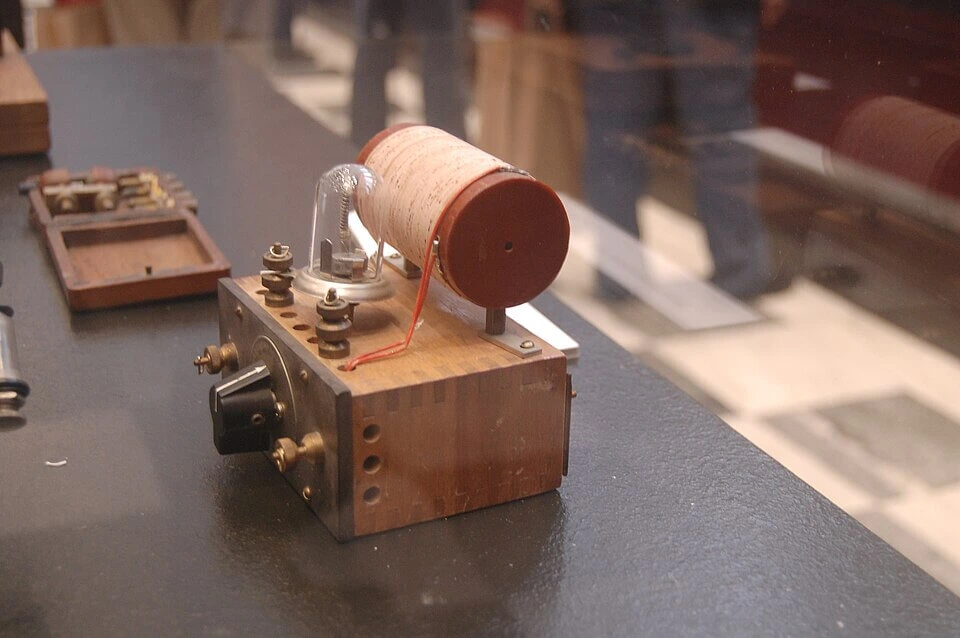
Galena’s 0.4 eV band gap also made it the rectifier of early radio. From around 1906 through the 1920s, galena crystals paired with a fine wire, the “cat’s whisker”, formed point-contact diodes in crystal radios, the first widely affordable wireless receivers. Karl Ferdinand Braun’s nineteenth-century work on asymmetric conduction in sulfide crystals laid the groundwork, and Greenleaf Whittier Pickard’s 1906 US patent on a silicon point-contact detector opened the field. Galena’s stronger signal and lower cost soon made it the dominant crystal in amateur and commercial sets, and crystal radio kits sold in vast numbers through the early 1920s, until the vacuum-tube triode displaced them by the end of the decade.
Identifying Galena in the Field
Three tests, in order, will resolve almost any specimen.
- Heft. Pick it up. Galena’s specific gravity of ~7.58 means a piece the size of a golf ball weighs as much as a small handful of quartz pebbles. Nothing else common in surface geology matches it except native metals.
- Cleavage. Tap a piece with a hammer. Galena breaks into cubes and stair-stepped rectangles bounded by three perpendicular {001} cleavage planes. No other metallic-lustred mineral does this.
- Streak and hardness. A grey to grey-black streak on an unglazed porcelain plate, plus a soft scratch test (a steel knife scratches it easily; a fingernail test is unreliable because galena sits close to fingernail hardness), distinguishes galena from hematite (red-brown streak, harder) and from dark sphalerite (yellow to brown streak, harder).
One caveat: weathered galena often loses its bright metallic shine and dulls to a sooty grey. A fresh fracture is essential for any visual check.
What Is Still Being Argued About
The mechanisms by which trace silver, bismuth, antimony, and thallium enter the galena lattice, solid solution versus nanoscale inclusions of sulfosalts, remain a live debate. George, Cook, and Ciobanu’s continuing LA-ICP-MS work and Renock and Becker’s surface-chemistry studies are gradually mapping the partitioning rules across deposit types. These have practical bite: knowing whether silver sits in the lattice or in nano-inclusions changes the metallurgical flowsheet.
The thermodynamics of galena formation were re-measured by Suraj Deore and Alexandra Navrotsky using oxide-melt solution calorimetry (American Mineralogist, 2006), pinning down enthalpies of formation that are still being applied in fluid-inclusion modelling of MVT systems. The timing and duration of MVT mineralisation events themselves remain contested, whether episodic million-year fluid pulses or short, intense brine surges, with recent in-situ U-Pb dating of hydrothermal carbonates beginning to resolve the question.
Lead-isotope provenance is the third active front. Lead has four stable isotopes whose ratios vary measurably between ore districts, and galena analysis has become a forensic tool on the back of that variation. Archaeometrists use it to source Bronze Age silver and Roman lead pipes. Lake-sediment cores read with the same isotopic systematics carry the pollution signature of specific smelting regions back through centuries. Contamination cases trace modern lead burdens to particular mines and refineries. Archaeometry, ore-deposit geology, and environmental forensics now lean on the same toolkit.
Frequently Asked Questions
What is galena? Galena is the natural mineral form of lead sulfide (PbS). It is the world’s primary lead ore and one of the densest common minerals, with a specific gravity around 7.58.
Where is galena found? Galena occurs worldwide in hydrothermal vein deposits, sedimentary-exhalative (SEDEX) bodies, and Mississippi Valley-type (MVT) carbonate-hosted ores. Major producing regions include southeast Missouri, Broken Hill and Mount Isa in Australia, Freiberg in Germany, and the historic Laurion mines of Greece.
Is galena dangerous to handle? Intact galena specimens are chemically stable and safe to handle, but wash your hands afterwards, lead is a cumulative toxin. Sanding, breaking, or heating galena releases lead dust or fumes and should only be done with proper ventilation and protective equipment. Do not let children handle galena unsupervised.
How can I identify galena in the field? Three tests: density (galena feels remarkably heavy for its size), cleavage (it breaks into cubic and stair-stepped fragments along three perpendicular planes), and streak (lead-grey to grey-black on unglazed porcelain).