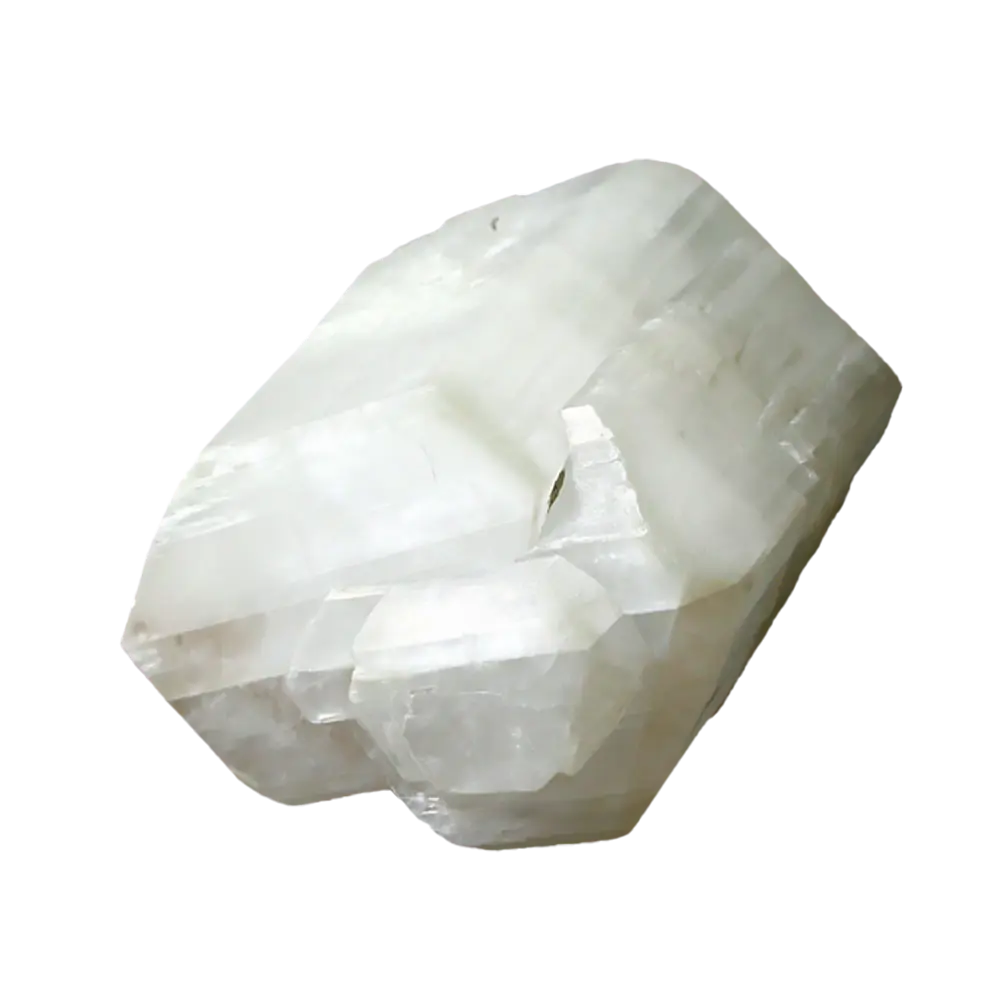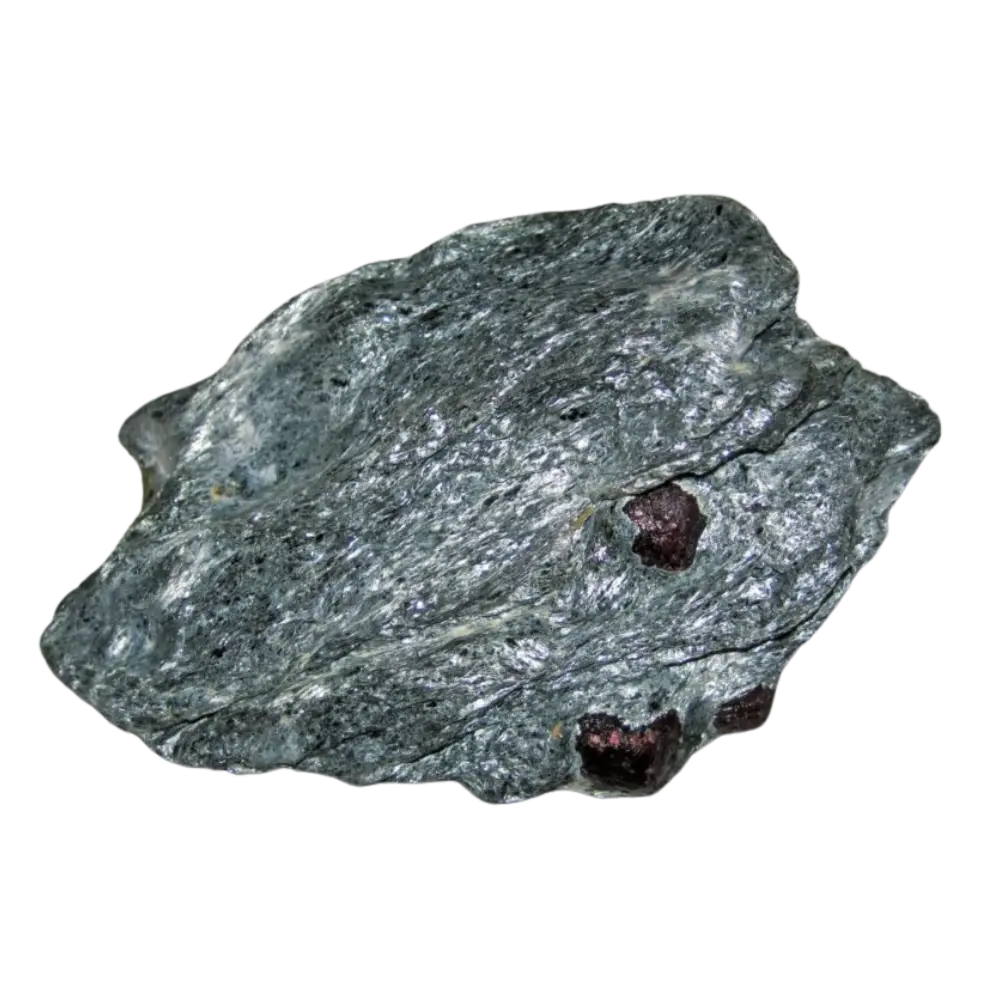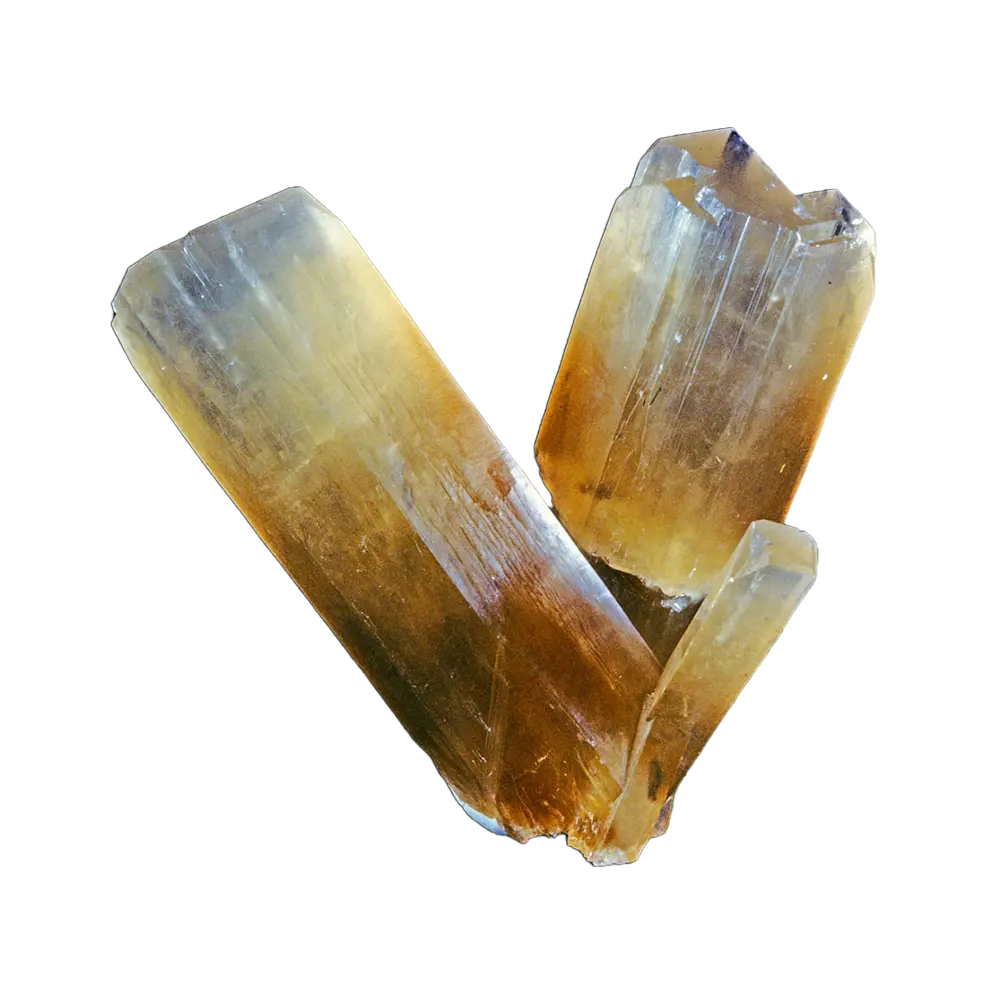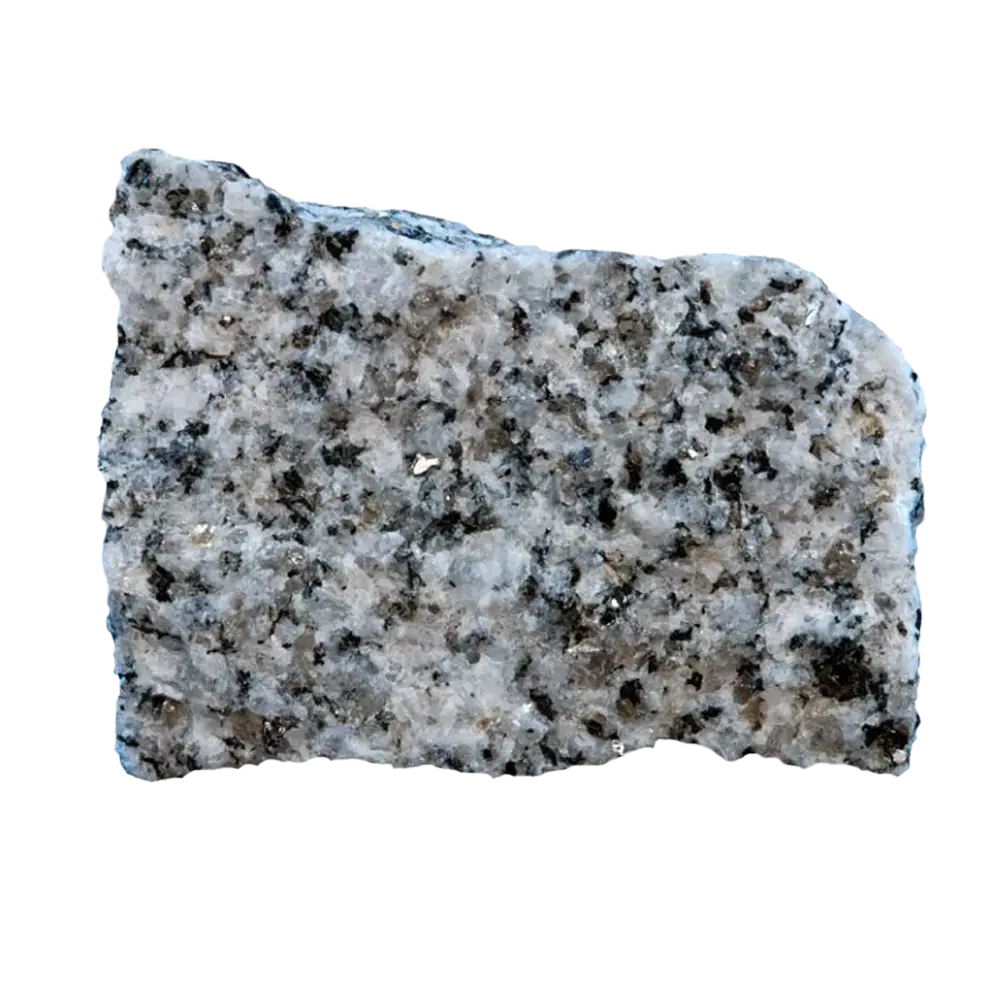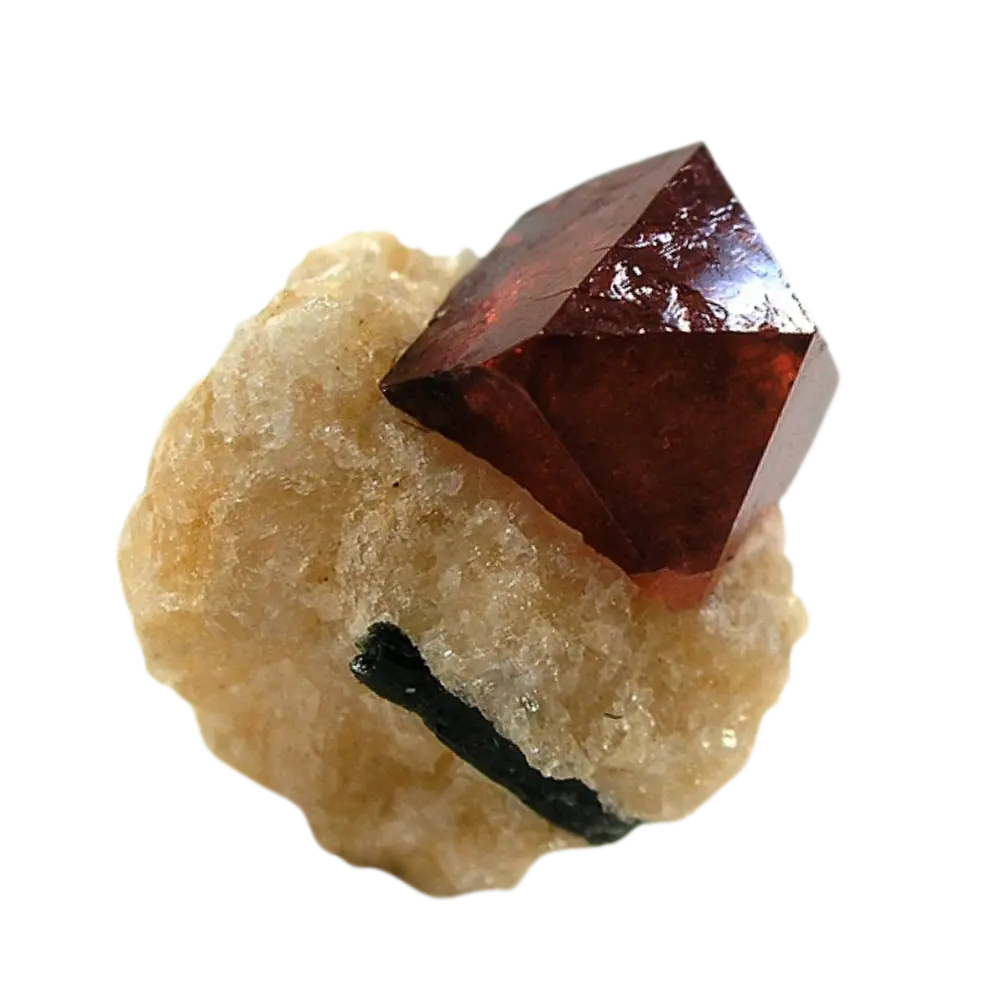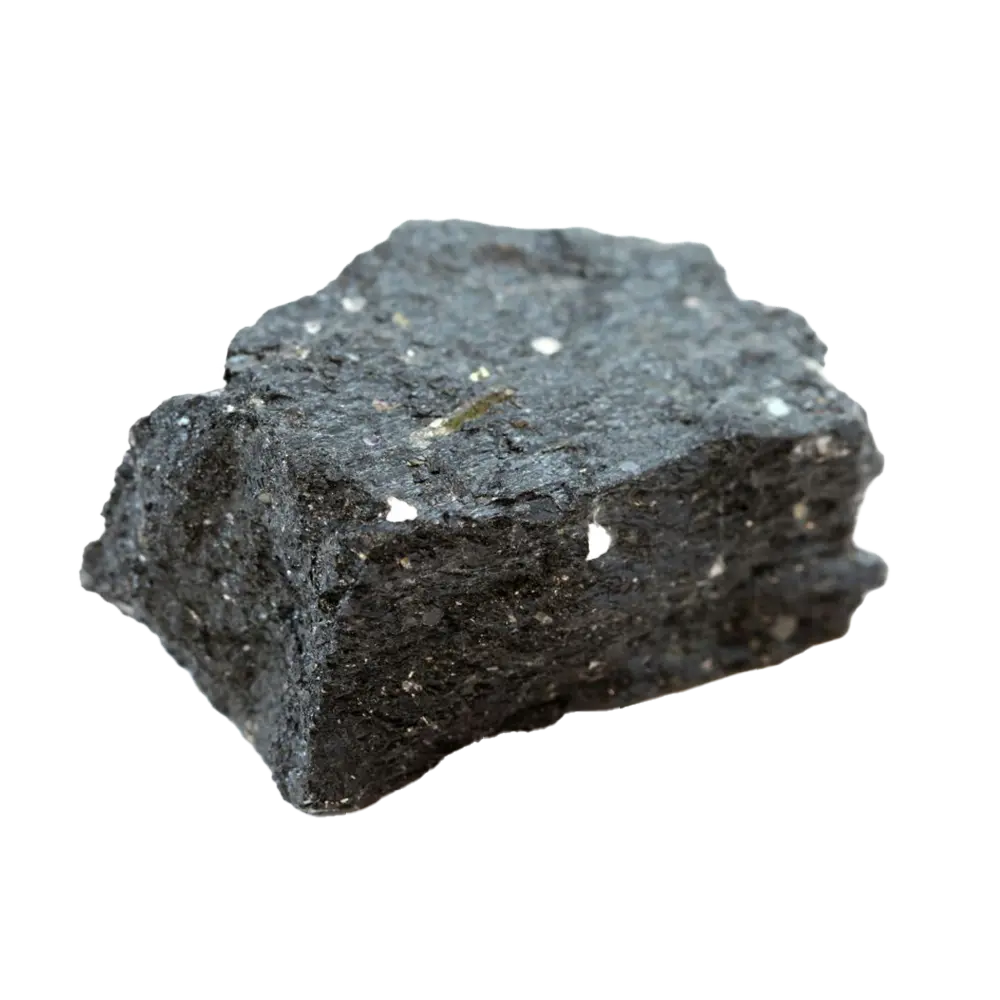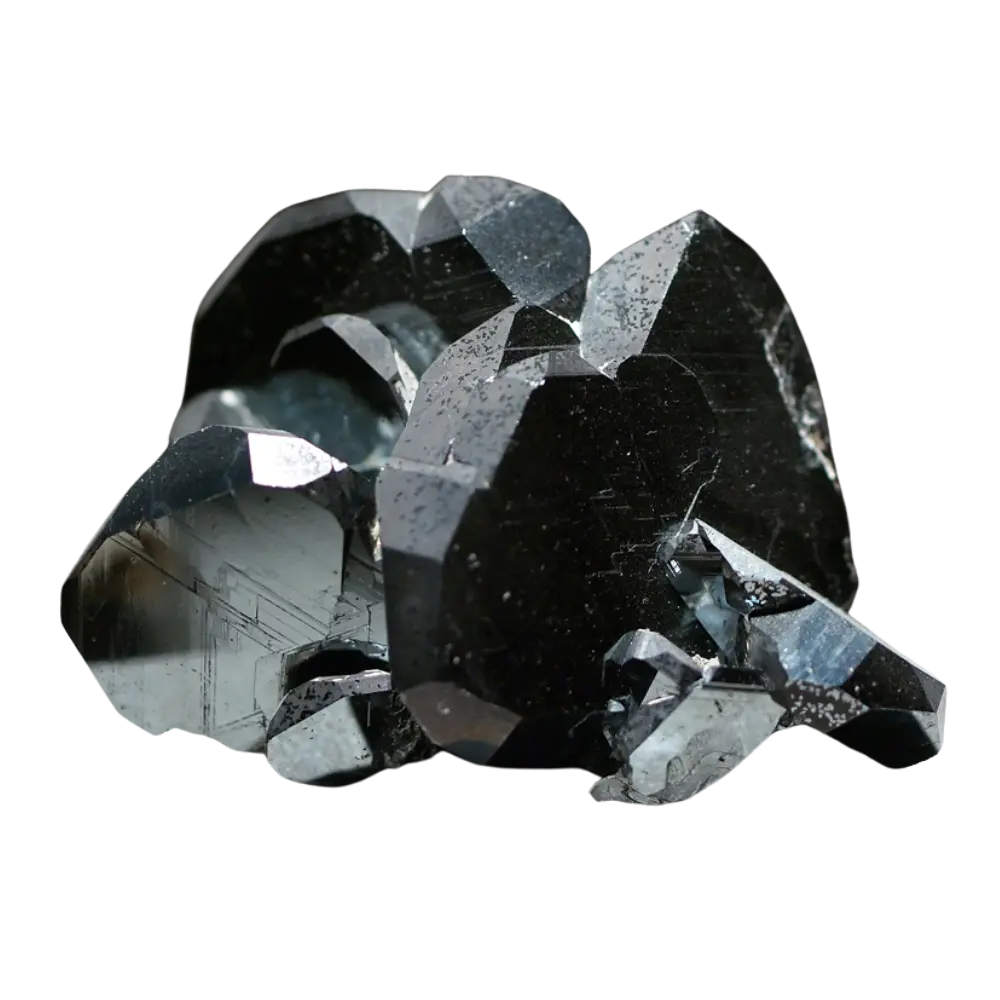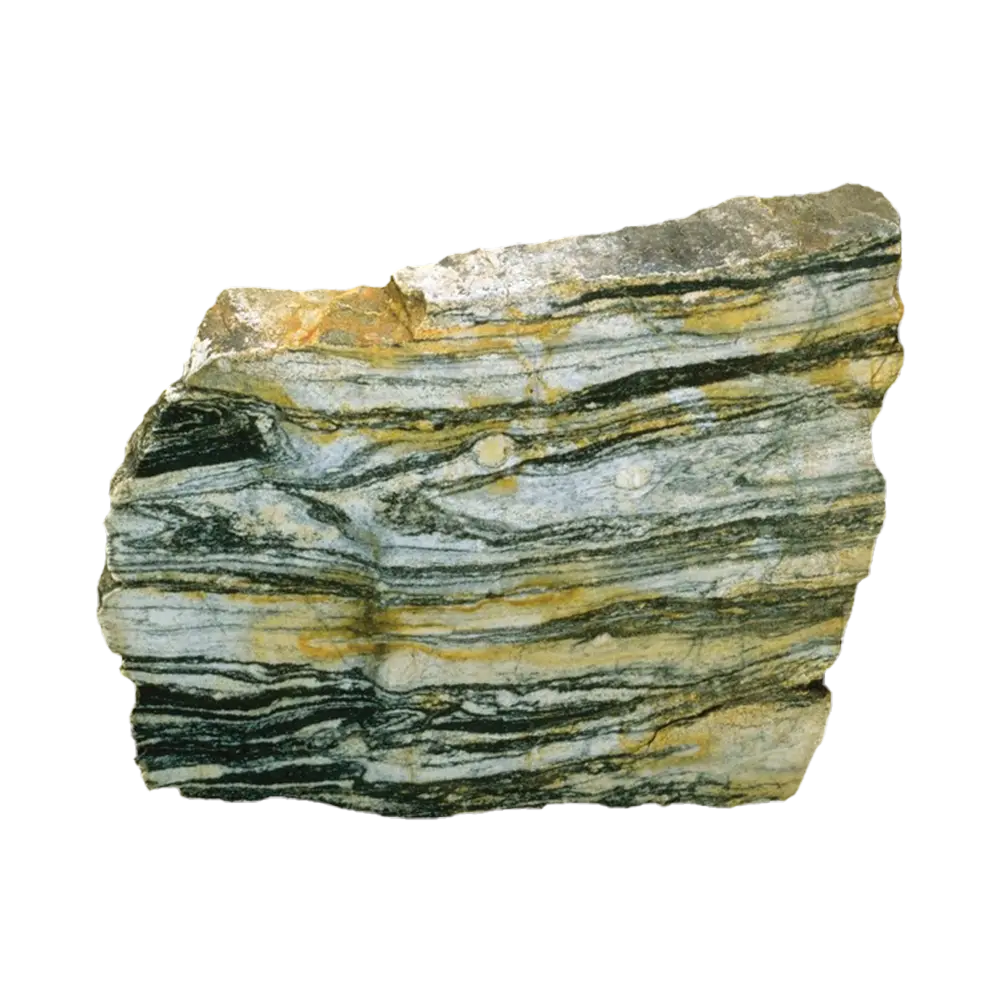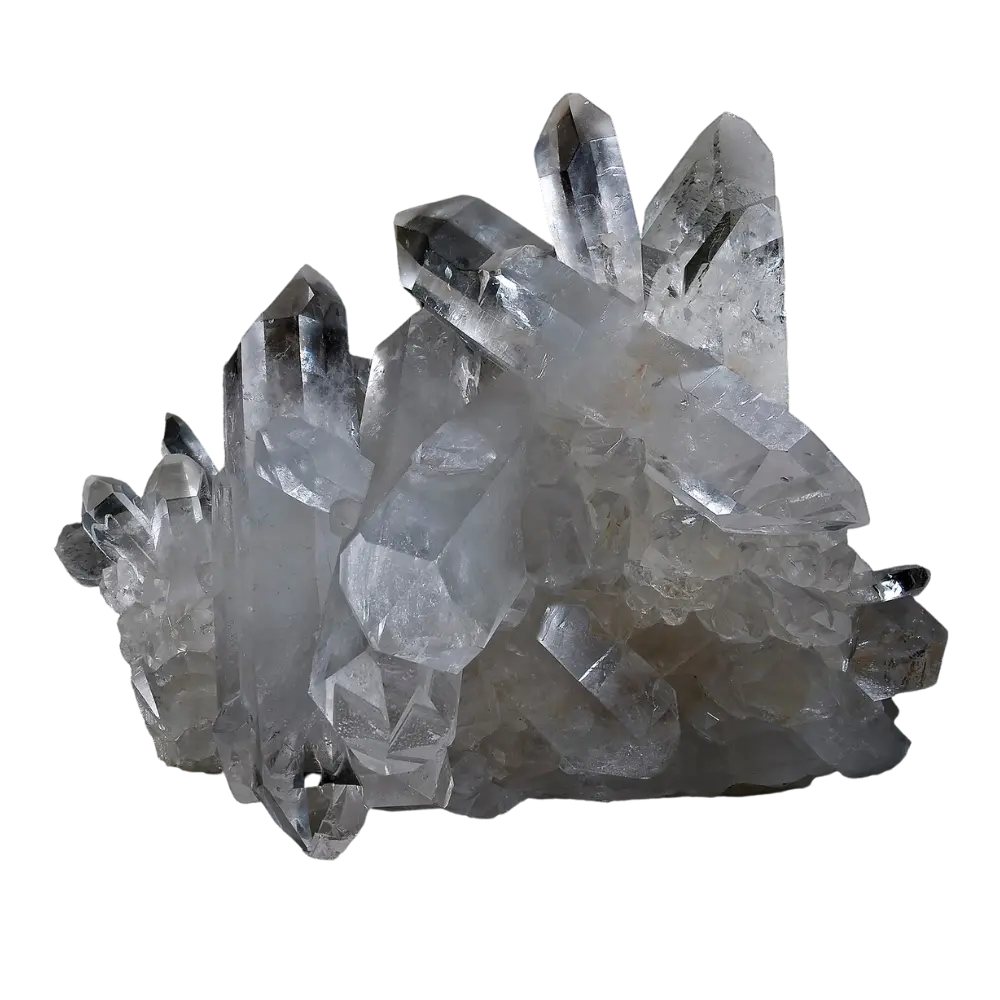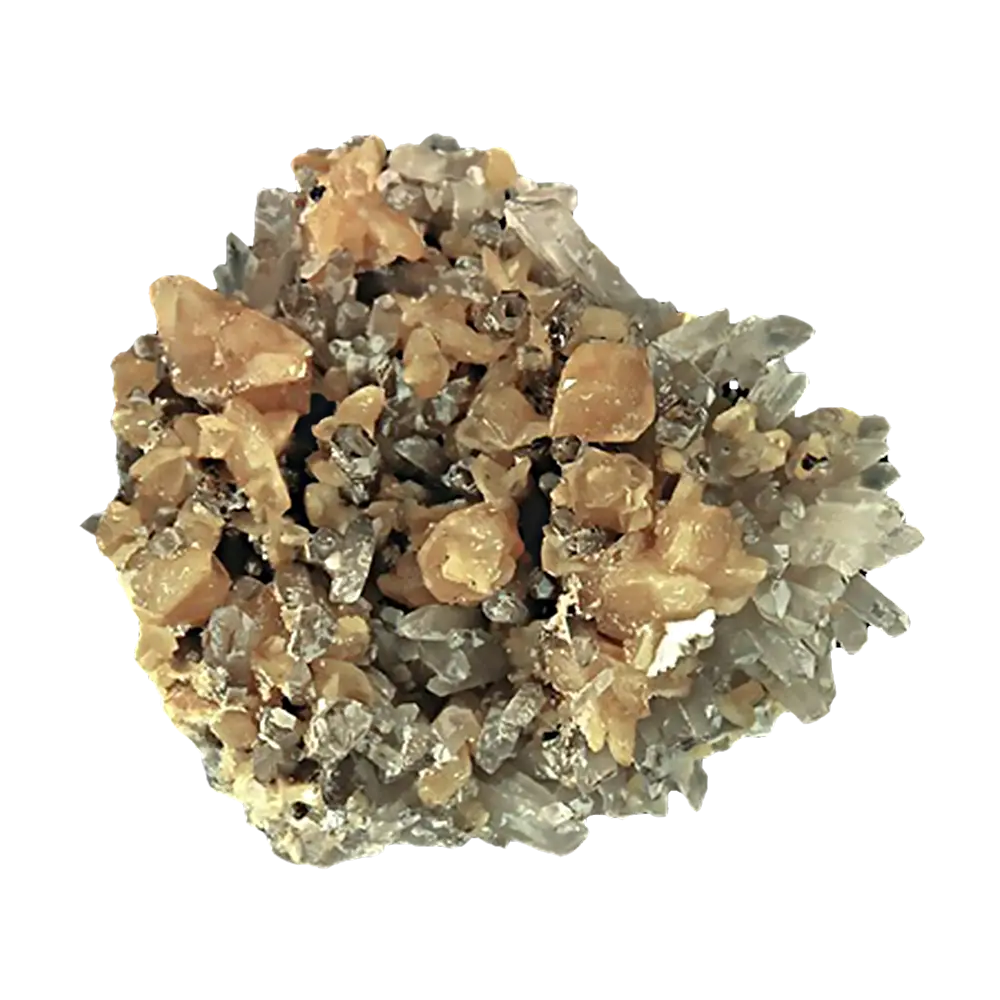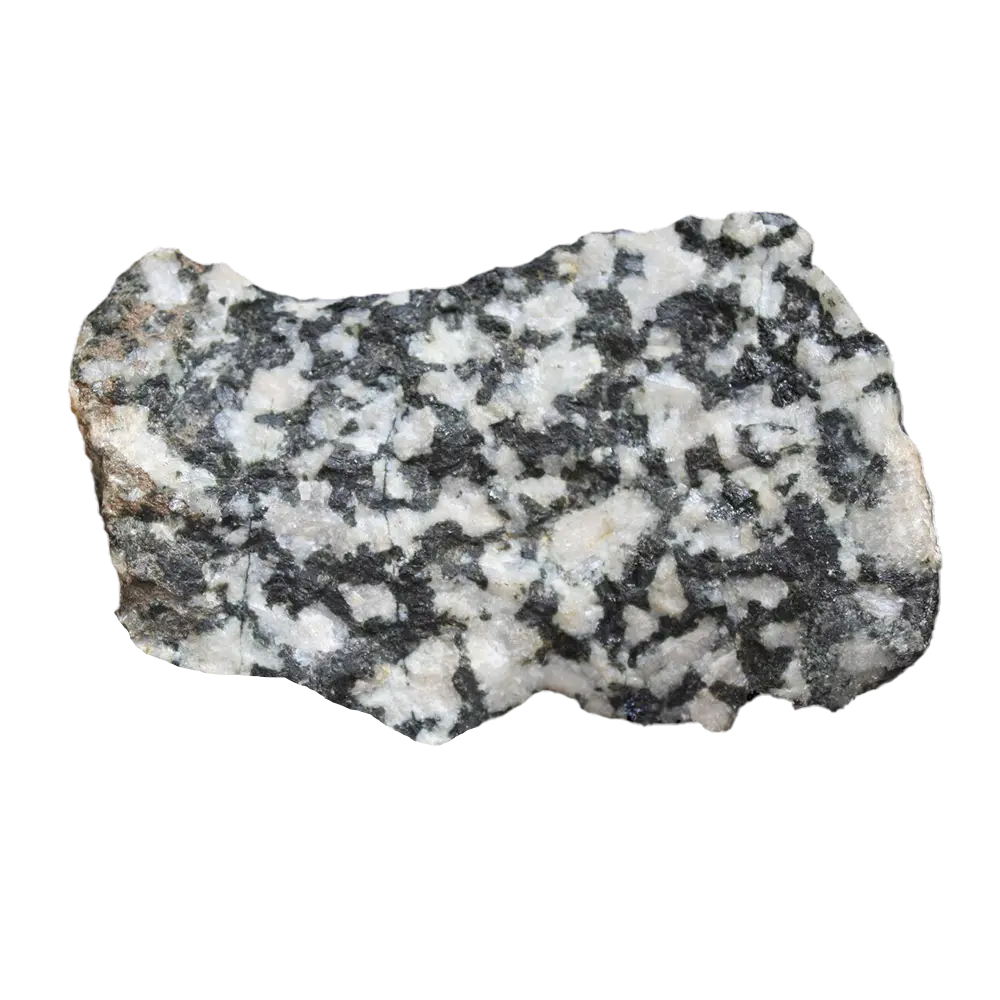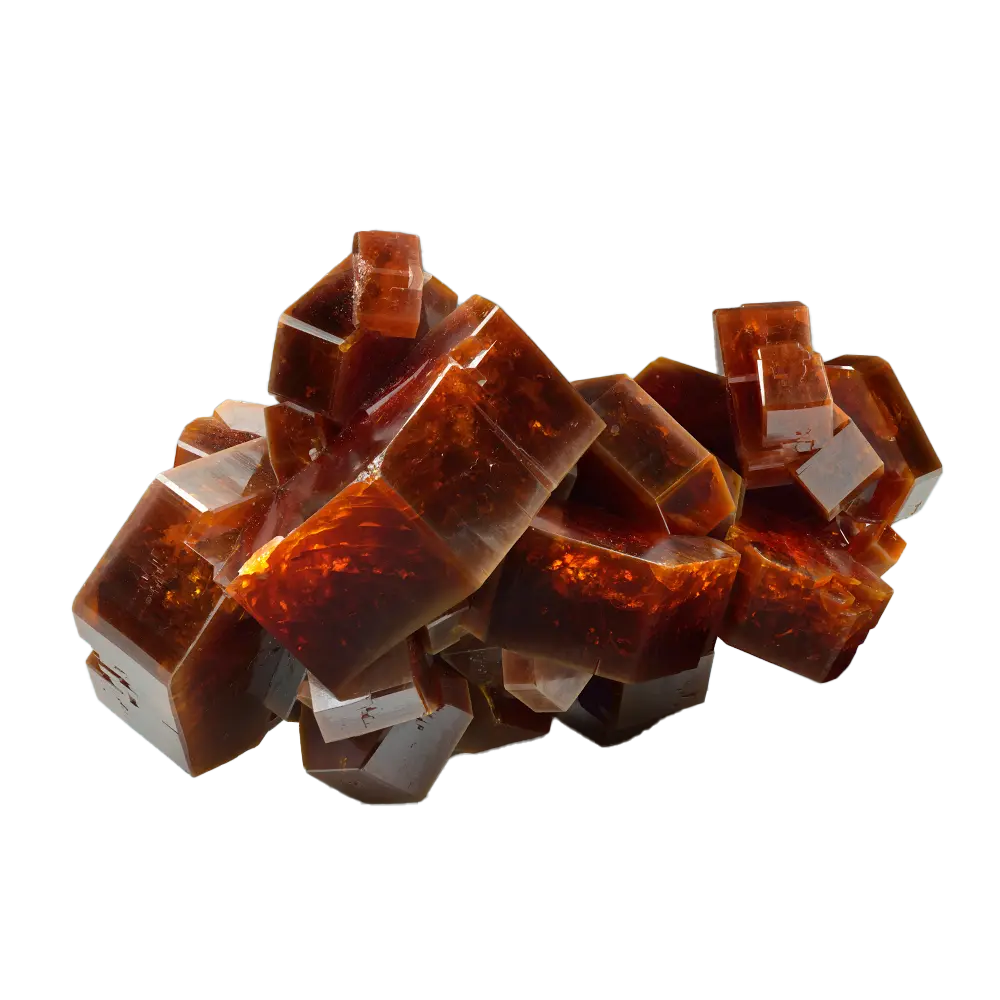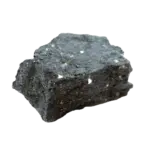
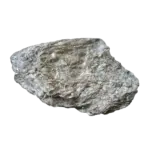
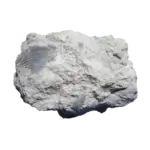
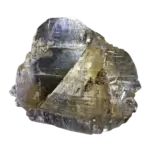
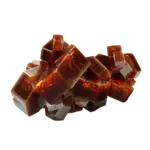
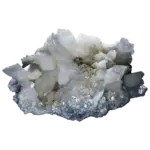
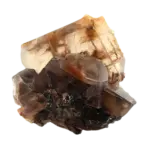
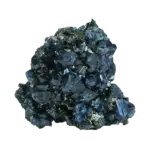
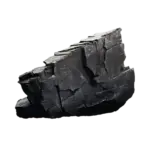
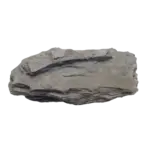
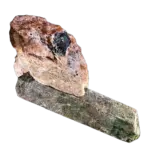
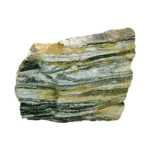
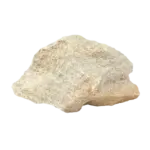
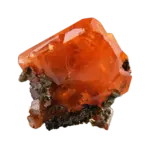
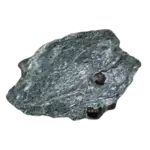
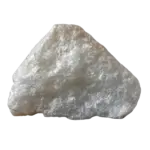
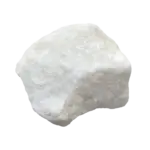
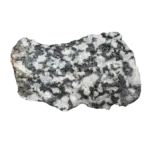
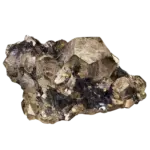
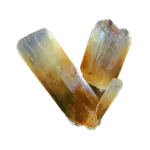
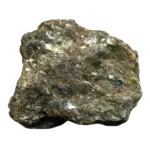
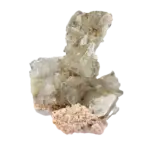
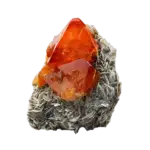
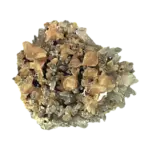
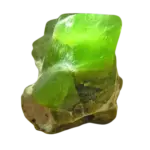
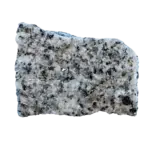
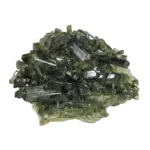
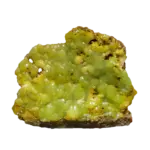
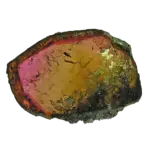
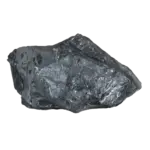
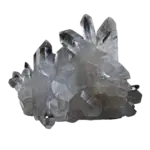
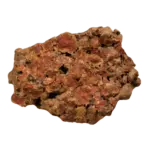
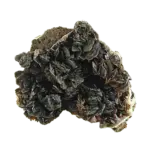
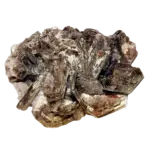
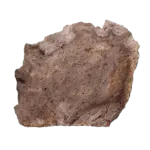
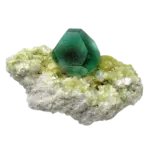
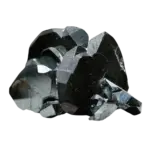
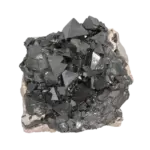
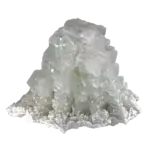
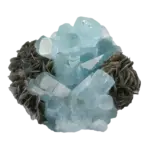
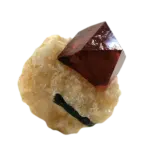
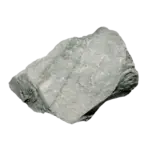
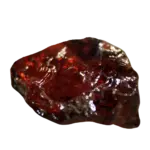
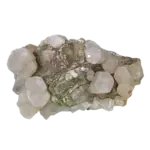
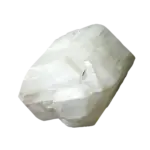
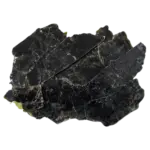
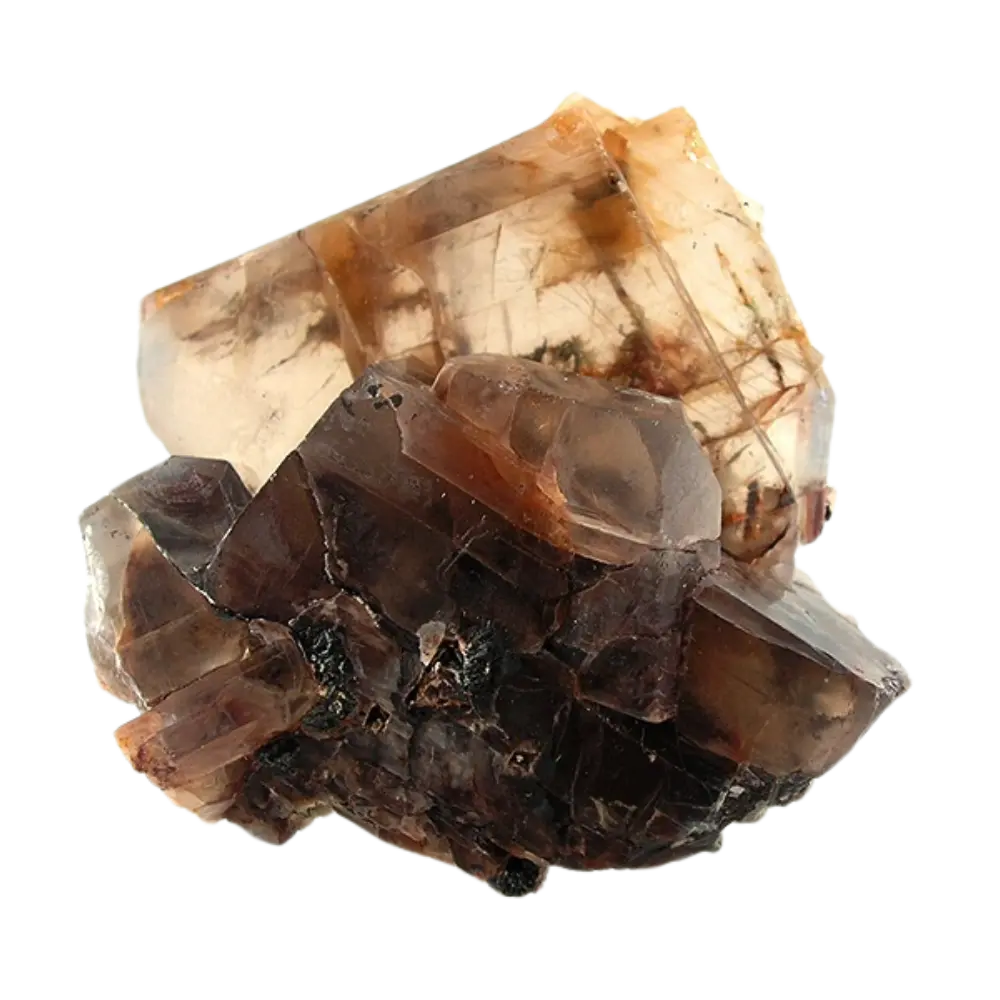
Feldspar is a group of aluminosilicate minerals that makes up roughly half of Earth’s continental crust and most of the lunar highlands. There are two main series, alkali feldspar (K–Na) and plagioclase (Na–Ca), and the group includes orthoclase, microcline, albite, anorthite and the gem varieties moonstone, sunstone, amazonite and labradorite.
Fact Sheet
- Mineral group: framework silicates (tectosilicates)
- Two main series: alkali feldspar (K–Na) and plagioclase (Na–Ca)
- General formula: (K,Na,Ca,Ba)(Al,Si)₄O₈
- Endmembers: KAlSi₃O₈ (orthoclase, microcline, sanidine), NaAlSi₃O₈ (albite), CaAl₂Si₂O₈ (anorthite), BaAl₂Si₂O₈ (celsian)
- Structure: corner-sharing SiO₄ and AlO₄ tetrahedra with K⁺, Na⁺, Ca²⁺ or Ba²⁺ in the framework cavities
- Hardness: 6 to 6.5 on Mohs; orthoclase is the Mohs-6 reference mineral
- Specific gravity: 2.55–2.76, up to 3.40 for celsian
- Cleavage: two planes near 90°, about 86° in plagioclase, close to 90° in alkali feldspar
- Lustre: vitreous to pearly
- Streak: white
- Color: typically white, pink, grey or buff; gem varieties show blue, green or red iridescence
- Crystal system: monoclinic (sanidine, orthoclase, celsian) or triclinic (microcline, plagioclase, anorthoclase)
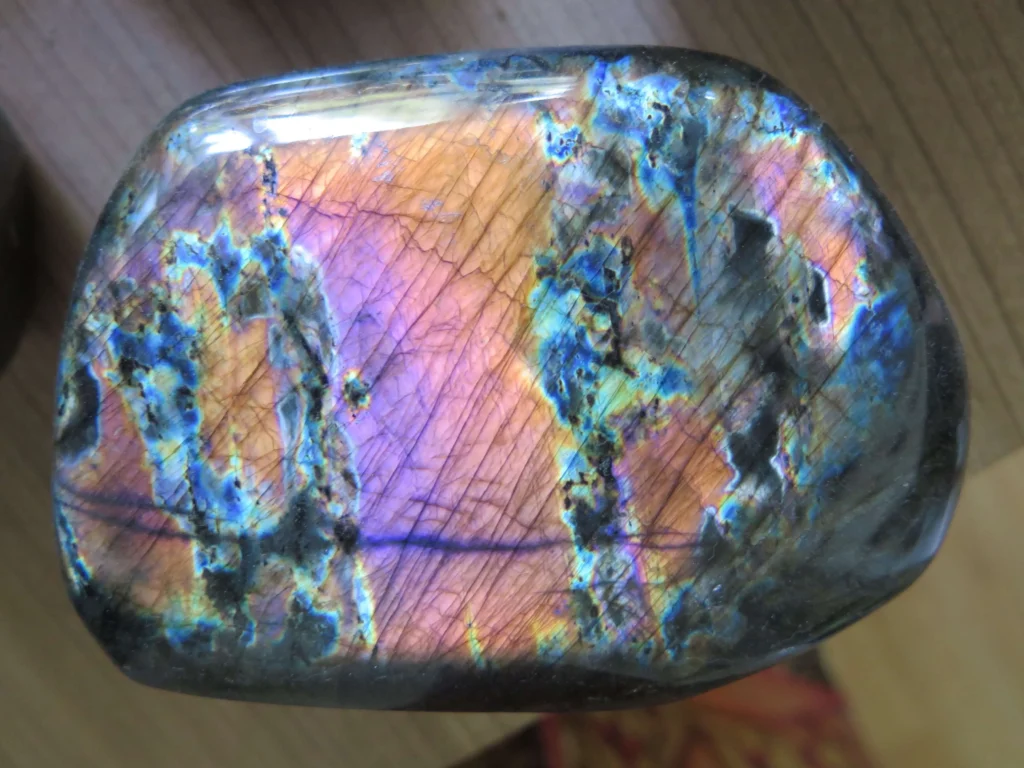
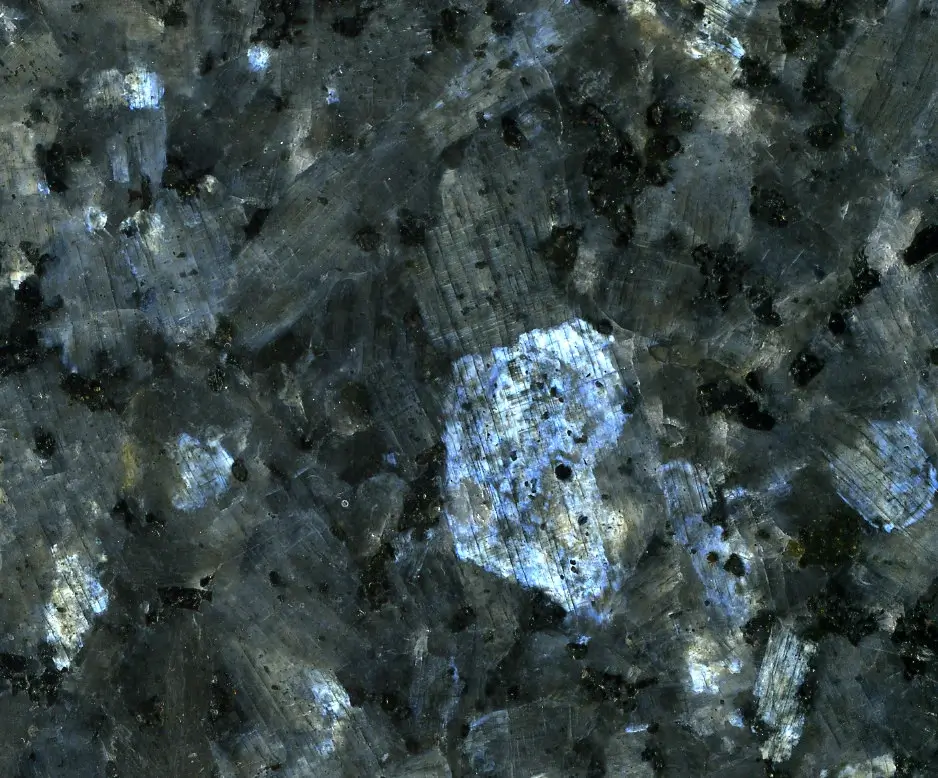
On the road south of Larvik, on the western edge of the Oslo Rift in Norway, glacially polished outcrops flash silver-blue when the sun crosses them at low angle. The rock there is larvikite, a Permian monzonite whose centimetre-sized feldspar crystals throw a slow blue-grey sheen called labradorescence as you walk past. The crystals doing the work are ternary feldspars, solid solutions of sodium, potassium and calcium endmembers, that unmixed on a sub-micron scale while the pluton cooled, around 295 million years ago. The same mineral group dominates the lunar highlands and tints most pink granite countertops. It is the single most abundant mineral family in the continental crust.
What is feldspar?
Feldspar is a group of aluminosilicate minerals that makes up roughly half of Earth’s continental crust. The group splits into an alkali series (K–Na endmembers) and a plagioclase series (Na–Ca solid solution). Structurally, feldspars are framework silicates built from corner-sharing SiO4 and AlO4 tetrahedra, with potassium, sodium, calcium or barium balancing the charge.
The framework accepts Na⁺, K⁺, Ca²⁺ and Ba²⁺ in its cavities, with coupled Al³⁺-Si⁴⁺ substitution in the tetrahedral sites keeping it charge-balanced. Because the major crustal cations all fit, feldspars dominate most common rocks.
Chemistry and crystal structure
Three endmembers plus one rare addition cover the chemistry. K-feldspar (KAlSi₃O₈) appears as three polymorphs, orthoclase, microcline and sanidine, distinguished by how Al and Si are ordered across the tetrahedral sites. Albite is NaAlSi3O8. Anorthite is CaAl2Si2O8. The barium feldspar celsian, BaAl2Si2O8, is rare but mineralogically important because it shows that the framework also accepts the much larger Ba2+. In all of them, half or a quarter of the tetrahedral sites are occupied by Al rather than Si, and the framework cavities hold the cations.
The crystal system depends on how Al and Si are distributed across the four non-equivalent tetrahedral sites. When the high-temperature melt cools quickly, the Al/Si distribution stays disordered and the structure is monoclinic: this is sanidine, the K-feldspar of rhyolites and trachytes. As cooling slows, Al migrates to specific sites, the symmetry drops to triclinic, and the same chemistry now expresses itself as microcline, the K-feldspar of slowly cooled granites and pegmatites. Orthoclase is the intermediate, partially ordered, still monoclinic form. Plagioclase is always triclinic because coupled Na++Si4+ ↔ Ca2++Al3+ substitution forces ordered Al positions.
Most feldspars also show characteristic twinning. Carlsbad twinning, common in orthoclase, is a rotation twin about the c-axis: two crystals are intergrown so they appear in hand specimen as a single prism with a visible composition plane down its length. Albite twinning produces the fine parallel striations on plagioclase cleavage faces, the field diagnostic that separates it from K-feldspar. Pericline twinning shows up on a different face. The name plagioclase, from the Greek for “oblique fracture”, and orthoclase, “straight fracture”, reflect the cleavage geometry: both species cleave on two planes near 90°, though plagioclase’s two cleavages meet at about 86° and alkali feldspar’s at close to 90°, neither is exactly orthogonal.
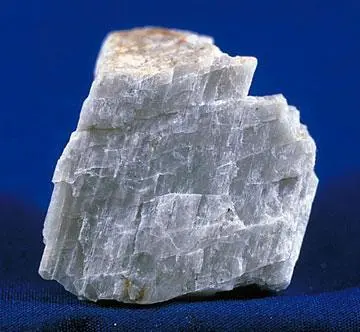
At high pressure the framework itself starts to change. Pakhomova and colleagues, using DESY’s PETRA III synchrotron in Hamburg and the Advanced Photon Source in Chicago, tracked single crystals of albite, anorthite and microcline to 27 GPa and published the results in Nature Communications in 2020. Below about 10 GPa the response is tetrahedral tilting; above that, AlO4 tetrahedra start converting to AlO5 and AlO6 polyhedra, producing dense high-pressure polymorphs that may persist metastably in cold subducted crust.
Physical properties
The group is unusually uniform in hardness and density given the chemical range. Orthoclase is the hardness-6 reference mineral on the Mohs scale; the other species run between 6 and 6.5. Specific gravities climb steadily as Ca replaces Na, then jump with Ba. Two cleavages meet near 90°, the lustre is vitreous to pearly, and most species are translucent to transparent in clean grains but chalky-opaque once weathered to clay.
| Species | Formula | System | Mohs | Specific gravity (g/cm³) |
|---|---|---|---|---|
| Sanidine | (K,Na)AlSi3O8 | Monoclinic | 6 | 2.56 |
| Orthoclase | KAlSi3O8 | Monoclinic | 6 | 2.55–2.63 |
| Microcline | KAlSi3O8 | Triclinic | 6–6.5 | 2.54–2.57 |
| Albite (An 0–10) | NaAlSi3O8 | Triclinic | 6–6.5 | 2.62 |
| Labradorite (An 50–70) | (Ca,Na)(Si,Al)4O8 | Triclinic | 6–6.5 | 2.69–2.72 |
| Anorthite (An 90–100) | CaAl2Si2O8 | Triclinic | 6–6.5 | 2.74–2.76 |
| Celsian | BaAl2Si2O8 | Monoclinic | 6–6.5 | 3.10–3.40 |
How it forms
Feldspar crystallizes across nearly the full range of igneous conditions, and re-equilibrates in metamorphic ones. In a cooling basaltic melt, calcic plagioclase appears first, around 1200 °C at low pressure, and the residual liquid drives later crystals toward more sodic compositions, the basis of Bowen’s continuous reaction series. In a granitic melt, alkali feldspar and a more sodic plagioclase crystallize together, often after quartz nucleates. The proportions of alkali feldspar, plagioclase and quartz are the axes of the QAPF diagram used to name plutonic and volcanic rocks.
Cooling, ordering and exsolution
During slow cooling, Al and Si migrate to their preferred tetrahedral sites, ordering the framework and dropping the symmetry from monoclinic to triclinic in the K-feldspars. Intermediate compositions also cross miscibility gaps in this temperature range, and a single homogeneous crystal unmixes into alternating lamellae of two slightly different compositions. In alkali feldspar, that produces perthite: thin sodic albite blebs in a potassic orthoclase or microcline host. The reverse texture, potassic blebs in plagioclase, is antiperthite. Where the two phases are comparable in volume it is called mesoperthite.
Plagioclase has its own gaps. In the peristerite gap, near An 0–17, very fine-scale unmixing produces the blue iridescence of some albite-oligoclase moonstones. In the Bøggild gap, near An 47–58 in the textbook approximation, lamellae of Na-rich (An 44–48) and Ca-rich (An 56–63) plagioclase alternate at periods of 128–252 nanometres and diffract visible light. That is labradorescence, first described by Danish mineralogist Ove Bøggild in 1924 and refined with transmission electron microscopy and atom-probe tomography by Jin and Xu in 2017. A third, less famous gap, the Huttenlocher, sits near An 67–90.
As a thermometer and chronometer
Because alkali feldspar and plagioclase coexisting in the same rock partition Na, K and Ca as a function of temperature, their compositions can be inverted for the temperature at which they last equilibrated. The standard model is Fuhrman and Lindsley’s ternary feldspar thermometer, published in American Mineralogist in 1988 and updated by Benisek, Dachs and Kroll in 2010. Two-feldspar thermometry routinely yields temperatures in the 600–1000 °C range for plutonic and granulite-facies rocks and is one of the more dependable petrological tools above amphibolite facies.
Two geochronological methods rely on K-feldspar. ⁴⁰Ar/³⁹Ar dating tracks cooling below about 150–300 °C. At the other extreme of timescales, infrared-stimulated luminescence (IRSL) of K-feldspar, pioneered by Hütt and colleagues in 1988, dates the last exposure of sedimentary grains to sunlight, with post-IR IRSL protocols now reaching back several hundred thousand years, well past the saturation limit of quartz OSL.
Where feldspar is found
Larvik, on the southern Oslo Rift, supplies the world’s commercial larvikite, the silvery-blue dimension stone that clads bank towers in dozens of capitals. The crystals are ternary feldspars showing both perthitic unmixing and labradorescence, and the larvikite intrusion was emplaced into Sveconorwegian gneisses during Permian rifting. The IUGS designated larvikite a Global Heritage Stone Resource in December 2017, in the first batch of designations alongside Portland stone and Carrara marble.
Ylämaa, in south-eastern Finland, is the type locality for spectrolite, a labradorite variety with an unusually wide colour gamut. The deposit was found in 1940 by Pekka Laitakari among the rock being quarried for Salpa Line tank obstacles, and named by his father Aarne Laitakari, then Director General of the Geological Survey of Finland, who had described similar colourful specimens and searched for their source for years. Nain, on the coast of Labrador, gives the species labradorite its name and supplies the deep-blue stones used in jewellery from the Nain Plutonic Suite, a 1.29–1.35 Ga anorthosite complex. Madagascar produces the bulk of the labradorite slabs currently sold.
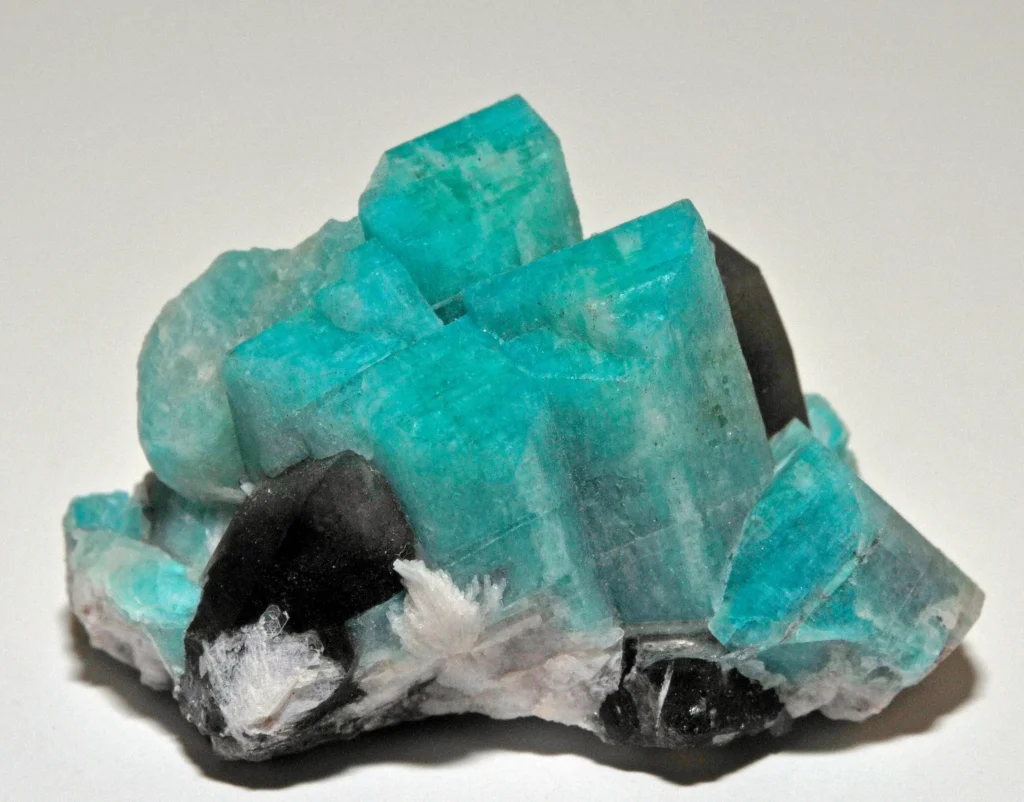
The Pikes Peak batholith in Colorado, emplaced 1.08 billion years ago, hosts miarolitic pegmatite pockets at Crystal Peak, Lake George and Glen Cove that have yielded the world’s finest amazonite, the lead-bearing green-blue variety of microcline, usually intergrown with smoky quartz. Plush, in Lake County, Oregon, is the type locality for Oregon sunstone, copper-bearing labradorite of about An 70 composition that became the official state gemstone in 1987. Tibet and Inner Mongolia produced the andesine at the centre of the 2005–2011 copper-diffusion controversy: laboratory work coordinated by GIA, the Gem Research Swisslab and George Rossman at Caltech showed that most red and red-green “andesine” entering the market had been artificially coloured by copper diffusion, although small quantities of naturally copper-bearing andesine exist.
Types of feldspar
Alkali feldspars
Sanidine is the high-temperature, disordered K-feldspar of rhyolites, trachytes and some quenched lavas. Orthoclase is the partially ordered, monoclinic form; the pink crystals in most pink granites are orthoclase or microcline. Microcline is the fully ordered, triclinic, low-temperature form. Anorthoclase sits on the Na-rich end of the alkali series, often with a triclinic structure and rhomb-shaped crystals, the diagnostic feldspar of larvikite and rhomb porphyry.
Plagioclase series
The petrologic convention divides the albite–anorthite solid solution into six fields by mole percent anorthite (An): albite (An 0–10), oligoclase (An 10–30), andesine (An 30–50), labradorite (An 50–70), bytownite (An 70–90) and anorthite (An 90–100). The IMA Commission on New Minerals, Nomenclature and Classification treats plagioclase as a continuous series, Warr’s 2021 standardized symbol set in Mineralogical Magazine assigned it the symbol “Pl”, with albite, labradorite and anorthite as the formally listed compositional anchors. Petrologists use all six names because they pin down magmatic and metamorphic conditions.
Barium feldspars
Celsian (BaAl2Si2O8) is found in barium-rich manganese deposits, most famously at Jakobsberg in Sweden. Hyalophane is its alkali-bearing intermediate. They are rare but useful tracers of Ba-rich hydrothermal systems.
Gem varieties
- Moonstone: orthoclase or sanidine with a thin cryptoperthitic intergrowth of albite, producing the floating blue or white sheen called adularescence. Sri Lanka and southern India are the historical sources.
- Sunstone: feldspar with reflective platelet inclusions (hematite, copper or goethite) producing aventurescence; Oregon sunstone owes its red and green colours to native copper nanoplatelets, as confirmed by Wang and colleagues in American Mineralogist in 2025 using localized surface-plasmon-resonance modelling.
- Amazonite: blue-green microcline coloured by an intervalence charge-transfer mechanism involving structurally bound Pb²⁺ and OH⁻/H₂O in the feldspar framework; Pikes Peak and the Konso district of Ethiopia are the leading sources.
- Labradorite and spectrolite: labradorescent plagioclase from the Bøggild gap.
Uses and significance
Industrial feldspar is shipped in two grades. The coarser, around 20 mesh, goes to glassmakers, where it supplies alumina that hardens the melt and improves chemical durability. The finer grade, 200 mesh or below, goes to ceramicists, where it acts as a flux, lowering the vitrification temperature of porcelain and tile bodies and binding the silica-clay matrix into a glassy phase on firing. According to the U.S. Geological Survey’s 2024 Mineral Commodity Summary, U.S. feldspar production in 2023 had an estimated value of $60 million, mined by six companies in California, Idaho, North Carolina and Virginia. Glassmaking accounted for an estimated 60 percent of domestic end-use distribution in 2023 and ceramics for most of the remainder; more recent USGS figures show the two end uses converging toward parity, with ceramics overtaking glass in 2025. Turkey, Italy, India and China dominate world production.
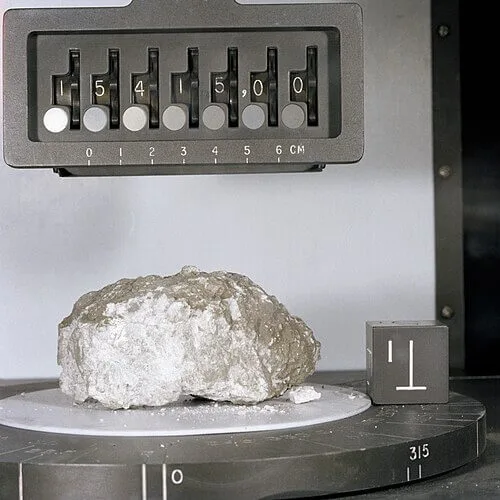
Feldspar also makes most of the Moon. The lunar highlands are dominated by ferroan anorthosite, rock that is more than 90 percent calcic plagioclase. Wood, Dickey, Marvin and Powell argued in 1970 that this crust formed by flotation of buoyant plagioclase on a global magma ocean. SELENE/Kaguya spectroscopic mapping reported by Ohtake and colleagues in Nature in 2009 revealed that some highland surfaces are essentially 100 percent plagioclase, tightening the magma-ocean constraint considerably. Anorthosite sample 60025, returned by Apollo 16, has been dated to 4.367 ± 0.011 Ga by Borg and colleagues in 2011 using concordant Sm-Nd and Pb-Pb chronometers. Michaut and Neufeld revisited the flotation model in Geophysical Research Letters in 2022, arguing for a long-lived slushy magma ocean rather than a single short-lived liquid layer.
Anorthite also figures in current climate-mitigation research. Among silicate minerals proposed for enhanced rock weathering, anorthite has one of the highest dissolution rates at near-surface conditions, and laboratory column experiments published in Frontiers in Climate in 2022 found that anorthite and albite released enough Ca and Na to consume measurable amounts of CO2 without the nickel-leaching problem of olivine. Whether feldspar-rich rock powders scale economically is unsettled.
How to identify it in the field
Feldspar’s standard field signature is two cleavages near 90°, hardness just above a steel knife, vitreous lustre and a pale colour, most often white, pink, grey or buff. To separate alkali feldspar from plagioclase in a hand specimen, look first for fine parallel striations on the brightest cleavage face: these are albite-law twin lamellae, diagnostic of plagioclase. Pink to salmon tones usually flag alkali feldspar; chalky white-to-grey surfaces with striations flag plagioclase. Under crossed polars in thin section, microcline often shows a ‘tartan’ cross-hatch pattern, the simultaneous expression of albite and pericline twin laws, distinctive enough to be a one-glance identification.
Weathered feldspar is its own clue. Because feldspar formed at high temperature is unstable in surface conditions, exposed grains alter to clay minerals: kaolinite for K-feldspar and Ca-poor plagioclase, smectite or sericite for more calcic plagioclase. The chalky look of a weathered granite face is feldspar partway through that conversion, and it is why feldspar contributes the second-largest detrital grain population in sandstones after quartz.
What remains uncertain or actively researched
The geometry of the lunar magma ocean’s flotation crust is unresolved. Pure anorthosite (greater than 98 percent plagioclase) is hard to form in standard fractional-crystallization models, the residual melt has to stay low enough in viscosity for plagioclase to separate cleanly. Recent work by Michaut and Neufeld in 2022 and by Dygert and colleagues argues for a stratified, slushy magma ocean and ‘serial magmatism’ in which lower-crustal plagioclase diapirs intrude older mixed crust. Lunar far-side samples returned by Chang’e-6 in 2024 should test this directly.
Exsolution kinetics in the Bøggild and peristerite intergrowths are also still being worked out. The width of the labradorescent compositional window, the exact diffusion paths during exsolution, and why some samples in the right composition fail to develop iridescence are being unpicked with atom-probe tomography and synchrotron diffraction (Jin & Xu 2017; European Journal of Mineralogy review 2022).
A more applied question is whether feldspar-rich rock dust can be deployed at gigatonne scale as a carbon-dioxide drawdown tool. Anorthite weathers fast on a mineralogical timescale, but whether the cost per tonne of CO₂ sequestered is competitive with direct air capture, and whether the soil-chemistry side-effects are acceptable, remain open. CarbonPlan’s 2023 review found that field measurements of enhanced-weathering fluxes lag the optimistic laboratory rates, sometimes by a factor of ten.
Frequently Asked Questions
What is feldspar used for? Most of it goes into glassmaking and ceramics. Coarser grades supply alumina that hardens glass; finer grades flux porcelain and tile bodies, lowering the temperature at which the clay-silica matrix vitrifies.
Is feldspar a rock or a mineral? A group of minerals, not a rock. Specifically, framework aluminosilicates split into an alkali series (K–Na) and a plagioclase series (Na–Ca). Rocks made mostly of feldspar include granite, anorthosite and larvikite.
How can you tell feldspar from quartz? Quartz has no cleavage and breaks conchoidally; feldspar cleaves on two planes near 90°. Quartz is harder (Mohs 7 vs 6). And quartz is almost always colourless or smoky in granite, while feldspar is white, pink or grey.
What is the difference between plagioclase and alkali feldspar? Plagioclase is a Na–Ca solid solution; alkali feldspar is K–Na. In hand specimen, plagioclase shows fine parallel striations on the brightest cleavage face (albite twinning) and alkali feldspar usually doesn’t.