Biotite

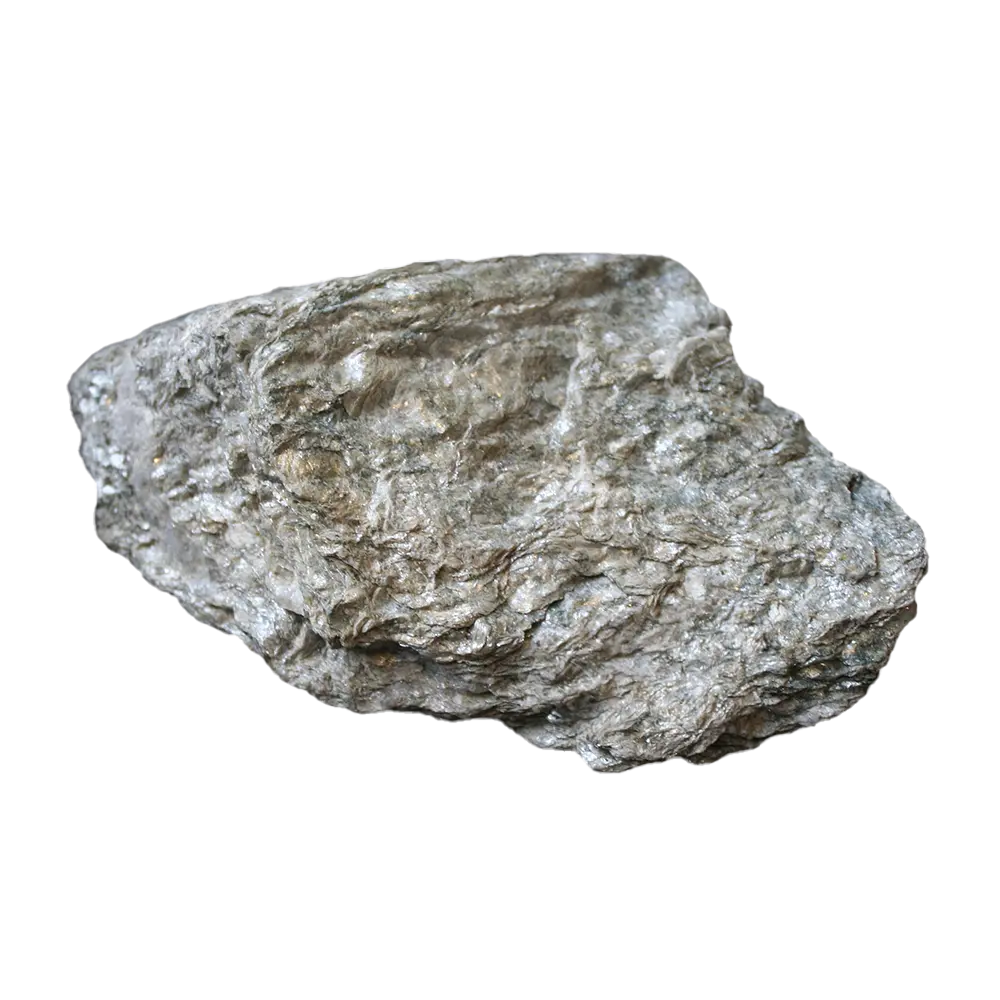
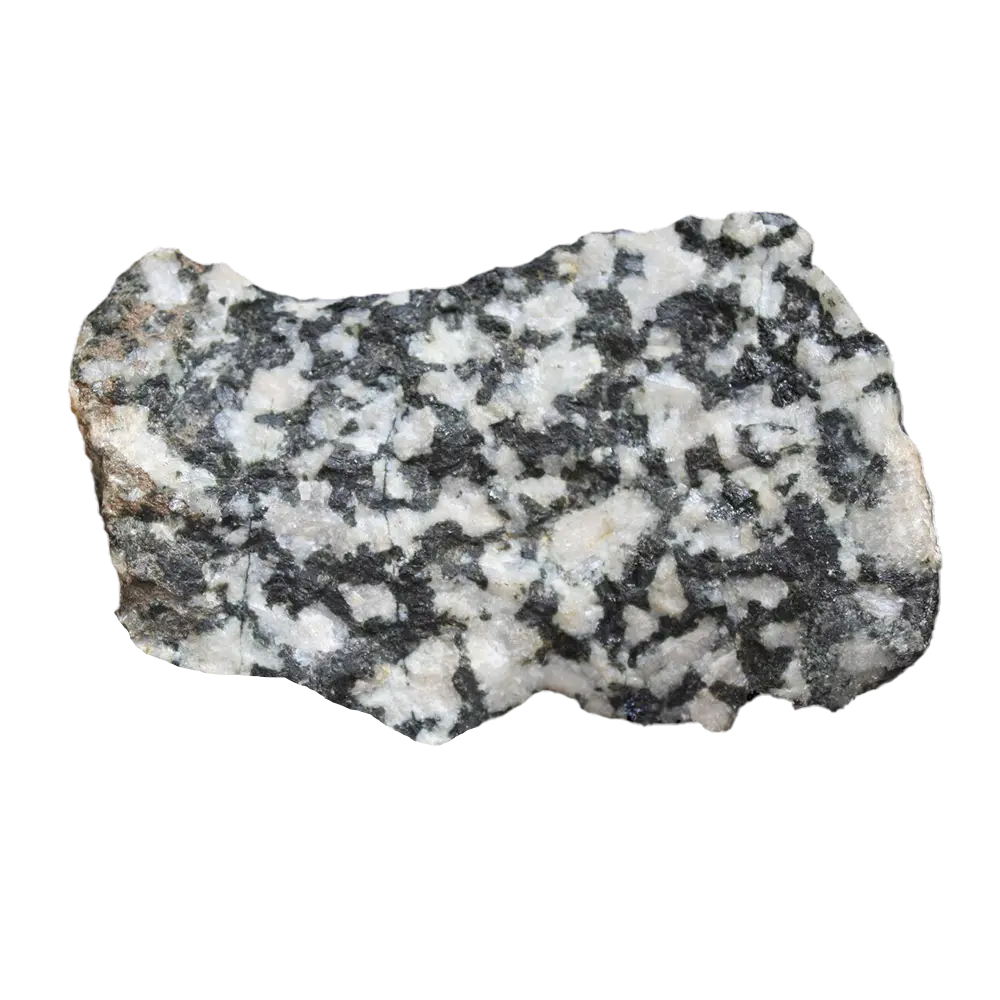
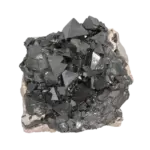
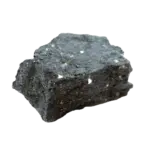
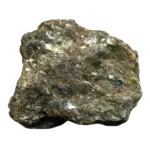
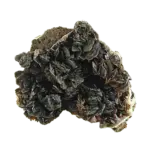
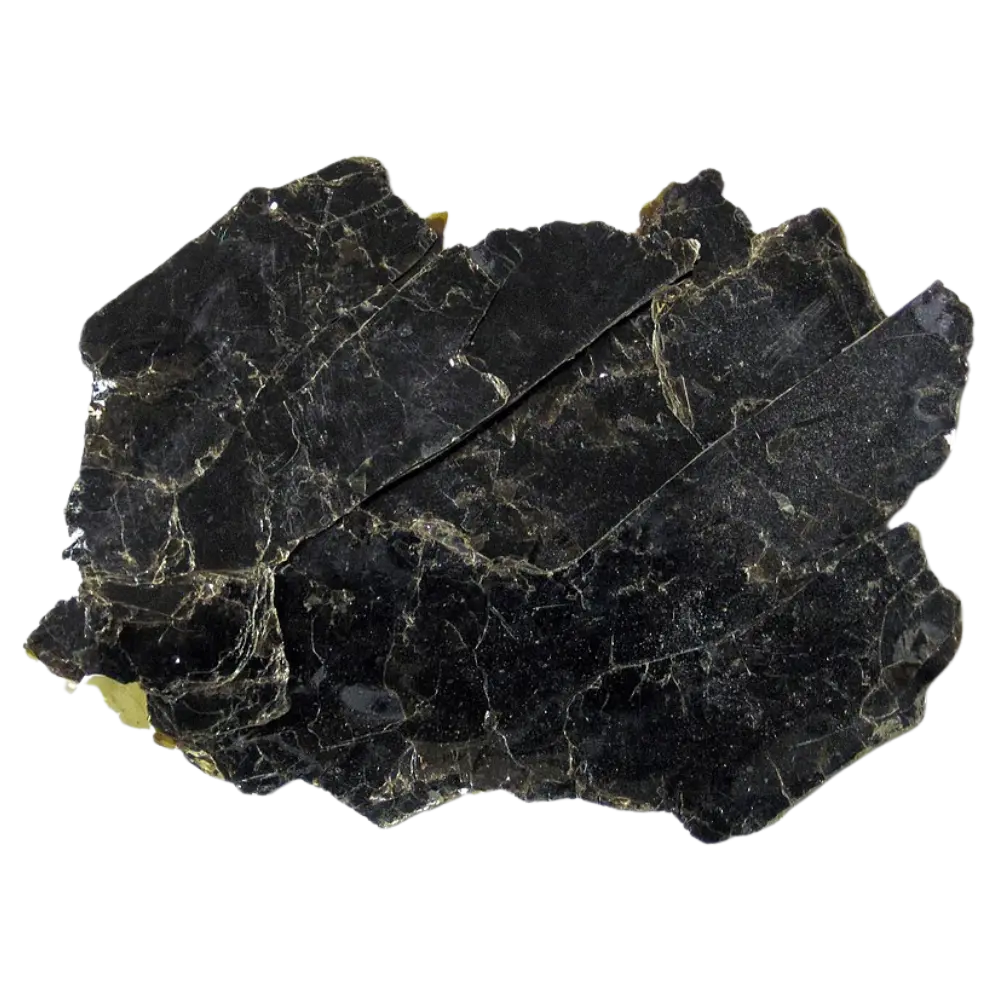
Dark black biotite mica mineral specimen
Pascal founder of Geoscopy

admin 

Biotite: the dark mica that records the age of mountains

Biotite is the most common dark mica in the Earth’s continental crust: a sheet silicate found in nearly every granite, schist, and gneiss you’ll ever pick up. It’s also one of the workhorses of modern geochronology: more igneous and metamorphic rocks have been dated using biotite than almost any other mineral. The dark flakes you see in a polished granite countertop are quietly carrying a record of when, and how fast, a mountain belt cooled.
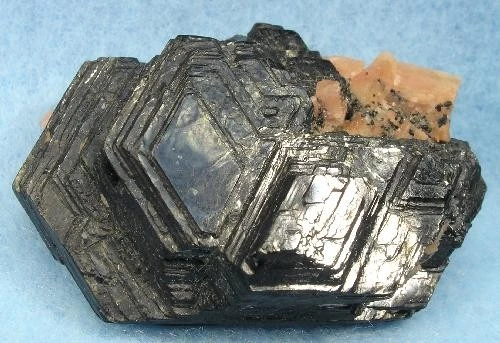
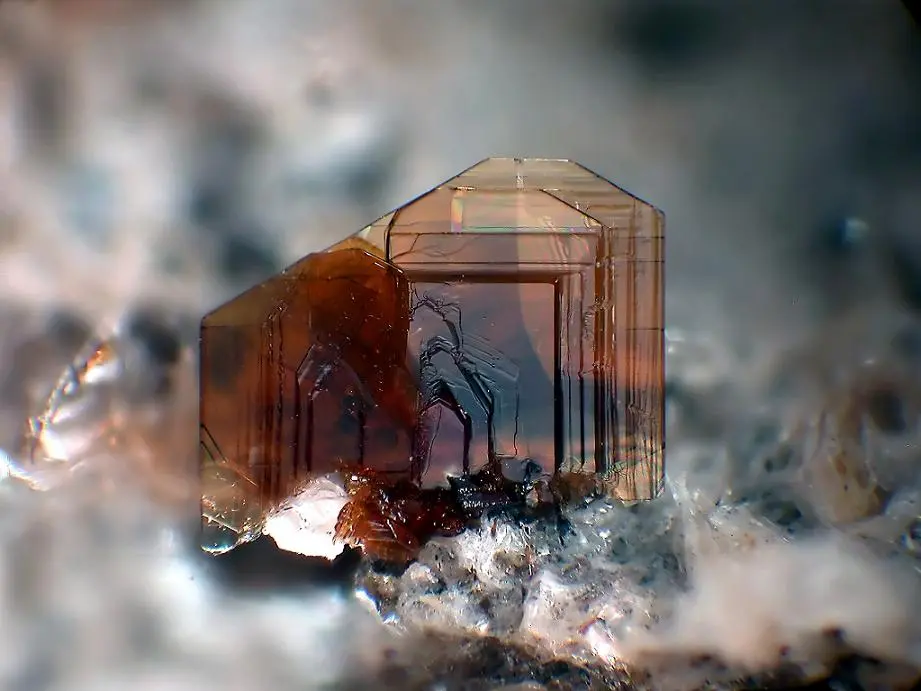
Pseudohexagonal biotite “book” on orthoclase matrix, Erongo Mountains, Namibia. Specimen ~8 cm. Photo by Robert M. Lavinsky, CC BY-SA 3.0.

Fact sheet

  • Mineral group: Mica group, trioctahedral subgroup (phyllosilicate)

  • Generalized formula: K(Mg,Fe)₃(AlSi₃O₁₀)(F,OH)₂

  • IMA status: Since 1998, “biotite” is a series name, not a valid mineral species. It covers trioctahedral micas between or close to the phlogopite–annite and eastonite–siderophyllite joins (Rieder et al., 1998).

  • Crystal system: Monoclinic (pseudohexagonal habit)

  • Hardness: 2.5–3 (Mohs)

  • Specific gravity: 2.7–3.4 (increases with iron content)

  • Cleavage: Perfect basal {001} splits into thin, flexible elastic sheets

  • Luster: Vitreous to pearly on cleavage surfaces

  • Streak: White to pale grey

  • Color: Black to dark brown when iron-rich; lighter brown to greenish-brown as Mg replaces Fe (grading toward phlogopite)

What “biotite” actually means

Older textbooks treat biotite as a single mineral species. It isn’t. The CNMMN Subcommittee on Nomenclature of the Micas (Rieder et al., 1998) redefined biotite as a compositional series within the trioctahedral micas, encompassing four end-members: phlogopite (KMg₃AlSi₃O₁₀(OH)₂), annite (KFe₃AlSi₃O₁₀(OH)₂), eastonite, and siderophyllite. Most “biotites” you’ll encounter sit somewhere between phlogopite and annite, with the Fe/(Fe+Mg) ratio doing most of the work in determining color and density.

The name itself dates to 1847, when Johann Friedrich Ludwig Hausmann coined it in honor of the French physicist Jean-Baptiste Biot, who in 1816 worked out the optical properties of mica that today let geologists identify it under a microscope in seconds.

How to identify it in the field

Biotite is one of the easiest minerals to identify with no equipment beyond a fingernail and a hand lens:

  • Dark color (black to brown), almost always in flat, flexible sheets

  • One perfect cleavage, flakes peel off cleanly, often called “books”

  • Soft enough that a fingernail will scratch it (Mohs 2.5–3)

  • Flexible and elastic: bend a sheet and it springs back. Chlorite, the most common look-alike, is flexible but not elastic; once you bend a chlorite flake, it stays bent
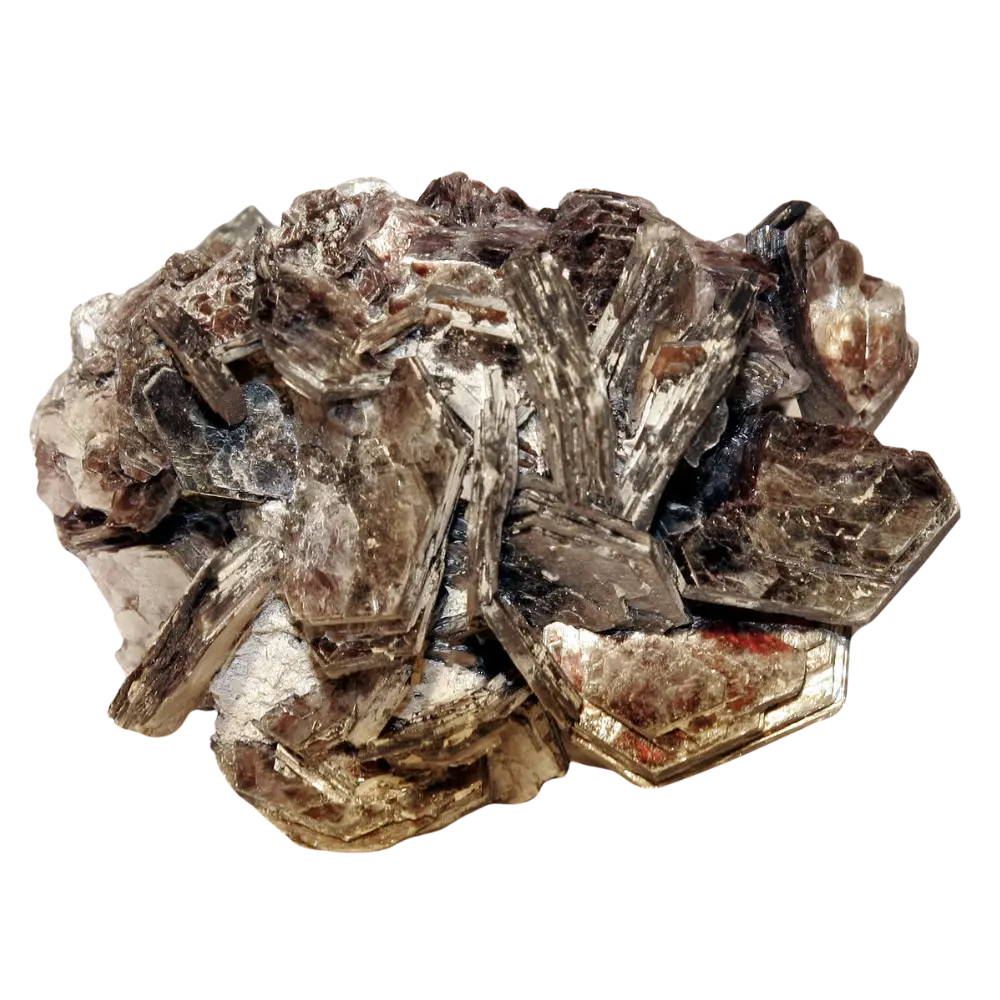
Biotite “book” showing perfect basal cleavage. The sheets can be peeled apart with a fingernail and remain elastic, a key field-identification feature distinguishing biotite from chlorite. Photo by Fred Kruijen, CC BY-SA (unmodified).

Under the microscope, biotite shows strong pleochroism (pale yellow to dark brown depending on orientation) and a characteristic “bird’s-eye extinction” under crossed polars. It commonly contains tiny inclusions of zircon or monazite surrounded by dark pleochroic haloes, radiation-damage rings produced over millions of years by the alpha decay of uranium and thorium in those inclusions. They are, in a real sense, fingerprints of deep time recorded in a single crystal.

Where biotite forms

Biotite is stable across an enormous range of pressures and temperatures, which is why it shows up almost everywhere in the crust.

Igneous rocks. Biotite is a primary mineral in most felsic to intermediate plutonic rocks: granite, granodiorite, tonalite, diorite, and pegmatite. It crystallizes from hydrous, K-rich silicate melts, typically forming after the first feldspars and quartz appear. Pegmatites in New England, Minas Gerais (Brazil), Bancroft (Ontario), and the Erongo Mountains (Namibia) are famous for producing centimetre-to-decimetre-sized euhedral biotite books. In volcanic rocks, biotite is rarer because it tends to break down at the low pressures of shallow magma chambers, but it appears as resorbed phenocrysts in some lamprophyres, dacites, and rhyolites, and famously in the lavas of Vesuvius and the Eifel volcanic field.
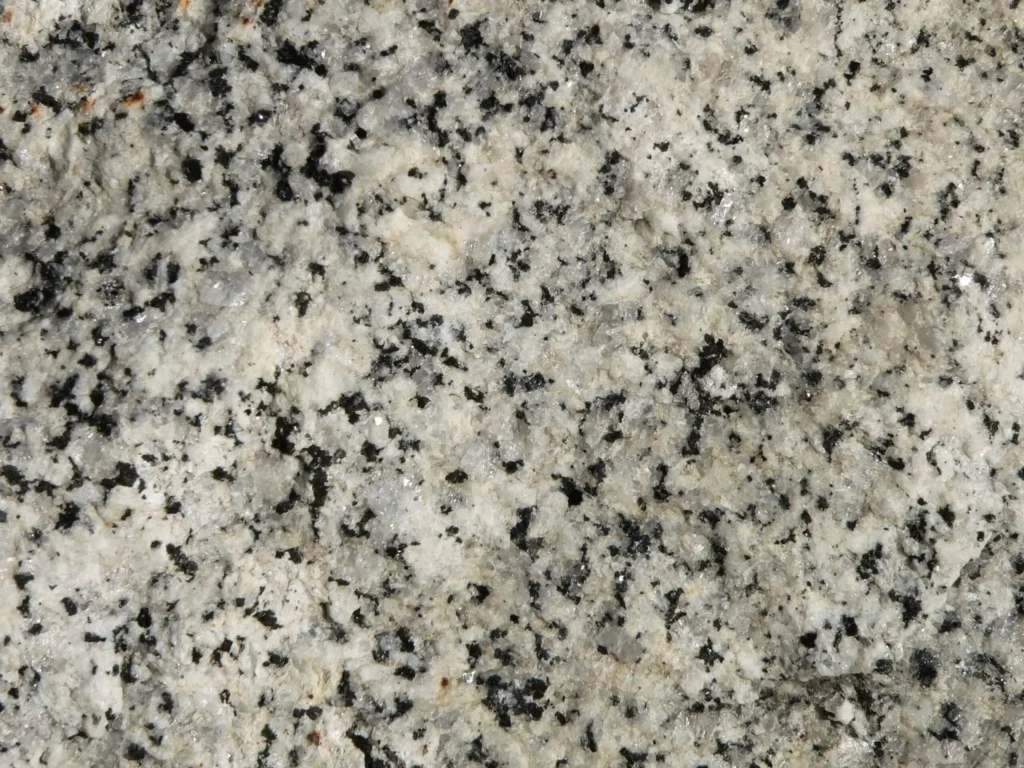
Biotite (the small black flakes) in granite, alongside pink alkali feldspar, white plagioclase, and grey quartz. In a typical granite, biotite makes up roughly 5–15 % by volume. Photo Copyright © 2007 by David Monniaux.

Metamorphic rocks. This is where biotite becomes an indispensable tool. In pelitic rocks (metamorphosed mudstones), biotite first appears at the upper end of greenschist facies, around 400–450 °C, through reactions that consume chlorite, muscovite, and K-feldspar. Its first appearance defines the biotite isograd, one of the six classic Barrovian index minerals first mapped by George Barrow in the Scottish Highlands and now recognized worldwide. The sequence chlorite → biotite → garnet → staurolite → kyanite → sillimanite is the standard reference for regional metamorphism in collisional orogens.

Why geologists actually care: dating mountains

Biotite contains roughly 6–9 wt % potassium, of which a small fraction is the radioactive isotope ⁴⁰K. Over time, ⁴⁰K decays to ⁴⁰Ar, which is trapped inside the crystal lattice. By measuring the ratio of these two isotopes, either directly (K–Ar) or via the more precise ⁴⁰Ar/³⁹Ar method, geologists can calculate when biotite last cooled below its argon closure temperature, around 300–350 °C.

That number matters because it makes biotite a thermochronometer: it doesn’t simply record the age of crystallization, it records the moment a rock cooled through ~300 °C as it was exhumed toward the surface. Biotite Ar–Ar ages from a single mountain belt let geologists reconstruct cooling histories, exhumation rates, and the tempo of orogenesis with remarkable precision. Biotite is also commonly used in Rb–Sr geochronology, which can yield even tighter age uncertainties (~0.3 %) on multi-collector ICP-MS systems (Charlier et al., 2006).

Alteration: from biotite to clay

Biotite weathers and alters readily. The most common reaction in nature is its retrograde transformation to chlorite, which produces the greenish, dull-lustred flakes you see in altered granites and low-grade metamorphic rocks. Further weathering converts biotite to vermiculite and eventually to kaolinite-group clays, releasing potassium, iron, and magnesium into soils. This is why biotite-rich rocks make notoriously poor building stones: the alteration creates iron-staining and weak basal partings that cause weathering and rust spots on granite curbstones, façades, and countertops.

Real uses (and a myth to retire)

Despite biotite’s abundance, it has surprisingly few direct industrial uses. The widely repeated claim that biotite is used as an electrical insulator is a confusion with muscovite, the colorless, iron-poor mica that dominates the commercial sheet-mica trade. Biotite’s iron content gives it lower dielectric strength and higher electrical conductivity, so it is not used in capacitors, transformers, or other dielectric applications.

The genuine uses of biotite are:

  • Geochronology and thermochronology, by far the most important application, as outlined above.

  • Metamorphic petrology: biotite-bearing assemblages are used in geothermobarometry (e.g., the garnet–biotite Fe–Mg exchange thermometer of Ferry & Spear, 1978) to estimate the temperatures and pressures rocks experienced.

  • Soil amendment, niche use: finely ground biotite is sometimes sold as a slow-release potassium and trace-element source for agriculture, though it is far less common than muscovite-derived “rock dust” products.

  • Cosmetics, occasional: biotite is sometimes used alongside muscovite as a darker-toned shimmer pigment, though muscovite dominates this market.
Share Rock

more rocks.minerals

View All
Dark gray shale rock sample

Shale

Sample of apatite mineral crystal

Apatite

Shist rock example

Schist

Green fluorite crystal on yellowish mineral matrix

Fluorite

Dark black biotite mica mineral specimen

Biotite

Shiny metallic pyrite mineral cluster

Galena

Calcite crystals on metallic mineral surface

Calcite

Polished sample of a gneiss rock

Gneiss

Clear barite crystal mineral specimen

Barite

Beryl crystals with brown mineral base

Beryl

Rough beige sandstone rock on white background

Sandstone

Dark blue scorodite crystal cluster mineral specimen

Scorodite

Borax mineral specimen

Borax

Borax is a sodium borate used in cleaning and glassmaking.

Read more
Shiny metallic pyrite mineral cluster

Pyrite

Pyrite, or “Fool’s Gold,” is used for sulfur and iron production.

Read more
Amphibole sample on white background

Amphibole

Amphibole is a diverse mineral group used for geological indicators and as insulation.

Read more
Gray quartzite rock on white background

Quartzite

Quartzite, a durable metamorphic rock made of quartz, is used in construction and countertops.

Read more
Shist rock example

Schist

Schist, a layered metamorphic rock rich in mica and quartz, is often used in construction.

Read more
Descloizite mineral crystal cluster

Descloizite

Descloizite is a lead-zinc vanadate mineral, mainly found in Namibia and Mexico.

Read more
Close-up of a granite rock sample

Granite

Granite is a durable igneous rock used in construction, monuments, and countertops.

Read more
Brown volcanic rock texture close-up

Rhyolite

Rhyolite, a silica-rich volcanic rock, is used in construction and research.

Read more
Shiny metallic pyrite mineral cluster

Galena

Galena is the main ore of lead and silver, used in batteries and shielding.

Read more
Limestone rock with visible fossil imprint

Limestone

Limestone, mainly calcium carbonate, is used in construction, cement, and water treatment.
Read more
Dark black biotite mica mineral specimen

Biotite

Biotite is a dark mica mineral used in insulation and geological studies.
Read more
Shiny black magnetite crystal mineral specimen

Magnetite

Magnetite, an iron oxide with magnetic properties, is used in steel production and catalysts.

Read more
Marble close-up

Marble

Marble, a calcium carbonate metamorphic rock, is used in sculpture, architecture, and countertops.

Read more
Green fluorite crystal on yellowish mineral matrix

Fluorite

Fluorite, a colorful calcium fluoride, is used as flux in steelmaking, glass, and as gemstones.

Read more
White halite rock salt crystal cluster

Halite

Halite, or rock salt, is a sodium chloride mineral used for seasoning, de-icing, and industry.

Read more
Muscovite mineral

Muscovite

Muscovite, a mica mineral, is used in insulation, fireproofing, and cosmetics.

Read more
Orange scheelite crystal on gray matrix rock

Scheelite

Scheelite, a calcium tungstate, is the main source of tungsten for tools and alloys.

Read more
Vanadinite crystal cluster on white background

Vanadinite

Vanadinite is a bright red mineral, primarily sourced from lead deposits.

Read more
Polished sample of a gneiss rock

Gneiss

Gneiss is a durable, banded metamorphic rock used in construction and decoration.

Read more
Monazite mineral crystal cluster

Monazite

Monazite, a group of rare earth minerals, is a key source of rare earth elements.

Read more
Piece of red and brown bauxite ore

Bauxite

Bauxite is the main aluminum ore, primarily found in Australia.

Read more
White dolomite crystal mineral cluster

Dolomite

Dolomite is a calcium magnesium carbonate used in construction and agriculture.

Read more
Dark gray shale rock sample

Shale

Shale, a fine-grained sedimentary rock, is used for natural gas, cement, and research.

Read more
Cluster of shiny brown mica crystals

Mica

Mica is a group of silicate minerals with varying compositions mainly in insulation and electronics.

Read more
Zircon crystal on beige mineral rock

Zircon

Zircon is a durable mineral used in jewelry, geological dating, and ceramics.

Read more
Bright yellow-green adamite specimen close-up

Adamite

Adamite is a rare, colorful orthorhombic mineral prized by collectors for its vibrant crystals.

Read more
Brown crystals of feldspar mineral specimen

Feldspar

Feldspar is an aluminum silicate used in ceramics, glass, and construction.

Read more
Rough beige sandstone rock on white background

Sandstone

Sandstone, composed of quartz and feldspar, is used in construction, paving, landscaping, and glassmaking.

Read more
Colorful watermelon tourmaline crystal slice

Tourmaline

Tourmaline is a colorful boron silicate mineral used as a gemstone and in electronics.

Read more
Metamorphic rock with dark red garnet crystals

Chlorite

Chlorite, a green phyllosilicate mineral, is used as a geological indicator and industrial filler.

Read more
Talc mineral

Talc

Talc, the softest mineral, is used in baby powder, cosmetics, ceramics, and plastics.

Read more
Beryl crystals with brown mineral base

Beryl

Beryl is a gemstone mineral, including emerald and aquamarine, and a source of beryllium.

Read more
Wulfenite crystal specimen

Wulfenite

Wulfenite is a bright orange or yellow mineral, prized by collectors.

Read more
Large basalt on white background

Basalt

Basalt is a dark, fine-grained igneous rock used in construction, monuments, and geological studies.

Read more
Shiny black coal

Coal

Coal, mainly carbon, is used for energy and steel production.

Read more
Dark blue scorodite crystal cluster mineral specimen

Scorodite

Scorodite, a hydrated iron arsenate, is valued for arsenic containment and as a collector’s mineral.

Read more
Green pyroxene crystal mineral specimen

Pyroxene

Pyroxene, a silicate mineral group found in igneous and metamorphic rocks.

Read more
Calcite crystals on metallic mineral surface

Calcite

Calcite is a trigonal calcium carbonate mineral used mainly in construction for making cement.

Read more
Diorite rock close up

Diorite

Diorite is a tough igneous rock used in construction, art, and in research.

Read more
Shiny metallic hematite crystal cluster

Hematite

Hematite is an iron oxide mineral used for iron ore, pigments, and radiation shielding.

Read more
Raw red garnet gemstone close-up

Garnet

Garnet is a group of silicate minerals used as gemstones and abrasives.

Read more
White kernite crystal

Kernite

Kernite is a boron-rich mineral used in glassmaking, detergents, and ceramics.

Read more
Bright green olivine crystal mineral specimen

Olivine

Olivine, a magnesium iron silicate, is used in gemstones (peridot) and refractory materials.

Read more
Clear barite crystal mineral specimen

Barite

Barite is a barium sulfate mineral used in drilling, shielding, and paints.

Read more
Clear quartz crystal cluster on black background

Quartz

Quartz, a silicon dioxide mineral, is used in jewelry and electronics.

Read more
Sample of apatite mineral crystal

Apatite

Apatite is a calcium phosphate mineral found in various colors, primarily used in fertilizers.

Read more
Large translucent gypsum mineral specimen

Gypsum

Gypsum, a soft calcium sulfate mineral, is primarily used as plaster or in cement production.

Read more

join.me

Geology made clear, in your inbox.

Get clear, visual explainers on rocks, minerals, deep time, and the most fascinating parts of Earth science from Geoscopy.
Dark black biotite mica mineral specimen

Biotite

Biotite is a dark mica mineral used in insulation and geological studies.

Read more