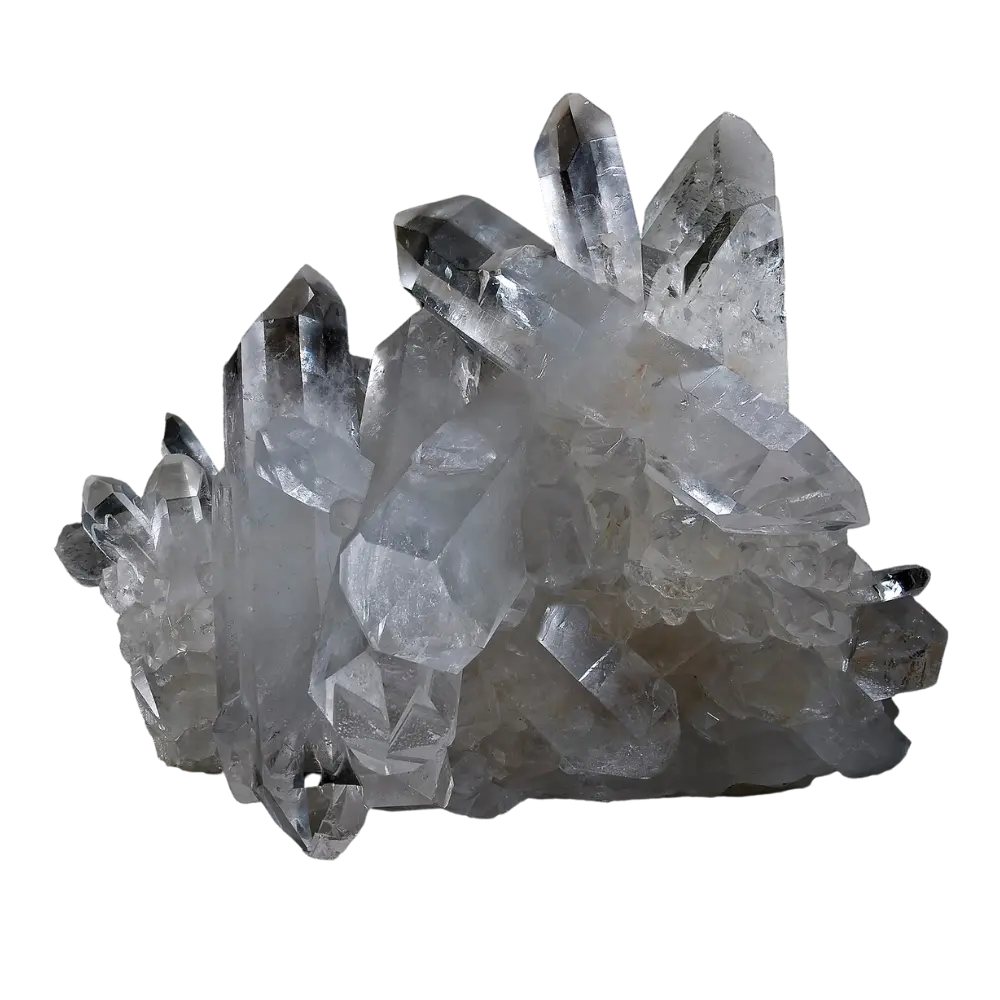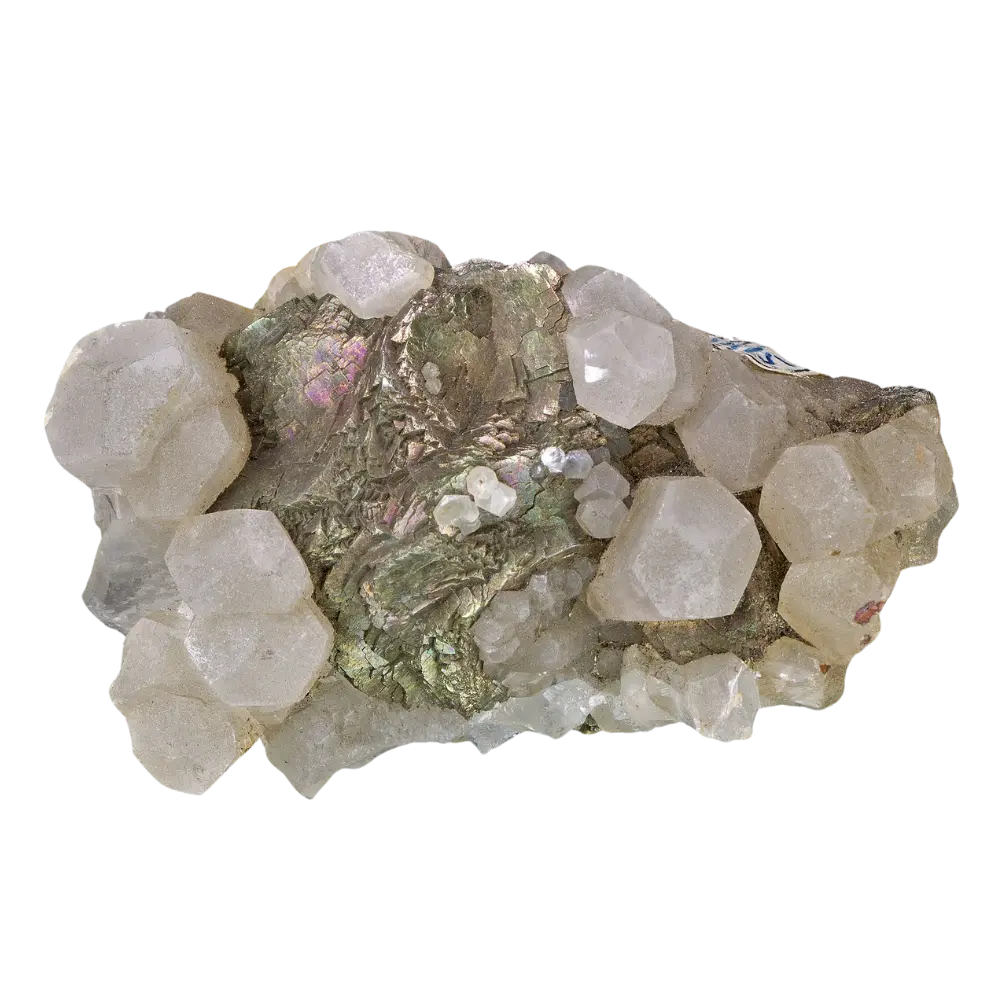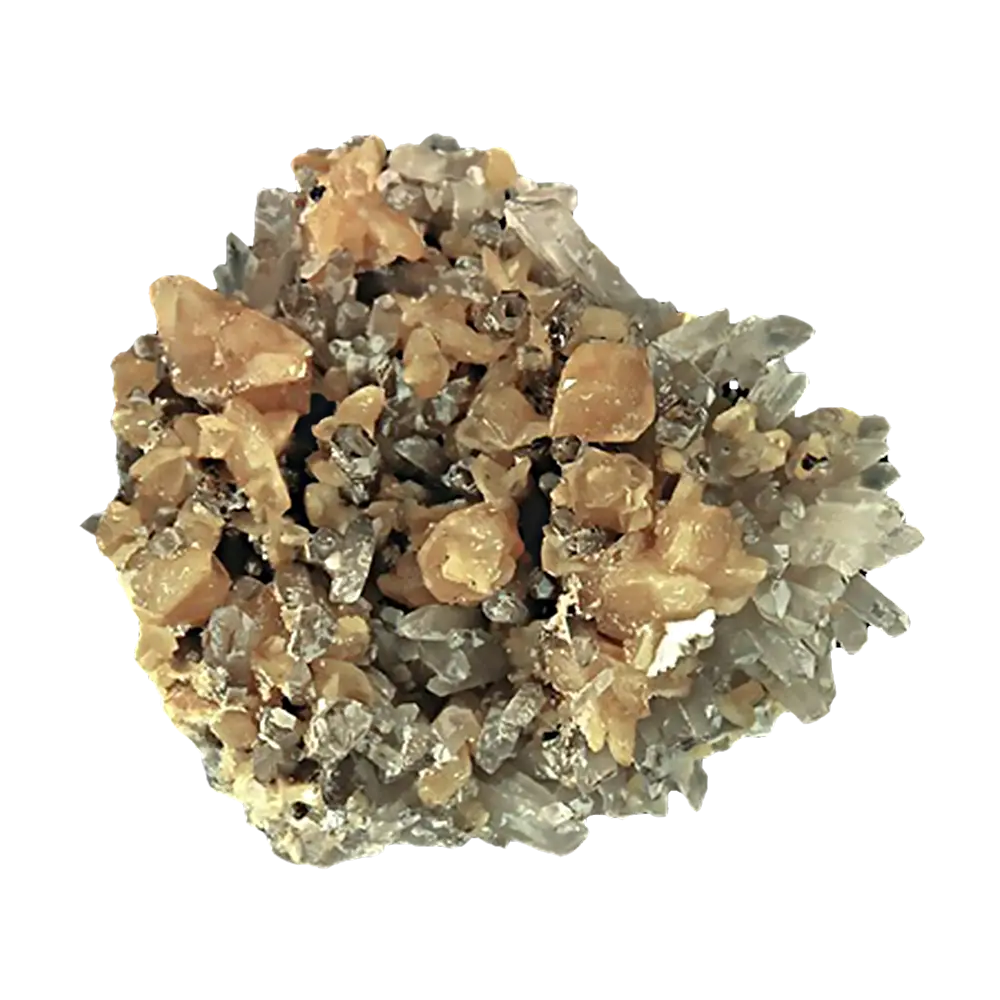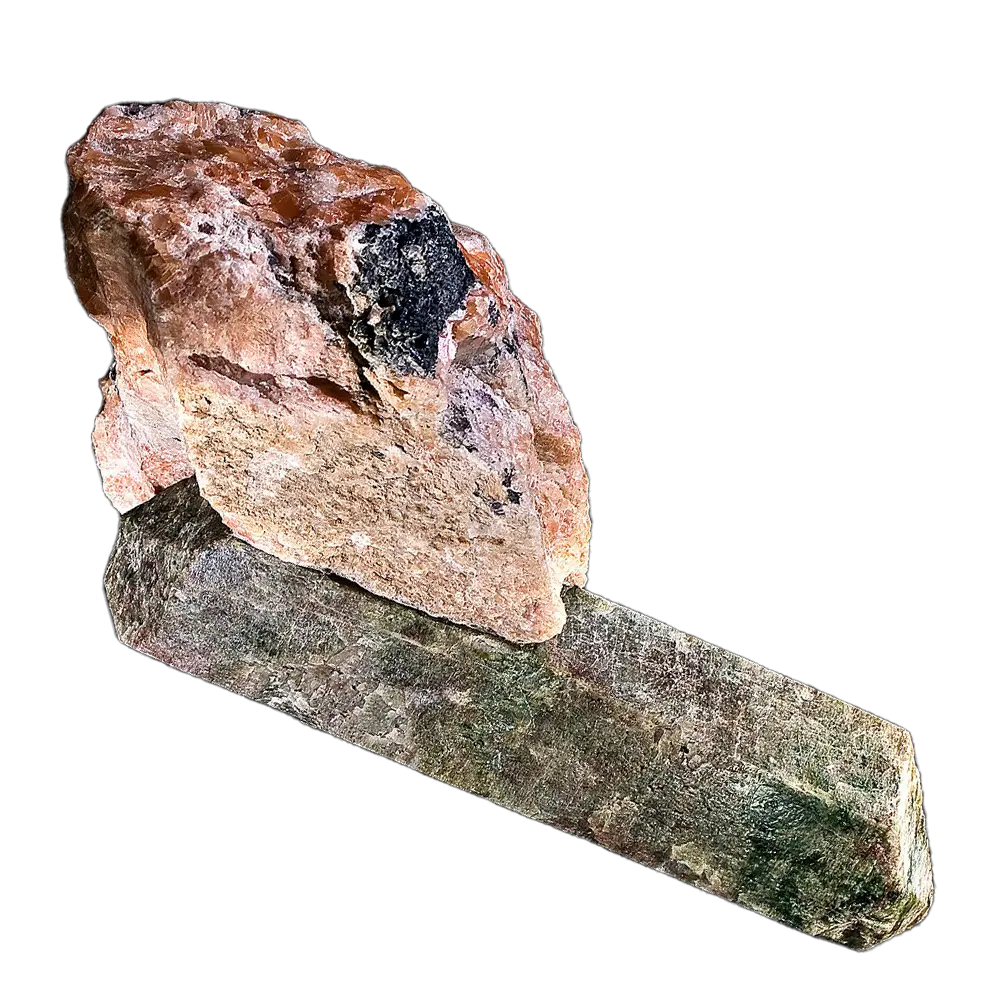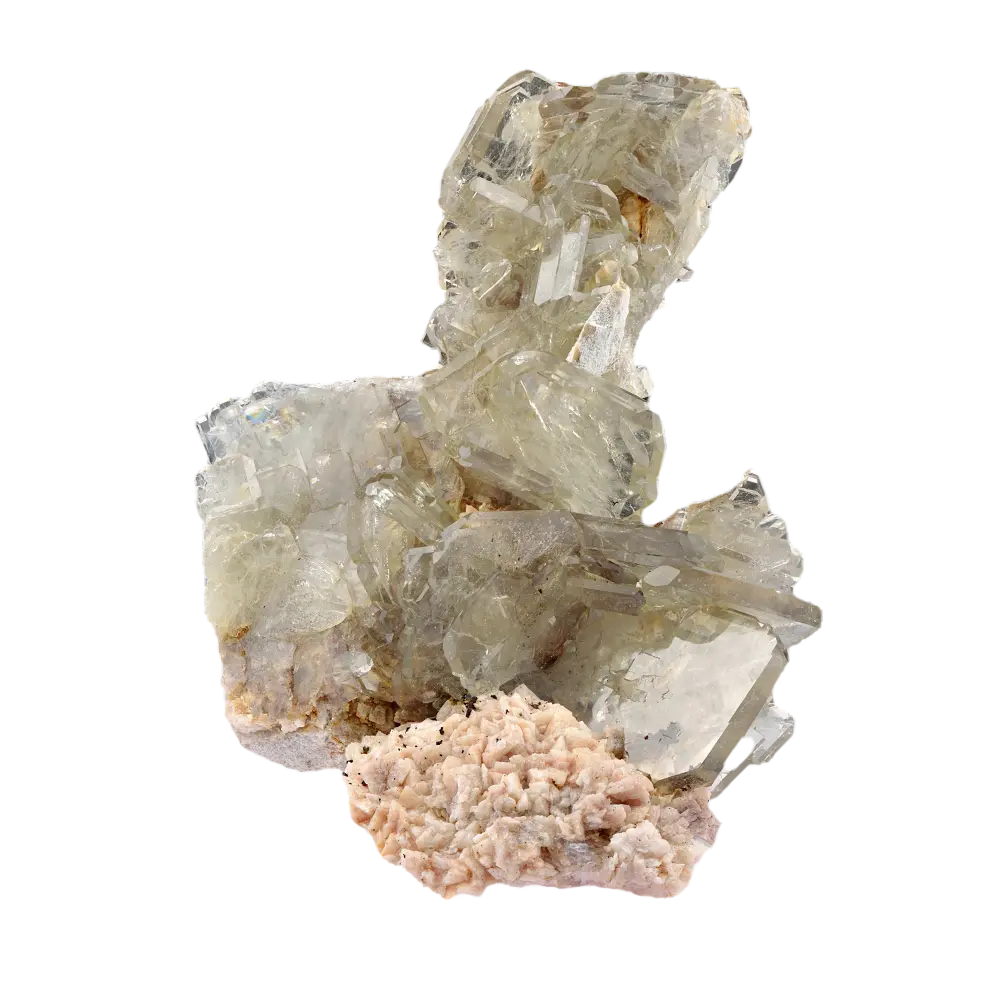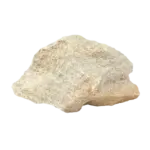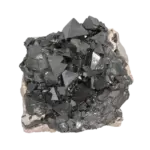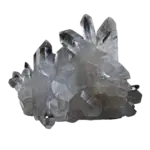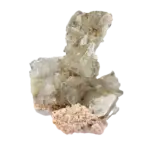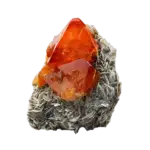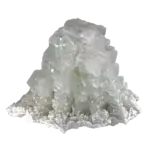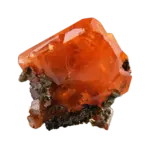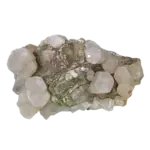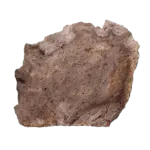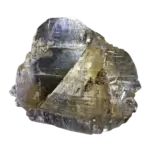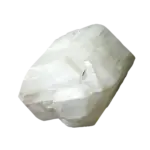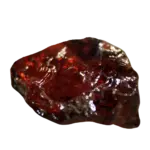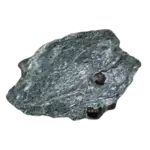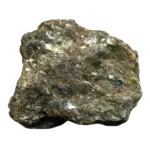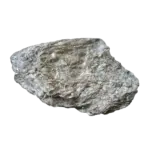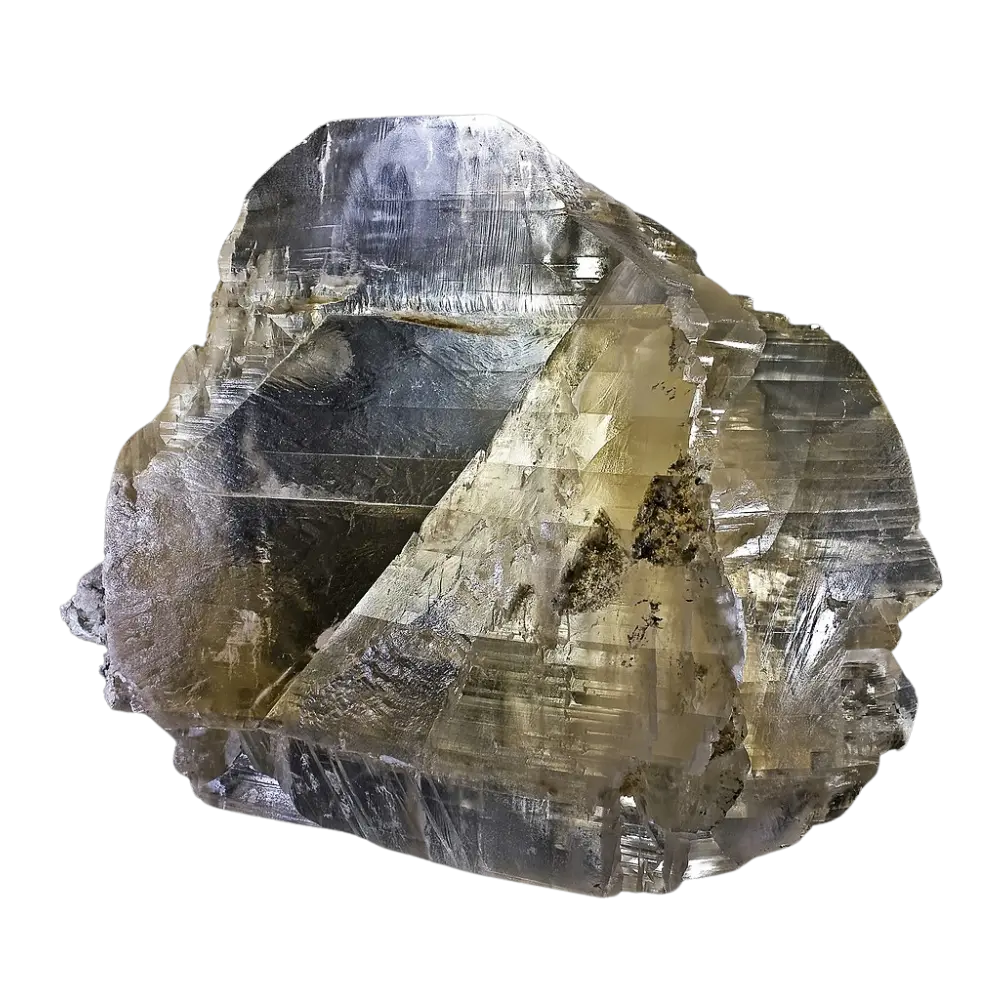
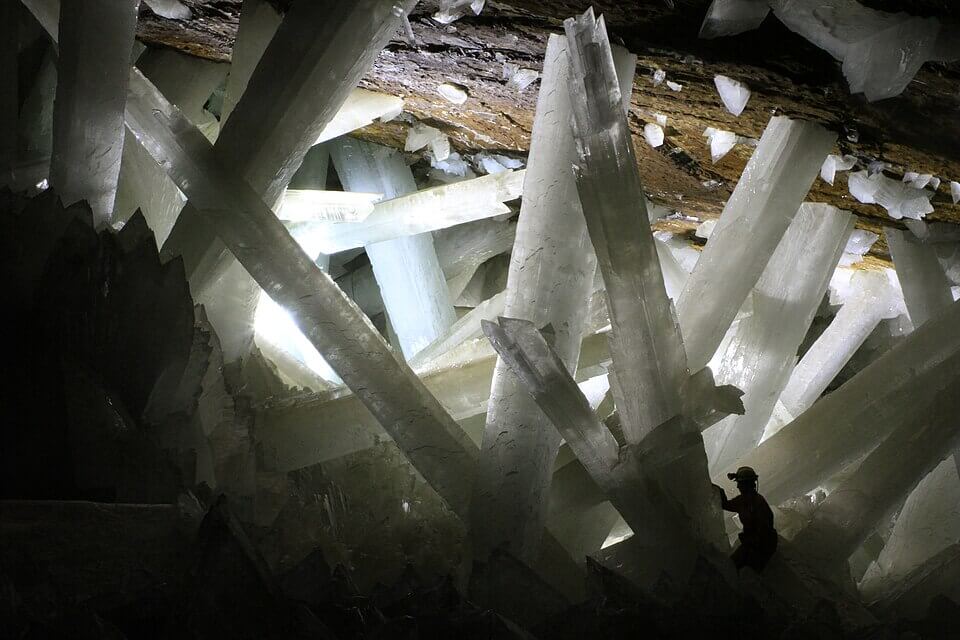
Nearly 300 metres below the desert near Naica, in Chihuahua, Mexico, the air sits at 58 °C and 99 percent humidity. Walking is slow even inside a refrigerated suit. From the limestone walls of a horseshoe-shaped chamber, beams of glass-clear gypsum jut at every angle, some longer than a city bus. The largest measured crystal is 11.40 metres long and weighs roughly 12 tonnes. These are megacrystals of selenite, the transparent variety of one of the most ordinary minerals on Earth: calcium sulfate dihydrate, chemical formula CaSO4·2H2O. The same compound coats drywall in suburban kitchens and forms the white dunes of New Mexico.
What is gypsum?
Gypsum is a soft, hydrous calcium sulfate mineral with the formula CaSO4·2H2O. It crystallises in the monoclinic system, scratches with a fingernail at Mohs hardness 2, and is the most abundant sulfate mineral in Earth’s sedimentary cover. The same name applies to the rock made largely of this mineral, often interbedded with halite and anhydrite in evaporite sequences. Gypsum is the defining mineral of hardness 2 on the Mohs scale.
The word comes from the Greek gypsos, the term for the calcined plaster the Greeks burned out of the same rock. Gypsum has been quarried at Montmartre, on the northern edge of Paris, since Roman times. The Montmartre beds supplied so much of the calcined powder traded across medieval Europe that the material came to be known, in English by the late 14th century, as plaster of Paris.
Chemistry and crystal structure
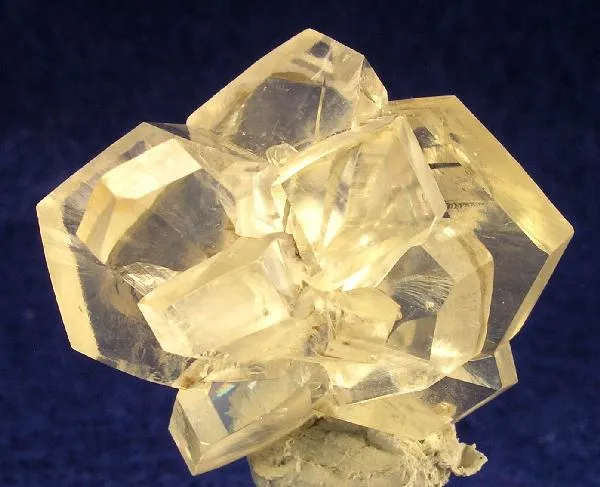
The structure of gypsum is layered. Double sheets of calcium ions linked to sulfate tetrahedra alternate with sheets of water molecules, all stacked perpendicular to the crystallographic b-axis. Those water layers are the weak link. They are why a clean cleavage flake of selenite peels from a crystal like a sheet of mica and why the {010} cleavage is described as “perfect” in every reference text.
Crystallographers Pedersen and Semmingsen refined the structure by neutron diffraction in 1982, fixing the space group as I2/a (an alternate setting of monoclinic group C2/c, No. 15) with unit-cell parameters a = 5.679 Å, b = 15.202 Å, c = 6.522 Å, and β = 118.43°. A 2004 Rietveld study by De la Torre and colleagues, published in Powder Diffraction, confirmed those values within tight error bars and remains the working reference for industrial X-ray quantification of cement and plaster phases.
Gypsum’s two molecules of water are not loose moisture. They are bonded into the lattice and only leave at elevated temperature. Heat gypsum to roughly 100–150 °C and it loses about three-quarters of that water to become bassanite (CaSO4·½H2O), the hemihydrate sold as plaster of Paris. Push past about 200 °C and it dehydrates fully to anhydrite (CaSO4). Add water back, and the powder will set hard within minutes as the gypsum lattice reassembles. That reversible dehydration is the basis of an industry that moves more than 150 million tonnes of rock each year.
Fact Sheet
| Property | Value |
|---|---|
| Formula | CaSO4·2H2O |
| IMA status | Valid (grandfathered) |
| Crystal system | Monoclinic, point group 2/m |
| Space group | I2/a (β = 118.43°) |
| Mohs hardness | 2 (defining the scale point); measured 1.5–2, varies with direction |
| Density | 2.31–2.32 g/cm³ |
| Cleavage | {010} perfect; {100} distinct; {011} good |
| Lustre | Subvitreous; pearly on {010}; silky if fibrous |
| Streak | White |
| Colour | Colourless, white, grey; yellow, pink, brown, reddish if impure |
| Optical class | Biaxial (+); α = 1.521, β = 1.523, γ = 1.530 |
| Solubility (25 °C, pure water) | ~2.0–2.5 g/L; retrograde at higher temperature |
| Twinning | Common on {100} (swallowtail and cruciform twins) |
Gypsum’s solubility is retrograde — it becomes less soluble as water heats up, the inverse of how most salts behave. Its thin cleavage sheets are also flexible, bending without snapping back. Held against the tongue, gypsum has a faintly chalky taste rather than the bitterness of epsomite or the sharp salinity of halite.
How gypsum forms
Gypsum precipitates from sulfate-rich water under modest temperatures. The classic setting is a restricted marine basin where seawater evaporates: calcium and sulfate concentrate, gypsum drops out, halite follows once the brine becomes saltier still. Several other pathways produce the mineral, and the geological record contains all of them.
Marine evaporite basins
The most spectacular case in the geological record is the Messinian Salinity Crisis, between 5.97 and 5.33 million years ago, when restricted gateways to the Atlantic turned the Mediterranean into a partly dried-up basin. More than one million cubic kilometres of evaporites, carbonate, gypsum, anhydrite, and halite, accumulated on the seafloor. Marco Roveri and colleagues, in a long sequence of papers culminating in a 2014 synthesis in Marine Geology, divided these deposits into a Primary Lower Gypsum (PLG, 5.97–5.60 Ma) deposited in shallow silled sub-basins, a Resedimented Lower Gypsum (RLG) shed into deeper water, and an Upper Gypsum (UG) marking the gradual refill. The Vena del Gesso of the northern Apennines and the gessi of Sicily are textbook examples, with selenite beds metres thick that can be correlated across the western Mediterranean.
Whether the Mediterranean fully desiccated, whether some gypsum precipitated from low-salinity brines diluted by rivers, and whether the crisis ended in a catastrophic Zanclean flood are still active questions. A 2024 review by Andreetto and colleagues in Nature Reviews Earth & Environment summarises the unresolved debates.
Continental playas
Gypsum also accumulates in closed continental basins. The world’s largest gypsum dune field, White Sands National Park in the Tularosa Basin of New Mexico, covers 712 km² of shifting white sand grains derived from selenite crystallised on the floor of late-Pleistocene Lake Otero. Mineral-rich runoff from the San Andres and Sacramento Mountains drained into the basin and evaporated; wind broke the resulting selenite plates into grains and pushed them downwind. The process is still running today: every 10 to 15 years, floodwaters in Lake Lucero refresh the system and grow fresh crystals.
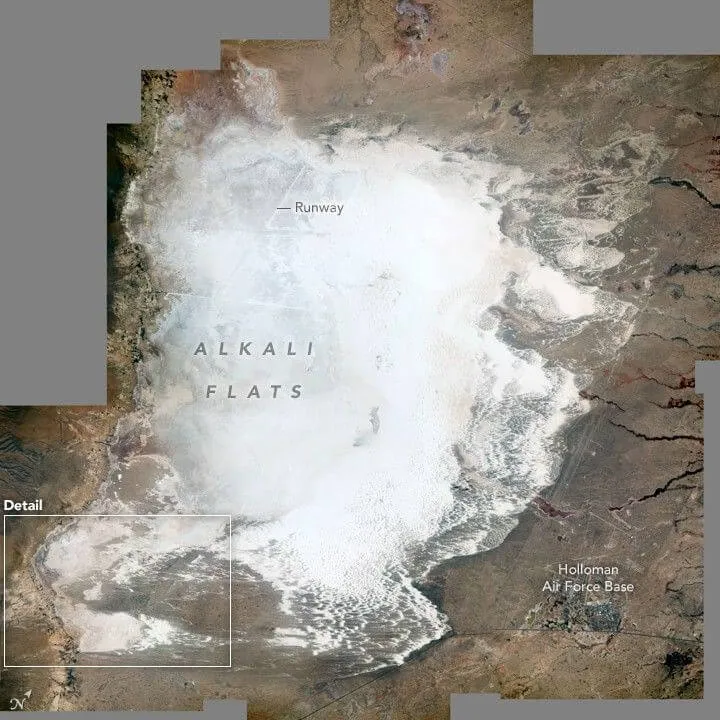
The dune field also preserves the oldest secure human footprints in the Americas. Tracks pressed into gypsum-rich playa sediments and bracketed by Ruppia cirrhosa seeds yielded calibrated radiocarbon ages between 21,000 and 23,000 years ago: work led by the U.S. Geological Survey and published in Science in 2021, with confirmation by additional dating methods in 2023.
Hydration of anhydrite
A great deal of the gypsum mined for industry was never primary. It is anhydrite that has been re-hydrated by groundwater at shallow depths, gaining about 60 percent in volume as the lattice incorporates two molecules of water per formula unit. The reverse, gypsum dehydrating to anhydrite during burial, happens during diagenesis. The crossover, the so-called gypsum–anhydrite transition, has been studied since van’t Hoff’s day and is still debated. Hardie’s 1967 paper in American Mineralogist placed the equilibrium at about 58 °C in pure water at one atmosphere. A 2023 reassessment by Wolfgang Voigt and Daniela Freyer pulled the figure down to 42 ± 1 °C. The discrepancy matters because anhydrite is notoriously slow to nucleate from solution at low temperatures, and field deposits often record a kinetic, not a thermodynamic, boundary. In chloride brines saturated with halite, Hardie showed the boundary can drop to about 18 °C.
Hydrothermal and volcanic settings
Where rising hot fluids meet cooling carbonate host rocks, gypsum can precipitate at moderate temperature. Naica is the famous example. Below the Naica mine sits a magma chamber 3–5 km down. Hot, sulfate-bearing water rose, dissolved anhydrite from the limestone, and held steady for hundreds of thousands of years just below the gypsum–anhydrite phase boundary. Juan Manuel García-Ruiz and colleagues, working from fluid inclusions, established in Geology in 2007 that the crystals grew from a solution held at 54.5 ± 2 °C: only a few degrees below the transition. Alexander Van Driessche and co-workers later measured the growth rate of those crystals at about 1.4 × 10⁻⁵ nm/s and proposed that nucleation goes via amorphous bassanite clusters rather than directly to gypsum, an idea still being tested.
Gypsum also forms as a by-product of sulfuric-acid attack on carbonate rock, common in oxidising sulfide deposits and around volcanic fumaroles, and as efflorescent crusts in arid soils.
Varieties
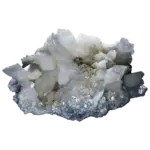
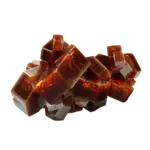
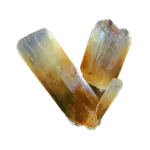
- Selenite: transparent, well-formed crystals, sometimes metre-scale. Named from seléné, Greek for moon, after the pearly cleavage surfaces.
- Satin spar: fibrous, with a silky sheen; cuts and polishes into cabochons.
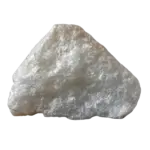
- Alabaster: fine-grained massive variety, carved since antiquity from Mesopotamia to Nottingham.
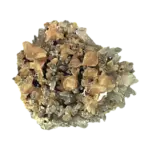
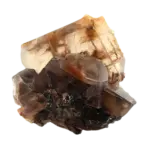
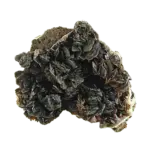
- Desert rose: rosettes of bladed crystals that incorporate sand grains, forming in arid sabkha and playa settings.
- Swallowtail twins: contact twins on {100} that produce distinctive V- or heart-shaped pairs.
- Gypsum flower: radiating speleothem crystals that grow from cave walls.
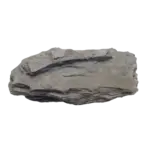
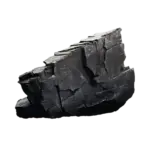
- Rock gypsum: massive bedded variety, the bulk industrial feedstock.
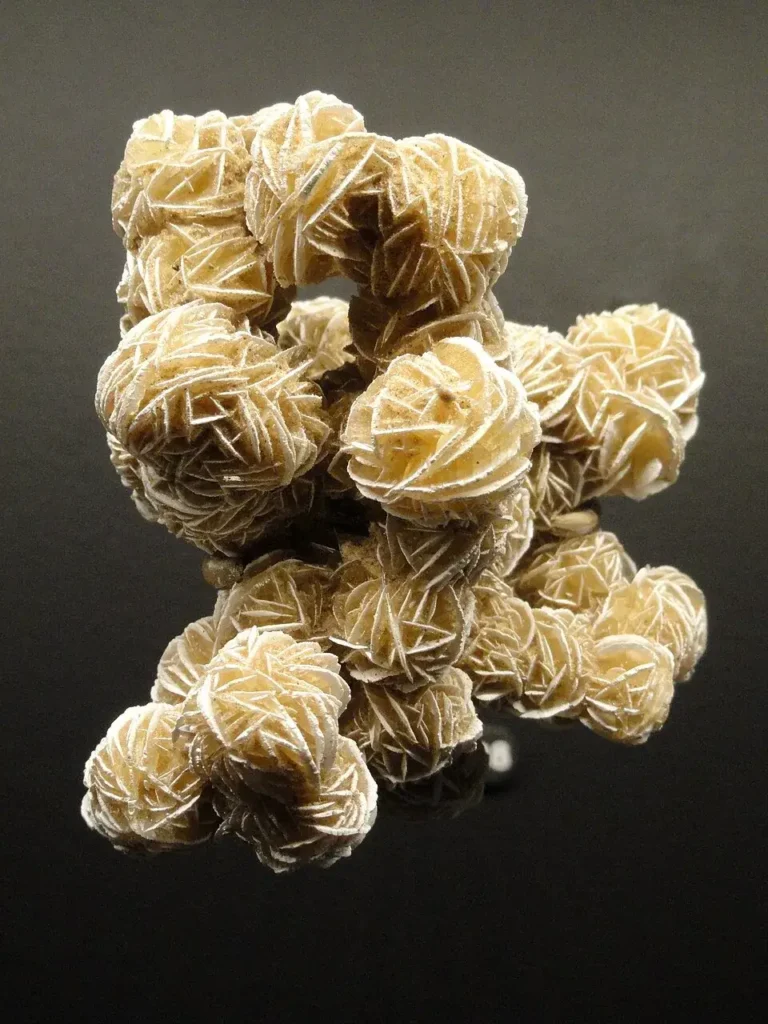
Where gypsum is found
Gypsum is the most common sulfate mineral on Earth, and large beds occur on every continent. Localities that have produced especially notable specimens or that anchor regional industries include the following.
The Naica mine in Chihuahua, Mexico, with its giant selenite caves. The Geode of Pulpí in Almería, Spain, an 8-metre-long cavity lined with transparent gypsum crystals up to 2 m long, whose origin García-Ruiz and Van Driessche traced in 2019 in Geology to a slow temperature-driven ripening process. The Vena del Gesso and the Caltanissetta basin in Sicily, key outcrops of Messinian gypsum. The Paris Basin, where Montmartre’s gypsum gave plaster of Paris its name. Nottinghamshire and Cumbria in the United Kingdom, where Permian and Triassic gypsum has been mined for centuries. The Ebro Basin of northeastern Spain. Playas across South Australia and the Cloncurry region of Queensland. The Great Salt Plains of Oklahoma, source of the rose rocks adopted as the state’s official mineral. And the spectacular gypsum speleothems of Lechuguilla Cave in New Mexico’s Carlsbad Caverns.
Then there is Mars. In 2011, NASA’s Opportunity rover analysed a thumb-wide white vein at the rim of Endeavour Crater that mission principal investigator Steve Squyres described as the strongest evidence the mission had found for liquid water flowing through Martian bedrock; the team published the discovery in Science in 2012 and identified the vein as gypsum or a closely related calcium sulfate. NASA’s Curiosity rover later traced abundant light-toned calcium-sulfate veins crosscutting the Yellowknife Bay mudstones of Gale Crater. Nicolas Mangold and Marion Nachon’s team, publishing in JGR Planets in 2014, showed those veins are mostly hydrated, and a 2016 follow-up by William Rapin in Earth and Planetary Science Letters identified the dominant phase as bassanite, possibly the dehydrated descendant of gypsum that once formed in a wetter Mars.
What is gypsum used for?
Heat gypsum and it loses water. Add water back and the powder sets hard within minutes. That reversible reaction is the basis of an industry that moves more than 150 million tonnes of rock each year. Plaster of Paris, gypsum board (drywall, sheetrock), and dental and orthopaedic casts all rely on the same reversible hydration. According to the U.S. Geological Survey’s Mineral Commodity Summaries, world crude gypsum production in 2023 was about 150 million tonnes. The United States led with around 22 Mt, followed by Iran at roughly 16 Mt, with major output also from China, Turkey, Spain, and Mexico. At the start of 2023, U.S. wallboard manufacturing capacity stood near 34 billion square feet a year.
About a third of U.S. gypsum supply now comes from synthetic gypsum, chiefly flue-gas desulfurization (FGD) gypsum recovered from coal-fired power plants, which is chemically indistinguishable from the natural mineral and is used in wallboard, cement, and agriculture. Beyond construction, gypsum acts as a set retarder in Portland cement (about 5 percent by mass), as a soil amendment for sodic and clay-heavy farmland, as a calcium and sulfur source in fertiliser, in glassmaking, and as the food additive E516. Alabaster sculpture is older than written history.
How to identify gypsum in the field
- Scratch test: a fingernail (~2.5 on Mohs) leaves a clear mark.
- Cleavage: peel off thin, flexible sheets in one direction; pearly sheen on the cleaved face.
- Low density: feels noticeably lighter than calcite or barite of similar size.
- Solubility: slow but real in water; gypsum landscapes etch into karst over thousands of years.
- Heat test (lab): heating drives off water and leaves a white powder that re-sets with added water.
What’s still being argued about
The exact temperature of the gypsum–anhydrite transition in pure water remains a genuine debate, with values clustering between 42 and 58 °C depending on whether the estimate is based on calorimetry, solubility, or thermodynamic modelling. The kinetics are slower than the thermodynamics, and natural deposits often preserve the slow phase rather than the equilibrium one. The nucleation pathway of gypsum from solution, direct or via amorphous calcium-sulfate and bassanite precursors, is an active area in geochemistry. The Messinian Salinity Crisis still divides researchers over how much of the Mediterranean dried out, how fast, and how much of the gypsum precipitated from heavily diluted brine fed by rivers and Paratethyan inflow. On Mars, what the Curiosity and Opportunity sulfate veins tell us about the planet’s habitable past, and whether any of them preserve biosignatures, depends on chemistry that has yet to be sampled in the lab: a question that Mars Sample Return and future astrobiology missions will inherit.
The same mineral that built the Naica crystals is in the wall behind your desk. Most of the time it is worth remembering that.
Frequently Asked Questions
Is gypsum a rock or a mineral? Both. Gypsum is the mineral CaSO4·2H2O. Rock gypsum is the sedimentary rock made mostly of that mineral, usually with minor anhydrite, halite, clay, or carbonate.
Why is gypsum used in drywall? Gypsum dehydrates when heated and rehydrates when mixed with water, setting hard in minutes. The bound water inside the lattice also makes gypsum board fire-resistant: in a fire, that water absorbs heat as it evaporates before the wall itself can burn.
What is the difference between gypsum and anhydrite? Water. Gypsum is CaSO4·2H2O; anhydrite is CaSO4, with no structural water. Anhydrite forms at higher temperatures or under burial, and re-hydrates to gypsum near the surface — a transition with about a 60 percent volume increase.
Is gypsum safe to handle? Yes. Gypsum is non-toxic, water-soluble in small amounts, and listed as the food additive E516. Dust from cutting drywall is a respiratory irritant like any fine mineral dust, but the material itself is among the most benign rock-forming minerals.