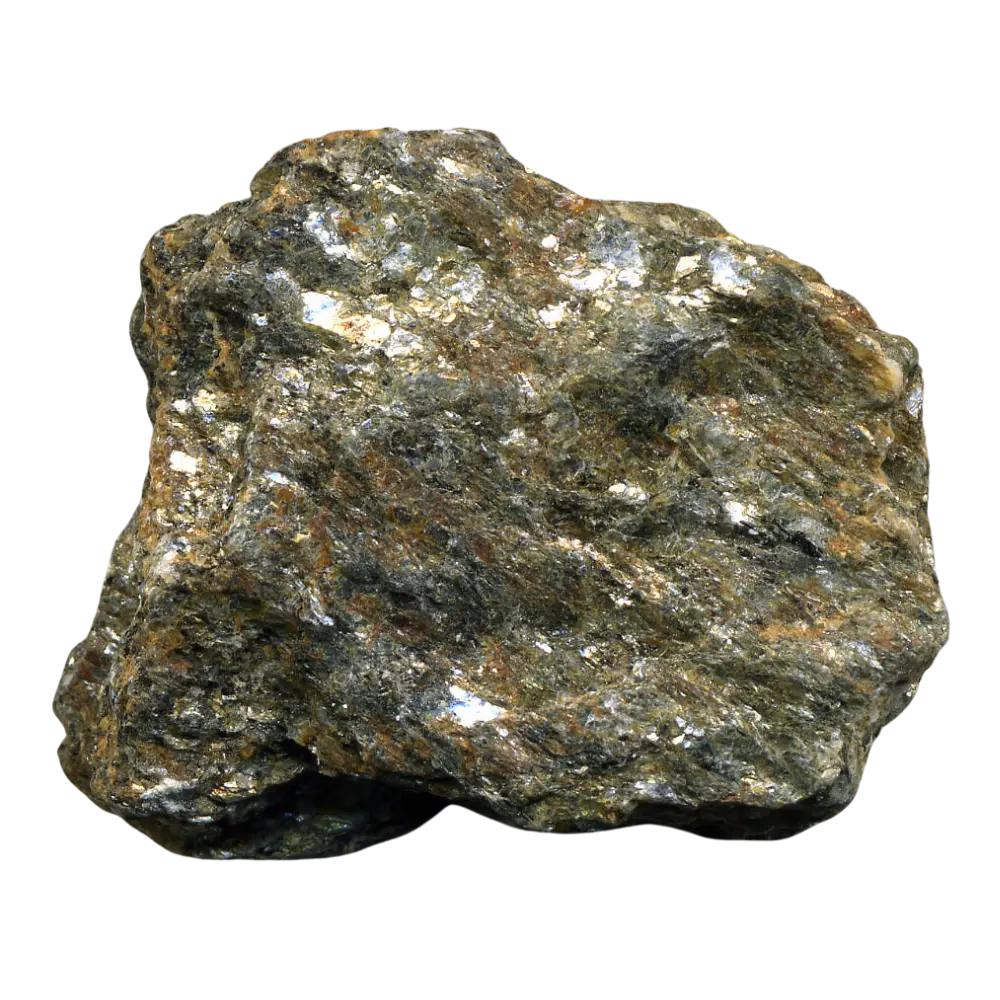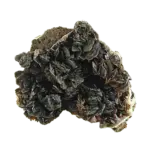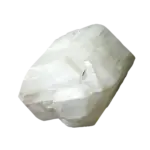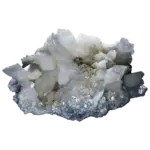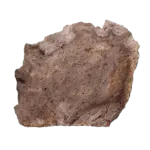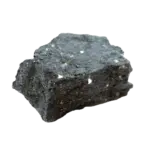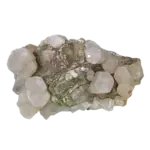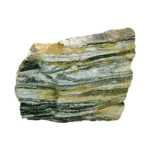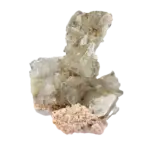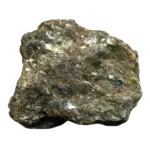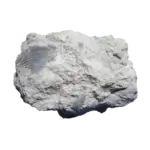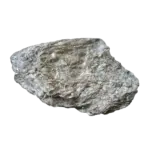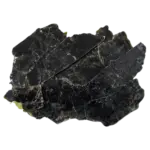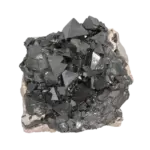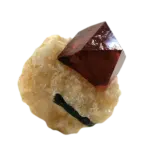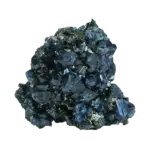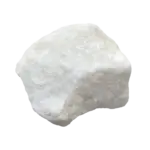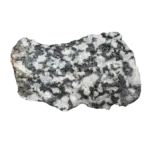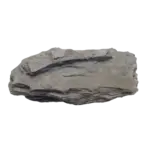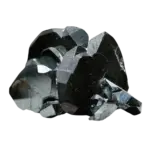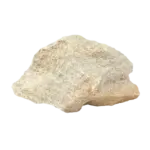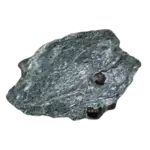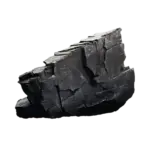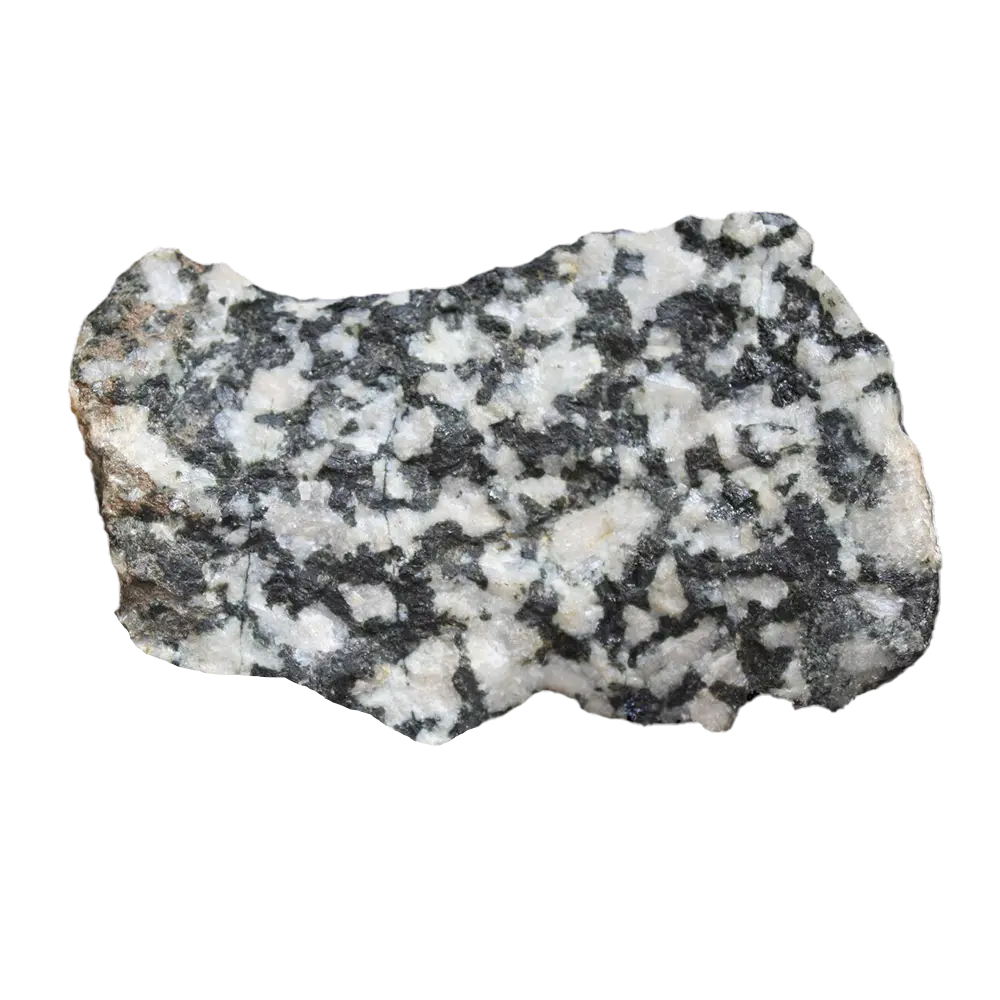
Diorite is a coarse-grained plutonic igneous rock with an intermediate composition between granite and gabbro. Light plagioclase feldspar and dark hornblende crystallise side by side as magma cools slowly underground, producing the speckled “salt-and-pepper” texture that makes diorite identifiable in hand specimen. It is the intrusive cousin of andesite and is especially common in magmatic arcs above subduction zones.
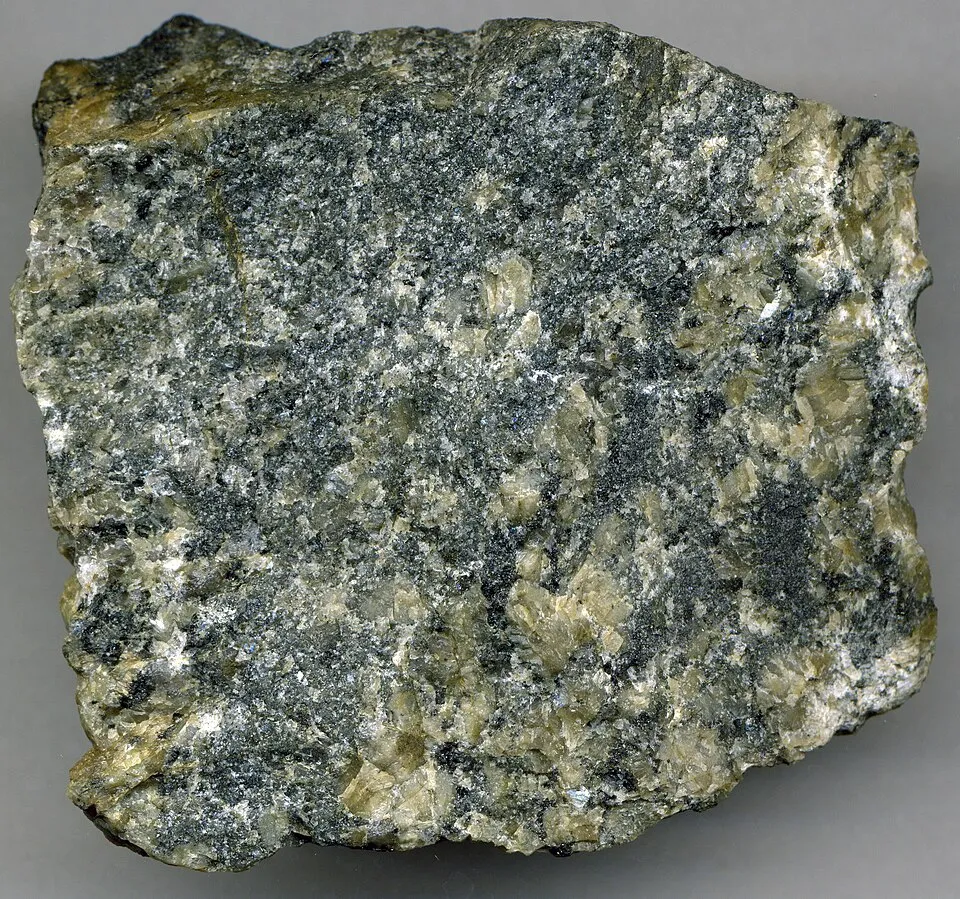
Fact Sheet
- Rock type: Intrusive (plutonic) igneous rock, intermediate composition
- Texture: Phaneritic (coarse-grained); occasionally porphyritic or, rarely, orbicular
- Silica content: ~52–63 wt% SiO₂
- Major minerals: Sodic plagioclase (oligoclase–andesine, >90% of the feldspar), hornblende, biotite; minor pyroxene, <5% quartz
- Mohs hardness: Approximately 6–6.5 (rock-scale, derived from constituent minerals)
- Density: 2.8–3.0 g/cm³
- Volcanic equivalent: Andesite
- Tectonic setting: Continental and island volcanic arcs above subduction zones
- Common uses: Crushed stone, dimension stone, ancient sculpture
What is diorite?
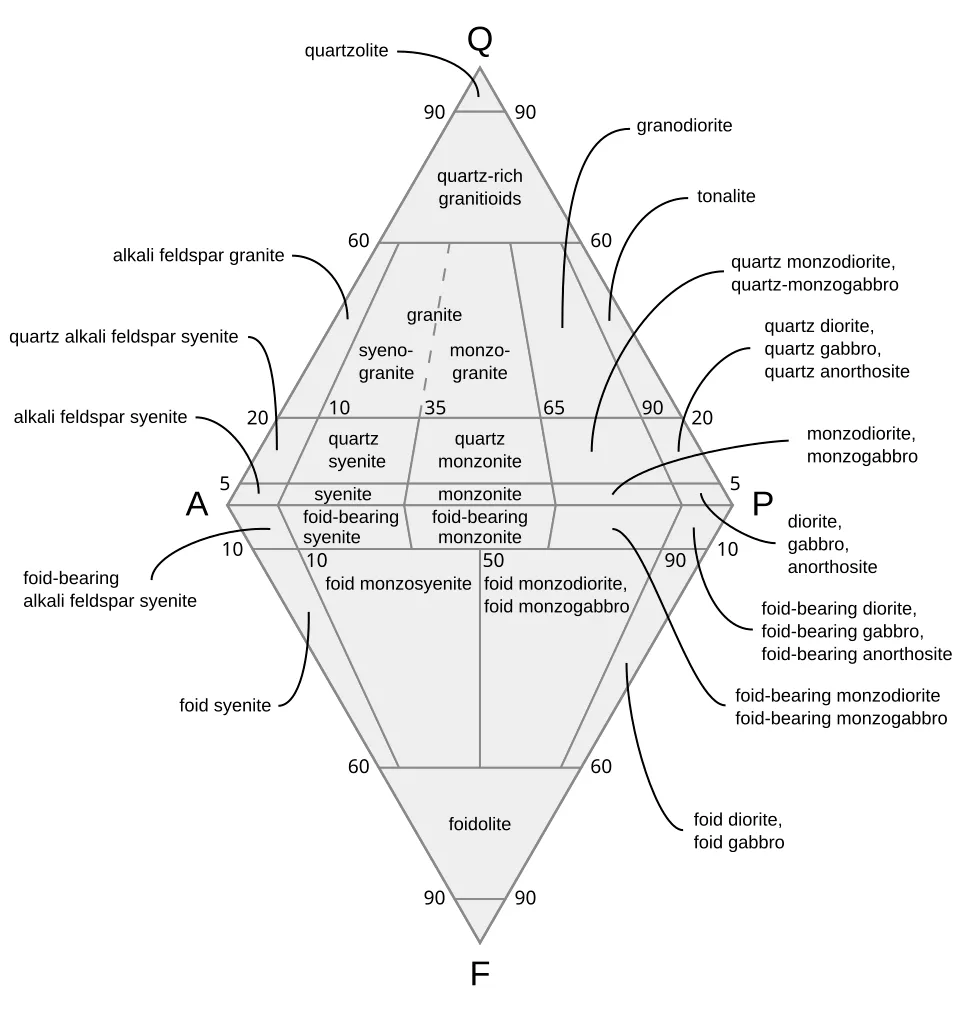
In strict IUGS-style usage, diorite is a coarse-grained plutonic rock whose light minerals plot in field 10 of the QAPF diagram. In practical terms, quartz is less than 5% of the QAPF minerals, feldspar is overwhelmingly plagioclase rather than alkali feldspar, and the average plagioclase composition is sodic to intermediate, with anorthite content below 50. BGS also separates diorite from anorthosite and gabbro using the mafic-mineral proportion: if mafic minerals exceed 10% and the average plagioclase is An < 50, the rock is diorite; if the plagioclase is more calcic, the equivalent rock falls toward gabbro.
Add 5–20% quartz and the rock is quartz diorite. Above 20% quartz, the name depends mainly on the alkali feldspar–plagioclase ratio: plagioclase-rich compositions move toward tonalite, while increasing alkali feldspar shifts the rock toward granodiorite and granite. Add more alkali feldspar at low quartz contents and the rock moves toward monzodiorite.
The name comes through French from Greek diorízein, “to distinguish,” a fitting name for a rock in which pale feldspar and dark mafic minerals are often easy to tell apart by eye.
How diorite forms
Many of the best-known diorites are products of convergent-margin magmatism, especially continental and island arcs above subduction zones. When an oceanic plate descends beneath another plate, water released from hydrated minerals in the slab lowers the melting point of the overlying mantle wedge. The mantle partially melts, generating hydrous basaltic magma that rises, ponds in the lower crust, and evolves through fractional crystallisation, crustal assimilation, and magma mixing. Intermediate magmas produced in this process crystallise in the crust to form diorite, granodiorite, and tonalite, the most common intrusive rocks of continental arcs.
Because the magma cools slowly inside the crust, individual crystals have time to grow large enough to see without a microscope. The result is the coarse, holocrystalline texture geologists call phaneritic. If the same magma had reached the surface and cooled quickly, it would have crystallised as andesite, the volcanic equivalent of diorite, and the rock that gives the Andes their name.
Mineralogy and varieties
The dominant mineral in any diorite is plagioclase feldspar, usually oligoclase to andesine, white to grey, often with visible polysynthetic twinning. The dark phases that give diorite its peppery look are most often hornblende, an amphibole, accompanied by biotite mica. Pyroxenes (augite, rarely orthopyroxene), small amounts of quartz, and accessory minerals such as apatite, titanite, ilmenite, zircon, and magnetite round out the assemblage.
Several named varieties exist:
- Quartz diorite: contains 5–20% quartz; a transitional rock between diorite and tonalite.
- Leucodiorite: light-coloured, mafic minerals between roughly 10–25% (low colour index).
- Melanodiorite: darker, with mafic minerals exceeding 35%.
- Monzodiorite: diorite with appreciable alkali feldspar; sits between diorite and monzonite.
- Orbicular diorite: a rare and visually striking variety in which crystals form concentric rings around nucleation centres, producing a fabric that looks almost organic.
Where diorite is found
Diorite is not a rock you have to hunt for in obscure corners of the world. Diorite occurs in many continental-arc and island-arc plutonic belts, usually alongside tonalite, granodiorite, granite, and gabbroic rocks. The Sierra Nevada Batholith of California, the Coast Plutonic Complex of British Columbia and Alaska, the Cretaceous to Miocene plutons of the Andes, the Lachlan Fold Belt of southeastern Australia, the Caledonian intrusions of the Scottish Highlands, and the Variscan plutons of the Harz Mountains in Germany, all contain diorite alongside their more famous granitic relatives.
For collectors and field geologists, classic localities include Salem and Essex County in Massachusetts, the Sierra Nevada outcrops of California, the Hannukainen iron-ore district of Finnish Lapland, and the green diorite quarries near Sacsayhuamán outside Cuzco.
Diorite in human history
Diorite is hard, dense, takes a fine polish, and weathers slowly. Several ancient civilisations imported it across thousands of kilometres for monumental sculpture.
The statues of Gudea
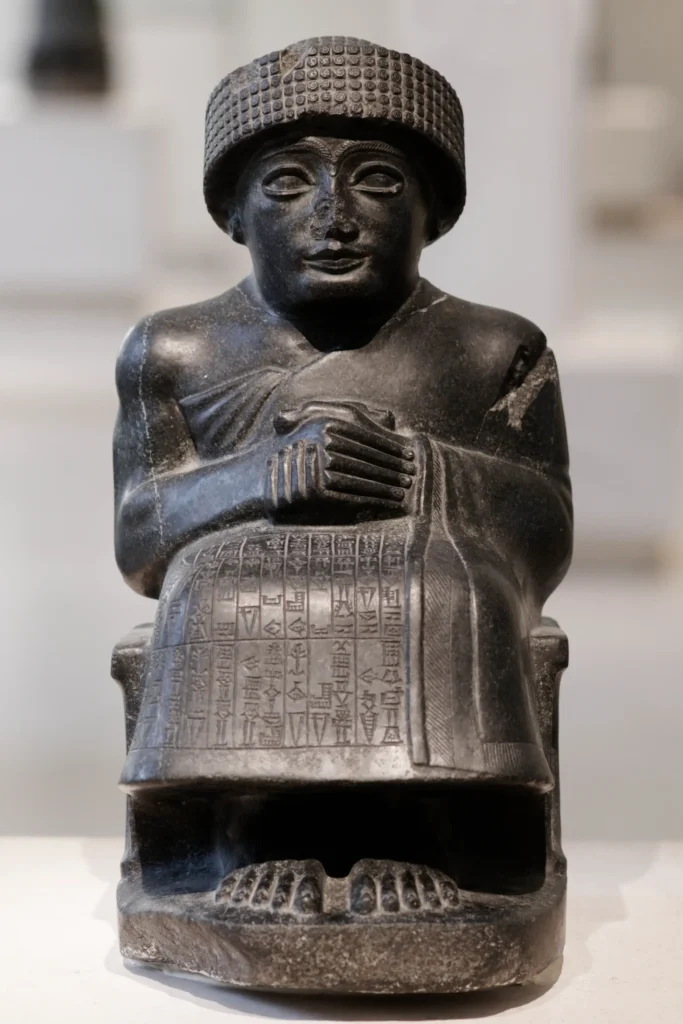
The clearest and best-attested ancient use of diorite comes from the city-state of Lagash in southern Mesopotamia, where King Gudea (c. 2150–2125 BC) commissioned more than twenty seated and standing statues of himself in diorite. The Mesopotamian floodplain has no native hard stone of any kind, and Gudea’s own inscriptions explicitly record that he imported the dark hard stone from Magan, a region usually associated with southeast Arabia, especially present-day Oman, although the exact geological source and even the modern petrographic name of some “diorite” statues remain debated. The choice was deliberate: in an inscription on one of the statues, Gudea forbids the use of silver, lapis lazuli, copper, tin, or bronze for his image, specifying diorite alone. The statues survive today in the Louvre, the British Museum, and the Metropolitan Museum of Art.
The Code of Hammurabi: actually diorite?
Popular sources almost universally describe the Code of Hammurabi stele in the Louvre as diorite, but the material identification has been contested for over a century. The original 1902 publication by Jean-Vincent Scheil called it diorite. A century later, the Louvre Assyriologist Béatrice André-Salvini described it as black basalt with olivine, and several recent scholarly works have followed her. A 2026 paper in npj Heritage Science by Chandra Reedy proposes a concrete non-invasive analytical pathway to settle the question, while noting that the balance of recent scholarship now leans toward basalt. Until that analysis is carried out on the stele itself, the identification remains formally open.
The Twelve-Angled Stone of Cuzco
Inca masons worked with three principal stones: Yucay limestone, black andesite from the Rumiqolqa quarries, and a green diorite porphyry from the Sacsayhuamán area outside Cuzco. The most famous single block in the Inca world, the Twelve-Angled Stone of Hatun Rumiyoq, set into a wall in the historic centre of Cuzco, is carved from this green diorite. It weighs roughly six tonnes, has twelve precisely cut angles, and fits its neighbours so tightly that mortar was unnecessary.
What about Egyptian “diorite” statues?
The famous seated statue of Khafre in the Cairo Museum is often described as diorite, and Egyptologists historically called the rock “Chephren diorite.” Modern petrographic work has shown that most of the so-called Egyptian diorite, including the Khafre statue and other fourth-dynasty royal sculptures, is actually anorthosite gneiss from quarries at Gebel el-Asr, a banded metamorphic rock rather than a true plutonic diorite. True diorite was used by ancient Egyptians, but mostly for tools and small vessels rather than monumental statuary.
Modern uses
Diorite never reached the commercial scale of granite, mostly because it is rarer in large, uniformly textured outcrops and because its variable composition makes it harder to market under a consistent trade name. Where it is quarried today, the main applications are:
- Crushed stone aggregate for road bases, railway ballast, and concrete fill, where its hardness and durability rival granite and trap rock.
- Dimension stone for cladding, paving, kerbing, countertops, and tiles, often sold as “black granite” or under proprietary trade names that obscure the actual mineralogy.
- Cobbles and setts, especially in older European cities, diorite cobblestones can still be found underfoot in parts of Britain, Germany, and the Low Countries.
Diorite, granite, and gabbro: how to tell them apart
Granite, diorite, and gabbro form a compositional series of coarse-grained plutonic rocks, but they are genuinely different rocks. The quickest field distinctions:
- Granite: abundant quartz (>20%), pink or grey alkali feldspar, biotite. Lighter overall colour. Felsic.
- Diorite: little to no quartz (<5%), white sodic plagioclase, hornblende and biotite. Strong salt-and-pepper contrast. Intermediate.
- Gabbro: no quartz, calcic plagioclase, dark pyroxenes dominant. Overall dark and mafic.
A coarse-grained rock that looks roughly half light and half dark, with little visible quartz and clearly distinguishable hornblende crystals, is almost certainly diorite.
Why diorite matters in geology
Diorite is also a record of how continental crust grows. Average continental crust has a chemistry close to andesite, diorite’s volcanic equivalent, and most modern models of continental growth involve mixing arc-derived intermediate magmas into the crust over long timescales. The diorites exposed in eroded batholiths today are direct samples of the magmatic engine that has been building continents since the Archean.
Frequently asked questions
Is diorite harder than granite?
Roughly equal. Granite tends to score slightly higher because its abundant quartz (Mohs 7) raises the rock-scale hardness, while diorite is dominated by plagioclase (Mohs 6) and hornblende (Mohs 5–6). In practice, both behave similarly under abrasion, and the difference rarely matters in construction.
Is diorite a metamorphic rock?
No. Diorite is plutonic, it crystallises from magma at depth. Metamorphic rocks with similar mineralogy do exist (amphibolite, for instance, can resemble diorite), but they form in the solid state and usually show foliation that diorite lacks.
What is the volcanic equivalent of diorite?
Andesite. Same chemistry, different cooling history.
Why is diorite called a “salt-and-pepper” rock?
Because its two main mineral groups, pale plagioclase feldspar and dark hornblende plus biotite, appear in roughly equal proportions and at similar grain sizes. The result is a fabric of contrasting white and black crystals visible to the naked eye.