







Introduction
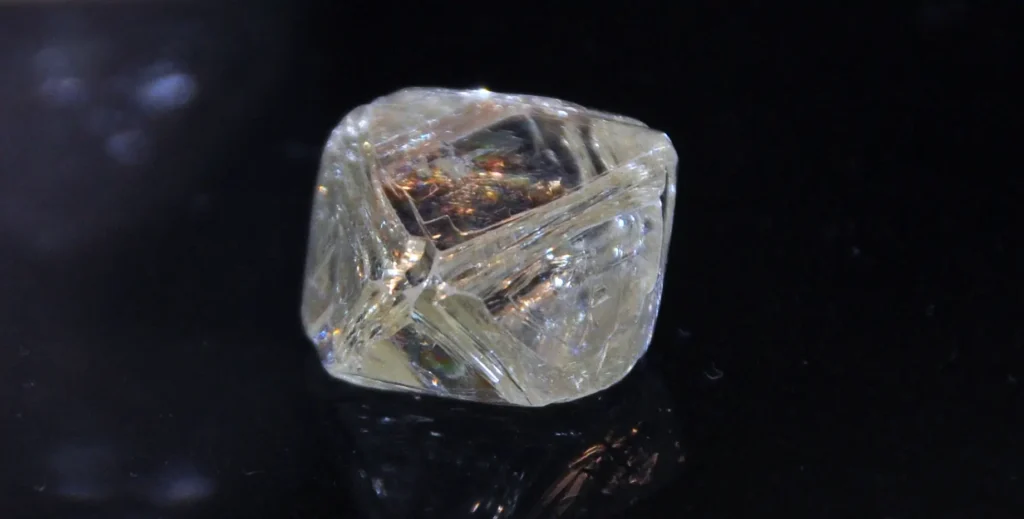
An uncut octahedral diamond from South Africa. The eight-sided shape reflects diamond’s cubic crystal structure and is one of the classic forms diamonds can grow into in the mantle. Photo: James St. John / CC BY 2.0 via Wikimedia Commons.
The story many of us learned in school, that diamonds are squeezed coal, is one of the most stubborn myths in earth science. It survives because the real geology is stranger and harder to fit on a cereal box.
Coal is a shallow-crustal sedimentary rock made from buried plant matter. The great swamp deposits that supplied much of the world’s coal are mostly Carboniferous and younger: hundreds of millions of years old, not billions.1. Most dated natural gem diamonds are more than a billion years old. Many formed around 140–200 kilometers below the surface, in the cold mantle roots beneath ancient continents. Their carbon was either long-resident mantle carbon or surface carbon recycled into the mantle by subduction, not coal. The two share an element. Their usual geological histories are almost entirely different.
Here is the version geologists actually work with.
Quick answer: how diamonds form
Most lithospheric gem diamonds form about 140–200 km below the surface in the subcratonic mantle, at pressures around 5 GPa (about 50,000 atmospheres) and temperatures near 1,300 °C2. They crystallize from carbon-bearing fluids and melts beneath the oldest, thickest parts of the continents. Many dated natural diamonds are ancient, commonly hundreds of millions to billions of years old, with major populations between about 1 and 3.5 billion years old. They reach the surface only when kimberlite magma tears upward from deep below the lithosphere and carries them with unusual speed. The journey is geologically abrupt: in some models, hours to days for key stages of ascent, not slow uplift over millions of years.
Why diamonds don’t come from coal
Coal forms in the upper few kilometers of Earth’s crust, when plant matter is buried in swampy environments and slowly transformed by heat and pressure. Diamonds form in mantle conditions where coal beds do not exist and cannot survive as coal. Even when a diamond contains carbon with an organic isotopic signature, that carbon reached the mantle through subducted sediment or altered oceanic crust, not as an intact lump of coal. The carbon in a typical gem diamond was either part of Earth’s long-resident mantle carbon reservoir or was recycled into the mantle by subducting oceanic plates long before the diamond reached the surface.
The important distinction is not that surface carbon can never enter the diamond story. It can. The problem is the cartoon version: a coal seam pushed deeper and deeper until it becomes diamond.
Once you compare the settings, the coal story falls apart quickly:
- The material is wrong: diamond carbon was mantle-hosted at crystallization; even recycled surface carbon reached the mantle by subduction, not as buried coal.
- The depth is wrong: diamonds grow around 150–200 km down, not in shallow sedimentary basins.
- The pressure is wrong: shallow coal basins never reach the tens of thousands of atmospheres needed for diamond stability.
- And the timing is wrong: many diamonds are billions of years old, while the great coal deposits are mostly hundreds of millions of years old.
Some diamonds — especially the eclogitic diamonds discussed below — do contain carbon recycled from the surface. But that carbon traveled to the mantle inside subducting oceanic plates hundreds of millions of years before crystallizing as diamond. It was not a lump of coal squeezed in a press.2
What diamond growth actually needs
Strip away the romance, and diamond formation needs four things to line up.
1. Carbon
Diamond carbon is mantle-hosted at the time of crystallization, but isotope studies show more than one source. Some carbon appears to be long-resident mantle carbon. Some was recycled from the surface by subduction, probably as carbonate, altered oceanic crust, or sedimentary carbon carried deep into the mantle. The recycled fraction is well-documented in eclogitic diamonds, whose carbon-isotope signatures match marine sediments and, in some cases, ancient biomass.
2. Pressure
Under the right mantle conditions, diamond is the stable high-pressure form of carbon. At mantle-relevant temperatures, the graphite–diamond boundary lies around 4–5+ GPa; below that boundary graphite is the stable polymorph, while above it diamond is stable. Most lithospheric gem diamonds form between about 4.5 and 6 GPa, equivalent to depths of roughly 150–200 km3. At lower pressures, graphite is the thermodynamically stable form of carbon, but diamond can persist metastably if the conversion is kinetically blocked. Which is why diamonds survive at Earth’s surface.
3. Temperature
The mantle is hot but not uniformly so. Diamonds crystallize between roughly 900 and 1,400 °C, warm enough for carbon to mobilize in fluids and melts, cool enough for diamond to remain stable against graphite. Much of the convecting mantle is too hot, at a given pressure, for long-term diamond stability.
4. A growth medium
Gem diamonds are not made by simply squeezing solid rock. They generally grow from carbon-bearing fluids, melts, or metallic liquids, often through redox reactions in mantle rocks. Carbon dissolves into these media. When pressure, temperature, oxygen fugacity, or surrounding chemistry changes, diamond can crystallize.

Carbon’s pressure–temperature phase diagram. Diamond is only thermodynamically stable above roughly 4–5 GPa. Every diamond at the surface is technically metastable. Diagram: User Femto / public domain via Wikimedia Commons.
Plot pressure against temperature, and the rules become visible. The diamond/graphite boundary runs from about 4 GPa at 1,000 °C to roughly 5.5 GPa at 1,400 °C. Beneath an old, cold continent, the geotherm just crosses into the diamond stability field at roughly 150–200 km depth. The geotherm beneath most ocean basins or young mountain belts does not enter that same diamond-stability window. That is why economically important mantle-derived gem diamonds are overwhelmingly a cratonic phenomenon: they come from a particular kind of old, cold continent.
There is one more catch, and it is not about pressure or temperature. It is about kinetics. Diamonds at Earth’s surface are technically metastable. They should turn into graphite. They don’t, because the activation energy for the conversion is so high that at room temperature it would take longer than the age of the universe. Diamonds are forever in practice, not in principle.
Where diamonds form: beneath the oldest continents
Diamonds are not crustal rocks. They form in the mantle, mainly beneath a particular kind of old continent: cratons.
Cratons
Continents have a hidden anatomy. The visible part, mountains, plains, sedimentary basins, sits on older, deeper structures called cratons. A craton is an old, stable continental core, commonly with Archean crustal nuclei and a thick, cool lithospheric mantle keel that may extend roughly 150–250 km below the surface.4.
Those mantle roots are the diamond factories. They are cold relative to surrounding mantle, chemically depleted (most of their meltable components were extracted billions of years ago), and stable on geological timescales. The combination keeps them in the diamond stability field for the long durations diamond growth requires.
The pattern is global but selective. Famous diamond provinces cluster around old continental roots, including the Kaapvaal craton in southern Africa, the Siberian craton, the Slave craton in northern Canada, the West African and Congo cratons, and parts of India, Brazil, and Australia.
Examples include:
- Kaapvaal (southern Africa): Cullinan, Letseng, Venetia
- Siberian (Russia): Mir, Udachnaya, Yakutia
- Slave (northern Canada): Ekati, Diavik, Gahcho Kué
- West African: Sierra Leone, Liberia, Guinea
- Congo / Kasai (central Africa): Mbuji-Mayi
- Amazonian craton / Rio Negro–Juruena province (Brazil): Juína, including superdeep diamonds such as the Pearson ringwoodite-bearing sample.
- Tanzania: Williamson and related Tanzanian diamond occurrences
- Dharwar craton, southern India: historic Golconda/Krishna-region diamonds.
- Bundelkhand region, central India: Panna/Majhgawan diamond province.
- Superior (Canada): Victor mine in Ontario
- North Australian / Kimberley: including Argyle, an exception covered later

The Mir pit in Yakutia: 525 m deep, 1.2 km across, a literal cross-section through a Devonian kimberlite pipe in the Siberian craton. Photo: Staselnik / CC BY-SA 3.0 via Wikimedia Commons.
Why most of Earth doesn’t make diamonds
Young mountain belts do not produce the classic mantle-derived gem diamonds delivered by kimberlites. Rare ultra-high-pressure metamorphic microdiamonds exist in collisional belts, but they are a different geological story and are not economically mined. Modern oceanic lithosphere does not provide the old, cold, thick mantle roots needed for the classic kimberlite-hosted gem-diamond system. Thinned continental margins like the U.S. East Coast don’t either. Their lithosphere is too thin, too warm, or both: the diamond stability field starts deeper than the lithosphere extends.
Any diamond found in a young mountain stream is alluvial: eroded from older rock somewhere upstream and transported there by water. Its real birthplace is older and deeper.
Two types of natural diamonds
Most lithospheric diamonds fall into two broad families: peridotitic diamonds, grown in mantle peridotite, and eclogitic diamonds, grown in rocks linked to subducted oceanic crust.5 Peridotitic diamonds make up roughly two-thirds of lithospheric diamonds, while eclogitic diamonds account for much of the rest.
Peridotitic diamonds (P-type)
These form in peridotite, the dominant rock of the upper mantle. Their inclusions, tiny grains of olivine, orthopyroxene, and chrome-rich pyrope garnet trapped during growth, are the same minerals that make up cratonic mantle. Their carbon-isotope signature (δ¹³C ≈ −5 ‰) matches bulk mantle carbon. Many well-dated P-type diamond populations are Archean, commonly older than 2.5 billion years; some are older than 3 billion years. Many crystallized while their host cratons were still stabilizing.
Eclogitic diamonds (E-type)
These have a more complicated history. Their inclusions, sodic pyroxene, calcic garnet, match eclogite, the high-pressure form of basaltic ocean floor. Eclogite reaches the deep mantle by subduction: when oceanic plates dive beneath continents, the basalt that was once seafloor transforms into eclogite at depth.
Eclogitic diamonds are especially revealing. Their carbon isotopes range much more widely (−20 to +5 ‰), with a strong tail toward isotopically light carbon: the kind of signature you get from biological matter or from carbonate sediments laid down in the ocean. That isotopic signal is one of the cleanest clues that surface carbon can be carried down by subduction and later locked into diamond.
E-type diamonds also span a broader range of ages, from late Archean (~2.9 Ga) through the Mesoproterozoic and into the more recent past. Each age cluster corresponds to a separate ancient subduction event preserved in the diamond record.

Eclogite, pyrope garnet (red) in a blue matrix mainly of glaucophane. Eclogitic rocks, commonly linked to subducted oceanic crust, are one of the two principal lithospheric diamond host associations. Photo: Minerallo, CC BY-SA 4.0 via Wikimedia Commons.
How old are diamonds?
Geologists date diamonds by analyzing their mineral inclusions, using radioactive decay systems as ultra-slow clocks. Sulfide inclusions allow rhenium-osmium dating. Silicate inclusions allow samarium-neodymium dating. Where suitable U- or Pb-bearing inclusions are available, U–Pb or Pb-isotope systems can also be useful. Diamond dating is difficult because the diamond itself usually cannot be dated directly, but inclusion geochronology has revealed the broad age structure of diamond formation.
After decades of inclusion dating, the broad picture is clear: many natural diamonds are ancient, commonly between about 1 and 3.5 billion years old6. P-type diamonds cluster between 2.5 and 3.3 Ga. E-type diamonds skew younger, mostly 1–2 Ga, but extend back to ~2.9 Ga.
To put that in context, a typical gem diamond is older than:
- Complex life on Earth. First multicellular animals: ~600 Ma.
- Land plants. First true land plants: ~470 Ma.
- Coal. First major coal beds: ~360 Ma.
- The dinosaurs. First dinosaurs: ~230 Ma.
- Pangaea. Last supercontinent: 330–175 Ma.
- Earth’s first major oxygen buildup. Most P-type diamonds predate the Great Oxidation Event (~2.4 Ga), although many E-type diamonds are younger.
Many famous diamond-bearing kimberlites are tens to hundreds of millions of years old, and therefore much younger than the diamonds they carry. Some carrier magmas are older, including Proterozoic lamproites such as Argyle.7 The diamond is almost always vastly older than the magma that delivered it. A typical diamond has spent more than 90% of its existence sitting motionless in cold mantle, doing nothing, before being violently extracted during a brief, unusually rapid eruption.
How diamonds reach the surface: the kimberlite eruption
If diamonds form 150 km down, how do they get to the surface? Through a class of volcanic eruption so peculiar that no one has ever observed one. The youngest known kimberlite eruptions are the Igwisi Hills in Tanzania, dated by cosmogenic ³He on olivine to roughly 10,000–12,000 years ago.
Kimberlites are not normal volcanoes
A kimberlite is a deep-sourced, CO₂-rich, ultramafic magma: very low in silica, very high in magnesium. It originates below the lithosphere and can fracture upward through more than 150 km of overlying rock. Diamond-bearing kimberlites usually do not form broad lava fields or high volcanic cones. They form narrow, carrot-shaped pipes called diatremes: steep-sided bodies filled with fragmented volcanic rock, mantle debris, and sometimes diamonds.

A schematic kimberlite pipe: the carrot-shaped diatreme that delivers diamond-bearing mantle xenoliths from 150 km depth to the surface in a violent, gas-charged eruption. Diagram: Asbestos / CC BY-SA 3.0 via Wikimedia Commons.
The dangerous trip upward
The trip up has to be fast. Once a diamond drops below ~4 GPa, somewhere in the upper mantle on the way up, graphite becomes the stable polymorph. If the diamond stays at lower pressures and high temperatures for too long, its surface starts converting to graphite.
Published estimates of ascent rate vary depending on what part of the journey is being measured. Experiments and models on diamond preservation suggest ascent rates of several meters per second may be needed to prevent significant graphitization. Diffusion studies on minerals carried up in kimberlites, argon loss in phlogopite, hydrogen loss in olivine, imply source-to-surface transport over hours to days, with acceleration during the volatile-rich late stages of ascent.8
The exact rates are debated, but the broad point is not: kimberlites are extremely fast for magmas that start so deep. Kimberlites are among the fastest deep magmatic systems we know.
How the magma accelerates
A 2012 paper by Russell and colleagues offered a clean explanation. Kimberlite parental melts are CO₂-rich. As they ascend, they assimilate orthopyroxene from mantle wall-rocks, which drives the melt’s silica content up and collapses CO₂ solubility. The dissolved CO₂ comes out of solution as a free gas; the bulk density of the magma crashes; the now-buoyant mixture accelerates upward. Russell and colleagues described the mechanism as “assimilation-fuelled buoyancy.”9 The closer the magma gets to the surface, the more violently the gas exsolves, and the eruption ends in an explosion that excavates the diatreme.

A small octahedral diamond locked in serpentinised kimberlite. Kimberlite is the carrier of diamonds, not usually the rock in which they grew. Photo: Géry Parent / CC BY-SA 3.0 via Wikimedia Commons.
What’s inside a diamond? Tiny windows into Earth’s deep mantle
Diamond inclusions are tiny samples from depths of roughly 150 to 750 km: places no drill will ever reach. For deep-Earth geology, they are among the most valuable mineral specimens we have.
Water in the transition zone
In 2014, a team led by Graham Pearson reported a small, unremarkable brown diamond from Juína, Brazil, containing a single grain of ringwoodite: a high-pressure polymorph of olivine that is only stable between 520 and 660 km depth10. The ringwoodite contained water, bound chemically into the crystal structure. Pearson’s group reported approximately 1 wt% H₂O. A recalibration by Thomas et al., using updated infrared absorption coefficients on the same sample, refined the value to 1.43 ± 0.27 wt%11.
That one trapped grain showed that the mantle transition zone, 410 to 660 km down, can be locally water-bearing. How much water the transition zone contains globally remains contested. Geophysical proxies (electrical conductivity, seismic velocity) suggest the bulk transition zone holds 0.1–1 wt% H₂O. If it averaged the Pearson sample’s value, the transition zone alone would contain water equivalent to one to several surface oceans. That is a real implication, not a settled fact.

A 150-µm crystal of synthetic blue ringwoodite. A natural inclusion of this same phase, found in a Brazilian superdeep diamond in 2014, provided one of the first direct mineral samples from Earth’s transition zone. Photo: Jasperox / CC BY 3.0 via Wikimedia Commons.
Cubo-ice (formerly ice-VII)
In 2018, Tschauner and colleagues identified inclusions of ice-VII, a high-pressure form of crystalline water that is only stable above ~2.4 GPa, inside super-deep diamonds12. Ice-VII inside a diamond means liquid water was present at depths of at least 410 km when the diamond formed, was sealed inside, and froze into its high-pressure structure during the diamond’s ascent.
The IMA approved the phase as a mineral in 2017, originally as ice-VII; under updated polymorph nomenclature, it is now called cubo-ice. The name has changed, but the implication has not: these inclusions show that aqueous fluid can exist locally at great mantle depths.13.
Davemaoite
In 2021, Tschauner’s group identified davemaoite, calcium silicate perovskite, named for the high-pressure physicist Ho-kwang “Dave” Mao, inside a diamond14. CaSiO₃-perovskite is predicted to be a major phase of the lower mantle (below 660 km) and to preferentially incorporate heat-producing elements such as uranium, thorium, and potassium. The original interpretation was that the inclusion represented the first natural sample of a lower-mantle mineral.
The interpretation is contested. Walter et al. (2022, Science) argued that the data are equally consistent with a sub-cratonic lithospheric origin and that the inclusion’s composition does not uniquely require lower-mantle stoichiometry15. Tschauner’s group responded the same year. The IMA approval and naming stand. The depth attribution remains an open question.
CLIPPIR diamonds: some of the biggest gems grew from metallic liquid
The world’s largest gem diamonds belong to a peculiar class. CLIPPIR, introduced by Smith et al. in 2016, stands for Cullinan-like, Large, Inclusion-Poor, Pure, Irregular, Resorbed: a family of unusually large, pure, deeply sourced diamonds.
CLIPPIR diamonds are gigantic, exceptionally pure, and they come from much deeper than ordinary diamonds — between 360 and 750 km, well into the sublithospheric mantle16. The few inclusions they contain are not silicate minerals but tiny pockets of solidified iron-nickel metal, sometimes with iron carbides, often surrounded by thin films of methane and hydrogen.
Those metal pockets are the actual growth medium. CLIPPIR diamonds precipitated directly from molten Fe-Ni metal in the deep mantle17. That requires very reducing conditions, such as those expected in parts of the deep mantle where metallic iron can be stable.
A 2021 follow-up traced the iron back to the surface. Smith and colleagues measured iron isotopes in CLIPPIR metal inclusions and found δ⁵⁶Fe values of +0.79 to +0.90 ‰; values that fall outside the range of any known mantle composition and match magnetite formed when ocean-floor peridotite reacts with seawater18. Some of the biggest gem diamonds on Earth, in other words, may owe their existence to iron-rich material that was once seafloor and was dragged hundreds of kilometers down by subduction.
Argyle: the mine that breaks the usual rules
Most of what you’ve just read describes the standard model. The Argyle mine in northwestern Australia, the world’s largest source of pink diamonds before its 2020 closure, breaks much of it19.
Argyle is odd in almost every way. It is hosted not by kimberlite but by olivine lamproite. It sits near the margin of the Kimberley craton rather than deep inside an Archean craton. Its diamonds are mostly eclogitic, and its famous pink and red colors come from deformation of the crystal lattice rather than simple chemical impurity.
The Olierook study argued that Argyle owes its existence to extension along an ancient continental collision zone during supercontinent rifting20. Stress along that long-healed scar opened pathways for unusual deep magmas to escape. The exploration implication is significant: there may be other “Argyles” hidden along ancient collision zones that later experienced extension, far from the Archean craton targets that have dominated diamond exploration for a century.
Are lab-grown diamonds real diamonds?
Yes. A lab-grown diamond has the same crystal structure, hardness, refractive index, and thermal conductivity as a natural one. Chemically and structurally, they are the same mineral.
What differs is how the diamond is made and what that process leaves behind.
HPHT (high pressure, high temperature)
HPHT replicates mantle conditions in a press. Carbon dissolves in a molten metal flux, typically iron, nickel, and cobalt, at 5–7 GPa and 1,300–1,600 °C and recrystallizes onto a diamond seed. HPHT diamonds often contain trapped metal flux as inclusions, frequently show a cuboctahedral habit, and sometimes display nitrogen point defects rare in nature. Growth time: from hours to weeks, depending on size, quality, and process conditions.
CVD (chemical vapor deposition)
CVD is the newer technique. A microwave plasma dissociates methane and hydrogen in a low-pressure chamber, and carbon atoms deposit layer by layer onto a diamond seed substrate. CVD diamonds tend to be very pure, often Type IIa, nitrogen-free, and free of metal inclusions, but they show characteristic strain patterns from layered growth. Growth rate: a few microns per hour.
How labs tell them apart
Distinguishing natural from synthetic is now routine for accredited gemological labs21. Many natural diamonds carry mantle-derived inclusions such as garnet, olivine, sulfide, or pyroxene; lab-grown diamonds instead show growth features, impurity patterns, fluorescence behavior, and inclusions characteristic of HPHT or CVD synthesis. They also show patterns of nitrogen aggregation that take hundreds of millions to billions of years at mantle temperatures to develop; synthetics have not existed long enough. UV fluorescence, photoluminescence spectroscopy, and infrared absorption provide the final confirmation.
The geological lesson hidden in lab-grown diamonds is that the diamond crystal itself is nothing special. We can produce it industrially and quickly. What is rare is the natural process. The mantle does the same chemistry, but across hundreds of kilometers and billions of years.
How geologists find diamond deposits
Diamonds are usually too rare to search for directly at the beginning of exploration. Even productive diamond deposits usually contain only tiny amounts of diamond, often on the order of less than a carat to a few carats per ton, meaning grams or less of diamond in a thousand kilograms of rock. So exploration relies on indirect signals.
Kimberlite indicator minerals
Diamonds come up alongside other high-pressure mantle minerals that are far more abundant and more durable in surface conditions. The classic indicator suite includes:
- Chrome-rich pyrope garnet: particularly the G10 subcalcic variety, associated with diamond-grade mantle rock.
- Chrome diopside: a bright green pyroxene.
- Magnesium-rich ilmenite (picroilmenite).
- Chromite.
Each can carry a chemical fingerprint that points back to diamond-fertile mantle. Stream sediments and glacial till are panned, the heavy mineral grains examined under microscopes, and suspect grains analyzed by electron microprobe. If their chemistry falls into the diamond-indicator field, a kimberlite is somewhere upstream or up-ice.
Geophysics
Once an area is narrowed down, airborne magnetic and gravity surveys can resolve the small, roughly circular anomalies that kimberlite pipes typically produce. Combined with the indicator-mineral trail, those become drill targets. The 1990s discoveries of Ekati and Diavik in the Canadian Northwest Territories are textbook examples of this workflow at continental scale.
Why the recipe almost never works (and diamonds are rare)
Carbon is one of the most abundant elements in the Earth system. Trillions of tons cycle through the atmosphere, oceans, biosphere, and crust. So why are diamonds rare?
Because every link in the chain that produces them is improbable, and the chain is long. The carbon has to be in the mantle at a depth where pressure exceeds 4 GPa, in a region cool enough to stay below the diamond/graphite boundary, in contact with a fluid or melt that can dissolve and reprecipitate it, beneath a craton that has remained intact for billions of years. Then it has to be carried to the surface by a kimberlite or lamproite eruption fast enough to prevent graphitization. Several thousand kimberlite occurrences are known worldwide, but only a small minority are economic diamond deposits. A pipe may sample the wrong mantle depth, rise too slowly, lose diamonds to resorption, or simply fail to entrain many diamonds in the first place. Of those that did, most are uneconomic.
That is why diamond exploration is strange: in the right pipe, diamonds are a mineable commodity. A few kilometers away, they may as well not exist.
What diamonds tell us about Earth’s deep interior
Diamond inclusions are direct, in-situ samples of Earth’s interior at depths we will never drill to. Three findings stand out.
Ringwoodite from Juína (Pearson et al. 2014) put a number on water in the mantle transition zone. The bulk hydration state remains contested, but the existence of significant water at 410–660 km depth is no longer in doubt.
Iron-nickel-sulfur inclusions in CLIPPIR diamonds (Smith et al. 2016, 2021) showed that subducted ocean-floor material reaches at least 660 km depth and seeds diamond growth there. The heavy iron-isotope signature of those inclusions is the best mineralogical evidence we have that surface geochemistry is recycled into the deepest mantle accessible to sampling.
Davemaoite (Tschauner et al. 2021), if its lower-mantle origin holds against the Walter critique, would be the first natural sample of a major lower-mantle phase, and a window onto where heat-producing elements actually reside.
Each of these discoveries came from a trapped mineral grain smaller than a speck of sand, often inside a diamond no jeweler would have looked at twice. Diamonds are not romantic. They are couriers.
Frequently asked questions
Are diamonds made from coal?
No. Most gem diamonds form around 140–200 km below the surface in the mantle, while coal forms a few kilometers below the surface in the crust. Some diamonds contain recycled surface carbon, but that carbon reached the mantle through subducted sediment or altered oceanic crust, not as a lump of coal squeezed into diamond.
How long does a diamond take to form?
Crystallization probably takes thousands to millions of years once conditions are right. But the diamonds we mine started forming 1–3.5 billion years ago. Their long age is less about growth time and more about the time they spent waiting in the mantle before being delivered to the surface by a kimberlite eruption.
Are diamonds older than dinosaurs?
By about an order of magnitude. Most natural diamonds are 1–3.5 billion years old. Dinosaurs first appeared about 230 million years ago. A typical gem diamond predates not just the dinosaurs but most multicellular life entirely.
What’s the difference between natural and lab-grown diamonds?
In mineral identity, none: both are diamond, pure crystalline carbon. The differences are in how they form. Natural diamonds grew in the mantle over geological timescales and contain mineral inclusions from that environment. Lab-grown diamonds are synthesized in days to weeks and have different impurity patterns. Specialized labs distinguish them through inclusion analysis, fluorescence, and spectroscopy.
Can a diamond turn back into graphite?
In principle, yes. Graphite is the more stable form of carbon at Earth’s surface, so diamond is metastable. In practice, the conversion at room temperature would take longer than the age of the universe. Diamonds become unstable on human timescales only when heated to several hundred degrees in the presence of oxygen, and at that point they burn rather than convert.
What’s the largest diamond ever found?
The Cullinan, recovered from South Africa in 1905, weighed 3,106.75 carats (621 g) before cutting. It was eventually cut into 105 individual stones, several of which sit in the British Crown Jewels. Since then, the Karowe mine in Botswana has produced a new generation of giant rough diamonds: the 1,109-carat Lesedi La Rona in 2015, the 1,758-carat Sewelô in 2019, and Motswedi in 2024. Motswedi was originally announced as 2,492 carats and later measured by GIA at 2,488.32 carats, making it the second-largest diamond ever recovered.
Further reading
The most useful recent reviews and the original papers behind the science in this article:
- Eaton-Magaña, S. et al. (2024). Laboratory-Grown Diamonds: An Update on Identification. Gems & Gemology, GIA.
Shigley, J. E. (2016). HPHT and CVD Diamond Growth Processes. GIA. - Stachel, T. & Harris, J. W. (2009). Formation of diamond in the Earth’s mantle. J. Phys.: Condens. Matter 21, 364206. — The most-cited modern technical review of mantle diamond formation. Start here.
- Shirey, S. B. & Shigley, J. E. (2013). Recent advances in understanding the geology of diamonds. Gems & Gemology 49(4), 188–222. — Authoritative on diamond ages and origins; freely available from GIA.
- Stachel, T., Aulbach, S. & Harris, J. W. (2022). Mineral inclusions in lithospheric diamonds. Reviews in Mineralogy & Geochemistry 88, 307–391. — Current state-of-the-art.
- Pearson, D. G. et al. (2014). Hydrous mantle transition zone indicated by ringwoodite included within diamond. Nature 507, 221–224. — Discovery of water in the transition zone.
- Thomas, S.-M. et al. (2015). Quantification of water in hydrous ringwoodite. Frontiers in Earth Science 2:38.
- Tschauner, O. et al. (2018). Ice-VII inclusions in diamonds. Science 359, 1136–1139. — First direct evidence of free aqueous fluid below 410 km.
- Tschauner, O. et al. (2021). Discovery of davemaoite, CaSiO₃-perovskite, as a mineral from the lower mantle. Science 374, 891–894. — And Walter et al. (2022, Science 376, eabo0882) for the depth-attribution dispute.
- Smith, E. M. et al. (2016). Large gem diamonds from metallic liquid in Earth’s deep mantle. Science 354, 1403–1405. — The CLIPPIR paper.
- Smith, E. M. et al. (2021). Heavy iron in large gem diamonds traces deep subduction of serpentinized ocean floor. Science Advances 7, eabe9773.
- Russell, J. K. et al. (2012). Kimberlite ascent by assimilation-fuelled buoyancy. Nature 481, 352–356.
- Olierook, H. K. H. et al. (2023). Emplacement of the Argyle diamond deposit into an ancient rift zone triggered by supercontinent breakup. Nature Communications 14, 5274.
Image credits are listed individually in each caption. Wikimedia Commons licences were checked before publication; readers should consult the linked file pages for full licence terms.
- Smit, K. V. (2018). “How Do Diamonds Form in the Deep Earth?” Gems & Gemology, GIA. See also Shirey, S. B. & Shigley, J. E. (2013). “Recent Advances in Understanding the Geology of Diamonds.” Gems & Gemology, 49(4), 188–222. ↩︎
- Stachel, T. & Harris, J. W. (2009). “Formation of diamond in the Earth’s mantle.” Journal of Physics: Condensed Matter, 21, 364206. See also Shirey, S. B. & Shigley, J. E. (2013), Gems & Gemology, 49(4), 188–222. ↩︎
- Shirey, S. B. & Shigley, J. E. (2013). “Recent Advances in Understanding the Geology of Diamonds.” Gems & Gemology, 49(4), 188–222. ↩︎
- Stachel, T. & Harris, J. W. (2009). “Formation of diamond in the Earth’s mantle.” Journal of Physics: Condensed Matter, 21, 364206. ↩︎
- Shirey, S. B. & Shigley, J. E. (2013). “Recent Advances in Understanding the Geology of Diamonds.” Gems & Gemology, 49(4), 188–222. ↩︎
- Stachel, T. & Harris, J. W. (2009). “Formation of diamond in the Earth’s mantle.” Journal of Physics: Condensed Matter, 21, 364206. See also Stachel, T., Aulbach, S. & Harris, J. W. (2022). “Mineral inclusions in lithospheric diamonds.” Reviews in Mineralogy & Geochemistry, 88, 307–391. ↩︎
- Shirey, S. B. & Shigley, J. E. (2013). “Recent Advances in Understanding the Geology of Diamonds.” Gems & Gemology, 49(4), 188–222. ↩︎
- Shirey, S. B. & Shigley, J. E. (2013). “Recent Advances in Understanding the Geology of Diamonds.” Gems & Gemology, 49(4), 188–222. ↩︎
- Kelley, S. P., and J. A. Wartho. “Rapid kimberlite ascent and the significance of Ar-Ar ages in xenolith phlogopites.” Science 289.5479 (2000): 609-611. ↩︎
- Russell, J. K., Porritt, L. A., Lavallée, Y. & Dingwell, D. B. (2012). “Kimberlite ascent by assimilation-fuelled buoyancy.” Nature, 481, 352–356. ↩︎
- Pearson, D. G. et al. (2014). “Hydrous mantle transition zone indicated by ringwoodite included within diamond.” Nature, 507, 221–224. ↩︎
- Thomas, S.-M. et al. (2015). “Quantification of water in hydrous ringwoodite.” Frontiers in Earth Science, 2, 38. ↩︎
- Tschauner, O. et al. (2018). “Ice-VII inclusions in diamonds: Evidence for aqueous fluid in Earth’s deep mantle.” Science, 359, 1136–1139. ↩︎
- Hatert, F. et al. (2023). “CNMNC guidelines for the nomenclature of polymorphs and polysomes.” Mineralogical Magazine, 87, 225–232. ↩︎
- Tschauner, O. et al. (2021). “Discovery of davemaoite, CaSiO₃-perovskite, as a mineral from the lower mantle.” Science, 374, 891–894. ↩︎
- Walter, M. J. et al. (2022). “Comment on ‘Discovery of davemaoite, CaSiO₃-perovskite, as a mineral from the lower mantle.’” Science, 376, eabo0882. ↩︎
- Smith, E. M. et al. (2016). “Large gem diamonds from metallic liquid in Earth’s deep mantle.” Science, 354, 1403–1405. ↩︎
- Smith, E. M. et al. (2016). “Large gem diamonds from metallic liquid in Earth’s deep mantle.” Science, 354, 1403–1405. ↩︎
- Smith, E. M. et al. (2021). “Heavy iron in large gem diamonds traces deep subduction of serpentinized ocean floor.” Science Advances, 7, eabe9773. ↩︎
- Olierook, H. K. H. et al. (2023). “Emplacement of the Argyle diamond deposit into an ancient rift zone triggered by supercontinent breakup.” Nature Communications, 14, 5274. ↩︎
- Olierook, H. K. H. et al. (2023). “Emplacement of the Argyle diamond deposit into an ancient rift zone triggered by supercontinent breakup.” Nature Communications, 14, 5274. ↩︎
- Eaton-Magaña, S. et al. (2024). “Laboratory-Grown Diamonds: An Update on Identification.” Gems & Gemology, GIA. See also Shigley, J. E. (2016). “HPHT and CVD Diamond Growth Processes.” GIA. ↩︎
_(17865751279).jpg)


