Introduction
A simple field-tested method for telling igneous, sedimentary and metamorphic rocks apart using texture, grain size, layering, hardness and acid reaction.
The five questions geologists ask first
Beginners often try to identify rocks by memorising names. That is the slow way. Experienced geologists run a short decision tree, texture, grain size, layering, hardness, acid reaction, and the rock narrows itself down to a small handful of candidates before any name is reached for. This guide is that decision tree, written for someone who wants to walk a beach or footpath and place most rocks they pick up in the right family within thirty seconds.
This is the part most beginner guides skip. Rock identification is much less about knowing hundreds of names and much more about running a short decision tree. Most geologists start with the same questions: colour, grain size, layering, hardness, reaction to acid and geological context. Answer those well, and the rock often narrows itself down. Once that decision tree is in your head, the hundreds of formal rock names become less intimidating, because most rocks a beginner finds on a beach, footpath or field trip fall into a much smaller set of common types.
Five questions, five simple home tests and six common UK rocks that teach the edges of each rock family. A quick note on scope: this is a beginner’s field guide, not a laboratory classification scheme. Professional geologists may use thin sections, geochemical analyses and formal classification diagrams to name rocks precisely. Here, the goal is practical recognition: learning the textures, tests and clues that let you make a good first identification in the field.
The three rock families: igneous, sedimentary and metamorphic
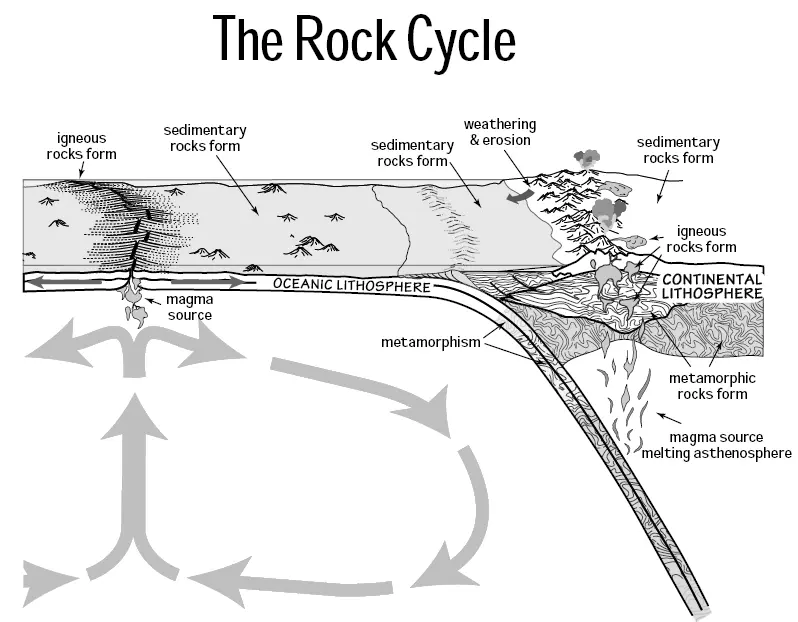
Almost every natural rock a beginner is likely to pick up belongs to one of three broad families. The boundaries are about how the rock formed, not what it’s made of, and the formation history is what you’re reading off the surface when you identify it.
Igneous rocks
Formed when molten rock cools and crystallises. Two flavours, defined by where the cooling happens. Intrusive igneous rocks (granite, diorite, gabbro) cool slowly inside the crust, so crystals grow large and visibly interlocking. Extrusive igneous rocks (basalt, rhyolite, obsidian) cool fast at the surface, so crystals are tiny or absent. The defining texture of any igneous rock is interlocking crystals with no fossils, no grains in the sedimentary sense, and usually no layers.
Sedimentary rocks
Formed at or near the surface from accumulated sediment. Clastic sediments (sandstone, shale) are made of broken-up bits of older rock cemented together; you can usually see or feel the grains. Chemical and biogenic sediments (limestone, chalk, halite, coal) precipitate out of water or accumulate as organic remains. The defining textures are layering (bedding), visible grains, and, uniquely, fossils. Sedimentary rocks are the family where acid reaction is most often useful, especially in limestone and chalk, because many contain calcium carbonate.
Metamorphic rocks
Formed when an existing rock is changed by heat, pressure, or both, without melting. The original minerals reorganise into new ones, often aligning along a preferred direction because the rock was being squeezed. That alignment is called foliation, and it’s the single most useful diagnostic in metamorphic rocks. Foliated metamorphic rocks include slate (the lowest grade), schist (medium grade) and gneiss (highest grade). Non-foliated metamorphic rocks like marble and quartzite form when the parent rock had no minerals that could align, they recrystallise into a uniform sugary texture instead.
In short: visible grains or fossils usually point to sedimentary rock. Interlocking crystals with no fossils or bedding usually point to igneous rock. Banding, aligned minerals or a sugary recrystallised texture usually point to metamorphic rock. Get the family right first, and the specific rock name becomes much easier.
The five-question flowchart
Run through these in order. By question three or four, you will usually know the rock family and have a short list of likely names.
Question 1 Are there visible layers, fossils, or sand-sized grains?
- Yes → Almost certainly sedimentary. Go to Q2.
- No → Probably igneous or metamorphic. Skip to Q3.
Question 2 What kind of sediment?
- Visible fossils, fizzes with acid → Limestone (or chalk if it’s pure white and marks your fingers).
- Gritty, with visible sand grains, often layered → Sandstone.
- Fine-grained, splits into thin sheets, dull → Shale or mudstone.
- Pure white, very soft, leaves marks on hands → Chalk.
Question 3 Is there foliation (banding or aligned minerals)?
- Yes → Metamorphic. Go to Q4.
- No, but interlocking crystals are visible or it looks crystalline/glassy → Igneous. Skip to Q5.
- No, but it has a uniform sugary or granular texture → Possibly non-foliated metamorphic (marble, quartzite). Test with acid: marble fizzes, quartzite doesn’t.
Question 4 What kind of foliation?
- Splits into flat thin sheets, dull sheen → Slate.
- Thin shiny wavy bands of flaky minerals (mica) → Schist.
- Thick alternating light and dark bands, coarse → Gneiss.
Question 5 How big are the igneous crystals?
- Visible interlocking crystals, light overall, with glassy grey quartz → Granite.
- Visible crystals, salt-and-pepper, no obvious quartz → Diorite.
- Visible crystals, dark and dense, no quartz → Gabbro.
- Crystals too small to see, dark and dense → Basalt.
- Glassy, no crystals, breaks with curved (conchoidal) fractures → Obsidian.
- Many small holes (vesicles), unusually light and sometimes able to float when dry → Pumice.
A flowchart is a starting point, not a guarantee. Real rocks are messy: a sandstone can be cemented with calcite and fizz; a basalt can have a few visible crystals (phenocrysts); a metamorphic rock can preserve sedimentary layers from its parent. When two answers feel plausible, run the home tests below to break the tie.
Five home tests that actually work
You don’t need a lab. You need a hand lens, an unglazed tile, a steel knife, a small bottle of vinegar, and ideally a copper wire and a small magnet. Total cost: roughly £10–20, depending on where you buy the kit. These five tests, in this order, resolve most beginner-level identifications.
1. The hardness test (Mohs reference)
The Mohs scale ranks minerals from 1 (talc) to 10 (diamond). For rock-level identification you don’t need fine resolution, you need to know roughly where on the scale your rock sits. Useful reference materials:
- Fingernail about 2.2
- Pure copper wire about 3.0 (note: modern UK 1p and 2p coins have been copper-plated steel since 1992 and behave like steel, not copper, so they are not a reliable Mohs 3 reference)
- Steel knife or nail about 5.5
- Window glass about 5.5
- Steel file about 6.5
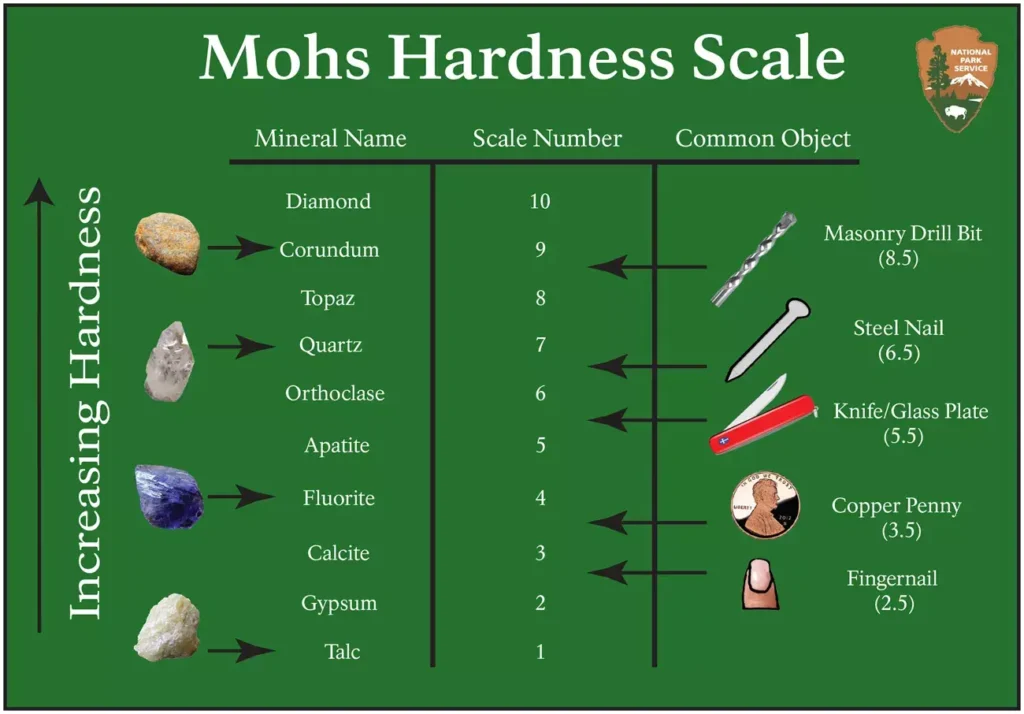
Try to scratch the rock with each in turn, starting soft. Chalk and gypsum scratch easily with a fingernail. Calcite (and most pure limestones) scratch with a copper wire. Granite, basalt, and quartzite will all scratch glass, they sit at 6 or above.
2. The acid test
Add a drop of dilute hydrochloric acid, usually 10% in geology kits, or white vinegar, usually about 5% acetic acid, to a fresh or scratched surface of the rock. Watch for fizz.
- Vigorous fizz → calcite-rich: limestone, chalk, marble, calcite-cemented sandstone.
- Slow fizz that only appears on a scratched surface → dolostone (magnesium-bearing carbonate).
- No reaction → not a carbonate. Rules out a large fraction of beginner candidates.
One thing many guides get wrong: vinegar reacts with limestone, but the reaction is much weaker and slower than with HCl. Don’t expect dramatic effervescence, expect a slow patient hiss over 10–30 seconds. If you use dilute HCl, wear eye protection and handle it carefully; vinegar is safer for beginners, but less sensitive.
3. The streak test (use it correctly)
Drag the specimen across the back of an unglazed porcelain tile. The colour of the powder it leaves, the streak, can be more diagnostic than surface colour, especially for metallic minerals, because coatings and weathering can disguise the outside of a specimen.
This test is most useful for minerals, not whole rocks. It shines for metallic minerals: hematite leaves a brick-red streak even when the surface looks black; pyrite leaves a greenish-black streak; magnetite leaves a black streak. For most sedimentary, igneous, and metamorphic rocks of the kind beginners pick up, the streak test isn’t directly diagnostic, but the moment you encounter a metallic-looking mineral inside a rock, this is the test that resolves it.
4. The heft (density) check
Pick up two rocks of similar size and compare the weight. This is unscientific but surprisingly informative. Rocks rich in heavy metallic minerals, magnetite, hematite, galena, pyrite, feel noticeably heavier than they look. Pumice and scoria, which are full of gas bubbles, feel oddly light. Most “ordinary” rocks (granite, sandstone, limestone, basalt) sit in a similar density range of around 2.5–3.0 g/cm³, so don’t expect heft alone to discriminate granite from basalt.
The popular shortcut “igneous rocks feel heavy, sedimentary rocks feel light” is misleading: pumice is igneous and floats, while many sandstones are denser than basalt. Use heft as a flag for outliers, not a primary test.
5. The magnet test
A small neodymium magnet (a fridge magnet is too weak) will visibly attract magnetite, some iron-rich basalts, and a few other iron-bearing minerals. Most basalt does not visibly stick to a fridge magnet, despite what some guides claim, that idea comes from confusing magnetite-rich basalts with the rock as a whole. If you suspect magnetite, the magnet is the fastest test. If you don’t, skip it.
Six common UK rocks worth knowing by sight
The UK packs an extraordinary geological range into a small landmass: Precambrian gneisses in the Hebrides, Carboniferous limestones across the Midlands, Mesozoic sandstones and chalks down the south, Tertiary basalts in Antrim. The six examples below will not cover every possibility, but they train your eye for the textures and tests that matter most.
1. Granite (Dartmoor, Cairngorms, Mourne Mountains)
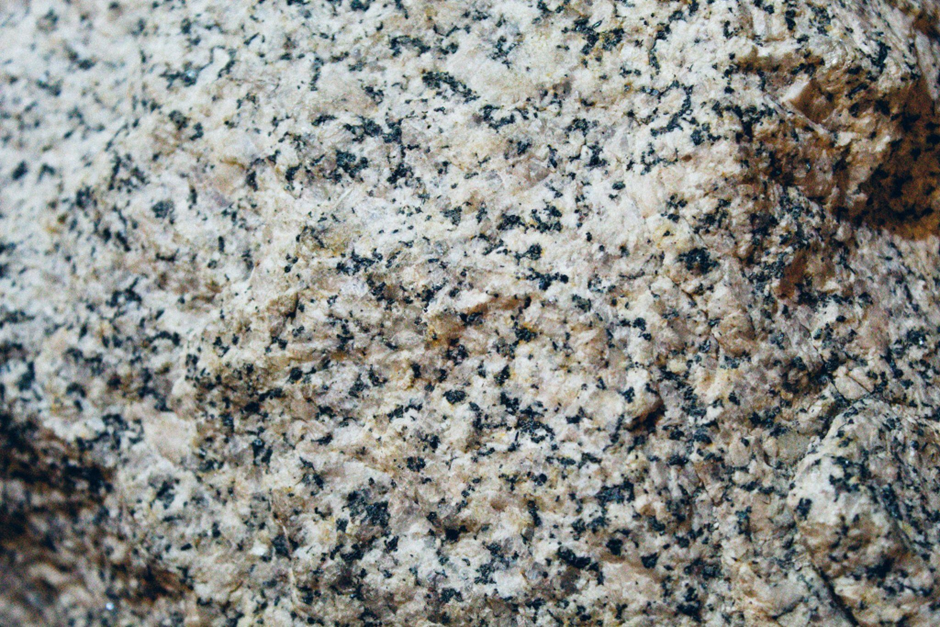
Granite is a coarse-grained intrusive igneous rock, and it’s the rock that built much of upland Britain. The diagnostic feature is the texture: interlocking crystals 1–5 mm across, dominated by glassy grey quartz, milky-white or pink feldspar, and dark mica or amphibole. No layers, no fossils, no fizz. Hard enough to scratch glass.
The single most reliable diagnostic is visible quartz: a hand lens reveals the quartz grains have no internal cleavage and look like cracked glass, while feldspar grains have flat reflective cleavage planes. If you can confirm quartz, you’ve ruled out gabbro and most diorites, leaving granite or granodiorite. Read more about granite at Geoscopy.
2. Limestone (Peak District, Yorkshire Dales, Mendips)
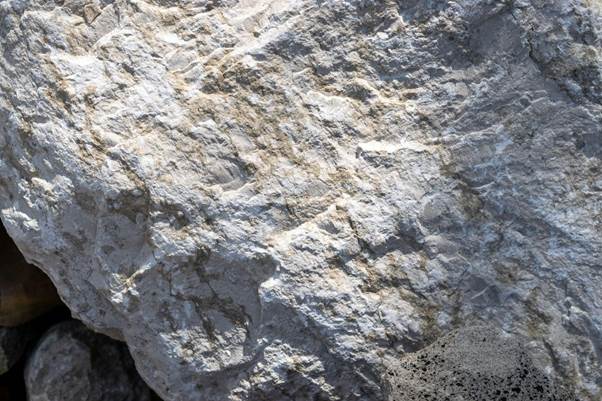
Limestone is a sedimentary rock made overwhelmingly of calcium carbonate, deposited in shallow tropical seas. Many classic UK limestones, including large areas of the Peak District and Yorkshire Dales, are Carboniferous in age and often fossil-rich, with crinoid stems, brachiopod shells and occasional corals. Colour ranges from light grey to cream. Texture is typically smooth, sometimes faintly sugary.
The diagnostic test is the acid test: limestone fizzes vigorously with HCl, slowly with vinegar. If your candidate doesn’t react at all, it isn’t limestone. Read more about limestone at Geoscopy.
3. Sandstone (Pennines, Hadrian’s Wall country, South Devon)
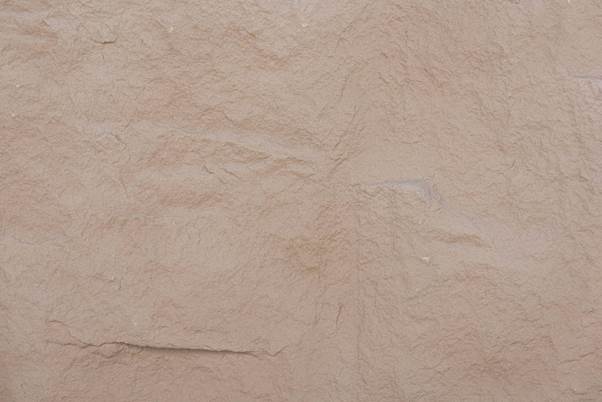
Sandstone is a clastic sedimentary rock made of cemented sand-sized grains (0.06–2 mm). UK sandstones run the gamut: red Devonian Old Red Sandstone, the yellow-grey Carboniferous Millstone Grit of the Pennines, the deep-red Triassic New Red Sandstone of Cheshire and South Devon. Iron oxides give the red colours; their absence gives the pale yellows and greys.
The diagnostic feature is texture you can feel: gritty like fine sandpaper, with grains visible to the naked eye or under a hand lens. Bedding planes are usually visible. Sandstone doesn’t fizz unless it’s calcite-cemented. The trickiest confusion is with quartzite (its metamorphic equivalent), see “Five mistakes” below. Read more about sandstone at Geoscopy.
4. Basalt (Antrim Plateau, Isle of Skye, Mull)
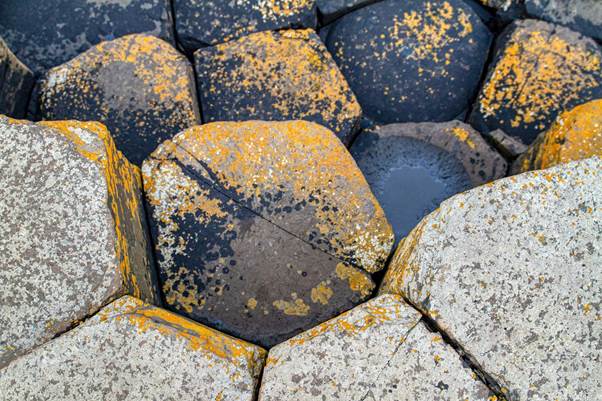
Basalt is a fine-grained extrusive igneous rock: the solidified equivalent of basaltic lava like that erupted in places such as Hawaii and Iceland. In the UK it forms the Antrim Plateau (including the Giant’s Causeway), the Cuillin foothills on Skye, and significant parts of Mull. It’s dark grey to black, dense, and the crystals are almost always too small to see without a hand lens.
The diagnostic features are the uniform fine grain and the dark colour, sometimes accompanied by gas bubbles (vesicles) where dissolved gases came out of the lava as it solidified. The hexagonal columns at Giant’s Causeway are not crystal shapes, they’re cooling joints that develop as the lava contracts. Read more about basalt at Geoscopy.
5. Slate (Snowdonia, Lake District, Argyll)
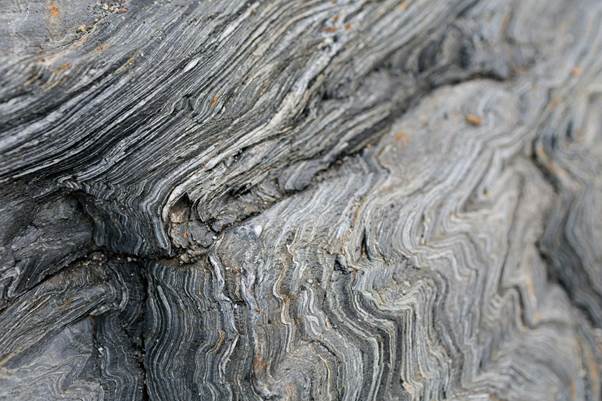
Slate is a low-grade metamorphic rock, formed when shale or mudstone is heated and compressed enough to develop slaty cleavage. The defining feature is slaty cleavage: a planar fabric along which the rock splits into flat thin sheets. Welsh slate is famously dark grey to blue-grey, but slates can be green, purple, or even black depending on the parent mud composition.
The single most useful field observation: in good slate, you can sometimes see both the original sedimentary bedding and the new slaty cleavage cutting across it at an angle. That intersection, bedding from the past, cleavage from the squeezing, is the visible record of a continental collision. Slate can preserve fossils (graptolites are common in Welsh slate), but they’re often deformed by the same compression that produced the cleavage.
6. Chalk (White Cliffs of Dover, South Downs, Yorkshire Wolds)
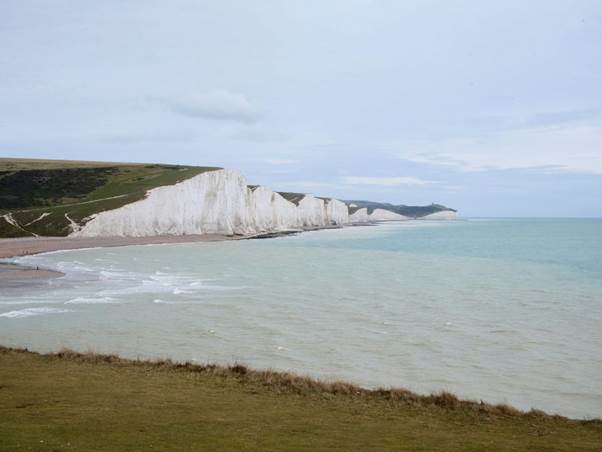
Chalk is a soft, pure white biogenic limestone made almost entirely of coccoliths, calcite plates from microscopic single-celled algae called coccolithophores that lived in the warm Late Cretaceous seas about 70–100 million years ago. A note on a common misconception: coccoliths are individual plates around 5–10 microns across and are not visible to the naked eye, or even under a standard hand lens. They show up under a scanning electron microscope. What you might see in chalk with a 10× hand lens are larger fossils: foraminifera tests, occasional bivalve fragments, and trace fossils.
Diagnostically, chalk is unmistakable: pure white to off-white, soft enough to mark your fingers, and fizzes vigorously with acid because it’s nearly pure calcite. The famous flint nodules embedded in chalk cliffs are a different rock entirely (microcrystalline quartz, formed by silica precipitation in the chalk pore space).
Five mistakes beginners make
1. Trusting colour over texture
Colour is the least reliable diagnostic in geology. Granite can be pink, white, grey, or red depending on which feldspar dominates. Basalt weathers from black to brown to rusty orange. Limestone ranges from cream to dark grey. The shape and size of the grains, crystals, or layers will tell you far more than the colour ever will.
2. Confusing sandstone with quartzite
Both are dominated by quartz. The difference is in how they fracture. Sandstone breaks around its grains, the broken surface looks like a beach. Quartzite breaks through the grains because metamorphism has fused them into a single quartz mass, the broken surface looks like glass. Hit a fresh edge with a knife: gritty drag means sandstone, smooth glassy slide means quartzite. Quartzite also won’t crumble when you scratch it; sandstone often will.
3. Assessing wet rocks
Water dramatically deepens colour and obscures grain texture. A wet sandstone can look almost black; a wet limestone can look like slate. Always identify dry, ideally with a fresh broken surface. River cobbles are particularly tricky because they’re abraded smooth and waterlogged, break one open and the inside often tells a different story.
4. Calling everything dark “basalt”
Plenty of dark rocks aren’t basalt. Gabbro is the same chemistry as basalt but coarse-grained (visible crystals). Dolerite is the same chemistry but medium-grained, often forms dykes and sills (the Whin Sill that Hadrian’s Wall sits on is dolerite, not basalt). Shale is sedimentary and dark grey. Slate is metamorphic and dark grey. Hornfels is metamorphic and very dark. Texture, not colour, distinguishes them.
5. Ignoring location
Geological context is a free diagnostic. If you’re walking on Dartmoor and you find a coarse-grained crystalline rock, the prior probability that it’s granite is enormous, because Dartmoor is a granite batholith. If you’re on the Antrim coast, dark fine-grained rocks are basalt with extremely high probability. The British Geological Survey now provides the free Geology of Britain Viewer, which lets you explore bedrock and superficial geology across Great Britain. When in doubt, photograph the rock and leave it where it is. When in doubt, leave it and photograph.
Rock identification quick reference table
| Rock | Family | Diagnostic features | Hardness | Acid test | UK locations |
|---|---|---|---|---|---|
| Granite | Igneous (intrusive) | Coarse interlocking crystals; visible quartz | 6–7 | No reaction | Dartmoor, Cairngorms, Mournes |
| Limestone | Sedimentary (biogenic) | Fossils; cream-grey; fizzes | 3–4 | Vigorous fizz | Peak District, Dales, Mendips |
| Sandstone | Sedimentary (clastic) | Visible sand grains; bedding | 4–7 (varies) | Usually no reaction | Pennines, Hadrian’s Wall, Devon |
| Basalt | Igneous (extrusive) | Dark, dense, very fine grain | 5–6 | No reaction | Antrim, Skye, Mull, Staffa |
| Slate | Metamorphic (low grade) | Splits into flat thin sheets | 3–4 | No reaction | Snowdonia, Lake District, Argyll |
| Chalk | Sedimentary (biogenic) | Pure white, very soft, marks fingers | 1–2 | Vigorous fizz | South Downs, Dover, Wolds |
Going further
If you’ve worked through this guide, you should now be able to place most rocks you pick up on a UK path or beach into the right family within a minute or two. The next step is repetition, identification is a perceptual skill, and reading more guides won’t replace handling specimens.
- Get a 10× hand lens (around £5). Use it on every rock you pick up. The grain-scale features that matter most are invisible without one.
- Visit a county geology trail. The Geologists’ Association publishes excellent local field guides for most of the UK.
- Build a small reference collection. Even six well-labelled specimens from known locations (you know what they are because you know where they came from) anchors your eye for everything else.
- Use the BGS Geology of Britain Viewer before any field trip, knowing the bedrock geology of where you’re standing turns identification from guesswork into confirmation.
Frequently asked questions
How do I identify whether a rock is igneous, sedimentary or metamorphic?
Look for diagnostic textures. Igneous rocks have interlocking crystals or are glassy, with no fossils or sedimentary layering. Sedimentary rocks show layers, sand-sized grains, or fossils, and are often softer. Metamorphic rocks show foliation (banding or alignment of minerals) or a uniform sugary recrystallised texture. Start with the family before trying to name the exact rock. In most beginner cases, three observations, texture, layering and grain size, will narrow the answer dramatically.
Does limestone really fizz with vinegar?
Yes, but more slowly and less dramatically than guides usually suggest. White vinegar is 5% acetic acid, while geological reference acid is 10% hydrochloric acid. With vinegar on a pure limestone, expect a slow patient hiss over 10–30 seconds, sometimes only on a freshly scratched surface. Dramatic effervescence is an HCl reaction, not a vinegar reaction.
What is the difference between schist and gneiss?
Both are foliated metamorphic rocks, separated by metamorphic grade. Schist forms at medium temperature and pressure; its foliation is thin, wavy, and dominated by visible flaky minerals (especially mica), often giving the surface a shimmer. Gneiss forms at higher grade; its foliation is thicker, with alternating light and dark bands at the millimetre-to-centimetre scale, and the texture is coarser. If you can see flakes, think schist. If you can see thick bands, think gneiss.
Can I identify a rock from a photo?
Sometimes, but you’ll always be more reliable in person. A photo can’t show hardness, density, fizz response, or how a fresh broken surface looks under a hand lens. If you’re posting a photo for help, include something for scale (a coin or finger), a fresh broken surface (not just the weathered exterior), and the location. Even rough location often resolves the identification on its own.
What basic kit does a beginner need for rock identification?
A 10× hand lens, an unglazed porcelain tile (back of a kitchen tile works), a small bottle of dilute HCl or white vinegar, a steel knife or nail, a copper wire, and a notebook. A small neodymium magnet is useful but optional. Total cost under £15. A geological hammer is genuinely optional for a beginner, and in many UK locations, illegal to use without permission.
Are there rocks I shouldn’t collect?
Yes, several categories. Don’t hammer fossils or rock from outcrops at Sites of Special Scientific Interest (SSSIs) without permission, at famous fossil localities like Lyme Regis, “no hammering” rules are explicit. Don’t collect from National Trust or National Park sites. Loose surface stones and beach pebbles may be acceptable in some places, but rules vary by landowner, protected status and local by-laws. Road cuts can be dangerous and may also require permission. When in doubt, photograph the rock and leave it where it is. When in doubt, leave it and photograph.