
Introduction
In the U.S., diamonds account for 92% of gemstone sales by value. That dominance owes more to a 1940s De Beers marketing campaign than to the geology. There are dozens of natural minerals that produce gemstones durable enough for an engagement ring, often with more striking color, stranger formation histories, and significantly lower prices than diamond.
What follows is a working list of ten diamond alternatives worth considering. The focus is on what each stone actually is, where it forms, and how it holds up to daily wear. Every entry covers the geology, the buyer-relevant practical details (hardness, common treatments, the catch nobody mentions in the showroom), and the trade-off you should understand before committing to a stone for the next several decades.
One thing to know before we start. The Mohs hardness scale runs from 1 (talc) to 10 (diamond), and for daily ring wear, 8 and above is comfortable. 7 to 8 works with reasonable care. Below 7 means protective settings and taking the ring off for active use. Hardness isn’t the same as toughness, though, and the distinction matters here: emerald sits at 7.5 to 8 on Mohs but chips more easily than tanzanite at 6.5, because emerald crystals are full of natural fractures. The difference is flagged where it’s relevant.
Quick comparison table
| Gem | Mohs hardness | Color range | Common treatment | Daily wear |
|---|---|---|---|---|
| Sapphire | 9 | Blue and every other color | Heat (standard) | Excellent |
| Ruby | 9 | Red | Heat, sometimes fracture-filling | Excellent |
| Emerald | 7.5–8 | Green | Oil or resin filling | With care |
| Morganite | 7.5–8 | Pink to peach | Sometimes heated | Good |
| Alexandrite | 8.5 | Green ⇄ red color change | Usually untreated | Excellent |
| Spinel | 8 | All colors | Usually untreated | Very good |
| Tanzanite | 6.5 | Blue-violet | Heat (universal) | Poor; cleaves |
| Tourmaline | 7–7.5 | All colors, often multi-color | Heat, irradiation | Good |
| Zircon | 7.5 | Blue, brown, yellow, colorless | Heat (universal for blue) | Good with care |
| Moissanite | 9.25 | Colorless and fancy colors | Lab-grown | Excellent |
1. Sapphire (Corundum)
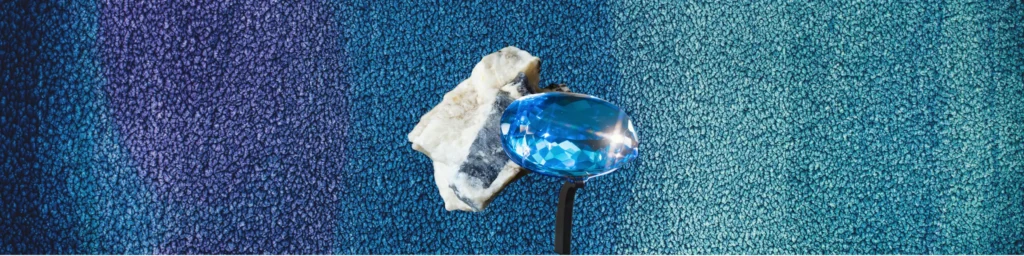
Sapphire is the obvious starting point and the obvious answer for most people who want a colored stone they don’t have to baby. Hardness 9 on Mohs, second only to diamond. The mineral is corundum (Al₂O₃), and ruby is the same mineral with different impurities — iron and titanium produce sapphire’s blue, chromium produces ruby’s red.
What most articles skip: sapphire isn’t necessarily blue. The trade calls every non-red corundum a “fancy sapphire,” which means pink, yellow, green, peach, even colorless are all on the table. Padparadscha — a salmon pink-orange Sri Lankan variety — runs higher per carat than blue at fine grades.
Most sapphires in the jewelry trade come from alluvial deposits: ancient riverbed gravels in Sri Lanka, Madagascar, and Myanmar where erosion already broke down the host rock and concentrated the dense corundum into placers. The crystal you wear was tumbled by water for thousands of years before someone sieved it out. The original host rocks are typically marble or basalt, products of the kind of high-temperature metamorphic and igneous activity that takes place in tectonically active regions.
Practical note: nearly all commercial sapphire is heat-treated to improve color. The treatment is stable, permanent, and disclosed by reputable dealers. Untreated sapphires command a meaningful premium and require a lab certificate (GIA, AGL, or SSEF). For anything above a few thousand francs, get the certificate.
2. Ruby (Corundum)
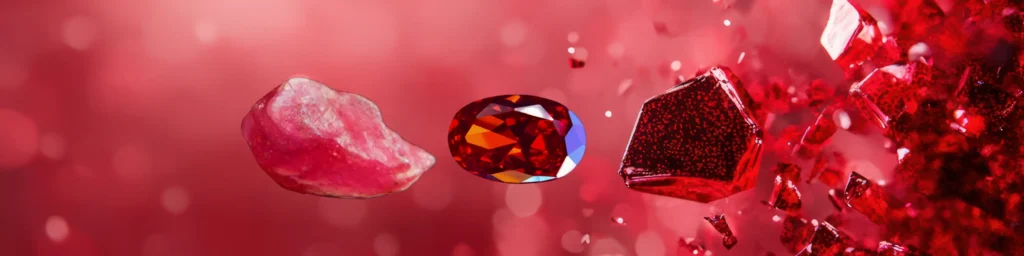
Ruby is sapphire’s red sibling: same mineral, different impurity. The chromium that gives ruby its red also makes the best stones fluoresce under ultraviolet light, which is why a fine Burmese ruby looks lit from within when sunlight hits it.
Top-quality ruby is the most expensive colored gemstone on Earth by carat. The 25.59-carat Sunrise Ruby cleared $30 million at Sotheby’s Geneva in 2015, roughly $1.2 million per carat — several times the price of comparable diamonds. The reason is rarity: ruby with no iron contamination, minimal inclusions, and the saturated “pigeon-blood” red of the Mogok region in Myanmar is a coincidence of conditions that almost never aligns. Diamond is geochemically common; gem-grade ruby is not.
Geologically, the famous Burmese rubies form in marble that has been altered by metamorphism, which provides the chromium and the right pressure-temperature window for corundum to crystallize. The same erosional cycle that produces alluvial sapphire also produces alluvial ruby — both stones often turn up in the same gem gravels.
For an engagement ring, a one- to two-carat ruby with standard heat treatment is the realistic option. Even at this scale, expect to pay several thousand francs per carat for clean material. The trade-off is hardness 9 and a stone that has carried cultural weight for longer than the diamond engagement ring tradition has existed.
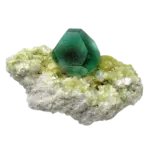
3. Emerald (Beryl)
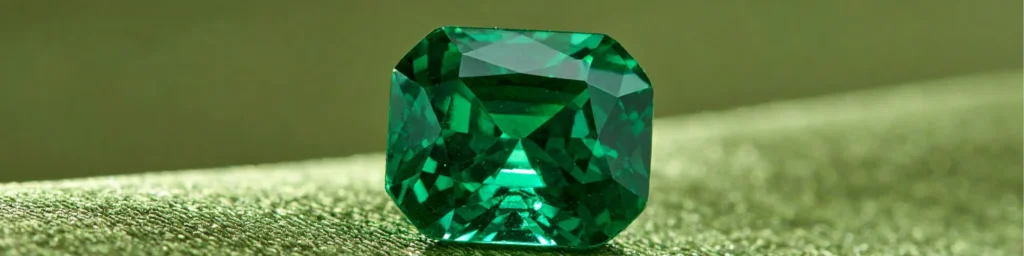
Emerald is where the recommendation gets cautious. Yes, it’s beautiful. Yes, it’s been mined since at least 1500 BC. But emerald is the most fragile gem on this list that anyone seriously suggests for daily wear, and you should know that before falling in love with the color.
Mohs hardness 7.5 to 8 looks fine on paper. The problem is internal structure. Almost every natural emerald contains a network of fractures and mineral inclusions that gemologists call jardin (French for garden). It’s part of the stone’s character, but those fractures make emerald prone to chipping from impacts that wouldn’t bother a sapphire. Most commercial emerald is also fracture-filled with cedar oil or polymer to mask the inclusions, and that filler can leak, dry out, or cloud over time. Ultrasonic cleaners destroy filled emeralds.
The geology is genuinely interesting and explains the inclusion problem. Emerald requires beryllium and chromium or vanadium in the same place — and those elements normally live in entirely different rocks. Beryllium concentrates in granitic pegmatites. Chromium and vanadium concentrate in ultramafic and certain sedimentary rocks. To form an emerald, hot hydrothermal fluids carrying beryllium have to physically reach chromium-bearing host rock and crystallize beryl in pockets and veins. Those veins are tectonically stressed environments, which is why the crystals come out fractured.
The major sources are Colombia (Muzo, Chivor), Zambia (Kafubu), and Afghanistan (Panjshir). Unlike sapphire and ruby, you don’t find emeralds in alluvial gravels — they break apart during erosion and have to be mined directly from the host rock.
Buy an emerald if the wearer will treat it carefully. A protective bezel or halo setting is mandatory, and the ring comes off for sports, gardening, and dishwashing. For an active wearer, choose something else.
4. Morganite (Pink Beryl)
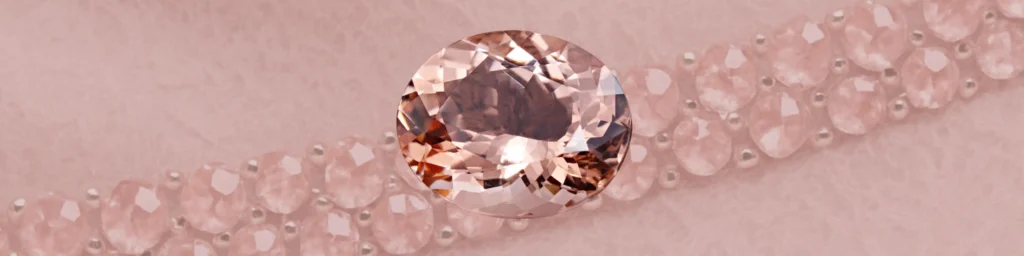
Morganite is beryl’s pink to peach variety, colored by trace manganese. Same mineral family as emerald and aquamarine, but without the inclusion problem — most facetable morganite is eye-clean. Hardness 7.5 to 8.
It’s the most affordable serious gemstone on this list, and that’s its biggest selling point. A clean three-carat morganite costs less than a clean one-carat sapphire. In rose gold with a halo setting, the soft pink reads vintage and feminine without veering into costume territory. Morganite has been the dominant “alternative engagement stone” since around 2015, which means the supply chain is mature and pricing is competitive.
The interesting geological note is that morganite forms in pegmatites — coarse-grained igneous rocks where the last fractions of granitic magma cool slowly enough that crystals reach exceptional size. Some pegmatite cavities have produced single morganite crystals over a meter long. The same pockets often contain tourmaline, kunzite, and topaz. Pegmatites are nature’s gem cabinet, and morganite is one of the more reliable inhabitants.
The name dates to 1911. George Frederick Kunz, the chief gemologist at Tiffany & Co., named the new pink beryl after the financier J.P. Morgan in recognition of Morgan’s gem-collecting philanthropy. Kunz also has a pink gemstone (kunzite) named after him; the Gilded Age was a productive era for naming things after wealthy men.
One caveat: morganite color saturates with crystal size. Small morganites (under one carat) often look almost colorless. To get the pastel pink the photos sell you on, plan for a two-carat stone or larger.
5. Alexandrite (Color-Change Chrysoberyl)
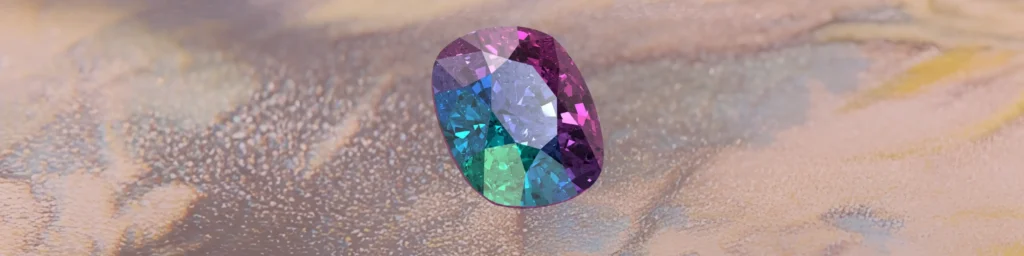
Alexandrite is the only gem on this list that does an actual trick. In daylight, fine alexandrite is teal to bluish-green. Move it under incandescent light — a candle, a tungsten bulb, a halogen lamp — and it shifts to purplish-red.14 The phrase “emerald by day, ruby by night” is overused but not inaccurate.
The mechanism is optics, not magic. Alexandrite is a chromium-bearing variety of chrysoberyl (BeAl₂O₄). Chromium absorbs light in two narrow bands (yellow and blue-green) and transmits the rest. Daylight is rich in blue-green wavelengths, so the eye reads green. Incandescent light is rich in red, so the eye reads red. Same stone, same chemistry, completely different perceived color depending on what’s hitting it.
Hardness 8.5, between sapphire and diamond. Excellent for daily wear. The problem is finding one. Alexandrite was discovered in the Russian Urals in the 1830s and named after the future Tsar Alexander II. The Russian deposits are essentially exhausted. Today’s market is mostly Brazilian, Sri Lankan, and East African material, and a stone over a carat with a strong color change runs into five figures fast.
Test the color change before buying. A weak shift from gray-green to brownish-red is not the real article. Insist on viewing the stone under genuine daylight (or a daylight-balanced LED) and under warm incandescent light. If the change isn’t dramatic and obvious, the stone isn’t alexandrite-grade — and you’re paying alexandrite prices for chrysoberyl.
6. Spinel
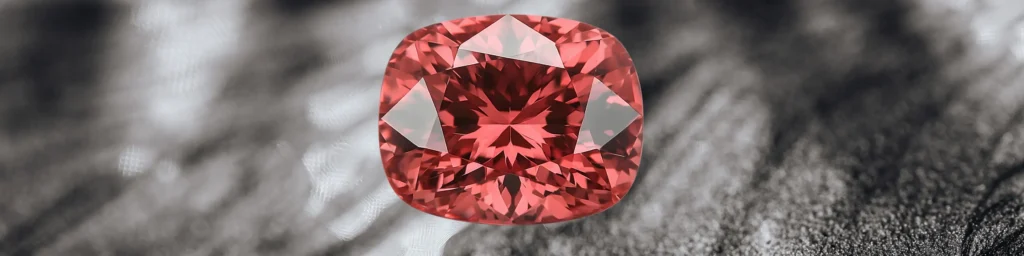
Spinel is the gem trade’s open secret. It does most of what ruby does — same red, hardness 8 on Mohs, frequently better natural clarity — for roughly a third of the price. Most red spinel on the market is also untreated, which is unusual for a colored gemstone.
The historical credential is that the Black Prince’s Ruby in the British Imperial State Crown is a 170-carat spinel, not a ruby. So is the Timur Ruby in the same collection. Until the late 18th century, every red stone was called a ruby; spinel and corundum weren’t separated as distinct mineral species until 1783, by Romé de l’Isle. By that point a lot of “rubies” in royal treasuries had been miscategorized for centuries. The trade still uses the historical term “balas ruby” for some red spinel.
Geologically, spinel and ruby form in the same environments — typically in marbles altered by contact metamorphism — and often come out of the same alluvial gravels in Myanmar and Sri Lanka. Spinel’s chemistry is magnesium aluminum oxide (MgAl₂O₄); ruby’s is aluminum oxide (Al₂O₃). The conditions that produce both stones overlap closely, which is why they’re frequently mined side by side.
The recommendations: cobalt-blue spinel from Vietnam or Sri Lanka if you want the look of fine blue sapphire with cleaner natural clarity. Hot pink spinel from Myanmar if you want pink sapphire color at half the price. Red spinel for anyone who wants ruby’s look without the ruby premium and is willing to explain what spinel is to friends and relatives.
7. Tanzanite (Blue Zoisite)
Tanzanite has one serious weakness as an engagement stone, and it has to be addressed first. Hardness 6.5 with distinct cleavage. That means it scratches against anything quartz-grade or harder (countertops, asphalt, the metal of other rings) and can fracture along cleavage planes from a sharp impact. If you wash dishes wearing it, you will eventually damage it.
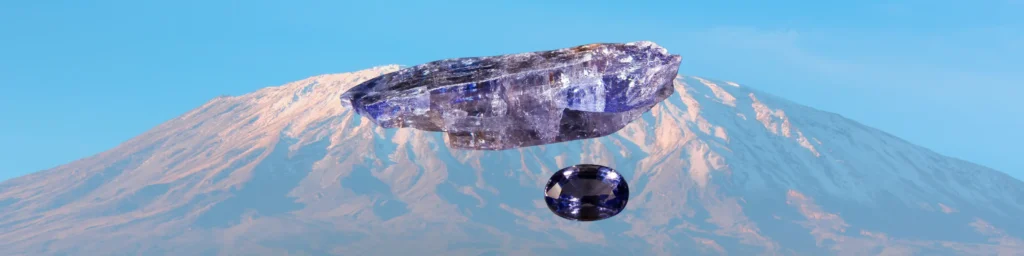
With that out of the way: tanzanite is the most striking blue-violet gem on Earth, and it comes from one place. The Merelani Hills of northern Tanzania, in a deposit roughly seven kilometers by two.18 Discovered in 1967 — the official Tiffany version of the story credits a Maasai herder named Ali Juuyawatu, though the historical record is contested. Either way, the deposit is finite and being mined out. Current industry estimates give it 10 to 30 more years of commercial production depending on grade.
Mineralogically, tanzanite is the blue gem variety of zoisite, a calcium aluminum silicate. The blue color comes from trace vanadium. Most rough tanzanite is brown when it leaves the ground; heat treatment around 500 °C oxidizes the vanadium and shifts the color to the blue-violet of jewelry-grade material. The treatment is universal — essentially every tanzanite on the market is heated. The geological setting is regional metamorphism in the Mozambique Belt of East Africa.
The optical property worth knowing about is trichroism. Tanzanite shows three different colors along its three crystal axes: blue, violet, and burgundy. Cutters orient the rough so the dominant face-up color is the blue-violet that the market wants, but if you tilt a tanzanite under directional light you’ll catch flashes of the other two colors. No diamond does this.
If you choose tanzanite, set it in a halo or bezel setting, take it off for anything physical, and budget for occasional repolishing. It’s a stone for someone who’ll wear it the way they’d wear a fine watch.
8. Tourmaline
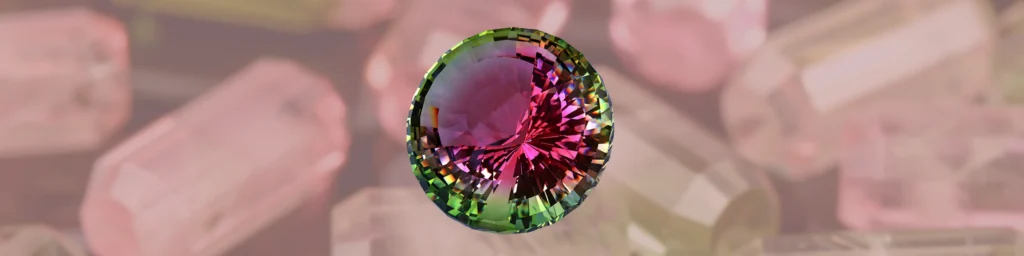
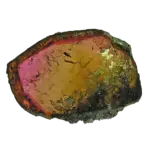
Tourmaline isn’t a single mineral. It’s a group of around 30 closely related borosilicate species, which is why it comes in essentially every color you’ve heard of and a few you haven’t. Iron-rich tourmaline is dark green or blue (schorl, indicolite). Manganese tourmaline is pink to red (rubellite). Copper-bearing tourmaline is the neon blue-green Paraíba variety that broke price records when it was discovered in Brazil in 1989. Watermelon tourmaline grows pink in the core and green at the rim in the same crystal.
Hardness 7 to 7.5, which is borderline acceptable for daily wear. Tourmaline doesn’t have emerald’s brittleness problem, and good cutting material is usually clean enough for bright sparkle.
Two practical recommendations. First, on Paraíba: the Brazilian deposits are essentially mined out, and the Mozambican and Nigerian copper-bearing tourmalines that the trade still markets as Paraíba run into thousands per carat for fine material. If you see a “Paraíba” under $200 per carat, it’s been heated, irradiated, mislabeled, or all three. Buy from a dealer who’ll provide an origin report.
The other property worth knowing is that tourmaline is pyroelectric and piezoelectric. Heat a tourmaline crystal or compress it, and it generates a small electric charge. Dutch traders in the 1700s noticed that heated tourmaline pulled ash and chaff out of pipe bowls; the structural reason is that tourmaline crystals have a polar c-axis and a permanent dipole moment. Pierre and Jacques Curie used tourmaline in their original 1880 piezoelectricity experiments. None of this is relevant to wearing the stone, but no other major gemstone has this property — which is the kind of fact a tourmaline ring earns you the right to mention.
9. Zircon
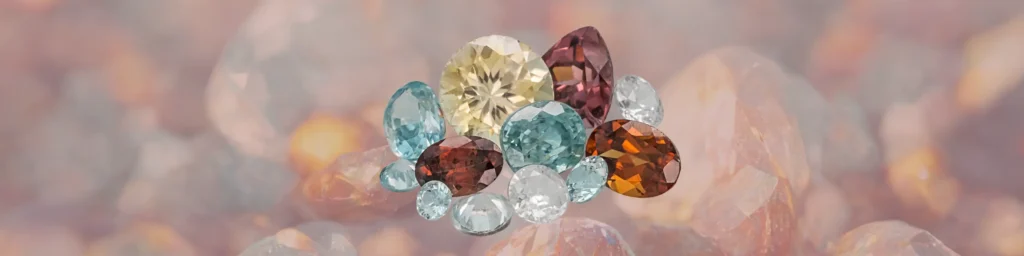
First clarification: zircon is not cubic zirconia. Cubic zirconia is a synthetic zirconium oxide invented in the 1970s as a deliberate diamond simulant. Zircon (ZrSiO₄, zirconium silicate) is a natural mineral that’s been used as a gemstone for at least 2,000 years. The names sound similar; the materials are unrelated.
The geological credential is hard to beat. Zircon is the oldest mineral on Earth — the oldest known crystals, recovered from the Jack Hills conglomerate in Western Australia, date to 4.4 billion years. They’re older than the oldest rocks, older than the moon, almost as old as the planet itself. Zircon is so chemically and physically resilient that crystals which formed in the Hadean eon have survived every subsequent erosional, metamorphic, and tectonic cycle and ended up in modern river gravels. Geochronologists use uranium-lead dating on zircon as the foundation of deep-time geology, because zircon retains its isotopic record almost indefinitely.
The gem zircon you’d put in a ring isn’t 4 billion years old — most facetable zircon is Cenozoic, hundreds of millions of years old at most. But the optical case for zircon is independent of its age. Refractive index 1.92 to 1.98 (diamond is 2.42), dispersion 0.039 (diamond is 0.044). A well-cut zircon throws nearly as much rainbow fire as a diamond, and significantly more than any other natural gem on this list. Before cubic zirconia was invented, white zircon was the diamond simulant in the trade, sometimes sold under the misleading name “Matura diamond.”
Hardness 7.5, but with a brittleness caveat. Some older zircons contain enough trace uranium and thorium that radioactive decay has, over geological time, partially disordered the crystal lattice — these are called “metamict” zircons and are noticeably softer and more fragile than fresh material. A reputable dealer will sell only “high zircon,” meaning fully crystalline, undamaged stones. Blue zircon, the popular color for jewelry, is heat-treated brown zircon. The treatment is stable and universal; there’s essentially no naturally blue zircon on the market.
Zircon is underpriced relative to its optics. A clean blue zircon over two carats can be had for well under $500, and a colorless one for less. The trade-off is the brittleness, which means a protective setting and gentle handling.
10. Moissanite (Silicon Carbide)

Moissanite is the only entry on this list that’s primarily a synthetic. Natural moissanite exists, but only in trace amounts in meteorites and in a few unusual terrestrial settings. The original 1893 discovery by Henri Moissan was in fragments from the Canyon Diablo meteorite at Meteor Crater in Arizona; he initially mistook the crystals for diamond. It took six years to confirm the material was silicon carbide (SiC), a compound that essentially doesn’t form in Earth’s oxidizing crust because silicon prefers to bond with oxygen here.
The moissanite in jewelry is grown in industrial reactors using a process developed by Cree Inc. and originally licensed to Charles & Colvard. Hardness 9.25 on Mohs, between corundum and diamond. Refractive index 2.65 (higher than diamond’s 2.42), dispersion 0.104 (higher than diamond’s 0.044). In practical terms: a moissanite throws roughly two and a half times more rainbow fire than a diamond of the same cut, and it’s essentially uncratchable in everyday use.
The economic argument is straightforward. A 1.5-carat round-brilliant moissanite of jewelry grade runs around $400 to $700. A 1.5-carat round-brilliant diamond of comparable color and clarity runs $7,000 to $15,000. The optical properties are demonstrably superior on the metrics that produce sparkle, the hardness is higher than any natural gem except diamond, there’s no mining footprint, and there’s no inclusion problem because the synthesis produces nearly perfect crystals.
The honest case against: moissanite is birefringent (doubly refractive), which can give a subtle “fuzzy” look from some angles in larger stones, especially when viewed straight down at the table facet. The higher dispersion reads as more colorful and less white than diamond — diamonds are deliberately cut to suppress fire and emphasize white brilliance. Some people prefer moissanite’s rainbow look. Some find it gaudy in stones over two carats. Look at one in person before deciding.
If you want diamond’s appearance without diamond’s price tag or supply-chain ethics, moissanite is the rational answer. The cosmic-origin backstory is a bonus, even though your stone was grown in North Carolina.
Frequently asked questions
What is the most durable diamond alternative for an engagement ring?
Moissanite, at Mohs 9.25, is the hardest natural-or-synthetic gem after diamond and the most durable choice. Among purely natural gems, sapphire and ruby (both Mohs 9) are the toughest options for daily wear. Alexandrite at 8.5 and spinel at 8 are also excellent. Avoid tanzanite, opal, pearl, and emerald for high-impact daily wear unless you’re committed to a protective setting and careful handling.
Which diamond alternative looks most like a diamond?
Moissanite is the closest visual match for a colorless diamond and is essentially indistinguishable to the naked eye in most settings, though its higher dispersion produces more visible rainbow fire. White sapphire is the closest natural alternative but lacks diamond’s brilliance and reads slightly glassier. Colorless zircon throws fire close to a diamond’s but is rarely seen in modern jewelry.
Are diamond alternatives cheaper than diamonds?
Almost always. Lab-grown moissanite runs roughly 5–10% of the price of a comparable diamond. Sapphire, spinel, tourmaline, zircon, and morganite all sit well below diamond per carat. The exceptions are top-grade ruby, fine alexandrite, and cobalt-blue spinel, which can match or exceed diamond prices at the highest quality grades because the supply is so much more constrained.
Is moissanite a real gemstone or a fake?
Moissanite is a real mineral with its own species name (it’s been recognized by the International Mineralogical Association since the 1900s) and its own crystal structure. It occurs naturally in meteorites and a small number of terrestrial settings, but commercially available moissanite is lab-grown because natural crystals are too small for jewelry use. It is not a “fake diamond” any more than a sapphire is a fake diamond — it’s a different mineral that happens to look similar.
Do diamond alternatives hold their value?
Most colored gemstones have a less liquid resale market than diamonds, so secondary-market pricing is unpredictable. Fine ruby, sapphire, alexandrite, and Paraíba tourmaline have appreciated substantially over the last several decades — the top of these markets behaves more like a collectibles market than a jewelry market. Mass-market gems like morganite, tanzanite, and lab-grown moissanite generally don’t appreciate and shouldn’t be bought as investments. Buy a stone because you want to wear it, not because you expect to sell it.