



Introduction
A man pushes through jungle undergrowth, machete in hand. One step lands on what looks like ordinary mud. His boot vanishes. Then his knee. He grabs a vine, the vine snaps, and the camera lingers on a hat settling onto a smooth brown surface as if the earth had swallowed a person whole and closed over the gap. That scene, in some form, has played out in hundreds of films. The trope peaked in the 1960s: journalist Daniel Engber, writing in Slate, calculated that “nearly 3 percent of the films in that era, one in 35, showed someone sinking in mud or sand or oozing clay,” a figure the University of Texas program EarthDate also cites, rounding it to one in 33.
The physics is less cooperative. You can get stuck in quicksand. You can be trapped long enough for a tide or exhaustion to kill you. But the slow vertical swallowing, the part where the surface closes over your head, does not happen, and the reason is measurable.
The clearest statement comes from a 2005 paper in Nature by Asmae Khaldoun, Erika Eiser, Gerard Wegdam and Daniel Bonn of the University of Amsterdam, titled “Liquefaction of quicksand under stress.” Their one-page report states the conclusion outright: “a simple sinking test demonstrates that it is impossible for a human to be drawn into quicksand altogether.”

What is quicksand?
Quicksand is ordinary sand or silt that has lost its ability to hold weight because water has filled and pressurized the spaces between its grains.
Dry sand supports a person because each grain rests against its neighbors. The contact points form chains of force that carry the load down into the ground. Pour in water until the grains are fully saturated, and the situation can still be stable: wet beach sand near the waterline is firm enough to drive on. The danger appears when the water between the grains comes under pressure from below, from an upwelling spring, a rising tide, an artesian source, or seismic shaking. When that pore-water pressure rises high enough to push the grains slightly apart, the friction that held them together drops toward zero. The packing that engineers sometimes describe as a “house of cards” collapses, and the mixture that looked like solid ground starts to behave like a dense fluid.
Britannica defines quicksand as saturated, loose sand that loses its strength and turns fluid once the trapped water can no longer drain away, giving the liquefied sediment a soft, spongy consistency. The water has to be unable to drain away. As long as the pore water is trapped and pressurized, the grains float apart and the ground gives way.
This is why deserts are mostly the wrong place to look, despite what cartoons suggest. Quicksand needs water. It turns up where water rises through sand: riverbanks, marshes, the edges of springs, alluvial fans, and above all tidal flats, where a retreating sea leaves behind sand saturated from below. Tidal flats and intertidal sediments are the classic global setting, from Morecambe Bay in England to the bay of Mont-Saint-Michel in France.

The rheology: why a tiny push changes everything
Quicksand belongs to a family of materials called non-Newtonian fluids, whose apparent thickness, their viscosity, depends on how hard you push them. Water is Newtonian: stir it gently or violently and its viscosity is the same. Quicksand behaves in the opposite way to the more familiar cornstarch-and-water mixture sold as a science toy. That mixture, oobleck, is shear-thickening: hit it and it stiffens. Quicksand is shear-thinning: push it and it turns runny. Non-Newtonian behavior is what makes both substances feel like they are breaking the rules of solids and liquids.
The Amsterdam group measured exactly how dramatic this shear-thinning is. Working with natural quicksand in a laboratory rheometer, they found the material was extraordinarily sensitive to small changes in applied stress. In their companion 2006 article “Quicksand!” in Europhysics News, they reported that viscosity measurements showed almost a factor of one million difference between quicksand sitting undisturbed in its “solid” state and quicksand that had been disturbed past its tipping point.
Science magazine’s news coverage of the 2005 paper put numbers on the trigger: “Just a 1% change in stress caused the viscosity of the mixture to drop by a factor of nearly a million, a change that essentially turned the quicksand from solid earth to gooey liquid.” In plain terms, the Europhysics News authors wrote, this is “the difference between sinking away with a few millimetres every hour, and sinking with a meter per second.”
Liquefaction is only the first half of the mechanism. Once the structure collapses, the mixture separates into two phases: a water-rich layer and a dense, sand-rich sediment. That sediment compacts around whatever is trapped in it. As the apparent viscosity climbs back up because of the high sand fraction, the trapped object is now gripped by a packed, heavy slurry. The material that yielded a moment ago has repacked into something far harder to move through.
The clay, the salt, and a salt lake in Iran
What turns a patch of wet sand into a genuine trap rather than a temporary soft spot? The Amsterdam team’s field samples point to clay and salt.
Daniel Bonn collected the natural quicksand he studied from a salt lake near Qom, in Iran, a site with a grim local reputation. As the Europhysics News article recounts, “local shepherds insist that whole camels were swallowed up by the quicksand.” Laboratory analysis of the samples showed that, besides sand and water, the material contained considerable amounts of clay, on the order of 5 to 10 percent, plus salt.
The clay is what makes the house of cards stand and then fall so suddenly. Fine clay particles form a fragile gel that loosely bridges the sand grains, holding the loose packing together while it sits undisturbed. The Amsterdam group described it as a delicate colloidal structure whose viscosity slowly increases with time at rest. Disturb it and the clay gel liquefies, Bonn compared the effect to yogurt turning runny when stirred, and the supporting structure gives way. Salt plays a supporting role by helping the clay aggregate and by promoting the dense sediment that forms after collapse. When the researchers built a synthetic “laboratory quicksand” to reproduce the natural material’s flow behavior, the recipe was bentonite (a swelling clay) mixed with sand and salt water.
Not everyone agrees salt is essential. Science quoted civil engineer T. Leslie Youd of Brigham Young University, who said he had stepped into freshwater quicksand himself, disputing the idea that salt is a required ingredient. Bonn’s reply was that quicksand without salt does not form the same trapping sediment and is therefore probably less dangerous. The disagreement matters: the Amsterdam mechanism is specific to the clay-and-salt quicksand sampled in Iran, and freshwater “quick” conditions in soil mechanics can arise more generally wherever pore pressure cancels the grain-to-grain stress.
Can you drown in quicksand?
The myth fails on a comparison of densities. The human body has an average density very close to that of water, about 1 gram per cubic centimeter. Quicksand is a mix of water and mineral grains, so it is substantially denser. To test what that means for a body, the Amsterdam researchers ran a sinking experiment. They placed beads with a density of 1 gram per milliliter, matching the average density of human tissue, on their quicksand and disturbed the system. The beads sank partway and stopped. As the Nature paper’s summary states, “it is impossible to sink beads with a density of 1 g per ml. So animals and humans, with a similar average density, will not be drawn into quicksand completely. They should sink only half-way.”
This is Archimedes’ principle doing its ordinary work. An object settles until the weight of the displaced sand-water mixture equals its own weight. Because the mixture outweighs the body volume for volume, equilibrium arrives around waist height. Bonn told National Geographic that a trapped person would sink in “a little deeper than your waist,” adding, “I would say there would be some pressure on the chest, but not enough to cause serious trouble.”
A widely repeated figure puts quicksand’s density at about 2 grams per cubic centimeter, twice that of the body. That round number is repeated in secondary references such as Wikipedia rather than stated as a precise measurement in the primary papers, so treat it as an illustration of the principle, not a measured value. NBC News, reporting the 2005 study, gave the contrast in different units: an average human body at about 62 pounds per cubic foot against quicksand at roughly 125, the same near-2-to-1 ratio. The principle itself is solid: the body is buoyant in quicksand, and a buoyant object cannot be pulled fully under by the fluid it floats in.
So the cinematic image has the physics backwards. You don’t sink out of sight. You stop at roughly waist depth, half-submerged, and then cannot get out.
Why escape is so hard: the force of a car
Getting unstuck is hard, and the Amsterdam group quantified why. After the sand packs around a trapped limb, freeing it means dragging it through dense, compacted material while water struggles to flow in behind to fill the space. The pressure of the surrounding mixture works against you.
Pulling a foot out at one centimeter per second would take roughly the force needed to lift a medium-sized car. National Geographic, Science, and Britannica all repeat this car-lifting comparison and attribute it to Bonn’s group.
The exact force in newtons is reported inconsistently across secondary sources. The Naked Scientists, recounting Bonn’s measurements, write that “the force need to extract a trapped foot (ten thousand Newtons) is equivalent to that needed to lift the average family car.” An Agence France-Presse report carried by Phys.org instead states that “just to haul out a foot requires a force of 100,000 Newtons, about the same as that needed to lift a medium-sized car.” Both are described as “equivalent to lifting a car,” which tells you the comparison is carrying more weight than the precise number; 10,000 newtons corresponds to lifting roughly a one-tonne car, while 100,000 newtons is closer to a small truck. The practical conclusion holds either way: a person cannot generate that force with a single leg, which is why thrashing fails and why the films were at least right that struggling makes things worse.
Is dry quicksand real?
For most of history, travelers’ tales of caravans vanishing into dry desert sand were dismissed as folklore. In 2004, a separate group showed the effect can be real, at least in the laboratory.
Detlef Lohse, Remco Rauhé, Raymond Bergmann and Devaraj van der Meer of the University of Twente published “Creating a dry variety of quicksand” in Nature. They took very fine sand, with a typical grain diameter of about 40 micrometers, and blew air up through it from a perforated base to loosen its internal structure. Then they switched the air off and let the bed settle. The result was sand with a packing fraction of only about 41 percent, far looser than the 55 to 60 percent of untreated sand. With its force chains weakened, this sand could no longer hold weight.
The researchers released a weighted ball (radius 2 cm, mass 133 g) onto the surface from just above it. The ball sank to a depth of about five diameters, disappearing into sand that, moments earlier, had looked perfectly ordinary. Then came something the wet variety never produces. As the void left by the ball collapsed, a jet of sand shot up. The companion technical paper, published the same year in Physical Review Letters as “Impact on soft sand: void collapse and jet formation,” analyzed the mechanism. In the Nature note the team reported that, above a threshold mass, ‘a jet is formed that shoots sand violently into the air,’ roughly 100 to 130 milliseconds after impact, followed by a granular eruption as a trapped air bubble forced its way back to the surface. The final depth of the ball scaled linearly with its mass, and above a threshold mass the jet appeared.
Two cautions. First, this was a controlled aerated bed; how often nature produces and preserves such loosely packed dry sand is not well established, and the authors and later commentators have been careful not to claim that desert caravans routinely vanish this way. Second, dry quicksand traps by a different route than the wet kind, there is no buoyant water holding the body up, so loose dry granular material can in principle engulf an object more completely, the way loose grain in a silo can bury a person. Beyond the name, the two have little in common.
The earthquake connection: when whole neighborhoods liquefy
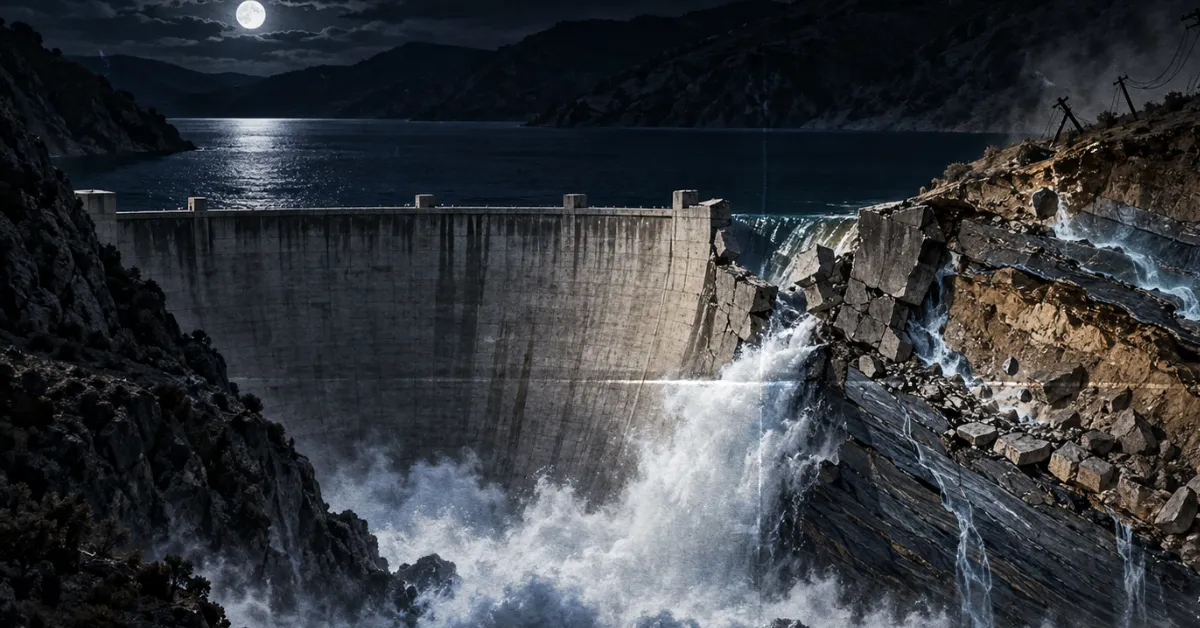
The same physics that grips a hiker’s boot operates at the scale of cities during earthquakes, where it is called soil liquefaction, one of the most destructive secondary effects of a large quake.
The U.S. Geological Survey describes the process directly: liquefaction occurs in saturated soils where water fills the space between particles. Before an earthquake the grains carry the load through their contacts. Shaking disrupts that framework so the particles no longer support the weight, groundwater pressure rises, the grains become suspended in the water, and the soil flows. As the USGS puts it, soil that behaves like a liquid “can lose its ability to support structures” and can “erupt to the ground surface to form sand boils (‘sand volcanoes’).”

A “sand boil” roughly 2 m (6.6 ft) across that erupted in the median of Interstate 80 near the Bay Bridge toll plaza during the 1989 Loma Prieta earthquake, when shaking liquefied buried sand and forced a sand-water slurry to the surface. The vented sand carried marine shell fragments from the deposit below. Photo: J.C. Tinsley, U.S. Geological Survey, public domain.
Sand boils are the surface signature of the same two-phase separation seen in the lab. The collapsing grain structure squeezes pressurized water and sand upward through cracks, and vents slurry at the surface: the same expulsion of a water-rich phase that follows the grain-packing collapse in the Amsterdam experiments.
The case that taught engineers to take liquefaction seriously was the Niigata earthquake of June 16, 1964, an event of roughly magnitude 7.5 (estimates range from Ms 7.4 to Mw 7.6), centered in the Sea of Japan off the northwest coast of Honshu; it killed roughly 26 to 36 people and destroyed about 3,500 homes. Much of the city sits on loose, water-saturated sand laid down by the Shinano and Agano rivers. When the shaking hit, that ground liquefied. At the Kawagishi-cho complex, eight four-story, reinforced-concrete apartment buildings on reclaimed land, the blocks rotated and tipped as the soil beneath their shallow foundations lost its strength. They were built to survive the shaking, and structurally they did. Some leaned as much as 80 degrees from vertical and one overturned almost completely, yet the structures themselves stayed largely intact. As the Utah Geological Survey notes, “liquefaction caused these apartment buildings to tip over during the 1964 magnitude 7.4 Niigata, Japan, earthquake.” Subsidence of up to 140 centimeters was measured across affected parts of the city.
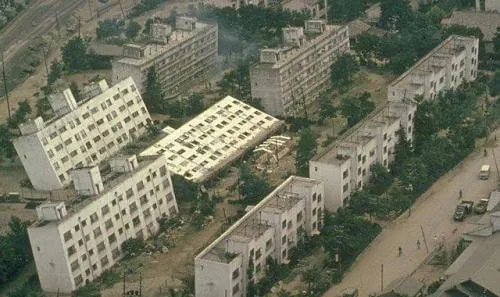
Liquefaction in the same earthquake destroyed other infrastructure: the Showa Bridge over the Shinano River collapsed as lateral spreading of the liquefied soil displaced the piles supporting its piers. Liquefaction, then, is normal, well-understood soil behavior, not an exotic trap. A patch of quicksand on a tidal flat and a liquefied city block in an earthquake are the same physics at different scales.

How do you get out of quicksand?
The escape advice that follows from the physics is unglamorous and effective, and it is close to the opposite of the panicked thrashing the movies show.
Stop fighting
Rapid, forceful movement is exactly what liquefies the sand around you and lets you settle deeper. The Amsterdam findings explain why: stress drops the viscosity, so every violent kick turns more of the surrounding material to liquid beneath you.
Drop weight
A heavy backpack adds to the load your buoyancy has to balance and pushes your equilibrium depth lower. Shedding it raises the level at which you float.
Lean back and spread your weight
Because the body is buoyant in quicksand, spreading your weight over a larger area, leaning toward horizontal, as you would in a pool, lets more of you rest at or near the surface.
Work water back in, slowly
The reason a trapped leg is so hard to pull is that the packed sediment resists and water cannot rush in fast enough behind it. Small, slow movements, gentle circling or wiggling of the trapped limb, reintroduce water into the dense sand around it, lowering its local density and loosening its grip until the leg eases out. It is slow, and it works with the material rather than against it.
The real dangers are not suction but what befalls a person who is stuck and cannot get free quickly: a rising tide on a coastal flat, sun exposure and dehydration, hypothermia in cold water, or simple exhaustion. Britannica notes that the genuine hazard is a trapped person being caught by an incoming tide, and adds that even these accidents are very rare. Quicksand often occurs precisely in tidal areas, which is why the danger is real even though drowning by engulfment is not. Other natural hazards of saturated and unstable ground, from sinkholes to landslides, are far more lethal than the quicksand of the movies.
Myth versus reality
Strip away the cinema and the picture is straightforward. Quicksand is real. It is saturated, loosely packed sand or silt held together by a fragile clay structure and pressurized water, and it liquefies when disturbed. It can trap a person firmly enough that self-rescue is hard and outside help may be needed. In a clay-and-salt setting it grips with a force that, limb for limb, exceeds what a human can pull against.
What it cannot do is pull you under and close over your head. Your body is lighter, volume for volume, than the sand-water mixture, so you float at roughly waist depth. The 2005 Nature paper settled the central question with a laboratory test rather than an anecdote: a body-density object sinks halfway and stops. You will not drown in quicksand the way the explorer does in the film. You will get stuck, and the way out is to lie back and let water work its way back into the sand. If you want more of the strange behavior of granular ground, our explainers on booming and singing sand dunes show how the same loose grains can sing as well as swallow.