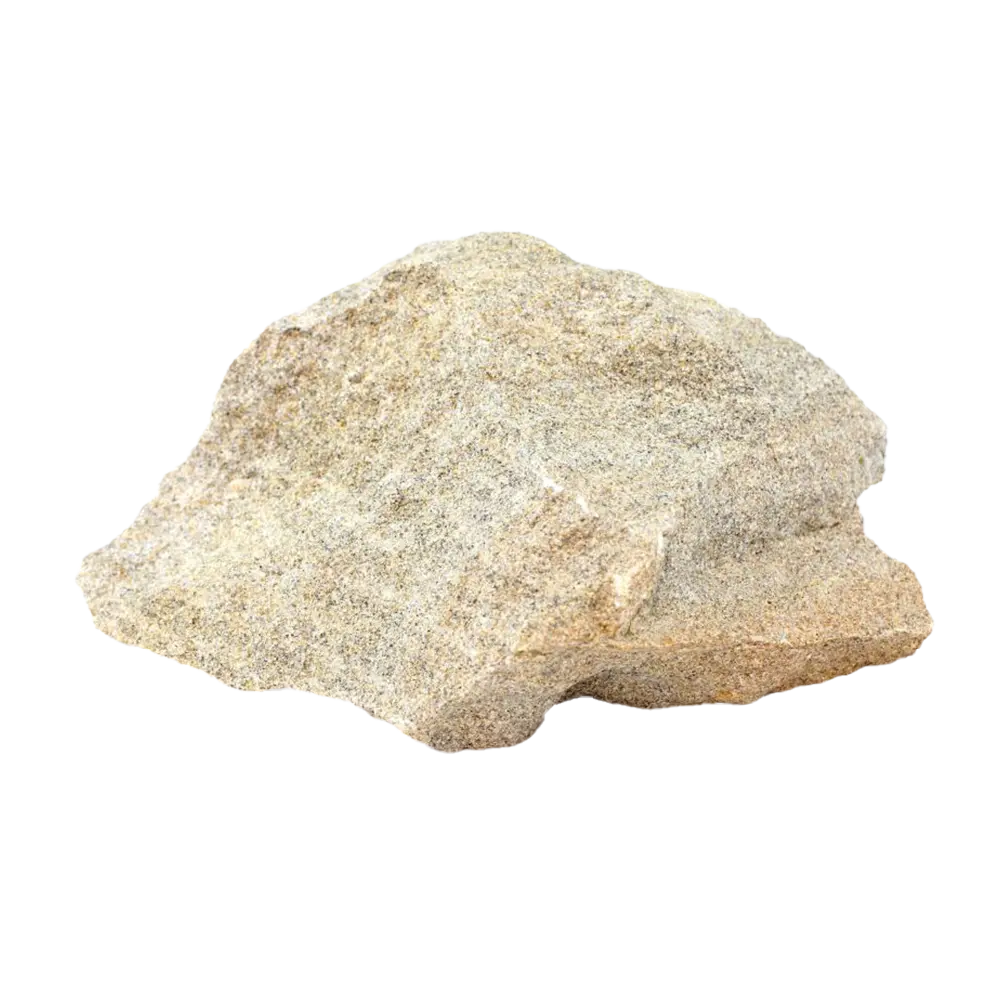

Introduction
Desert varnish is a dark, paper-thin coating of manganese and iron oxides bound up with windblown clay that forms on stable rock surfaces in deserts over hundreds to thousands of years. It is rarely thicker than a human hair, it grows more slowly than almost anything else on Earth, and for two centuries nobody could explain why it concentrates so much manganese. In 2021 a team at Caltech offered the strongest answer yet: the varnish is the chemical residue of microbial life clinging to the harshest surfaces in the desert. The same minerals are now turning up on Mars, which is why a stain you could scrape off with a fingernail has ended up at the center of the search for life beyond Earth.
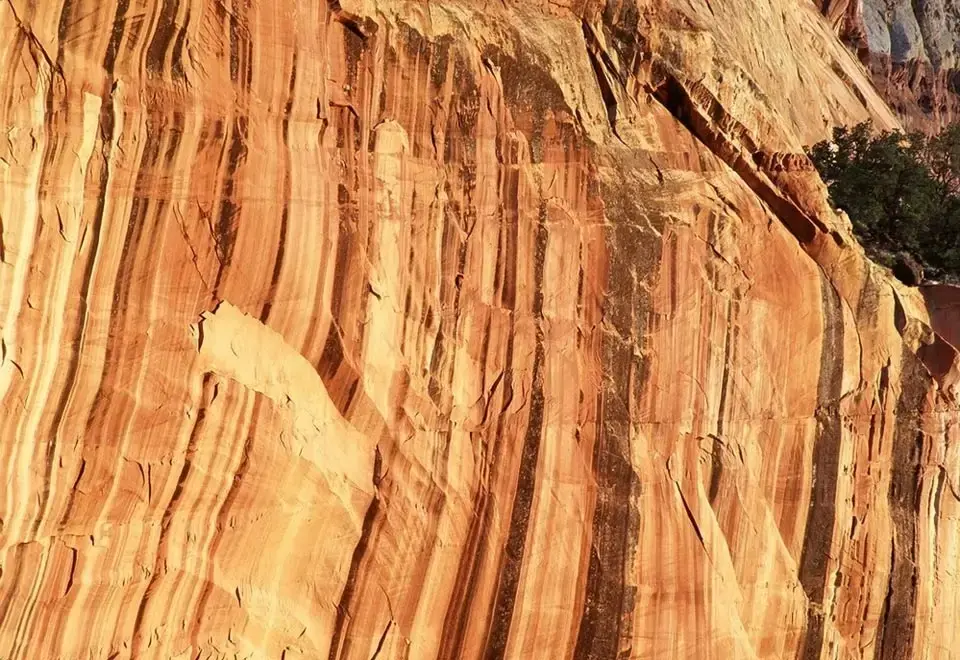
A Black Polish on the Rocks at Bahia, 1832
In late February 1832, a 23-year-old naturalist named Charles Darwin came ashore at Bahia, on the coast of Brazil. HMS Beagle had been at sea for two months. Darwin was overwhelmed by the tropical forest, he filled his diary with butterflies and tangled roots, but on a rocky point where a small stream ran into the sea, something stranger caught his eye. The rocks were black. Not weathered grey, not lichen-covered, but glossy, as if someone had rubbed them with graphite.
He had read about this. Alexander von Humboldt, the explorer whose writing had pulled Darwin toward natural history in the first place, had described something close to it three decades earlier on the great rivers of South America. What Darwin saw at Bahia was the brown, iron-rich cousin of that coating; the jet-black manganese version belonged to Humboldt’s river cataracts. He set both down with the precision that would define the rest of his life:
“At the cataracts of the great rivers Orinoco, Nile, and Congo, the syenitic rocks are coated by a black substance, appearing as if they had been polished with plumbago. The layer is of extreme thinness; and on analysis by Berzelius it was found to consist of the oxides of manganese and iron. In the Orinoco it occurs on the rocks periodically washed by the floods, and in those parts alone where the stream is rapid; or, as the Indians say, ‘the rocks are black where the waters are white.'”
Charles Darwin, Journal of Researches (later published as The Voyage of the Beagle), 1839
Plumbago is an old word for graphite. The Swedish chemist Jöns Jacob Berzelius, one of the founders of modern chemistry, had run the analysis and found manganese and iron. That much was settled by the 1830s. What was not settled, and would not be settled for another 190 years, was the obvious follow-up question: how did it get there? Manganese is not a common element. Something was concentrating it on the surface of these rocks, in a film so thin it seemed almost immaterial, and that something refused to explain itself.
That Indian saying Darwin recorded, the rocks are black where the waters are white, turns out to be a sharp piece of field observation. The dark coating concentrates exactly where the rock is splashed, wetted, and dried again and again. Whitewater means spray; spray means a cycle of wet and dry; and that cycle, we now think, is precisely the rhythm that life on a bare rock learns to survive. The people who carved their stories into these surfaces had read the rock correctly long before any chemist did.
What Is Desert Varnish, and How Thin Is It Really?
Stand in any arid landscape on Earth, the Mojave, the Atacama, the Negev, the canyons of the American Southwest, and you will see it: rock faces stained brown to blue-black, sometimes streaked in vertical curtains where water has run down a cliff, sometimes coating a whole desert pavement of pebbles until the ground looks shellacked. This is desert varnish, also called rock varnish. The two terms mean the same thing; “rock varnish” is the term most geologists now prefer, because the coating is not confined to deserts.
The first surprising fact about desert varnish is how little of it there is. The coating ranges from about one micrometre thick, a hundredth the width of a human hair, up to a few tens or low hundreds of micrometres at most. It rarely exceeds 200 micrometres, roughly the thickness of two sheets of paper, even after tens of thousands of years. You are not looking at a thick crust. You are looking at a stain.
The second surprising fact is what it’s made of. Despite being defined by its darkness, and that darkness comes from manganese and iron oxides, the bulk of desert varnish is not metal oxide at all. It is clay. Typically more than half of the coating, often around 70 percent, is clay minerals, with roughly 30 percent manganese and iron oxides and a scatter of more than a dozen trace and rare-earth elements (Potter & Rossman, Science, 1977). The exact proportions vary from sample to sample. The clay is mostly windblown dust, plastered onto the rock and cemented in place. The varnish, in other words, is built largely from material that did not come from the rock beneath it. It is something the desert assembles on the surface, out of dust and air and a vanishingly small amount of metal.
It forms on almost anything, as long as the surface holds still. Sandstone, limestone, basalt, granite, the U.S. National Park Service notes that desert varnish “can form on any type of rock that makes stable surfaces.” Stability is the key word. A surface that is constantly spalling, eroding, or tumbling never accumulates varnish, because the coating is scraped away as fast as it forms. The darkest, most mature varnish is found on rocks that have sat undisturbed for millennia. That is exactly what makes it useful, and exactly what makes it slow.
One more thing about that composition took precise microscopy to see, and it changes how you picture the coating entirely. The manganese and iron in desert varnish are not smeared evenly through the coating. They are concentrated in the manganese-rich laminae and bound onto the surfaces of the clay platelets themselves. The clay does more than bulk out the film, it provides a vast surface area on which metal oxides can nucleate and grow, and it physically holds the structure together as it builds up, layer on microscopic layer. Strip away the romance of the dark polish and what you have, mechanically, is windblown dust cemented to rock by metal oxides, with the metal organised into bands a few micrometres apart. The geologist’s working description of varnish as a kind of thin “microsoil” of the desert surface is apt: it is a living-and-dying interface between rock, dust, water, and air.
That banding is not decoration. Sliced and viewed in cross-section, mature varnish shows alternating layers, darker, more manganese-rich bands and lighter, more orange, iron-and-clay-rich ones. The layers appear to record swings in climate: blacker, manganese-heavy laminae forming in wetter intervals, more orange laminae in drier ones. The pattern looks, to more than one researcher who has peered down a microscope at it, unnervingly like a barcode. That barcode is the basis of one of the dating methods we will come to, and it is also a quiet argument that the varnish is recording the environment around it as it grows, not simply accreting at random.
Where does the coating get going in the first place? The favoured raw material is atmospheric dust. Fine clay particles settle out of the air onto a stable surface; the rare wettings that a desert rock does receive, dew, fog, the occasional rain, the spray of Darwin’s cataracts, mobilise tiny amounts of manganese and iron; and as the surface dries, those metals oxidise and lock the dust in place. Repeat this a few thousand times and you have varnish. It explains why the coating builds best on the tops and faces of rocks exposed to dust and intermittent moisture, why it is thickest where surfaces have been undisturbed the longest, and why it appears even on rock types that contain almost no manganese of their own. The metal, like the clay, largely arrives from elsewhere. The rock is a substrate, not a source.
And although it is called desert varnish, the coating is not strictly a desert phenomenon. Rock varnish has been documented in humid temperate climates, in cold environments, even in Antarctica. Aridity favours it, slow weathering keeps surfaces stable, and the wet-dry cycling that drives the chemistry is pronounced in deserts, but the essential ingredients are a stable surface, a supply of dust, and intermittent moisture, and those can occur far from any desert. This is the main reason geologists increasingly prefer the term “rock varnish.” “Desert varnish” is the older, more evocative name, and the one most people know; both refer to the same thin dark skin on stone.
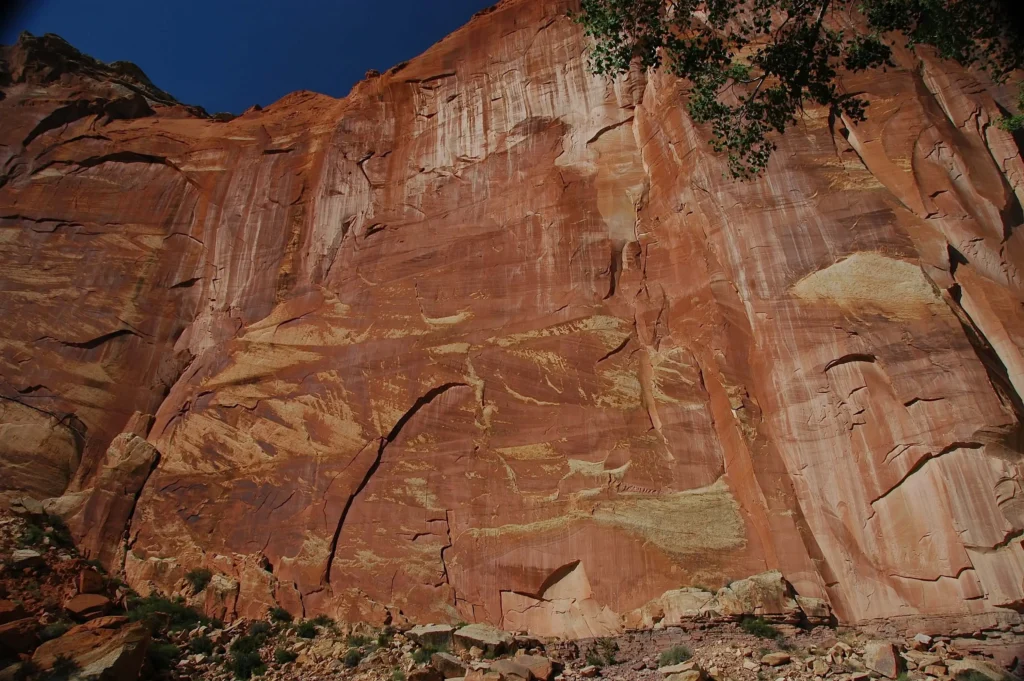
One more thing the close-up makes obvious: the colour of the varnish depends on its chemistry. Manganese-rich varnish is the blackest. Iron-rich varnish tends toward orange and red-brown. The ratio of the two metals shifts from place to place and even across a single boulder, which is one of the reasons the coating has been so hard to pin down, it is not one substance behaving one way, but a family of coatings that vary by site, climate, and the dust that happens to blow in.
Two Centuries of Competing Theories
Humboldt was first. During his expedition through the equinoctial regions of the New World between 1799 and 1804, he noticed dark coatings on rocks in the splash zone of the Orinoco rapids, in present-day Venezuela. He correctly guessed they were rich in iron and manganese, published a description in 1812, and is sometimes called the father of rock varnish for it. He could not say where the manganese came from. Neither could Berzelius, who confirmed the chemistry. Neither could Darwin, who saw the same coatings in Brazil and tied the observations together.
For most of the next century the question sat largely untouched, an odd footnote in desert geology. When researchers did return to it, they split into two camps, and the argument between them has run, in one form or another, ever since.
The abiotic camp: physics and chemistry alone
One camp argued the varnish was purely physical and chemical, no life required. In this view, manganese and iron dissolved out of dust and rock, then precipitated on the surface as the rock baked and the moisture evaporated. Sunlight does real chemical work here. Manganese and iron oxides are semiconductors; under ultraviolet light they generate reactive oxygen species that can oxidize dissolved manganese and lock it onto the surface. This photo-oxidation model has serious modern support (for example Xu and colleagues in Chemical Geology, 2019), and it explains why varnish loves sun-blasted, slowly weathering rock.
A related idea is the silica-gel, or “black opal,” model, developed by Randall Perry and colleagues in the mid-2000s. Here, dissolved silica forms a gel on the rock surface that traps metals, dust, and organic matter as it hardens, a kind of mineral flypaper. The model elegantly accounts for the clay and the trace elements. Its critics, including the geographer Ronald Dorn, counter that silica gels would build up in decades rather than millennia, and that the model struggles to explain why varnish concentrates so much manganese, why clay dominates the coating, and why iron-rich varnish forms even on iron-poor rock.
The biotic camp: something alive is doing this
The other camp suspected biology. The reasoning was partly chemical intuition: on Earth, sharply concentrated manganese oxides are usually a fingerprint of life. Microbes oxidize manganese as part of their metabolism, and they do it far faster and far more selectively than bare chemistry tends to. If you find manganese hoarded in one thin layer, a biologist’s first instinct is to look for a microbe doing the hoarding.
The pivotal early statement of this position came from Ronald Dorn and Theodore Oberlander in Science in 1981, in a paper titled, with no ambiguity, “Microbial origin of desert varnish.” They argued that manganese-oxidizing bacteria were responsible for concentrating the metal. It was here that the now-famous enrichment numbers entered circulation. Manganese makes up only about 0.12 percent of the Earth’s crust by weight, it is scarce. Yet in black desert varnish it is concentrated 50 to 60 times more than in the underlying soil. That degree of enrichment is hard to wave away as a chemical accident.
A word of caution about those numbers, because they are routinely mangled. The “50 to 60 times” figure is measured against the surrounding soil. When the comparison is made instead against the upper continental crust, a different and larger baseline, the enrichment comes out closer to 100 times, with published estimates ranging from roughly 40 to 200 times. Both figures are correct; they simply answer different questions. Any time you see a manganese-enrichment multiplier for desert varnish, the first thing to ask is: enriched relative to what? Conflating the two baselines is the single most common error in popular accounts of this rock.
For forty years the biotic camp had a strong circumstantial case and no mechanism. They could show microbes living in and on the varnish. They could show the manganese was concentrated the way life concentrates things. What they could not show was the actual physiological reason a living cell would bother to pile up manganese on a rock. Skeptics had a fair reply: microbes live on every surface on the planet, so finding them in varnish proves only that varnish is a surface, not that the microbes built it. The correlation was real. The causation was missing.
The deadlock had a specific shape, and it is worth naming because it is a recurring problem in geobiology. Manganese-oxidizing microbes are easy to find almost anywhere there is manganese and oxygen; their mere presence on a varnished rock is unsurprising and proves little. To clinch a biological origin you need to show not just that microbes are present, but that there is a reason rooted in their physiology for them to drive the specific chemistry you observe, in this case, the relentless one-way accumulation of manganese in a thin surface film. Without that “why,” the abiotic camp could always argue that the microbes were passengers on a coating that sunlight and evaporation were building anyway. The two camps could examine the same rock, the same manganese, the same bacteria, and walk away with opposite conclusions, because the decisive piece of evidence, a metabolic motive, simply wasn’t on the table. That is the gap the 2021 work set out to close.
The 2021 Breakthrough: Varnish as the Residue of Life
The missing mechanism arrived in June 2021, in the Proceedings of the National Academy of Sciences, from a team led by Usha Lingappa, then a geobiologist at Caltech, working with Woodward Fischer’s group and collaborators across several institutions. The paper has a deliberately dry title, “An ecophysiological explanation for manganese enrichment in rock varnish”, and a genuinely radical claim underneath it. The varnish, they argued, is not something microbes build on purpose. It is what they leave behind.
Lingappa’s team gathered 49 varnish samples and sequenced the DNA of the microbial communities living in them. One organism stood out from everything else: a cyanobacterium in the genus Chroococcidiopsis. Sequences belonging to its family turned up in 48 of the 49 samples and accounted for 25.9 percent, roughly a quarter, of all the genetic reads recovered from the varnish. A single variant of this organism made up eight percent of the reads on its own, and was completely absent from the surrounding soil. Whatever else lived in the varnish, this cyanobacterium was the dominant, defining inhabitant of the coating itself.
Chroococcidiopsis is one of the toughest organisms known. It shrugs off desiccation, salinity, and doses of ultraviolet and X-ray radiation that would sterilise most life. It is a favourite of astrobiologists precisely because it can survive conditions approaching those at the Martian surface. And it makes its living by photosynthesis, which, on a bare desert rock in full sun, is a dangerous way to live.
The argument turns on a single physiological problem. Photosynthesis under intense sunlight generates a flood of reactive oxygen species, superoxide and its relatives, that tear cells apart from the inside. A microbe clinging to an exposed rock face in the desert faces this oxidative assault constantly. The team found that the relevant Chroococcidiopsis, like other cyanobacteria they tested, accumulates extraordinary amounts of manganese inside its cells, in their words, “over two orders of magnitude higher manganese content than other cells,” meaning more than a hundred times. Manganese, in high enough concentration, is a potent antioxidant. The cells were stockpiling it as chemical armour against the oxidative damage of doing photosynthesis in the desert sun.
The choice of manganese as armour is not arbitrary, and this is part of what makes the model persuasive. Most life defends against reactive oxygen using enzymes, superoxide dismutase and catalase, that contain metals at their core and require a steady supply of resources to build and maintain. But there is an older, cruder, remarkably robust alternative. High concentrations of manganese ions, often paired with small metabolites, can mop up superoxide directly, without any enzyme at all. This non-enzymatic manganese antioxidant system is precisely the kind of defence you would expect to find favoured in an organism that lives at the ragged edge of survival, where building and repairing delicate protein machinery is a luxury. For a cyanobacterium baking on a rock, hoarding cheap, abundant manganese as a chemical shield is a sensible strategy. The accompanying commentary in the same journal underscored just how extreme the hoarding can be: some cyanobacteria accumulate manganese to internal concentrations four orders of magnitude above their surroundings. A cell that does this, then dies, leaves a manganese-rich smear on the rock. Multiply by uncountable generations across thousands of years, and you have a varnish.
And when those cells die and break down, the manganese they hoarded is left behind on the rock, where it oxidizes into the dark mineral coating we have been staring at since Humboldt. The varnish is not a structure. It is a graveyard, the accumulated mineral residue of generation after generation of microbes that loaded themselves with manganese to survive, then died and gave it up to the stone. As Lingappa put it:
“The understanding that varnish is the residue of life using manganese to thrive in the desert illustrates that, even in extremely stark environments, the imprint of life is omnipresent on the landscape.”
Usha Lingappa, Caltech, 2021
To make the case, the team went well beyond DNA. They mapped manganese inside individual cells using X-ray spectroscopy at the Stanford Synchrotron Radiation Lightsource, and used techniques such as NanoSIMS and electron paramagnetic resonance to confirm that the metal really was concentrated intracellularly, in the chemical form their model required. It is a careful, multi-instrument piece of work, and it supplies the one thing the biotic camp had lacked for four decades: a concrete physiological reason for a living cell to accumulate manganese on a rock.
Why this is the leading explanation, not the closed case
It is worth being precise about status here, because popular coverage tends to declare the mystery “solved.” The 2021 model is the strongest and best-supported explanation we have, and it elegantly resolves several things the abiotic models struggle with. But it is a leading hypothesis, not settled consensus.
The photo-oxidation and silica-gel models have not gone away, and there are real questions the biological account still has to answer fully, above all, how a coating that is 70 percent clay and only 30 percent metal oxide can be primarily a product of microbial manganese-hoarding, and how the very slow growth rate squares with the metabolic story. Many researchers now favour a polygenetic model, in which biology and abiotic chemistry both contribute, in proportions that probably vary from desert to desert. The geobiologist Kenneth Nealson framed the open question with a nice circularity: are the microbes there because the varnish is a nice place to live, or is the varnish there because the microbes made it? The 2021 paper tilts the answer hard toward the second. It does not entirely close the loop.
Desert Varnish and Petroglyphs: Humanity’s Oldest Canvas
Long before anyone argued about manganese, people had found a use for desert varnish. The coating is dark; the rock beneath it is usually much lighter. Chip through the varnish and you expose the pale stone underneath, and the contrast reads like ink on a page. For thousands of years, across every varnished desert on Earth, humans have used that contrast to make images. The technique even has a name: petroglyphs are images pecked, abraded, or scratched through a rock’s dark surface to reveal the lighter interior.
Nowhere is this clearer than at Newspaper Rock, in San Juan County, Utah, on the scenic byway leading into the Bears Ears region. A single vertical face of Wingate Sandstone, coated in dark varnish, carries more than 650 petroglyphs in one roughly 200-square-foot panel, one of the densest concentrations of rock art in the Southwest. The Navajo name for it is Tse’ Hone’, “the rock that tells a story.”
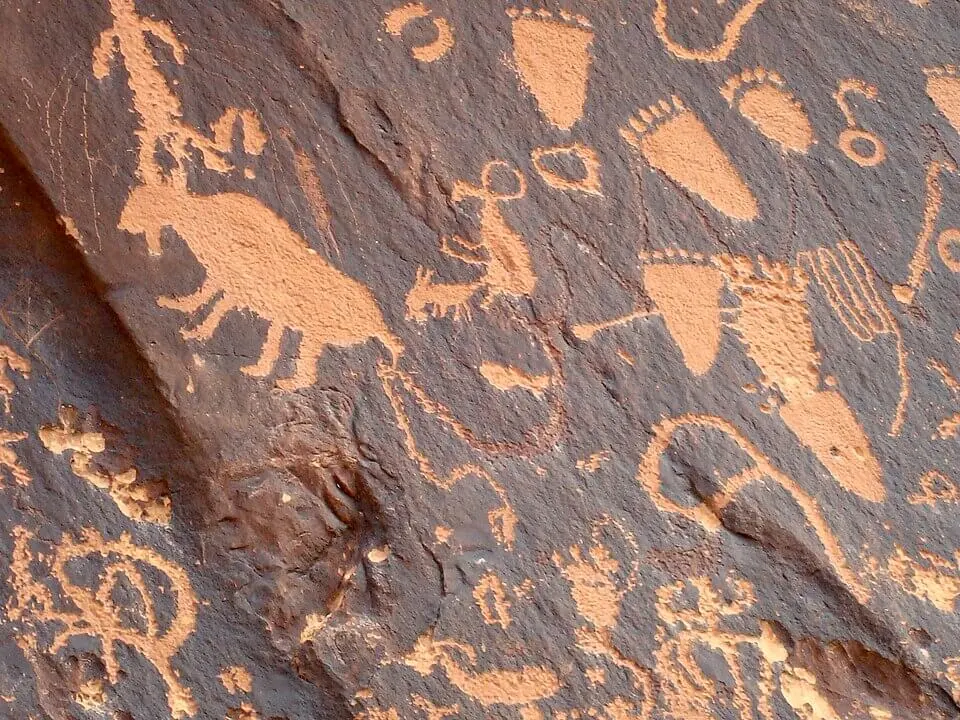
The images at Newspaper Rock were not made all at once. People of the Archaic, Basketmaker, Fremont, and Ancestral Puebloan cultures carved here from roughly the start of the current era until about 1300 CE, with later additions by Ute and Navajo people and, eventually, Anglo settlers. The panel is a palimpsest written over two thousand years, and the medium itself records time: where a petroglyph is old enough, desert varnish has begun to creep back over the exposed rock, slowly re-darkening the image. The artists were, without knowing it, drawing on the slowest clock in the desert.
And this was not a local trick. The same insight, that a dark rock skin can be cut away to make a permanent bright image, was discovered independently by people across the world’s arid regions. Varnished basalt and sandstone carry petroglyphs in the Coso Range and across the Great Basin of the American West, throughout the deserts of Arizona and New Mexico, in the Sonoran Desert of northern Mexico, across the Sahara and the Arabian Peninsula, and in the deserts of Australia. Wherever stable rock wore a coat of varnish, somebody eventually realised what it was for. The coating is one of humanity’s most widely and independently exploited natural media, a dark page that the driest parts of the planet quietly offered up, and that people on several continents learned to write on without ever comparing notes.
Can you date a petroglyph by its varnish?
That re-darkening raises a tantalising possibility. If varnish grows back at a steady rate, then the amount of varnish that has reformed inside a petroglyph should tell you how long ago it was carved. Several methods have been built on exactly this idea, and they are worth understanding, including their serious limitations.
Cation-ratio dating was proposed by Ronald Dorn in the early 1980s. The idea: certain mobile elements (potassium and calcium) leach out of the varnish over time relative to a stable element (titanium), so the ratio of potassium-plus-calcium to titanium falls as the coating ages. Calibrate that decline against surfaces of known age and, in principle, you can date an unknown one. Dorn and David Whitley applied it to petroglyphs in a 1983 Nature paper, “Cation-ratio dating of petroglyphs from the Western Great Basin, North America,” using rock art in the Coso Range of California as their test case.
Varnish microlamination (VML) dating takes a different approach. Sliced in cross-section, mature varnish reveals fine layers, dark manganese-rich bands and lighter, more orange ones, that appear to track wet and dry climate phases over time. The pattern of layers acts like a barcode that can be matched against a regional climate sequence, a method developed by Tanzhuo Liu and colleagues. Lead-profile dating, a third technique, reads the depth profile of lead in the coating, partly exploiting the spike in atmospheric lead from the leaded-gasoline era as a near-surface time marker.
Now the caveat, and it is a large one. Varnish dating is genuinely contested. The growth rate is not constant, Liu and Broecker found it varies enormously, and the coating accumulates among the slowest of any sedimentary deposit on Earth. The chemistry is not always stable; cations can move in ways that confound the cation-ratio assumption. In a pointed 1994 Quaternary Research paper titled, bluntly, that the methods are “neither comparable nor consistently reliable,” Paul Bierman and Alan Gillespie found no consistent relationship between varnish chemistry and age, and a 1998 Science study by Warren Beck and colleagues found similar ambiguities in radiocarbon dating of varnish. The fair summary is this: varnish ages are best treated as relative or minimum ages, not precise calendar dates, and the most reliable of the methods (VML) is correlative, it tells you the order of events and ties them to a climate record, not an exact year. When you read that a petroglyph is “X thousand years old” on varnish evidence alone, treat the number as a careful estimate, not a measurement.
The stakes in this argument have, at times, been high. Cation-ratio dating in particular produced some startlingly old ages for North American rock art and stone tools in the 1980s and early 1990s, ages that, if correct, would have reshaped the story of when and how people spread across the continent. That is exactly the kind of extraordinary claim that demands extraordinary scrutiny, and it got it. When independent teams could not reliably reproduce the cation ratios, or found that the chemistry of the varnish did not behave as cleanly as the method assumed, confidence in the technique’s absolute ages collapsed. The episode is now something of a cautionary tale in geochronology about building a clock on a process you do not yet fully understand. Notably, even Ronald Dorn, the method’s principal architect, publicly questioned the reliability of cation-ratio dating as it had been applied to high-stakes problems, including the geological dating around the proposed Yucca Mountain nuclear-waste repository.
There is a deeper irony worth sitting with. If the 2021 biological model is right, then varnish is not laid down by a clean, clocklike chemical reaction at all, it is the messy, episodic residue of life responding to climate, drought, and the accidents of where dust and microbes happen to thrive. That is a beautiful thing to learn about the coating, and a difficult thing for anyone hoping to read it as a precise calendar. A living process is exactly the kind of thing that resists being turned into a metronome. The same biology that makes desert varnish profound is part of what makes it a treacherous clock. Microlamination dating sidesteps this somewhat by reading the varnish as a climate proxy rather than a steady accumulation, matching its barcode of wet and dry layers against a regional sequence, which is why it has held up better than the chemical-ratio approaches. But even VML yields ages relative to a climate framework, not absolute years stamped on the stone.
None of which diminishes the rock art itself. The contrast that made dating attempts possible is the same contrast that made the images possible in the first place, a thin layer of microbial residue, dark against pale stone, turned into a writing surface by people who understood their landscape intimately. Desert varnish is, in a real sense, the oldest continuously used canvas in human history.
Desert Varnish and Mars: Why a Rock Coating Matters Beyond Earth
A stain you can scrape off with a fingernail has become a question about the universe. If concentrated manganese oxides on Earth are, as the 2021 work strongly suggests, a chemical fingerprint of life, then what does it mean when we find manganese oxides on Mars? There are two distinct Martian stories here, and keeping them separate matters enormously, because they are at very different stages of certainty.
Curiosity at Gale Crater: real manganese, a genuine puzzle
In 2016, Nina Lanza and colleagues reported something startling in Geophysical Research Letters. NASA’s Curiosity rover, using its ChemCam laser instrument in the Kimberley region of Gale Crater, had found mineral veins filling fractures in the sandstone that were extraordinarily rich in manganese, more than 25 weight percent manganese oxide, with individual measurements as high as the mid-30s. On Earth, that kind of manganese-oxide concentration is not something dry chemistry produces easily. It generally requires abundant free oxygen, or microbes, or both.
That is what made the finding matter. The team interpreted it as evidence that ancient Mars once had far more oxygen in its atmosphere and groundwater than it does today, a wetter, more Earth-like past. Lanza was careful about the biological angle, calling it far-fetched, but she did not hide how strange the chemistry was:
“The only ways on Earth that we know how to make these manganese materials involve atmospheric oxygen or microbes. Now we’re seeing manganese oxides on Mars, and we’re wondering how the heck these could have formed?”
Nina Lanza, Los Alamos National Laboratory, 2016
The signal is not confined to one site. NASA’s Opportunity rover, working thousands of miles away in Meridiani Planum, independently turned up high-manganese deposits, which suggests the conditions that concentrate the metal were widespread on early Mars rather than a local quirk of Gale Crater. To be clear about what the finding is and is not: it is strong evidence for oxygen-rich conditions in Mars’s distant past, and a real geochemical puzzle. It is not evidence of Martian life. Free atmospheric oxygen can oxidize manganese without any biology involved, and on early Mars there were plausible abiotic routes to produce it. The manganese is real and well measured. The interpretation stops well short of biology.
Perseverance at Jezero Crater: the “purple coatings”
The second story is newer, stranger, and far more uncertain, and it is the one that gets breathlessly mislabelled as “desert varnish on Mars.” Since landing in Jezero Crater in 2021, NASA’s Perseverance rover has found something its team did not expect: a ubiquitous purple-hued coating on rocks across the crater floor. Ann Ollila and Nina Lanza, of Los Alamos, reported on these coatings at the American Geophysical Union meeting in 2021 and again at the European Geosciences Union in 2023, using Perseverance’s SuperCam and Mastcam-Z instruments.
The coatings are visually reminiscent of desert varnish, and the resemblance is what sparked the comparison. But the chemistry is different in a way that matters. The Jezero purple coatings are enriched in hydrogen, iron oxides, and sulfates, and, crucially, they are not rich in manganese. They sit on rocks that appear to have formed from cooling magma, not from lake sediments. The hydrogen and iron both point to water having been involved at some point, which is interesting in its own right. But the single feature that makes terrestrial desert varnish a possible biosignature, concentrated manganese, is precisely the feature these Martian coatings lack.
Lanza herself drew the line clearly, while leaving the door open the way a good scientist does:
“The newfound coatings in Jezero don’t have the required manganese to be considered a varnish, but that doesn’t mean they couldn’t be associated with ancient microbial life… Who knows what Martian microbes do?”
Nina Lanza, Los Alamos National Laboratory, on the Perseverance coatings
So the honest framing is this. The Jezero purple coatings are an unconfirmed phenomenon, not established as varnish, not manganese-rich, and emphatically not evidence of life. What they are is a reason to look harder. Perseverance is caching rock samples for a future return to Earth, and coatings like these, thin films that may record the late chemical history of the Martian surface, and that on Earth we now associate with microbial survival, are exactly the kind of thing worth bringing home to a laboratory. The desert-varnish story has handed Mars scientists a hypothesis and a warning in the same breath: manganese might mean life; the absence of manganese means this is not that; keep looking anyway.
The Black Where the Waters Are White
Darwin stood on a rocky point at Bahia in 1832 and wrote down a saying he had heard secondhand: the rocks are black where the waters are white. He did not know he was describing the residue of life. Neither did Humboldt, who saw it first, nor Berzelius, who weighed its chemistry. The coating kept its secret through nearly two centuries of careful observers who could measure exactly what it was made of and not one of them could say why.
We can say more now. The black film in the splash zone is, most likely, what is left of microbes that armoured themselves with manganese to survive photosynthesis in a place that should have killed them, generations of the toughest life on Earth, dying and laying down their metal on the stone. Ancient artists turned that residue into a canvas. And robots a hundred million miles away are now scraping at purple films on Martian rock, asking the question the desert taught us to ask: when the surface goes dark, is something alive doing it? The waters are white where the stream runs fast. The rocks are black where life held on.
Frequently Asked Questions About Desert Varnish
What is desert varnish?
Desert varnish is a thin, dark coating of manganese and iron oxides mixed with windblown clay minerals that forms on stable rock surfaces in arid and semi-arid environments. It is typically only one to a few hundred micrometres thick, thinner than a sheet of paper, and is usually dominated by clay (often around 70 percent) with roughly 30 percent metal oxides, though the proportions vary. It is also called rock varnish, the term most geologists prefer because it also occurs outside true deserts.
How long does desert varnish take to form?
Very slowly. Measured growth rates are roughly 1 to 40 micrometres per 1,000 years, and mature coatings rarely exceed about 200 micrometres even after tens of thousands of years. That makes desert varnish one of the slowest-accumulating sedimentary deposits known on Earth (Liu & Broecker, Geology, 2000). Because growth rate varies with climate and location, varnish thickness gives only a rough, relative sense of a surface’s age.
Is desert varnish alive?
The varnish itself is not alive, it is a mineral coating. But the leading explanation, published in PNAS in 2021 by Usha Lingappa and colleagues at Caltech, is that the coating is the residue of life: it forms from manganese that desiccation-resistant cyanobacteria (mainly Chroococcidiopsis) accumulate inside their cells as antioxidant protection, then leave behind on the rock when they die. Abiotic chemical models still survive as alternatives or contributors, so this is the strongest current hypothesis rather than settled fact.
Why were petroglyphs carved into desert varnish?
Because of contrast. Desert varnish is dark, while the rock beneath it is usually much lighter. By pecking or scratching through the varnish, ancient artists exposed the pale stone underneath, creating high-contrast images. Sites such as Newspaper Rock in Utah carry hundreds of petroglyphs made this way over roughly 2,000 years.
Why is desert varnish important for Mars?
On Earth, sharply concentrated manganese oxides are usually a sign of life or abundant free oxygen. NASA’s Curiosity rover found manganese-oxide-rich veins (over 25 wt% MnO) in Gale Crater in 2016, interpreted as evidence of an oxygen-rich ancient Martian atmosphere, though not of life. Separately, the Perseverance rover has found purple coatings in Jezero Crater that superficially resemble varnish but contain hydrogen and iron oxides, not manganese, and are not considered varnish or evidence of life. Desert varnish gives scientists a framework for interpreting such Martian coatings.
Can desert varnish be used to date rock surfaces accurately?
Only approximately, and the methods are contested. Techniques including cation-ratio dating, varnish microlamination (VML), and lead-profile dating have all been developed, but varnish grows at variable rates and its chemistry can be unstable. Peer-reviewed critiques (for example Bierman & Gillespie, 1994) found cation-ratio dating unreliable, and varnish ages are best treated as relative or minimum ages rather than precise calendar dates.