

Introduction
On the morning of 5 February 1869, in a shallow gutter of red Victorian dirt called Bulldog Gully, a Cornish miner named John Deason caught his pick on something that would not give. He had been working the surface for puddling, near Moliagul, a few kilometres northwest of Dunolly, when the pick struck what he first took for a stone. He swung again. Same dull resistance. A third blow, and the same. When he finally scraped the soil away, he was looking at gold, and not a flake or a wire of it, but a mass so large he hid it until dark before daring to dig it out. By his own account, given decades later in his old age, he cleared the ground all the way around the thing before he understood what he had. His partner Richard Oates came over from a neighbouring paddock to help. The two men levered free the largest gold nugget the world has ever seen, the largest true nugget, at least, as distinct from the even heavier slabs of gold-laced quartz that would later turn up elsewhere in Australia. It had been sitting barely three centimetres below the surface, snagged against the roots of a tree.
They called it the Welcome Stranger. It was so heavy that the bank in Dunolly had no scales that could weigh it whole, and a local blacksmith had to break it apart on an anvil before the London Chartered Bank of Australia could buy it. For roughly a century and a half, a stubborn question has trailed behind discoveries like that one. Geologists have a serviceable account of where the gold came from in a general sense. The harder question is how so much of it gathers in one place, often locked inside a single vein of milky quartz, when the underground waters that supposedly carried it held almost no gold at all. In September 2024, a research team at Monash University in Melbourne published an answer that sounds, at first hearing, unlikely: the quartz itself may be doing the work, behaving like a natural battery that switches on every time the ground shakes.
The problem with a lump of gold in a block of glass
Start with the thing that should not be there. Crack open a specimen of gold-bearing quartz from a place like Bendigo or Ballarat, or from the Mother Lode of California, and you will often find native gold threaded through the white crystal as wires and flakes, sometimes a single mass weighing more than a bag of cement. The gold sits in the middle of the quartz, surrounded by a mineral that is chemically about as reactive as a windowpane. Quartz is silicon dioxide. It does not rust, it does not readily dissolve in ordinary groundwater, and it has no obvious chemical reason to coax gold out of passing fluid and stack it into a clump. If you wanted to design the least promising place to grow a kilogram of metal, an inert block of silica would be a strong candidate.

The fluid is the second part of the puzzle. The gold in these veins was delivered by hot, watery solutions moving through the deep crust during episodes of mountain building. Geologists have measured what such fluids carry, and the figure is small. In the abstract of their 2024 paper, Voisey and colleagues give it as less than one milligram of gold per kilogram of fluid, under one part per million. To picture that, imagine a tonne of water with under a gram of gold dissolved in it, spread evenly through the whole mass. To build the Welcome Stranger from a fluid that weak, you would need to pass an almost unimaginable volume of water through exactly the right spot, and somehow strip out every trace of metal it held, again and again, without the gold redissolving or escaping down the next fracture.
So the question that frames this whole story “how do gold nuggets form?” is really two questions. First, how does gold get into the deep fluids and travel at all? On that, the science is mature and broadly agreed. Second, once the gold is in the rock, what makes it gather into large, discrete masses inside chemically inert quartz rather than staying smeared out as invisible dust? That second question has resisted a clean answer, and it is the one the Monash team set out to attack. The distinction matters, because the new hypothesis does not claim to overturn what we know about the first question. It offers a fresh mechanism for the second.
How is gold formed, and how does it end up underground?
The gold in Earth’s crust is older than the crust itself. Heavy elements like gold are forged in violent astrophysical events, the deaths of massive stars and the collisions of neutron stars, and were already present in the cloud of gas and dust that built the Solar System. When Earth formed and then differentiated into core, mantle, and crust, most of its gold sank with the iron into the core, chemically drawn to metal. The gold we can actually reach is a thin inheritance left behind in the mantle and crust, later concentrated by geological processes into the few places rich enough to mine. No new gold is being made on Earth; every nugget is a redistribution of an ancient stock.
The concentrating step is where the interesting geology happens. According to the U.S. Geological Survey, gold reaches mineable grades through a handful of natural processes, and one family of deposits looms over all the others in importance. These are the orogenic gold deposits, “orogenic” simply meaning “born of mountain building.” They form deep in the crust along great fault systems during the slow-motion continental collisions that raise mountain belts. The gold of the Victorian goldfields that produced the Welcome Stranger, the gold of the Californian Mother Lode, the gold of West Africa’s Ashanti belt and Western Australia’s Yilgarn craton, much of it is orogenic. Far from being exotic outliers, these are the backbone of where humanity has found its gold.
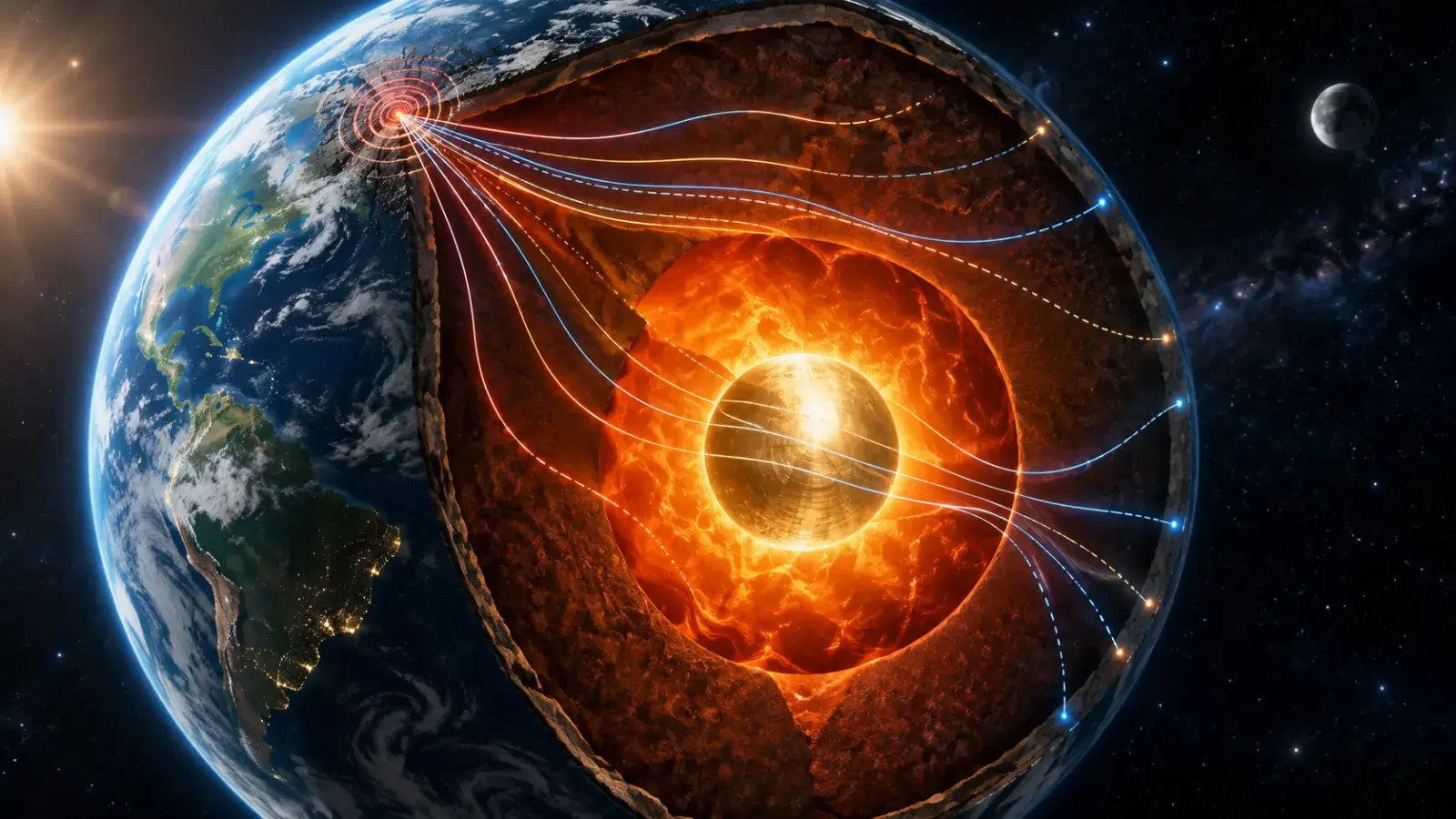
How that gold gets liberated and moved is described by a model that has become the textbook account, set out in detail by George Phillips and Roger Powell in the Journal of Metamorphic Geology in 2010. As a slab of buried, water-bearing rock is heated and squeezed during mountain building, its minerals begin to break down. Around the boundary between the greenschist and amphibolite metamorphic grades, a particular window of temperature and pressure deep in the crust, hydrous minerals such as chlorite become unstable and release their bound water, along with carbon dioxide, sulphur, and trace metals including gold. This process, called metamorphic devolatilization, generates enormous volumes of hot, chemically aggressive fluid. The rock is, in effect, sweating out its volatiles under heat and pressure, and the sweat carries gold.
That fluid carries gold not as loose atoms drifting in water but in chemical company. In the reduced, sulphur-rich conditions of these deep fluids, gold binds to sulphur to form soluble complexes, bisulphide species that let an unreactive metal hitch a ride through the crust. The fluids rise along faults and fractures, moving toward lower pressure and cooler rock nearer the surface. And as conditions change along the way, the gold comes out of solution. This is the conventional model of gold deposition, and the Monash paper states it cleanly in its own opening: gold precipitates from these dilute, hot, water- and carbon-dioxide-rich fluids because of changes in temperature, pressure, and fluid chemistry.
That account is well supported and is not in dispute. Drop the pressure on a fluid carrying gold-bisulphide complexes, let it cool, let it react with the surrounding rock or mix with a second fluid, and the chemistry that kept the gold dissolved falls apart. Gold precipitates. Over geological time, in the right structural trap, you accumulate an ore deposit. For the bulk of the gold in an orogenic system, the fine, disseminated metal spread through altered rock and threaded thinly through quartz, this is a satisfying explanation, confirmed by decades of fieldwork, fluid-inclusion studies, and laboratory chemistry. Nobody working on this problem is trying to throw it out.
It is the nuggets that strain it. Conventional precipitation, driven by gradual changes in temperature and pressure, tends to seed gold widely, many small grains nucleating in many places at once, the way frost forms across a whole windowpane rather than as a single boulder of ice. To explain why gold instead piles up into large, concentrated masses in specific spots inside inert quartz, the standard model has to lean hard on local quirks of plumbing and chemistry: a sudden pressure drop here, a particular reactive mineral there, a fortunate intersection of fractures. In many deposits these local effects clearly do contribute. But as a complete account of the biggest nuggets, the standard model has always felt forced, an explanation that needs a run of luck to land. The new hypothesis steps into that gap.
Why is gold found in quartz?
The marriage of gold and quartz is so reliable that prospectors have used it as a finding tool for centuries. See a “reef” of white quartz cutting through darker rock, and you have a reason to look closer. The association exists because the two minerals share a delivery system. The same hot, silica-saturated fluids that carry gold are carrying dissolved silicon dioxide, and when those fluids fill an opening in the rock, a fracture wrenched open during faulting, the silica crystallises out as vein quartz. Gold and quartz precipitate from the same fluid, in the same fractures, during the same geological drama. Find one and you have decent odds on the other. The Mother Lode of California is a textbook case: its gold-bearing quartz veins, some up to fifteen metres thick, formed along the Melones Fault Zone during the Early Cretaceous, roughly 108 to 127 million years ago, as hydrothermal fluids filled fractures in the deforming crust.

But shared plumbing only explains why gold and quartz turn up together. It does not explain the lopsided relationship, why the gold so often concentrates into something far larger and more localised than the dilute parent fluid should allow. That distinction matters for everything that follows. The fluids built the quartz and supplied the gold. The question is whether the quartz, once formed, then plays a second and far stranger role in deciding where the gold actually ends up. For most of the history of economic geology, nobody seriously proposed that quartz did anything active at all; it was the passive stage on which the chemistry performed. To see why that assumption is worth revisiting, you have to know one peculiar fact about quartz that has nothing to do with chemistry and everything to do with electricity.
What is piezoelectricity? The watch and the barbecue lighter
Squeeze certain crystals and they answer with a jolt of voltage. That is piezoelectricity, and it was first described by the brothers Jacques and Pierre Curie in 1880. The effect comes down to symmetry. In a crystal like quartz, the atoms are arranged in a lattice that has no centre of symmetry. At rest, the positive and negative charges in that lattice are balanced and their centres coincide, so the crystal is electrically neutral on the outside. Deform the lattice, press it, twist it, bend it, and you nudge those charge centres apart. The crystal develops a voltage across its faces, positive on one side and negative on the other. Release the stress and it relaxes back. Push and the voltage appears; let go and it vanishes. The word itself comes from the Greek piezein, to press.
The effect runs both ways, which is what makes it so useful. Apply a voltage to a piezoelectric crystal and it physically deforms; apply an oscillating voltage and it vibrates. This is the heart of the quartz watch on your wrist. Inside it, a tiny battery drives a sliver of quartz, cut into a tuning-fork shape, into mechanical oscillation. Quartz is so stiff and so consistent that it vibrates at an extremely stable rate, in a standard watch, exactly 32,768 times per second, a number chosen because it is two raised to the fifteenth power, convenient for the digital circuit that divides it down, and modest in its power demands. The circuit counts those vibrations and halves the count fifteen times in succession, and what falls out the bottom is one clean pulse per second. Every tick of a quartz clock is the voltage-driven shiver of a crystal, being counted. The reliability of modern timekeeping rests on the fact that a small piece of silica keeps near-perfect time when you run electricity through it.
The barbecue lighter shows the same physics running in the opposite direction. Press the button on a piezo igniter and you cock a small spring-loaded hammer; release it and the hammer slams into a piezoelectric crystal. The sudden, violent compression throws the crystal’s charge centres far apart in an instant, generating a voltage spike of several thousand volts, enough to leap an air gap as a visible spark and light the gas. There is no battery in the lighter. The energy of your thumb on the button becomes, by way of the crystal, a high-voltage spark. That is the direct piezoelectric effect: mechanical force in, electricity out. The same principle drives the igniters in gas stoves and the pickups in some electric guitars, and it is the principle at the centre of the gold story.

Now hold those two ideas together. Quartz produces electricity when it is mechanically stressed. And quartz is everywhere in the crust, it is, as the Monash team emphasises, the only abundant piezoelectric mineral on Earth. Veins of it run through the very fault zones where orogenic gold forms, the zones that rupture in earthquakes. An earthquake is, at bottom, an enormous and abrupt mechanical stress applied to a volume of rock. If that rock contains quartz, then every earthquake is squeezing a piezoelectric crystal on a scale no laboratory could match. The question Voisey and his colleagues asked was simple: what happens to the gold-bearing fluid sitting in the cracks when the quartz around it lights up with voltage?
Earthquakes and gold: a connection geologists already suspected
The idea that earthquakes and gold deposits are linked did not begin in 2024. Geologists have understood for decades that orogenic gold systems are fundamentally seismic, that the faults which host them were active, rupturing structures, and that the movement of the gold-bearing fluids was tied to the earthquake cycle. The conceptual groundwork was laid in 1975, when Richard Sibson and his co-authors proposed a mechanism they called seismic pumping in the Journal of the Geological Society. It is one of the foundational papers of structural and economic geology, and it is the second reference cited in the 2024 Monash study.
Sibson’s insight was about pressure and timing. In the run-up to an earthquake, stress builds on a fault and the rock around it dilates, opening microscopic cracks that suck in fluid. When the fault finally ruptures, that built-up volume is suddenly released and redistributed. Fluids that were squeezed into the fault zone get pumped through the crust in a rapid pulse tied to the moment of failure. A related idea, the fault-valve model, describes faults that seal shut between earthquakes as minerals precipitate within them, allowing fluid pressure to build underneath until the next rupture cracks the seal and releases a surge, a process documented in detail at gold-bearing structures such as the Wattle Gully Fault in Victoria. Either way, the picture is of a fault that breathes: drawing fluid in, slamming shut, building pressure, and venting it again with each seismic cycle. Gold deposition, in this view, comes in pulses keyed to the rhythm of earthquakes.
This matters because it tells us the quartz in these veins was not stressed once. It was stressed over and over, through thousands of earthquakes across the lifetime of the fault. The Monash team folds exactly this point into its reasoning: because orogenic deposits form along faults driven by repeated seismic activity, the quartz crystals in their veins will have experienced thousands of episodes of deviatoric stress. The seismic-pumping framework supplied the fluid and the repeated mechanical pulses, and it explained the episodic, fracture-controlled texture of so many gold veins. What it did not include was any role for the electrical behaviour of the quartz itself. The gold was assumed to come out of solution purely through chemistry, cooling, depressurising, reacting with the wall rock. Voisey and his colleagues proposed adding an electrical chapter to a story geologists thought they already knew, and it slots neatly into the existing account. The earthquakes were always there. What had been missing was the recognition that the shaking does not just move fluid, it powers the rock.
Can earthquakes really make gold? Inside the Monash experiment
To be clear about what is and is not being claimed: nobody is suggesting earthquakes create gold atoms. The gold is already there, dissolved in the fluid, an inheritance from the deep crust. The claim is that earthquake-driven electricity in quartz can pull that dissolved gold out and concentrate it. To test whether that was even physically possible, the Monash group, led by Christopher Voisey with co-authors including Andrew Tomkins and Joël Brugger, had to bring an earthquake into the laboratory and watch what the quartz did to the gold. This is a different kind of question from most economic geology, which works backwards from deposits that already exist. Voisey’s team ran the process forwards, under controlled conditions, to see whether the mechanism they suspected would actually fire.
The experimental setup was elegant in its directness. The team ran two kinds of test. In the first, they submerged slabs of quartz in a fluid carrying gold in dissolved, ionic form — a stand-in for a natural gold-bearing solution. In the second, they used a fluid seeded with pre-formed gold nanoparticles, to see whether the field would gather already-solid particles rather than only reduce dissolved ones. In both, they mechanically stressed the quartz in a way that mimicked the shaking of an earthquake, vibrating it at 20 hertz, twenty cycles per second. That figure sits squarely within the range of real seismic shaking; Voisey has noted that the frequencies carried by earthquake waves run from around one hertz up past twenty. The experiment, in other words, was not subjecting the quartz to some exotic, contrived stress dreamed up to force a result. It was shaking it at a rate the crust genuinely experiences during a quake, in a fluid resembling the one that genuinely bathes these veins.
The samples themselves came from a working gold mine. The quartz and gold used in the study were sourced from the Fosterville Gold Mine in central Victoria, one of the highest-grade gold mines in the world and a classic orogenic deposit, with samples and site access provided by Agnico Eagle. Grounding the experiment in real material from a working orogenic system matters: rather than idealised laboratory quartz disconnected from the geology it was meant to explain, this was rock from precisely the kind of deposit the hypothesis is about. The probing of stress and structure inside the crystals drew on neutron-scattering techniques, the kind of measurement that requires a facility most laboratories do not have, which is part of why the author list reaches beyond a single university.
Then they looked at what had happened on the surface of the stressed quartz. In the statement released by Monash University, Andrew Tomkins put it plainly:
“The results were stunning. The stressed quartz not only electrochemically deposited gold onto its surface, but it also formed and accumulated gold nanoparticles. Remarkably, the gold had a tendency to deposit on existing gold grains rather than forming new ones.”
Professor Andrew Tomkins, Monash University, in the Monash University statement (September 2024)
Unpack that and you have the whole mechanism. The voltage generated by the stressed quartz was doing real electrochemistry: it was reducing dissolved gold ions back to solid metallic gold and plating them onto the crystal. It was also building gold nanoparticles in the fluid. And, this is the part that turns a chemistry curiosity into a theory of nuggets, the new gold was not scattering itself randomly across the quartz. It was preferentially landing on gold that was already present. The crystal was not seeding fresh grains everywhere at once. It was feeding the grains that already existed.
Regarding the precise numbers, a note on sourcing is warranted. Several quantitative parameters of the experiment, the exact voltages, the magnitude of the mechanical stress applied to the quartz in megapascals, the precise concentrations of gold in the test solutions, live in the paper’s methods section and supplementary material, much of which sits behind a paywall. The peak voltages generated by the stressed quartz have been reported in coverage of the study as reaching on the order of one to one-and-a-half volts, which is modest in everyday terms but, as we will see, more than sufficient to drive the relevant chemistry. The specific magnitude of the deviatoric, or directional, stress applied in the experiments is detailed in the paper’s methods rather than its open summary, and rather than risk misstating it we decline to attach a precise figure to it here. What the open record establishes beyond doubt is the qualitative result: stressed quartz generated voltage, and that voltage deposited gold. The headline finding does not depend on any single number a reader cannot check.
The quartz battery: why gold grows on gold
The reason fresh gold prefers old gold comes down to a contrast in how the two materials handle electricity, and it is the conceptual key to the entire hypothesis. Quartz is an electrical insulator. It can generate a voltage when stressed, but it does not let charge flow freely across its surface. That makes it a poor place to start a chemical reaction; getting the first specks of gold to nucleate directly on bare quartz is slow and difficult, because the insulating crystal cannot easily shuttle the electrons the reaction needs. Left to itself, bare quartz is a poor host for new gold: the reaction is favorable, but the insulating surface cannot supply the electrons easily.
Gold is the opposite. Gold is an excellent conductor. The moment a grain of gold exists on the quartz, it behaves like a small electrode embedded in an insulator. When the quartz is stressed and develops its piezoelectric voltage, that voltage is delivered efficiently to the conductive gold grain, which concentrates the electrical action at its own surface. Dissolved gold arriving from the fluid is reduced and plated right there, onto the existing grain, because that is where the electrochemistry is happening. The grain grows. And a larger grain is an even better electrode, which captures the next pulse of deposition even more effectively. The process feeds on itself. In the language of electroplating, the existing gold is the cathode, and the quartz is a battery that keeps recharging it.
This is the image that gives the hypothesis its name. Voisey put it in terms anyone can hold onto, in the Monash statement.
“In essence, the quartz acts like a natural battery, with gold as the electrode, slowly accumulating more gold with each seismic event.”
Dr Christopher Voisey, Monash University, in the Monash University statement (September 2024)
Picture it running across geological time. A fault zone with quartz veins and a trace of gold sits in the crust, bathed in dilute fluid. An earthquake strikes. For the seconds of shaking, the quartz lights up with voltage, gold plates onto whatever gold is already present, and then the ground falls still. Centuries pass. The fault locks, pressure rebuilds, fluid seeps back into the fracture network. Another earthquake strikes, and the quartz lights up again, and a little more gold plates onto the growing grains. Repeat that across the thousands of earthquakes a long-lived fault experiences over hundreds of thousands or millions of years, and a microscopic fleck can, in principle, accrete into a visible grain, a wire, a nugget. The quartz is not a battery that runs down and dies. It is recharged by the planet itself, one earthquake at a time, for as long as the fault stays active.
It is worth being precise about the chemistry, because that is where the mechanism either holds or fails. Gold dissolved in these fluids is not metallic; it is gold in an oxidised, ionic form, bound up in complexes. Turning it back into solid metal is a reduction reaction, it requires electrons. That is exactly what a voltage supplies. When the stressed quartz develops its piezoelectric potential and that potential reaches a conductive gold grain, the grain’s surface becomes a site where electrons are available to hand off to arriving gold ions, reducing them to metal that plates onto the grain. The same physics that makes a lightning rod concentrate electrical discharge at its tip makes an existing gold grain concentrate deposition at its surface: charge gathers where conductivity is highest and geometry is sharpest. An insulating quartz face offers no such advantage, which is why bare crystal is slow to seed new gold while established grains pull metal out of solution readily. In the experiments, the team reported reducing gold from solution and accumulating gold nanoparticles, the two pathways Tomkins described, and both routed their product, preferentially, to gold that was already there.
The hypothesis also offers a neat account of something miners have long observed but rarely explained: that gold in quartz veins frequently forms highly interconnected networks, branching webs of metal rather than isolated dots scattered evenly through the rock. If gold grows preferentially on gold, then existing grains act as nuclei that link up and extend along the fractures where fluid and stress concentrate, building connected structures over many seismic cycles. The paper points to this as a feature the piezoelectric mechanism can help explain. The interconnected texture, on this reading, is a fingerprint of a growth process that favours what is already there, the same reason a charged object attracts more charge to its sharpest points.
The Welcome Stranger: anatomy of a record nugget
Return for a moment to Deason and Oates in Bulldog Gully, because the Welcome Stranger throws the puzzle into sharp relief, even though it is not itself an orogenic vein nugget in the textbook sense. The Welcome Stranger was an alluvial find, a nugget that had weathered out of its parent rock and been concentrated in surface gravels, which is part of why it was sitting just below the soil rather than locked in a reef deep underground. But alluvial nuggets begin their lives in bedrock veins before erosion frees them, tumbles them, and rounds their edges. A nugget of that scale began somewhere extraordinary, in a vein that had concentrated an improbable mass of metal before the landscape above it wore away.
The numbers are staggering, and the sources do not perfectly agree on them. The most detailed accounts, drawing on Terry Potter’s definitive 1999 study and reported on the nugget’s Wikipedia entry, give the Welcome Stranger a gross weight of about 109.59 kilograms when it was hauled from the ground, roughly 241 pounds. After it was trimmed of the rock still clinging to it, it weighed around 78 kilograms, and its net gold content came to approximately 72.02 kilograms, more than 2,300 troy ounces of gold. Museums Victoria, in its own collection record, describes the nugget more roundly as a 66-kilogram mass, while some records cite a calculated refined weight of about 97 kilograms and dimensions of roughly 61 by 31 centimetres. The figures differ because “weight” can mean the gross lump fresh from the ground, the trimmed mass, or the refined gold finally recovered, and because record-keeping in 1869, at a frontier bank, on scales never built for such a thing, was imperfect. Whichever figure you take, it remains the largest alluvial gold nugget ever found.
There is a poignant gap in the historical record: no photograph of the intact Welcome Stranger exists. The nugget was too valuable to leave whole, and was broken up on the anvil of Dunolly blacksmith Archibald Walls within days so the bank could weigh and buy it. The famous images of Deason and Oates posing with their find are later re-enactments, photographed that same year by William Parker, using a large lump of quartz to stand in for the long-vanished gold. Every replica you can see today, the casts displayed in the Old Treasury Building in Melbourne and at the Dunolly Rural Transaction Centre, the one owned by Deason’s descendants, descends from sketches and memory. A wood engraving of the nugget ran in The Illustrated Australian News on 1 March 1869, weeks after the metal itself had been melted into bars and shipped out of the country aboard a steamship. A seventy-two-kilogram piece of the planet’s strangest accretion process passed through human hands and was gone in under a month, recorded only in drawings and a staged photograph.

For scale against the new science: the largest orogenic gold nuggets found in place, still embedded in their quartz-vein settings rather than weathered into gravels, weigh around 60 kilograms, about 130 pounds, according to Voisey. That is the size of object the piezoelectric hypothesis is ultimately trying to explain. Not a dusting of gold, not a sprinkle of grains, but a mass of metal the weight of an adult human, assembled inside a vein from fluids that carried almost nothing. Explaining a gram of disseminated gold is one problem; explaining a grown man’s weight of it concentrated in a single quartz reef is a much harder one.
A useful point of contrast is the Holtermann Specimen, unearthed in October 1872 at Hill End in New South Wales. It is sometimes called the largest single mass of gold ever found, weighing on the order of 290 kilograms, but it is gold embedded in a slab of quartz, what miners call reef gold or a specimen, rather than a nugget of nearly pure metal. It contained on the order of dozens of kilograms of gold dispersed through the rock, sources vary on the exact figure. That distinction, between a clean alluvial nugget like the Welcome Stranger and a gold-laced quartz specimen like the Holtermann, is the territory the piezoelectric mechanism addresses: gold and quartz, intergrown in a fault-hosted vein, concentrated far beyond what the parent fluid should manage. The Holtermann Specimen is, in effect, a giant frozen snapshot of the process Voisey’s team set out to reproduce in miniature.
How much of the world’s gold does this explain?
The stakes of getting this right are not purely academic, because orogenic systems are not a minor curiosity in the gold world. They are central to it. Coverage of the Monash study, drawing on the researchers’ framing, reported that orogenic gold deposits account for as much as three-quarters of all the gold ever mined in human history, a figure that, if it holds, would make the nugget puzzle a question about the origin of most of the gold humanity has ever pulled from the ground, from the funerary mask of Tutankhamun to the bars in modern central-bank vaults.
That headline figure deserves a careful footnote, because the literature is not unanimous. The “up to 75 percent” framing comes from the study’s own presentation of its significance. The wider peer-reviewed literature on orogenic gold tends to be more conservative, with figures such as roughly 30 percent of the world’s gold reserves, or about a third of global gold production, commonly cited for the orogenic class. The discrepancy is partly a matter of definitions: what counts as orogenic, whether you are measuring historical production or known reserves, and how you classify the giant deposits that sit at the boundaries of the category, such as the enormous Witwatersrand basin in South Africa, whose origin has its own long-running debate. Either way, orogenic deposits are one of the most important sources of gold on Earth, supplying somewhere between a third and three-quarters of it depending on whose definition and dataset you adopt. The mechanism that builds their nuggets is therefore worth understanding, because it bears on a large fraction of all the gold there is.
A new hypothesis, not a closed case
A result this striking invites overstatement, and the researchers themselves have been notably disciplined about avoiding it. The piezoelectric mechanism is a powerful and well-evidenced hypothesis. It is not a proven, settled account of how every gold nugget on Earth came to be, and the Monash team has been the first to say so. Treating it as established fact would do the science a disservice and misrepresent what the experiment actually showed.
Consider what the experiment did and did not do. It demonstrated, in a controlled laboratory setting, that stressing quartz at seismic frequencies in a gold-bearing fluid generates voltage that deposits gold, and that gold grows preferentially on existing gold. That is a genuine, reproducible, and new physical effect. What the experiment did not do is grow a nugget. It ran for a short time at room temperature, depositing gold at scales measured under a microscope, not over the geological eons and the high temperatures and pressures of the real crust. Going from ‘voltage plates microscopic gold onto a grain during a lab experiment’ to ‘earthquakes built a sixty-kilogram nugget over millions of years’ is a large extrapolation. It is grounded in real physics and real geology, but the deep crust is hotter, more chemically complex, and far harder to observe than any benchtop.
Voisey has framed his own work modestly, describing it in coverage of the study as very much a pilot for the technique rather than a finished theory, and noting that it is not the kind of result that will immediately tell prospectors where to drill. Independent geoscientists who commented on the study were broadly receptive while keeping their footing. Several described the idea as physically sensible and a genuinely fresh way of thinking about an old problem; one consultant geologist went so far as to call it close to a certainty that episodic earthquakes are important in forming these orogenic nugget deposits. Others were more measured, noting that the mechanism may matter most for the remobilisation and concentration of gold that is already present in a system, rather than for the original delivery of gold into the crust. This is the line between explaining how gold first arrives and how it gathers into lumps once present, and it is where future work will test the hypothesis hardest.
It is also essential to keep the conventional model in the frame. The piezoelectric hypothesis does not overturn the established account of gold deposition through cooling, depressurising, chemically evolving fluids. The two are not rivals so much as collaborators working at different stages and scales. The conventional chemistry explains how gold gets into the crust, travels, and comes out of solution across a whole deposit. The piezoelectric mechanism offers a reason why some of that gold, once present even as a trace, concentrates into large discrete masses inside inert quartz rather than staying dispersed. The most likely truth is that real nuggets are the product of both processes acting together over enormous spans of time, with chemistry delivering the gold and electricity helping to gather it into the lumps that turn up, every so often, in a Bulldog Gully.
The research team and where the work was done
The study, “Gold nugget formation from earthquake-induced piezoelectricity in quartz,” was published in Nature Geoscience in September 2024. It was led by Christopher Voisey of the School of Earth, Atmosphere and Environment at Monash University in Melbourne. His co-authors span several institutions and specialisms, which is fitting for a problem that lives at the intersection of geology, chemistry, and physics, and which no single discipline could have cracked alone.
Andrew Tomkins and Joël Brugger, also of Monash University, brought expertise in ore geology and the geochemistry of metals; Nicholas Hunter, whose affiliations span Monash and La Trobe University, contributed to the structural and materials side; and Yang Liu of the Monash Centre for Electron Microscopy worked on imaging the gold at the fine scales where the deposition actually happens, the realm of nanoparticles and grain surfaces. Beyond Monash, Weihua Liu of CSIRO Mineral Resources contributed modelling of how gold behaves in solution, and Vladimir Luzin of the Australian Centre for Neutron Scattering at ANSTO, Australia’s nuclear science organisation, brought the neutron-scattering techniques used to probe stress and structure inside the crystals. TThe combination is telling. Plating gold onto quartz, and understanding how a fault might do it, drew on ore geology, the aqueous chemistry of metals, nanoscale imaging, and neutron measurement of stress inside a crystal lattice, no one discipline owns the whole problem. The samples, as noted, came from Agnico Eagle’s Fosterville mine, and the work was supported by the Australian Research Council and a Western Australian minerals research project.
What it would take to confirm the theory
A good hypothesis tells you what to do next, and this one does. Confirming that piezoelectric deposition genuinely builds nuggets in nature, rather than merely working on a benchtop, will take several lines of further work. Experiments at the high temperatures and pressures of the real crust would test whether the effect survives conditions far from a room-temperature laboratory, where the chemistry of gold in solution behaves differently. Longer-running experiments would probe whether deposition continues to favour existing grains over very many cycles, the regime that matters for building something large, as opposed to the brief runs done so far. And detailed study of natural nuggets, examining their internal structure, the way their gold connects and layers, and the textures frozen into them, could reveal fingerprints of episodic, electrically driven growth, if such fingerprints exist to be found.
There is also the question of how widely the mechanism applies. Orogenic deposits are the obvious arena, since they combine abundant vein quartz with intense, repeated seismicity along major faults. But quartz and faulting occur together in many geological settings, and part of the work ahead is mapping where the conditions for piezoelectric gold deposition are met and where they are not, which combinations of fluid chemistry, stress, and pre-existing gold actually switch the process on. The answer will sharpen the boundary between the cases this hypothesis explains and the cases that belong wholly to conventional chemistry. It may turn out that piezoelectric deposition is a major player in some deposits and a bit-part in others.
None of that uncertainty diminishes what has already been shown. For roughly 150 years, the presence of a heavy lump of gold in the middle of a block of chemically inert quartz, delivered by fluids that carried almost no gold, was a genuine gap in the science, a thing that happened constantly across the goldfields of the world and that no one could fully explain. The work of Voisey and his colleagues does not slam that gap shut, and it does not pretend to. But it has put something genuinely new and testable into it: the possibility that the crystal itself, jolted by earthquakes, helped build the gold it holds. Whether that mechanism scales from a benchtop to a sixty-kilogram nugget is now an empirical question, one that high-pressure experiments, longer runs, and the internal textures of natural gold may yet answer.
Frequently asked questions
How do gold nuggets form?
Gold nuggets form when gold carried in hot underground fluids is deposited and concentrated inside rock, most often in quartz veins. The conventional explanation is that gold precipitates out of solution as the fluids cool, lose pressure, and change chemistry. A 2024 study from Monash University adds a new mechanism for the largest nuggets: when earthquakes stress quartz, the crystal generates a piezoelectric voltage that electrochemically deposits gold from the fluid, with fresh gold preferentially building on gold that is already present. Over thousands of earthquakes, this could grow microscopic specks into substantial nuggets.
Why is gold found in quartz?
Gold and quartz are found together because they precipitate from the same fluids in the same fractures. Hot fluids moving through fault zones carry both dissolved silica and dissolved gold; when those fluids fill an opening in the rock, the silica crystallises as vein quartz while the gold is deposited alongside it. The new piezoelectric research suggests quartz may also play an active second role, using its stress-generated voltage to help concentrate the gold within the vein rather than acting as a passive host.
Can earthquakes really make gold?
Earthquakes do not create gold, the gold is already dissolved in underground fluids, having come from the deep crust. What the Monash research proposes is that the shaking of an earthquake stresses quartz, generating electricity that pulls existing dissolved gold out of solution and deposits it as solid metal. Over thousands of earthquakes, this could help build large nuggets. Earthquakes gather and concentrate gold that already exists; they do not create it. The headline ‘earthquakes make gold’ is shorthand for that more precise idea about deposition.
What are orogenic gold deposits?
Orogenic gold deposits form deep in the crust along fault systems during mountain building, when buried rocks are heated and squeezed, releasing gold-bearing fluids that travel along faults and deposit gold in quartz veins. They are among the most important gold sources on Earth, supplying somewhere between roughly a third and three-quarters of all gold ever mined, depending on how the category is defined. The Victorian goldfields that produced the Welcome Stranger and the Californian Mother Lode are classic examples.
What is piezoelectricity, and why does quartz have it?
Piezoelectricity is the generation of a voltage by a material when it is mechanically stressed. Quartz has this property because its crystal lattice lacks a centre of symmetry, so deforming it pushes the positive and negative charge centres apart and creates a voltage across the crystal. It is the same effect used in quartz watches, which keep time by counting a crystal’s vibrations, and in the spark igniters of barbecue lighters, which generate thousands of volts from the press of a thumb. Quartz is the only abundant piezoelectric mineral on Earth, which is central to the new theory of nugget formation.
Is the piezoelectric theory of gold nuggets proven?
No. It is a strong, well-evidenced hypothesis supported by laboratory experiments, but it has not been proven to be the mechanism behind natural nuggets. The experiments demonstrated the physical effect, stressed quartz deposits gold, and gold grows on gold, but did not grow a full nugget, and they ran at room temperature over short timescales. The researchers themselves describe the work as a pilot study, and the mechanism is understood to work alongside, not in place of, the conventional chemical model of gold deposition.