
You Have Noclipped Into the Earth
Stand in the middle of the Sarawak Chamber and your headlamp dies against the dark. Not because the lamp is weak. Because there is nothing for the light to hit. The far wall is more than four hundred metres away. The ceiling climbs to over a hundred metres above your helmet. You are standing inside a single room large enough to park a fleet of widebody jets wingtip to wingtip, and the only sounds are water dripping somewhere you cannot see and the click of cave swiftlets navigating by echo in the blackness overhead. The floor is a chaos of collapsed blocks the size of houses. The air is warm, wet, and completely still.
This is a real place. It sits under the rainforest of Borneo, inside a mountain called Gunung Mulu, and it has been there, empty and silent, for far longer than our species has existed.
If that description gives you a particular kind of unease, a sense that you have wandered somewhere you were never meant to be, somewhere familiar in shape but wrong in scale and emptiness, you already understand the internet aesthetic this essay is about. The Backrooms. Liminal spaces. The viral imagery of fluorescent-lit corridors and vacant rooms that feel haunted precisely because nothing is in them. The internet spent the last several years discovering that empty, transitional, in-between spaces are quietly terrifying. Earth has been manufacturing the genuine article for hundreds of millions of years, and it does the job better than any rendered hallway ever could.
The Aesthetic of the Empty Room
The word at the root of all this is older than the internet by a century. Liminality comes from the Latin limen, meaning threshold, and it entered scholarship through the folklorist Arnold van Gennep, whose 1909 book Les Rites de Passage described the structure shared by rituals across cultures. Van Gennep noticed that ceremonies marking a change in status, birth, puberty, marriage, death, moved through three stages: separation from the old role, a transitional middle phase, and reincorporation into society with a new status. He named that disorienting middle phase the liminal stage, after the threshold a person symbolically crosses. The anthropologist Victor Turner later expanded the idea, describing the liminal condition as “betwixt and between,” a state in which a person belongs to neither the world they left nor the one they are entering.
The internet borrowed the word and pointed it at architecture. A liminal space, in the online sense, is a place built for passing through rather than staying, a hallway, a stairwell, a waiting room, an empty parking lot at dawn, photographed without any of the people who give it purpose. Stripped of its crowd, a school corridor stops being a school corridor and becomes something stranger: a space whose entire purpose has walked out of frame. Research by Alexander Diel and Michael Lewis of Cardiff University attributed the unsettling nature of liminal spaces to the uncanny valley phenomenon, a familiar space that has deviated just enough from its expected context to register as wrong. The cultural theorist Mark Fisher called this quality eeriness and traced it to a “failure of presence”: the unsettling sense that something which should be there is absent.
There is a precise word for the feeling. The writer John Koenig coined it for his Dictionary of Obscure Sorrows, published as a book by Simon & Schuster in 2021: kenopsia, “the eerie, forlorn atmosphere of a place that’s usually bustling with people but is now abandoned and quiet.” Koenig defined it as a kind of negative population, a room so conspicuously empty that the absent people “glow like neon signs.”
Underneath kenopsia sits something Sigmund Freud described in 1919, in an essay called Das Unheimliche, “The Uncanny.” The German word unheimlich literally means unhomely, the opposite of heimlich, homely and familiar. Freud’s insight was that the uncanny is not simply the strange or the unknown. It is the familiar made strange, “that class of the terrifying which leads back to something long known to us, once very familiar.” A hallway is the most familiar thing in the world. An empty one, lit by humming tubes at three in the morning, is uncanny because it is the familiar wearing a wrong face.
The aesthetic went viral for a reason that had nothing to do with theory. In 2020, the COVID-19 lockdowns emptied the world’s public spaces all at once. Streets, terminals, malls, and schools that had never in living memory been vacant suddenly were, and people photographed them. The aesthetic that had been simmering on niche forums met a planet full of real-life kenopsia, and the #liminalspaces hashtag amassed nearly 100 million views on TikTok.
The Science of Emptiness: How You Build a Void That Lasts
A cave is a contradiction. Rock is heavy, and the rock above a large chamber wants very much to fall into the space below it. That a void the size of the Sarawak Chamber can open up and then stay open for hundreds of thousands of years is not obvious. It requires two separate pieces of physics: a way to remove the rock in the first place, and a way for what remains to hold itself up.
Removing the rock is chemistry. Most of the world’s great caves form in limestone, which is calcium carbonate, and limestone has a weakness, it dissolves in weak acid. Rain falling through the atmosphere and then through soil picks up carbon dioxide and becomes a dilute carbonic acid solution. When that mildly acidic water seeps into fractures, bedding planes, and joints in limestone, it reacts with the calcium carbonate and carries it away in solution as calcium bicarbonate. This is speleogenesis, the birth of caves, and in its commonest form, called epigenic, driven by water sinking from the surface, it works downward from the top of the rock. A second mode, hypogenic speleogenesis, works in reverse, with aggressive water rich in carbon dioxide or hydrogen sulfide rising from depth and eating the rock from below. (Editor: link “speleogenesis” to /glossary if a glossary entry exists.)
There is a beautiful problem hidden in this chemistry, and solving it explains why caves exist at all. In the early 1960s, calculations suggested that water flowing through a limestone fracture should become saturated with dissolved calcite within a few centimetres of travel. Once saturated, water cannot dissolve any more rock. By that logic, water entering a fracture should chew out a tiny dimple at the entrance and then go inert, and large cave systems should be impossible. They obviously are not impossible, so something was wrong with the model.
The resolution is what speleologists call the kinetic trigger, articulated by William White in 1977. Laboratory work confirmed that the dissolution rate of calcite does not decline smoothly as the water approaches saturation. Instead it drops off a cliff near the saturation point, slowing dramatically in the last stretch. This sounds like a detail. It is the whole game. Because the reaction nearly stalls near saturation, water that is ninety-something percent saturated keeps dissolving rock, slowly, far deeper into the fracture than the simple model allowed. Over geological time, that lets a hair-thin crack widen along its entire length rather than just at its mouth, until it becomes a conduit, then a passage, then a chamber. The physicist Wolfgang Dreybrodt and others built the modern mathematical models of this process, and they show caves growing from initial fractures over timescales of tens to hundreds of thousands of years.
So the rock leaves. Why doesn’t the roof follow it down?
The answer is the same one a Roman engineer would give you about an arch. When a void opens in rock, the weight of the overlying material redistributes itself around the opening, and in a strong, massive rock mass it forms a natural compression arch, a curve along which the rock is being squeezed rather than stretched. Rock is tremendously strong in compression and weak in tension. A typical cavernous limestone is far stronger in compression than in tension, by a factor of six or more, which is what lets an arched roof carry loads a flat one couldn’t. A flat cave ceiling behaves like a beam, and beams fail in tension on their underside; that is why flat roofs have limits. An arched roof converts the load into compression, which the rock shrugs off. Engineers modelling submerged limestone caves have calculated that a flat ceiling can span roughly 63 metres before it fails, while an arched roof of the same rock can span on the order of 240 metres. The near-perfect dome the laser scanners found in the upper Sarawak Chamber isn’t decoration, it’s the structural reason the room exists at all, the chamber holding itself up.
When a roof does fail, the rubble that falls, speleologists call it breakdown, piles on the floor and can itself stabilise the new, higher arch above. The Sarawak Chamber’s floor of house-sized blocks is a record of exactly this. Caves, in other words, aren’t permanent so much as slow: events rather than objects, unfolding too gradually for us to see them move. A chamber grows, reaches a span its roof cannot hold, sheds rock, re-arches higher, and eventually breaches the surface and dies, on a clock that runs to hundreds of thousands or millions of years. Every void in this essay is a frame from a film too long for any human to watch.
A Guided Tour of Earth’s Liminal Spaces
The Largest Rooms: Sarawak and Miao
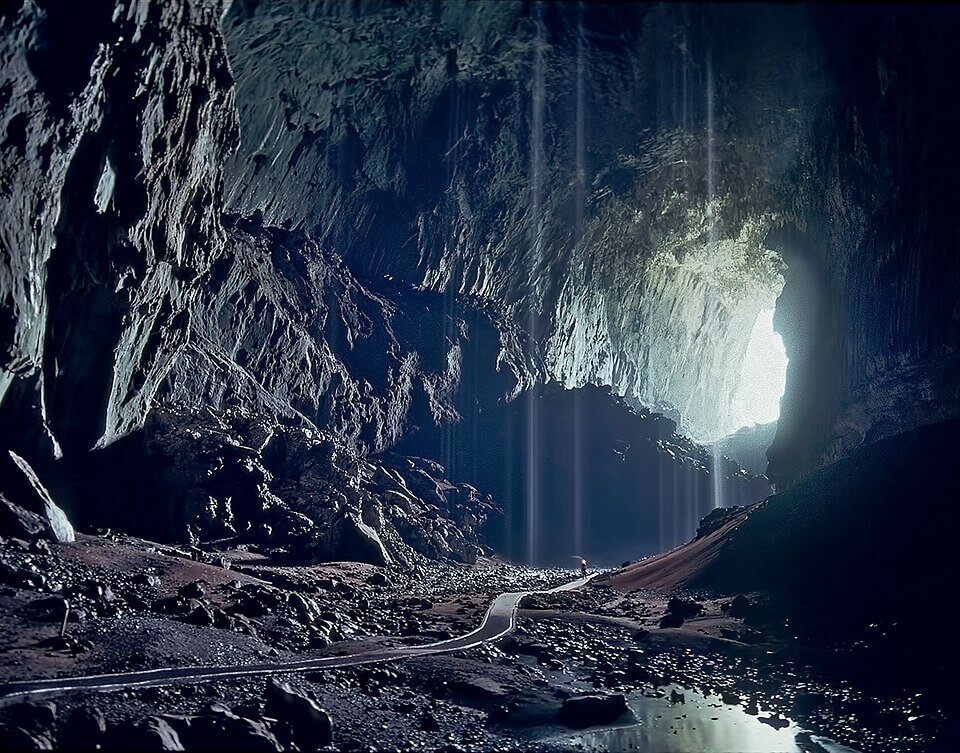
The Sarawak Chamber where this essay began was found by three British cavers, Andy Eavis, Dave Checkley, and Tony White, during the Mulu ’80 expedition (the chamber itself was entered in January 1981). They were surveying what they thought was a passage when the walls and roof simply receded out of lamplight, and it took them hours of compass work in the dark to grasp that they had walked into the largest underground room anyone had ever found. For three decades its true size was an educated guess. Then, in 2011, a team from the Mulu Caves Project hauled a laser scanner into the chamber and camped there for three nights, setting the scanner at nine stations around the chamber and taking some 13 million measurements. The numbers came back precise: a floor area of 164,459 square metres and a volume of 9,579,205 cubic metres, with the room measuring about 600 metres long, 435 metres wide, and up to 115 metres high. The work won the British Cave Research Association’s Arthur Butcher Award for cave surveying. Guinness World Records, working from a different reduction of the survey, lists the chamber’s surface area as approximately 154,530 square metres. The discrepancy is worth stating plainly rather than hiding: the chamber is the largest cave room on Earth by floor area, and the exact figure depends on how the scan data is processed.
By area, Sarawak reigns. By volume, it was dethroned. In 2013, a British-led expedition funded by the National Geographic Society and working with China’s Institute of Karst Geology in Guilin took laser scanners into the Miao Room, a chamber in the Gebihe cave system in Guizhou Province, China, first documented by a French-led team in 1989. Reprocessed with help from the University of Lancaster, the scans gave the Miao Room a volume of 10,780,000 cubic metres, about ten percent more than Sarawak, confirming it as the largest single cave chamber on Earth by volume. The result was announced at the Hidden Earth caving conference in the UK in late September 2014. Expedition co-leader Tim Allen captured the strangeness of the finding: “To me this is like discovering that K2 is larger than Everest.” The Miao Room is longer and narrower than Sarawak, about 852 metres long, which is why it holds more volume while covering less floor.
So which is “the largest cave chamber on Earth”? Both titles are real and they belong to different rooms. Sarawak is largest by area; Miao is largest by volume. Anyone who gives you a single answer is hiding one of them.
The Largest Passage: Hang Son Doong
A short flight away, in central Vietnam’s Phong Nha–Kẻ Bàng National Park, is a void of a different shape. Hang Sơn Đoòng is not the largest room but the largest cave passage in the world by volume, a continuous tunnel whose main gallery has been measured at 38.5 million cubic metres by the British Cave Research Association expedition leader Howard Limbert. The passage runs for more than five kilometres, stands over 200 metres tall and 150 metres wide in places, and its cross-section is reckoned to be about twice that of the next largest known passage. A 747 could fly down it without scraping a wingtip.
Its entrance was found in 1990 by a local man, Hồ Khanh, who sheltered from a storm by a cliff and felt a cold wind roaring out of a hole in the ground. He lost the location; around 2000, British cavers who had heard his account urged him to find it again, but he did not relocate the entrance until 2008, finally guiding a British–Vietnamese expedition inside in 2009. The Purdue University geologist Darryl Granger has dated the cave’s formation to roughly two to five million years, beginning when a river found a crack “the width of a hair” in the limestone ridge.
The detail that matters for this essay is what happens to the roof. In two places along Son Doong, the ceiling has collapsed, opening enormous skylights called dolines. The largest, nicknamed “Watch Out for Dinosaurs,” is a hole some 450 metres from cave floor to rim. Through these breaches, sunlight pours into a space that should be in absolute darkness, and a full jungle has grown on the cave floor, more than 200 plant species, trees exceeding 40 metres, and their own internal weather of mist and cloud. A doline is the visible moment of a cave beginning to die, the roof failing exactly as the physics predicts. It is also the most beautiful thing in the cave, a shaft of daylight falling through drifting fog onto trees that grew underground. The uncanny does not get more literal: a forest, in a cave.
The Salt Cathedral: Wieliczka
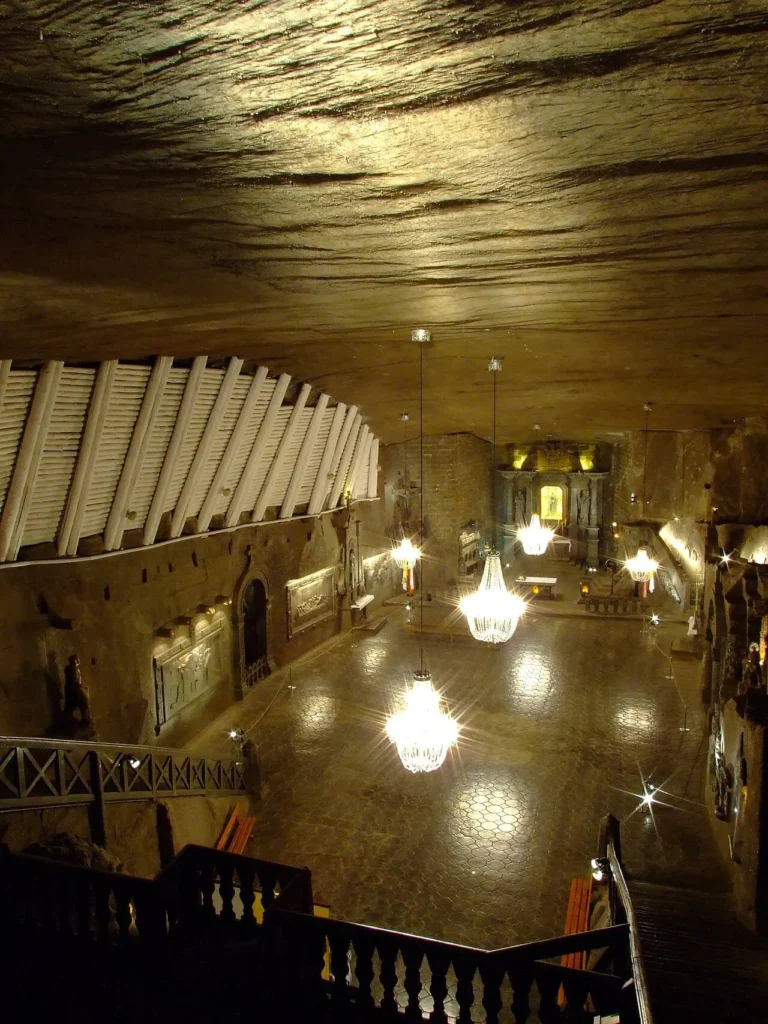
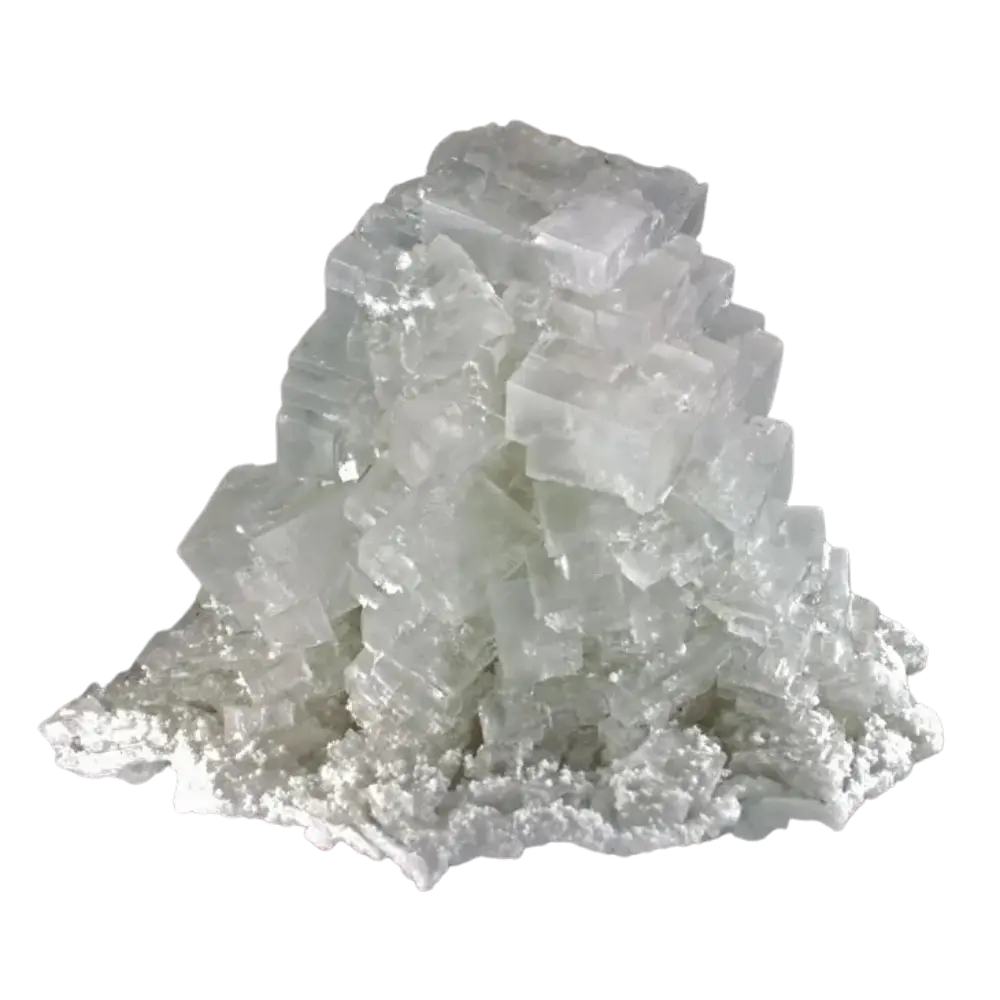
Not every great void is dissolved by water, and not every one is made by nature alone. Near Kraków in southern Poland, the Wieliczka Salt Mine descends through rock salt, the mineral halite, that crystallised out of an evaporating Miocene sea roughly thirteen million years ago. People have been digging table salt out of it since the 13th century, and over 700 years of mining they hollowed out a labyrinth that reaches 327 metres deep and threads through over 287 kilometres of passages on nine levels. It became one of the first sites inscribed on the UNESCO World Heritage List, in 1978.
The mine’s strangest room is St. Kinga’s Chapel, a full cathedral carved entirely out of rock salt about 101 metres underground, roughly 54 metres long, 18 metres wide, and 12 metres high. The floor, sculpted to look like tiled stone, is salt. The altarpieces, the bas-reliefs of biblical scenes, the statues, and even the chandeliers, whose crystals are salt dissolved and recrystallised to fake the clarity of glass, are all salt, carved by miner-artists over generations. The result is a human-made liminal space in the strictest sense: a room built for ritual passage, a church, sitting in the dark inside a mountain of salt, lit and silent and waiting. Wieliczka is what the Backrooms would look like if they had been carved by the faithful.
The Open-Air Void: Salar de Uyuni
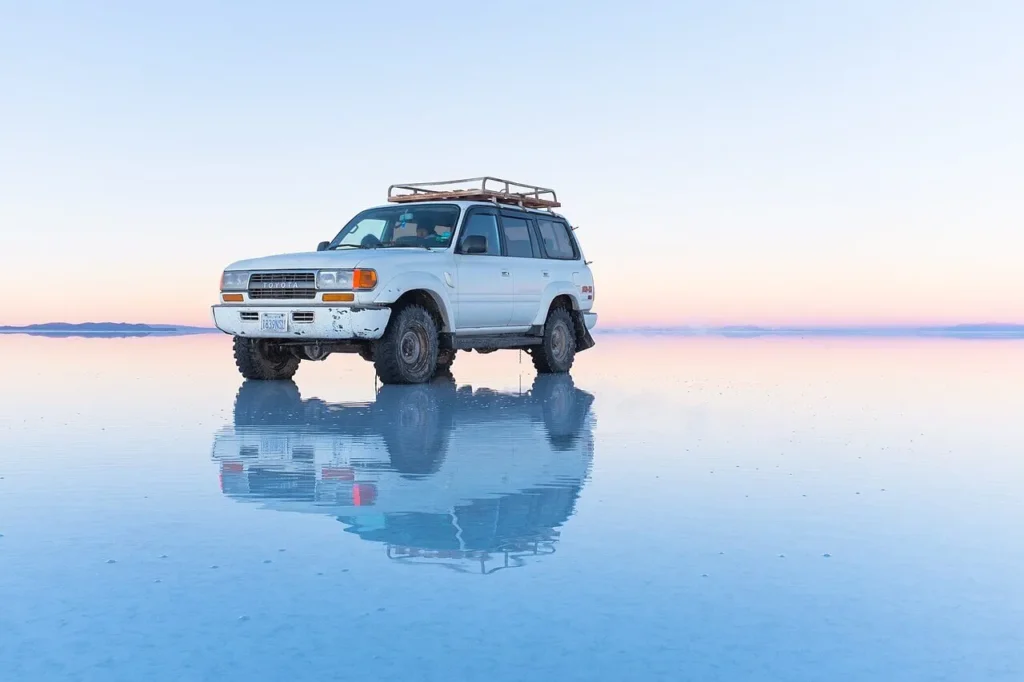
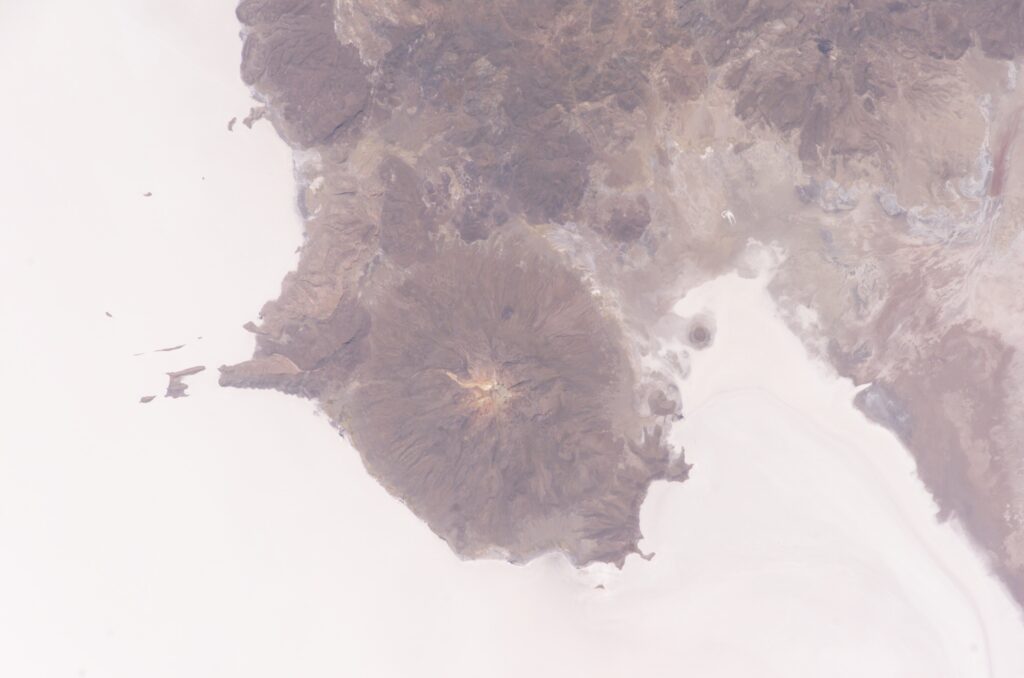
Emptiness does not require a roof. In southwest Bolivia, at about 3,656 metres above sea level on the Altiplano, lies the Salar de Uyuni, the largest salt flat on Earth at 10,582 square kilometres. It is the dried remnant of a chain of vast prehistoric lakes, Lake Minchin, which reached a maximum depth of around 150 metres, followed by Tauca and then Coipasa, that evaporated under the high Andean sun and left behind a crust of nearly pure salt several metres thick, sitting over an estimated ten billion tonnes of it.
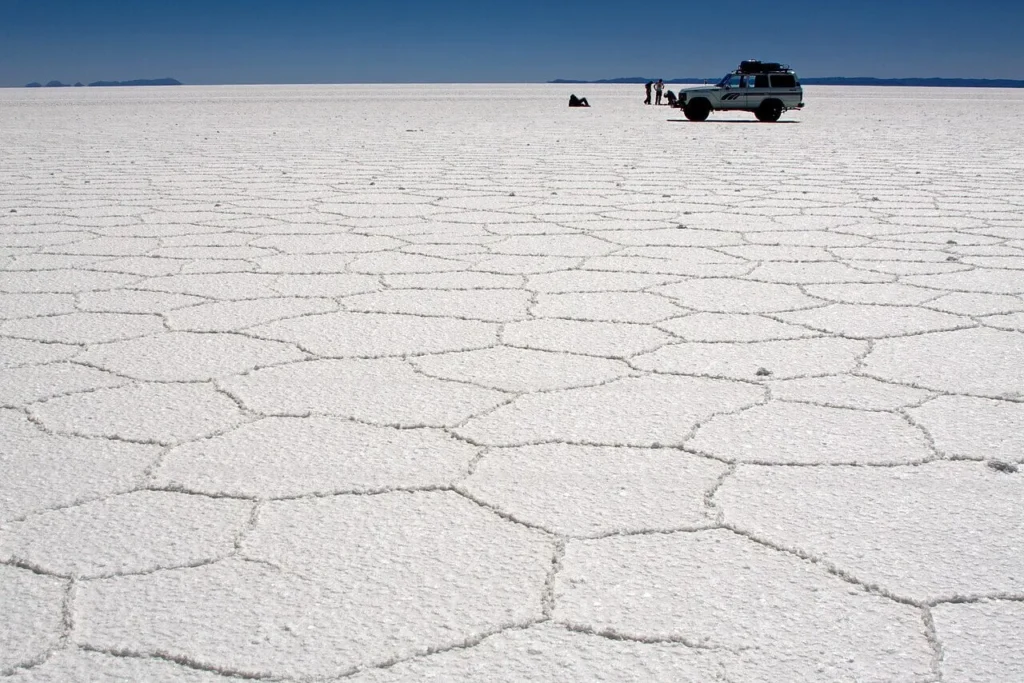
What makes Uyuni a liminal space rather than merely a large one is its flatness. Across the entire expanse, the elevation varies by less than a metre. It is one of the flattest surfaces on the planet, so flat and so stable and so reflective that NASA and the European Space Agency use it to calibrate the laser and radar altimeters on Earth-observing satellites, including ICESat and Envisat. In the dry season the crust contracts into a tessellation of pale polygons, hexagon after hexagon to the horizon, a tiled floor with no walls and no end. In the rainy season a thin film of water settles on the impermeable crust and the salar becomes the largest mirror on Earth, a perfect sheet that reflects the sky so completely that the horizon dissolves and a person walking across it appears to be walking through cloud, suspended between two skies with no ground at all. There is no better physical illustration of liminality, the betwixt-and-between, than standing on a surface where up and down have stopped meaning anything.
The Volcanic Corridor: Lava Tubes
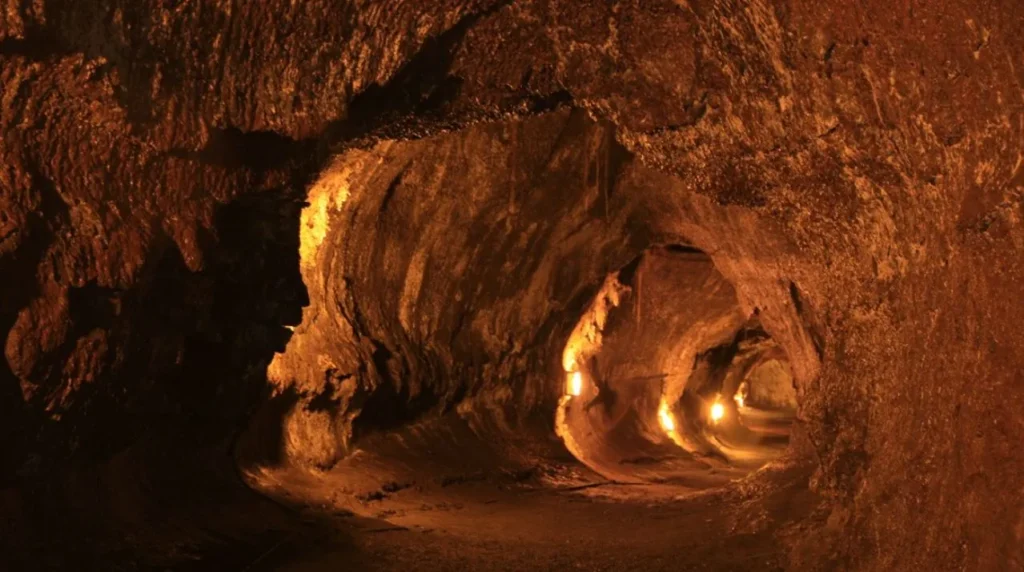
A lava tube is a cave that forms in hours instead of millennia. When fluid pāhoehoe lava, the smooth, ropey Hawaiian kind, erupting at temperatures around 1,185 degrees Celsius, pours downslope, its surface in contact with the air cools and crusts over while the molten interior keeps flowing. The crust insulates the lava beneath so well that heat is lost at only about one degree per kilometre, letting the flow run for tens of kilometres. When the eruption ends and the magma drains away, the crust is left behind as a hollow exoskeleton: a tube.
Hawaii’s Kazumura Cave is the longest and deepest lava tube known, surveyed at 65.5 kilometres long and descending 1,102 metres down the eastern flank of Kīlauea. It formed during the ʻAilāʻau eruption around five hundred years ago and was only fully connected into a single mapped cave in 1995, when cavers linked several previously separate tubes. Parts of it are wide and tall enough to feel like an abandoned subway tunnel, the walls smooth where rivers of rock melted them into shape, the ceiling hung with lavacicles. For visitors who want the experience without the expedition, the National Park Service maintains the Nāhuku, or Thurston, lava tube in Hawai’i Volcanoes National Park, a short walkable section of the same kind of void. Go far enough into any of them, past the last of the daylight, and you reach the dark zone, the part of the cave that has never received a photon of sunlight, where the only animals are troglobites, blind and pigmentless creatures adapted to permanent night.
The Vertical Voids: Moulins and the Abyss
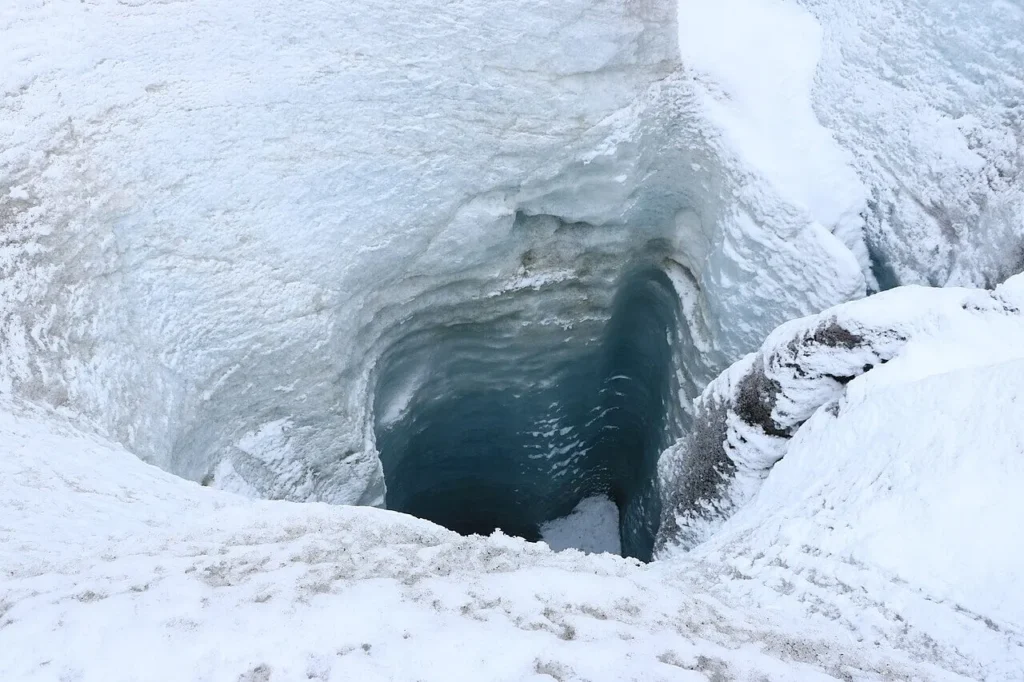
A moulin, or glacial mill, on the Athabasca Glacier, a meltwater shaft of blue ice dropping toward the glacier bed. License: CC BY 4.0, via Wikimedia Commons.
Some empty spaces drop straight down. On glaciers and ice sheets, surface meltwater finds a weakness in the ice and bores a roughly circular shaft called a moulin, up to about ten metres across and, in the great ice sheets, plunging hundreds of metres toward the bed. On the Greenland Ice Sheet, research published in Geophysical Research Letters found that surface meltwater lakes can drain through newly forming moulins in a matter of hours, the water hammering down a shaft of blue ice with a roar. To stand at the lip of one is to look down a shaft of glowing turquoise that narrows into black, a liminal space made of frozen water, on its way to disappearing the moment the glacier moves.
The deepest places humans have ever physically stood are also vertical, and they are made of limestone in the Arabika Massif of the Western Caucasus, in Abkhazia. Two caves there descend past two kilometres, the only two on Earth known to do so. For years the deepest was Krubera, also called Voronya, the “Crows’ Cave,” explored down through a series of shafts and flooded sumps to depths past 2,190 metres by Ukrainian-led expeditions in the 2000s and 2010s. In March 2018 a Russian team led by Pavel Demidov and Ilya Turbanov reached the bottom of nearby Veryovkina Cave at 2,212 metres, taking the world record. Then in 2024 a re-survey of Krubera revised its total depth to 2,224 metres, restoring it to first place. The honest summary is this: Krubera and Veryovkina have traded the record back and forth as survey methods improved, and both exceed 2,000 metres, the only two caves on Earth that do. As of the latest measurements Krubera is again the deepest known cave at about 2,224 metres, while Veryovkina, recorded at 2,212 metres in 2018, now stands at a confirmed 2,209 metres just behind it.
Reaching the bottom of either is a week-long expedition with a series of camps strung down the shafts, some of the vertical drops well over a hundred metres of free-hanging rope. The cold sits near 4 degrees Celsius, the passages are wet, and the danger is constant, a caver died alone in Veryovkina in 2020, his body found at 1,100 metres, and Demidov himself was killed by rockfall in another Arabika cave that same year. Demidov described the bottom of Veryovkina as being “as if you have had a look at the far side of the Moon.” Life persists even there: a springtail named Plutomurus ortobalaganensis, collected by the Ibero-Russian CaveX expedition in summer 2010 at 1,980 metres and described in Terrestrial Arthropod Reviews by Rafael Jordana and Enrique Baquero, is the deepest land animal ever recorded, blind and surviving on the thin scraps of organic matter that wash down from a surface it will never see.
The Flooded Blue: Cenotes and Sac Actun
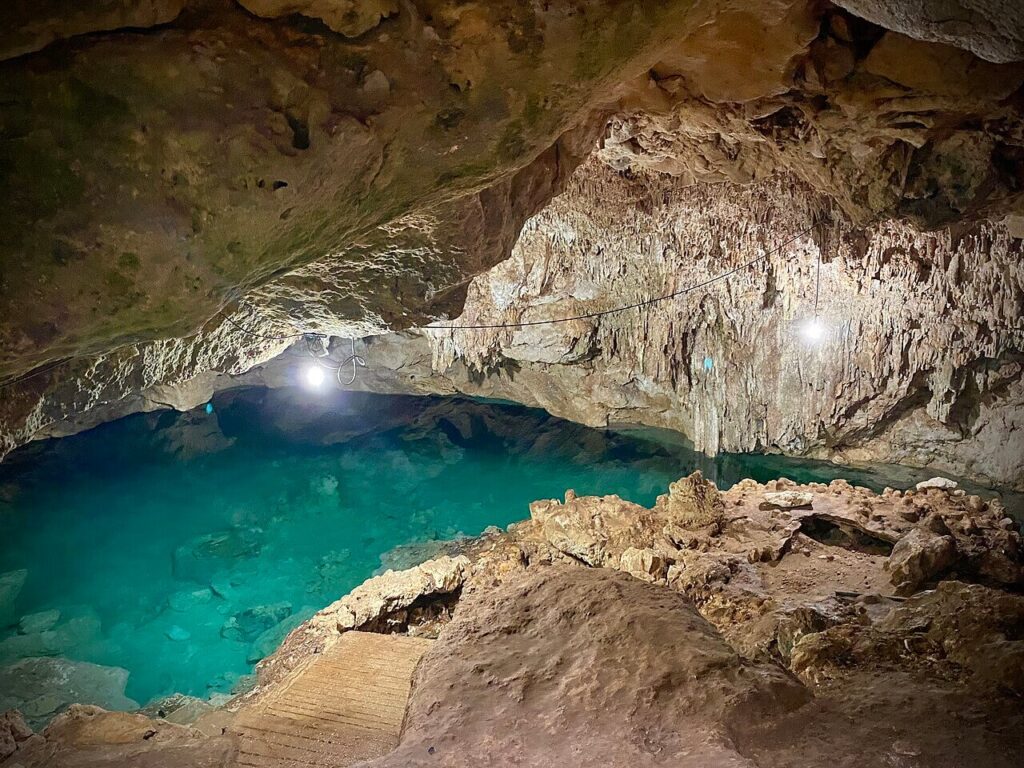
In Mexico’s Yucatán Peninsula, the limestone is riddled with flooded caves entered through sinkholes the Maya called cenotes, sacred wells, portals to the underworld. The longest of these underwater systems, Sistema Sac Actun near Tulum, was extended to about 372 kilometres in 2018 when divers from the Gran Acuífero Maya project, led by Robbie Schmittner, confirmed a connection to the neighbouring Dos Ojos system. It is now the second-longest known underwater cave, after the roughly 524-kilometre Sistema Ox Bel Ha, and it links well over two hundred cenotes through passages that average around 21 metres deep and reach 120 metres.
The eerie signature of these caves is the halocline, the boundary where fresh rainwater floating on top meets denser saltwater intruding from the sea below. The two layers refuse to mix, and swimming through the halocline the water shimmers and blurs as if you were passing through liquid glass or a heat-haze made of water. Light falls through the cenote openings in solid-looking shafts into water clear enough to see a hundred metres. These flooded voids are also time capsules: in a pit in Sac Actun called Hoyo Negro, divers found the skeleton of a teenage girl, named Naia, dated to between 12,000 and 13,000 years old, described as “the oldest, most complete and genetically intact human skeleton in the New World” in the study by James Chatters and colleagues published in Science on May 16, 2014, resting in the anoxic dark with the bones of Ice Age megafauna.
The Smallest Voids: Emptiness as a Measurable Property
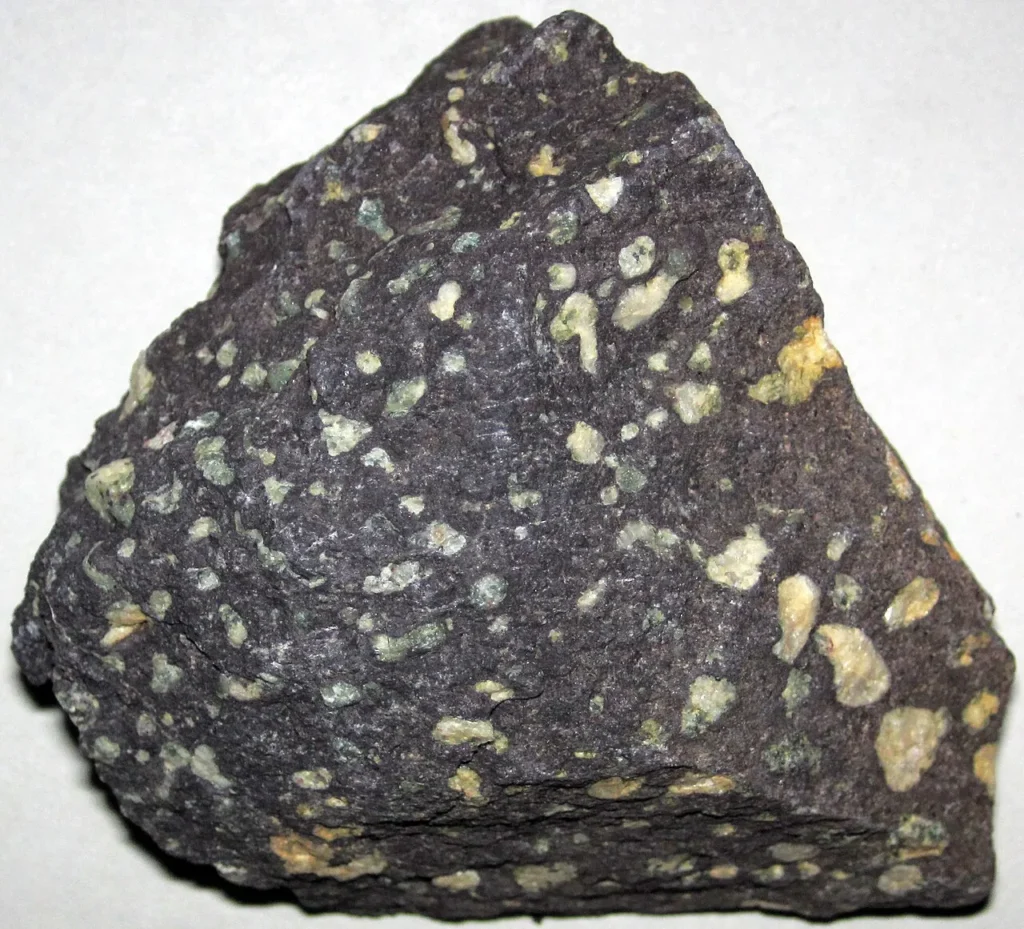
Everything so far has been a void you could walk, swim, or fall into. The liminal theme scales all the way down, because emptiness is one of the fundamental, quantifiable properties of rock. Porosity is simply the fraction of a rock’s volume that is empty space, the pores, cracks, and cavities between and within the grains. A sandstone aquifer might be a quarter empty by volume. That percentage decides whether the rock can hold water or oil, whether it can transmit them, and how the fluids move.
When the empty pockets get large enough to see, and especially when they cut across the grains and crystals of the rock rather than sitting neatly between them, geologists call them vugs. The petrophysicist F. Jerry Lucia defined a vug as a pore visibly larger than the surrounding grains, and the classic scheme of Choquette and Pray divides this vuggy pore space into separate vugs, isolated from one another, and touching vugs, which interconnect into a network. (Editor: “vug” could link to /glossary.) Keep enlarging a vug and it becomes a cavity, then a cavern. The Sarawak Chamber is, in the most literal sense, a vug you can stand inside. The same process, water exploiting a weakness, removing material, leaving emptiness, runs without interruption from a pore the width of a human hair, through a vug, through a passage, to a chamber that could hold a cathedral. Liminal space, then, is not really a feature of caves at all, it is a property of rock itself, present at every scale from the microscope to the continent.
What the Dark Does to a Human Being
There is a reason these places unsettle us beyond their size, and it is wired into the nervous system. Strip away light, strip away sound, strip away the rhythm of day and night, and the human animal comes apart in specific, measurable ways. We know this with unusual precision because of one man who used himself as the experiment.
In 1962, a 23-year-old French speleologist named Michel Siffre lowered himself into a cave beside an underground glacier in the Scarasson chasm in the Alps and stayed for about two months, with no clock, no calendar, and no sunlight. His original plan had been glaciological, but he realised mid-project that the real experiment was himself. He ate and slept only when his body demanded it and had a surface team log when he woke, slept, and called, but they never told him the time or date. When he emerged, he believed far fewer days had passed than actually had. His sense of time had not merely drifted; it had collapsed.
Siffre had stumbled into founding the field of human chronobiology. In 1972, with funding connected to NASA, which wanted to understand how astronauts would cope on long missions, he went deeper and longer: about six months, 205 days, alone in Midnight Cave near Del Rio, Texas. The findings were stranger than the first time. Free of any external time cue, his body abandoned the 24-hour day. His sleep–wake cycle first stretched to around 24.5 hours, and during two stretches it ballooned into a 48-hour rhythm, 36 hours awake followed by around 12 hours of sleep, without his being able to feel the difference. “I couldn’t tell the difference between sleeping two hours or eighteen hours,” he said. When the surface team told him on September 5 that the experiment was over, Siffre thought it was mid-August. He had lost weeks. The isolation took a heavy psychological toll; the work nearly destroyed him financially and emotionally, and he wrote of the mental disintegration of living outside time. He returned to the dark a third time in 1999, at sixty, to study how ageing changed the clock, and he died in 2024.
What Siffre demonstrated is that the human sense of time is not read off the external world by a reliable instrument; it is generated internally and then constantly corrected by cues from outside, chiefly the rising and setting of the sun. Remove the cues and the correction stops, and the internal clock free-runs into something that no longer matches the planet. This is the bridge between the geology and the aesthetic. A great underground void delivers, all at once, the full suite of sensory subtractions: total darkness, near-total silence, no horizon, no day, no other people. The liminal photograph of an empty hallway is a faint, safe taste of the same subtraction, the removal of the human presence that tells you where and when and who you are. The Backrooms made this literal with a man trapped in endless rooms. Siffre lived the non-fiction version, and came back unable to say how long he had been gone.
Emptiness and Deep Time
There is a final turn worth taking. The liminal aesthetic is fundamentally about human absence, the room that misses its crowd, the hallway that misses its footsteps. The geological voids are about something larger and older. The Sarawak Chamber was not abandoned by people, because people were never there. Its emptiness is not a lack of us, it is a completeness that has nothing to do with us at all.
These spaces were dark and silent for the entire span of human history, and the entire span before it. The carbonic acid widened the first fracture under Borneo while our ancestors were still small mammals. The salt of Uyuni dried under a sun that has watched whole species come and go. When the last caver climbs out of Veryovkina and the last diver surfaces from Sac Actun, the voids will not notice. They will go on dripping, dissolving, arching, and very slowly collapsing, on a clock indifferent to whether anyone is keeping it.
That is the real source of the unease, and it is why a cave does the job better than any rendered corridor. The Backrooms frighten by implying a watcher in the empty room. The genuinely uncanny thing about Earth’s great voids is that there is no watcher at all, and there never was, and the emptiness was never waiting for you to arrive or grieving you when you left. You noclipped in for an afternoon. The room has been there for a million years, and it is in no hurry. Step back from the edge, turn off the lamp, and listen to the water finding its way down through the dark, doing now exactly what it was doing long before there was anyone to hear it, and what it will keep doing long after.
Frequently Asked Questions
What is the largest cave chamber on Earth?
It depends on how you measure. The Sarawak Chamber in Gunung Mulu National Park, Borneo, is the largest by floor area, laser-scanned in 2011 at 164,459 square metres (Guinness World Records lists its surface area as approximately 154,530 square metres). The Miao Room in the Gebihe system in Guizhou, China, is the largest by volume, scanned in 2013 at 10,780,000 cubic metres, about ten percent more than Sarawak. Both records are legitimate; they simply measure different things.
Why don’t giant caves collapse?
Because rock is far stronger in compression than in tension, and a void in a strong rock mass forms a natural compression arch that carries the overlying weight around the opening rather than letting it pull the roof down. A typical cavernous limestone is many times stronger in compression than in tension, its compressive strength runs to around 100 megapascals, while its tensile strength is far lower, often by a factor of six or more. Flat ceilings have limited spans and tend to fail; arched roofs can span far more. When a roof does fail, the fallen rock (breakdown) can stabilise a new, higher arch. Caves are not permanent, they collapse and “die” over hundreds of thousands to millions of years.
What is the deepest cave humans have explored?
As of the most recent surveys, Krubera (Voronya) Cave in the Arabika Massif, Abkhazia, is the deepest known cave at about 2,224 metres, following a 2024 re-measurement. Nearby Veryovkina Cave held the record from 2018 at 2,212 metres. They are the only two known caves deeper than 2,000 metres, and the title has changed hands as surveying improved.
Are the Backrooms based on a real place?
The original 2019 image was a real room, a furniture and hobby shop in Oshkosh, Wisconsin, photographed before renovation, but the Backrooms themselves are fiction, a collaborative horror mythology invented in a 4chan thread. The broader “liminal spaces” aesthetic, by contrast, is built from photographs of real empty places. Earth’s real geological voids, like giant caves and salt mines, capture the same eerie emptiness without any of the invented threat.
Why do empty underground spaces feel eerie?
Partly because of the uncanny, described by Freud in 1919 as the familiar made strange, and partly because of what the writer John Koenig named kenopsia, the forlorn atmosphere of a place that should be full of people but is empty. Underground, the effect is amplified by genuine sensory deprivation: total darkness, near silence, and the loss of any time cue, which the explorer Michel Siffre showed can dismantle the human sense of time entirely.
What is the largest salt flat in the world, and why is it called a mirror?
The Salar de Uyuni in Bolivia, at 10,582 square kilometres, is the world’s largest salt flat and one of the flattest surfaces on Earth, varying by less than a metre in elevation across its whole expanse. In the rainy season a thin film of water on its impermeable crust turns it into a near-perfect reflective sheet, the “largest mirror on Earth”, that doubles the sky and erases the horizon.
How do lava tubes form?
When fluid pāhoehoe lava flows downslope, its surface cools and crusts over while the hot interior keeps moving, insulated so well it loses only about a degree per kilometre. When the eruption ends and the lava drains out, the hardened crust is left behind as a hollow tube. Hawaii’s Kazumura Cave, the longest and deepest known lava tube, is 65.5 kilometres long and descends 1,102 metres down Kīlauea.
References
- Mulu Caves Project — “Measuring Sarawak Chamber” and “Mulu Caves 2011” (laser-scan dimensions: 164,459 m²; 9,579,205 m³). mulucaves.org.uk
- Guinness World Records — “Largest single cave chamber (volume)” (Miao Room, 10,780,000 m³; Sarawak surface area ~154,530 m²); “Deepest cave”; “Longest underwater cave system explored.” guinnessworldrecords.com
- National Geographic — “China’s ‘Supercave’ Takes Title as World’s Most Enormous Cavern” (Miao Room). nationalgeographic.com
- British Cave Research Association / Howard Limbert; Wikipedia, “Hang Sơn Đoòng” (largest passage by volume, 38.4 million m³).
- UNESCO World Heritage Centre — “Wieliczka and Bochnia Royal Salt Mines.” whc.unesco.org
- NASA Earth Observatory / NASA Science — “An Expanse of White in Bolivia” (Salar de Uyuni, 10,582 km²; altimeter calibration). science.nasa.gov
- USGS Volcano Hazards Program / National Park Service — Nāhuku (Thurston) lava tube; Guinness World Records, “Deepest lava cave” (Kazumura, 65.5 km, 1,102 m). usgs.gov
- Wikipedia — “Krubera Cave” (2024 re-measurement to 2,224 m); “Veryovkina Cave” (2018, 2,212 m).
- Copernicus / Hydrology and Earth System Sciences — “Early hypogenic carbonic acid speleogenesis in unconfined limestone aquifers.” hess.copernicus.org
- arXiv — “The initial stages of cave formation: Beyond the one-dimensional paradigm” (White’s 1977 kinetic-trigger mechanism; Dreybrodt models).
- Waltham & others — rock-failure / arch stability in caves (compressive vs tensile strength; flat ~63 m vs arched ~240 m spans); “Bubble-Induced Cave Collapse,” NIH PMC.
- Choquette & Pray (1970) and F. J. Lucia (1983, 1995) — carbonate porosity and vug classification.
- Cabinet Magazine — “Caveman: An Interview with Michel Siffre” (1962 Scarasson; 1972 Midnight Cave, 205 days, 48-hour cycle). cabinetmagazine.org
- R. Jordana & E. Baquero, Terrestrial Arthropod Reviews — Plutomurus ortobalaganensis, deepest land animal (Krubera, 1,980 m, 2010).
- J. C. Chatters et al., Science, 16 May 2014 — Hoyo Negro / “Naia” skeleton (12,000–13,000 yr).
- John Koenig — The Dictionary of Obscure Sorrows (Simon & Schuster, 2021), “kenopsia.”
- Arnold van Gennep — Les Rites de Passage (1909); Sigmund Freud — Das Unheimliche / “The Uncanny” (1919).
- Wikipedia — “The Backrooms” and “Liminal space (aesthetic)” (4chan origin, May 12 2019; Diel & Lewis, Cardiff University; #liminalspaces ~100M TikTok views; Kane Parsons / A24).