
Introduction
A guide and a tourist are picking their way across the crater floor of a Tanzanian volcano before dawn. The ground is warm. In the half-light it looks like dried mud, gray, crusted, cracked into plates. Then a fissure opens a few meters away and something pours out that should not exist: a glossy black liquid, runny as used motor oil, moving fast and giving off almost no glow. It is lava, roughly the temperature of a self-cleaning oven at full cycle, and by the time the sun is properly up, the black ribbon it leaves behind will already be fading to the color of bone.
This is Ol Doinyo Lengai, the only volcano on Earth that erupts natrocarbonatite lava, and nothing else on the planet behaves like it.
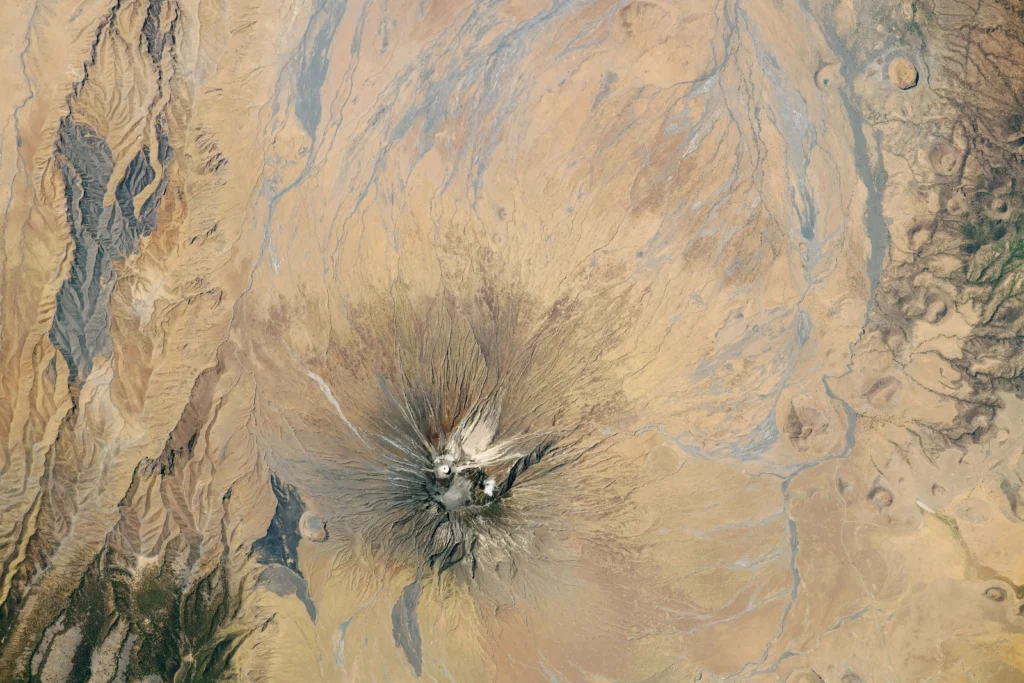
The volcano sits at the southern end of Lake Natron in northern Tanzania, a near-perfect cone rising about 2,000 meters above the floor of the East African Rift to a summit of roughly 2,960 meters. The Maasai call it Ol Doinyo Lengai, the Mountain of God. To volcanologists it is the only active volcano on the planet that erupts natrocarbonatite: a lava made not of silica but of sodium and calcium carbonate, so chemically strange that for decades nobody believed it was lava at all. Early visitors looked at the black, bubbling pools and assumed they were mud.
This is the story of why the lava is cold, why it is black, why it turns white, and why a remote cone in the Rift Valley has become a touchstone for everything from the birth of oceans to the geology of Mars and Mercury.
What Is Natrocarbonatite, and Why It’s So Strange
Nearly every lava you have ever seen a photograph of is a silicate lava: a melt built around silicon and oxygen, the same chemical backbone as quartz, glass, and most of the rocks beneath your feet. Basalt, andesite, rhyolite, these are silicate melts, and silicon-oxygen chemistry dictates how they behave.
Ol Doinyo Lengai is the exception. Its signature lava is a carbonatite: an igneous rock made of more than 50% carbonate minerals. Carbonatites are rare but not unheard of in the geological record. The standard catalogue, Woolley and Kjarsgaard’s “Carbonatite Occurrences of the World” (Geological Survey of Canada, 2008), counts roughly 527 carbonatite occurrences ranging in age from the Archaean to the present, of which only 49 are extrusive. Nearly all are ancient, intrusive, and long since cooled. What makes Lengai unique is that it is the only volcano known to erupt carbonatite lava in historical time, and its particular flavor is the rarest of all: a sodium-rich carbonatite, or natrocarbonatite.
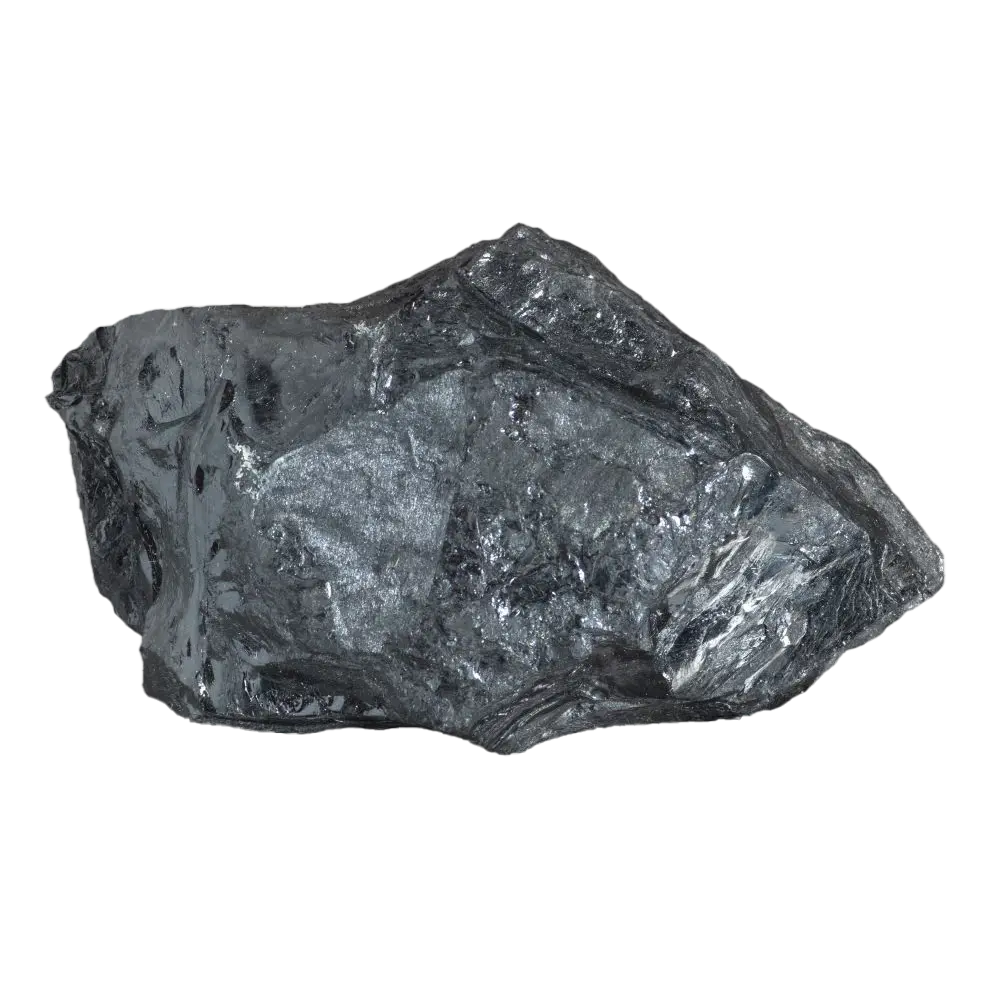
The composition is genuinely bizarre. Fresh natrocarbonatite contains roughly 30% sodium oxide (Na₂O) by weight and almost no silica, in typical lavas, silica is the main ingredient. The melt is dominated instead by two unusual carbonate minerals that crystallize as it cools, which we’ll meet shortly. The first scientific description came from the British geologist John Barry Dawson, who recognized the sodium-carbonate lavas from the 1960–61 eruption and published the finding in Nature in 1962, titling his paper, plainly enough, “Sodium Carbonate Lavas from Oldoinyo Lengai, Tanganyika.”
One consequence worth stating carefully: natrocarbonatite is enriched in the light rare earth elements, lanthanum, cerium, neodymium and their neighbors, relative to ordinary rock. This is a real geochemical signature, and it makes the lava scientifically valuable for studying how rare earths concentrate. But Ol Doinyo Lengai is not a rare-earth ore deposit, and nobody mines it. The world’s economic rare-earth carbonatites are ancient, calcium-rich intrusive bodies where ore minerals have been concentrated over hundreds of millions of years to extraordinary grades: Mountain Pass in California averages roughly 8–9 wt% total rare-earth oxides, and China’s Bayan Obo and Maoniuping deposits about 3–6 wt% (Watts et al., American Mineralogist, 2026). Lengai’s fresh, sodium-rich lava is a different beast entirely: fascinating, but not a mine.
Why Ol Doinyo Lengai Has the Coldest Lava on Earth
Here is the number that makes geologists do a double take. Most silicate lavas erupt somewhere between 700°C and 1,200°C; a Hawaiian basalt flow runs around 1,100–1,170°C. Natrocarbonatite comes out of the ground at roughly half that temperature.
The most-cited measurements were made in June 1988 and published in Science in 1989 by the French volcanologist Maurice Krafft and the German petrologist Jörg Keller, and they are precise: “Temperatures ranged from 491° to 519°C. The highest temperature, measured from a carbonatitic lava lake, was 544°C.” In their fuller account in the Bulletin of Volcanology the following year, Keller and Krafft summarized the range of lava-lake and flow temperatures as 491–544°C.
A second team led by J. B. Dawson, also working the 1988 activity and publishing in Geology in 1990, measured somewhat higher numbers: an extrusion temperature of 585 ± 10°C, which is where the often-quoted “580–590°C” range comes from. The two sets of figures don’t perfectly agree, and it’s worth being honest about that: depending on the method, the year, and exactly what was being measured, a fast-moving flow, a quiet lake, a spattering vent, published eruption temperatures for Lengai span roughly 490°C to 590°C. The review by Kervyn and colleagues frames the whole phenomenon neatly, describing natrocarbonatite’s “low temperature (495–590 °C, compared to 700–1200 °C for silicate lavas).” Either way, this is the coldest lava measured anywhere on the modern Earth.
Why so cold? It comes back to chemistry. Silicate melts are held together by strong silicon-oxygen bonds that require enormous heat to break and keep molten. Natrocarbonatite has none of that scaffolding. Its sodium-calcium-carbonate chemistry simply melts at a far lower temperature, so it can flow freely at heats that would leave basalt as solid rock.
Why the Lava Is Black (and Glows Only at Night)
A river of lava looks red-orange for the same reason an electric stove element does: it is hot enough to radiate visible light. That incandescence is a thermometer you can see. Drop the temperature far enough and the glow slides out of the visible range into the infrared, the object is still pouring out heat, but your eye registers nothing.
Natrocarbonatite sits right at that threshold. At around 500°C it radiates too little visible light to look red in daylight. So in the African sun, fresh Lengai lava looks black, a slick, dark liquid that fooled early observers into thinking the crater was full of mud. Only after dark does the deception lift: at night, the same flows show a faint dull-red incandescence, weak but unmistakable, the one visible sign that this black liquid is genuinely molten rock and not slurry.
This is the origin of Lengai’s nickname as the black lava volcano, and it is not a metaphor or a trick of photography. It is a direct readout of how cold the lava is.
The White-Overnight Mystery: Nyerereite and Gregoryite
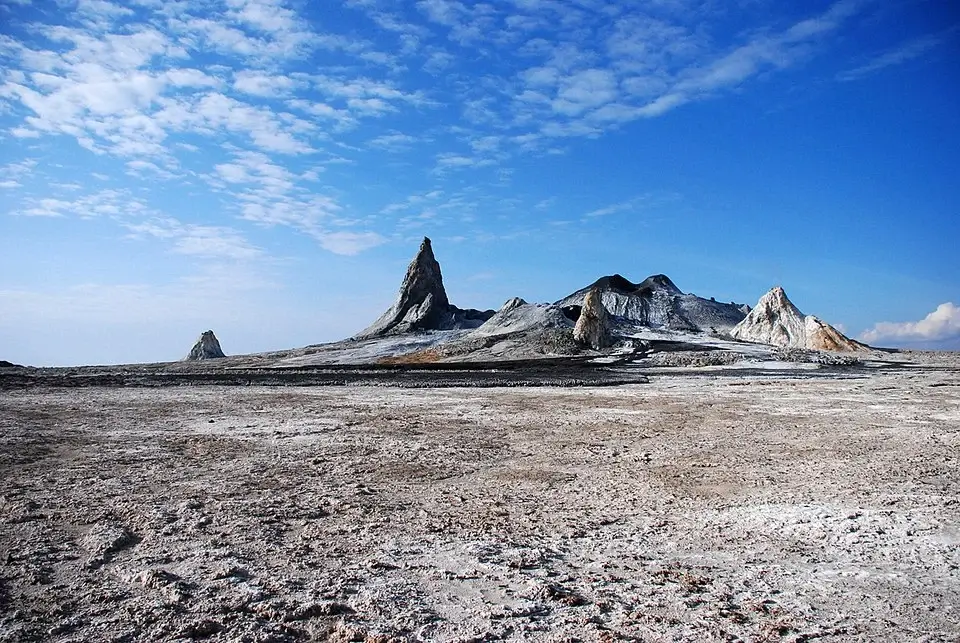
Within hours of erupting, the jet-black lava begins to pale, first to gray, then brown, then a chalky, crumbling white. Drape a fresh flow in rain and it whitens almost on contact. A landscape that was glossy and dark at dawn can look snow-dusted by the following day.
The culprits are the two minerals that make natrocarbonatite what it is. Fresh lava is built largely around nyerereite, ideally Na₂Ca(CO₃)₂, and gregoryite, ideally Na₂CO₃, both anhydrous sodium-rich carbonates, set in a groundmass of fluorite and the salts sylvite and halite. The formulas and compositions were pinned down in detail by Anatoly Zaitsev and colleagues in 2009.
The names are a small monument to the people who built the science. Nyerereite honors Julius Nyerere, the schoolteacher who became the first president of independent Tanzania. Gregoryite honors John Walter Gregory, the British geologist who explored the Rift in 1892–93, coined the very term “rift valley,” and wrote the 1896 classic The Great Rift Valley. The mineral was named for him in 1980; the Gregory Rift, the eastern branch of the whole system, carries his name too.
Here is the chemistry of the color change. Nyerereite and gregoryite are wildly out of equilibrium with damp air. They are hygroscopic, they grab water straight from the atmosphere, and the moment they do, they begin reacting. Within as little as two hours of eruption, atmospheric humidity converts the black surface into a white powdery crust of new minerals, including thermonatrite and nahcolite. Over the following days, weeks, and months, rainwater and air drive a longer cascade, producing a whole suite of secondary carbonates, pirssonite, gaylussite, shortite, trona, calcite, as documented by Zaitsev and Keller. The hard black rock turns soft, pale, and crumbly. In hollow, inactive spatter cones, dripping alkaline brines even build delicate stalactites of trona and other salts.
The transformation is so reliable that the crater floor becomes a kind of calendar: the blackest flows are newest, the gray ones are weeks old, the bone-white ones older still.
How Runny Is It? The Most Fluid Lava on Earth
Everyday intuition says heat means flow, so cold lava ought to be sluggish. Lengai inverts that: its natrocarbonatite is the most fluid lava ever measured, despite being the coldest.
The numbers are startling. Viscosity is measured in pascal-seconds (Pa·s); water sits at about 0.001 Pa·s. Basaltic lava, considered “runny” among silicate magmas, runs from roughly 100 to 10,000 Pa·s. Natrocarbonatite, by the rheological measurements of Gill Norton and Harry Pinkerton published in the European Journal of Mineralogy in 1997, ranged from 0.15 to 85 Pa·s in laboratory tests and 1 to 120 Pa·s in the field. The Dawson team’s 1990 Geology figures span a similar 0.3 to 120 Pa·s. Kervyn and colleagues summarize the contrast as “very low viscosity (10⁻¹ to 10² Pa s, compared to 10² to 10⁴ Pa s for basalt).” Norton and Pinkerton found that aphyric (crystal-free) natrocarbonatite behaves as a Newtonian fluid with eruptive viscosities more than an order of magnitude lower than the most fluid basaltic melt.
In plain terms, the lava has the consistency of warm oil, it races rather than oozes. Observers describe thin pahoehoe-like sheets only centimeters thick, and flows can move faster than a person can comfortably walk. Once again the secret is the missing silica. In silicate magmas, silicon and oxygen polymerize into long molecular chains that tangle and resist flow, that’s what makes lava viscous. Natrocarbonatite has no such chains to snarl it up, and a high content of halogens like fluorine and chlorine drops the viscosity even further. Norton and Pinkerton found that tripling the halogen content cut apparent viscosity by three orders of magnitude.
The flip side of all this fluidity is danger of an unusual kind. Because the lava is thin and fast and gives off little warning glow, people have walked into it. The Smithsonian’s Global Volcanism Program reported one stark case: on 21 August 2007, a Maasai porter accompanying Chris Weber’s climbing group fell into an active lava flow of around 500°C in the crater. He managed to climb out, but with both legs and one arm seriously burned, and months later was still bedridden near Engare Sero. It is the rare volcano where a person can fall into the lava and climb back out alive, though alive is not the same as unharmed.
The 2007–2008 Eruption: When the Mountain Changed Its Voice
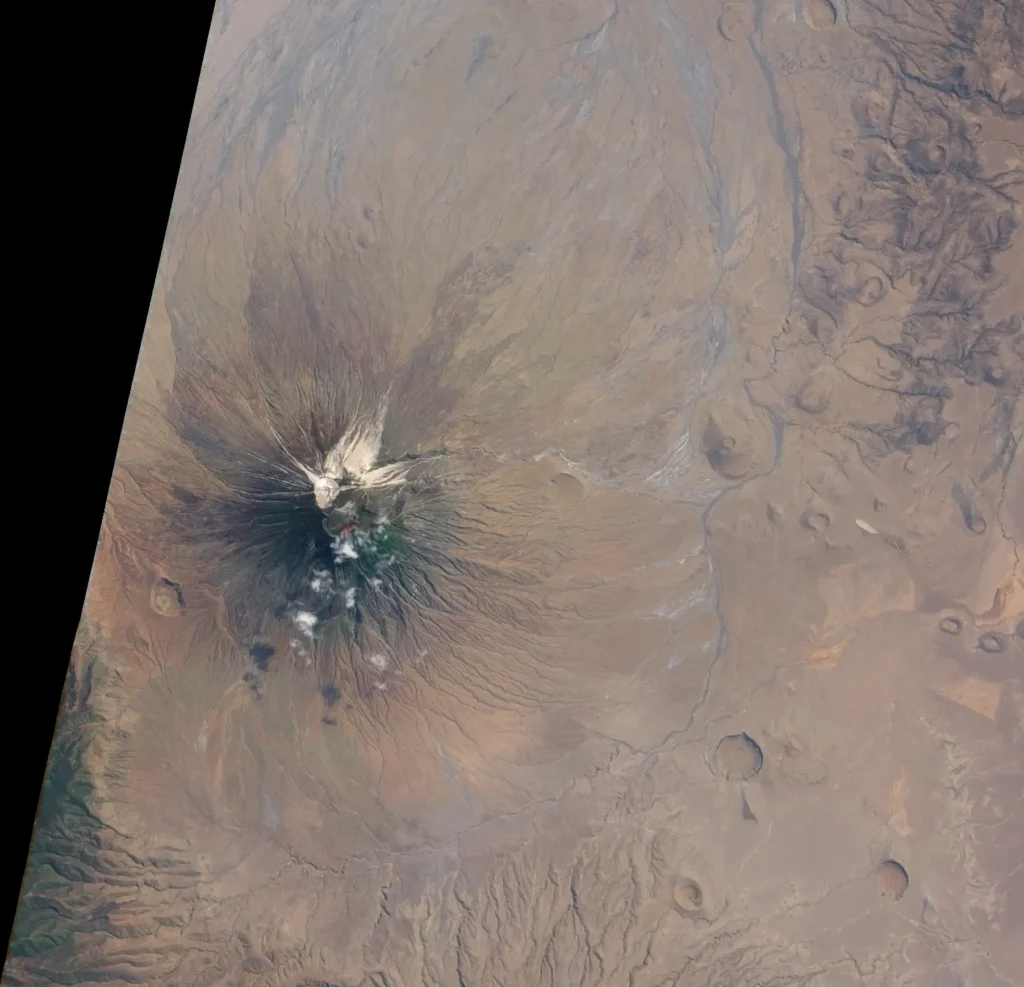
For about 25 years, from 1983 onward, Ol Doinyo Lengai did what it does best: quietly effused natrocarbonatite, building hornitos (chimney-like spatter cones) and slowly filling its northern crater with thin black flows that whitened in the sun. Then, on 4 September 2007, after a quarter-century of gentle behavior, the volcano abruptly switched to violent, episodic explosive eruptions, a change driven not by the cold carbonatite but by a silica-bearing (nephelinitic) magma entering the system.
The transition had been telegraphed. A voluminous lava eruption in March 2006 was followed by roughly a year of quiet, then renewed natrocarbonatite activity in June 2007, then a volcano-tectonic earthquake swarm in July 2007, a swarm that included dozens of events larger than magnitude 4, linked to a dike intruding beneath the nearby rift floor. Tremors were felt across the Kenya-Tanzania border region.
Here the popular record needs correcting, and it’s worth doing carefully. A widely repeated claim, it appears on Wikipedia, is that the 4 September eruption produced “a 3-kilometre-high eruption column and a new crater 100 metres deep and 300 metres wide.” Checked against the primary literature, that summary is muddled. The definitive scientific account is Kervyn and colleagues’ 2010 paper in the Bulletin of Volcanology, which reconstructed the eruption from field observations, ASTER and MODIS satellite data, and near-daily photographs from local pilots. Their findings:
- Eruption columns were not a single 3 km plume. After the onset, activity ranged “from 100 m high ash jets to 2–15 km high” columns, with distinct peaks at the end of September 2007 and in February 2008. (Some analyses citing the paper’s body text note columns reaching up to about 18 km during the February 2008 phase.)
- The explosive eruptions built up a roughly 400-meter-wide, 75-meter-high pyroclastic cone inside the crater.
- Ash was dispersed to about 100 km distance.
The “300 m wide, 100 m deep crater” figure refers to something different, the pit crater excavated by the explosions where the old lava platform had been. Later photogrammetric work (Laxton 2022; Tournigand and colleagues, 2023) puts that pit at roughly 300 m wide and 130 m deep. The constructed cone and the excavated pit are two distinct features, and secondary sources routinely conflate them. The eruption reached an estimated Volcanic Explosivity Index of 3.
The human impact was real. Ash fell on Engare Sero village some 18 km away, lasting over 12 hours during the 4 September paroxysm; residents, mostly Maasai herders, fled with their livestock. February and March 2008 brought the first pyroclastic flows ever documented at the volcano, small avalanches of hot ash spilling down the flanks. Pilots reported plumes climbing past 12 and even 15 km altitude. By April 2008 the explosive phase was waning, and the volcano gradually returned to its familiar quiet effusion of black lava inside the deepened crater, where it remains today.
Engai’s Mountain: The “Mountain of God”
Long before any geologist measured a viscosity here, the mountain had a name and a meaning. In the Maasai language, Ol Doinyo Lengai means “Mountain of God.” The Maasai and neighboring Sonjo regard it as the dwelling of Engai (also spelled Enkai), the deity of creation, a god who, in one telling, withdrew to the summit after being struck by a hunter’s arrow. The mountain has carried other local names too: Donjo Ngai, Oldonyo L’Engai, and more.
It is a living sacred site. Maasai still climb it to pray and to perform ceremonies, especially in times of drought or hardship, bringing petitions to Engai at the source of the rains. That spiritual weight sits alongside the volcano’s scientific fame without contradicting it: a mountain that pours out black liquid that turns white by morning, glows only in the dark, and shakes the ground for weeks before it roars hardly needs embellishment to feel like the home of a god.
Around its base, the landscape amplifies the strangeness. To the north lies Lake Natron, a shallow soda lake whose waters can reach a pH above 10, caustic, blood-red with salt-loving microbes, fed by mineral springs and baking under temperatures that climb past 40°C. Forbidding as it is, Natron is the single most important breeding site on Earth for the lesser flamingo: BirdLife International records that 1.5–2.5 million of them, 75% of the world’s population, depend on this one lake during the breeding season, protected by the very hostility that keeps predators away. The same rift chemistry that produces sodium-carbonate lava on the mountain produces a sodium-carbonate lake at its feet.
A Volcano Born of a Continent Tearing Apart
Ol Doinyo Lengai is not a random outburst. It is a symptom of one of the largest geological events on the planet: the slow rupture of a continent.
The volcano stands in the Gregory Rift, the eastern branch of the East African Rift System, a roughly 3,000-kilometer fracture along which the African continent is splitting into two. To the west lies the great Nubian plate, carrying most of the continent; to the east, the smaller Somali plate is peeling away. The two are separating slowly, GPS geodesy puts the Nubia–Somalia opening at about 6–7 mm per year (Stamps et al., 2008; Saria et al., 2014), roughly the rate your fingernails grow, but over geological time that is enough to tear continental crust apart and, eventually, to let in the sea. Geologists expect that in perhaps five to ten million years the rift will subside far enough for ocean water to flood in, splitting off a new microcontinent and opening a new ocean basin. The Afar region to the north, where three rift arms meet, is the only place on Earth where scientists can watch a continental rift transition into an oceanic one in real time.
Rifting is what makes carbonatite volcanism possible. As the crust stretches and thins, the hot mantle beneath rises and begins to melt. A very small degree of melting of carbon-bearing mantle, or the separation of an immiscible carbonate-rich liquid from a silica-bearing parent magma, can produce carbonatite. Carbonatites occur almost exclusively in continental rift settings, and East Africa is their classic home: Lengai has extinct carbonatite siblings nearby, including Kerimasi and Homa Mountain.
The deep origins were illuminated by a 2009 study in Nature led by Tobias Fischer, who sampled Lengai’s volcanic gases during an eruption. The team found that the gases, carbon dioxide, helium, nitrogen, argon, were chemically indistinguishable from those venting along mid-ocean ridges, even though Lengai sits far from any spreading center. The implication is large: a single, well-mixed reservoir of volatiles in the upper mantle feeds both mid-ocean ridges and continental rifts. The carbonatite is tapping straight into the deep Earth. The National Science Foundation, which funded the work, summarized the headline curiosity in its title: at Lengai, mantle carbon that would escape as gas at any other volcano instead emerges locked into solid, sodium-rich lava.
Why Ol Doinyo Lengai Matters: From Mars to Mercury
A cold black volcano in Tanzania might sound like a one-off curiosity, but its scientific reach extends well beyond Earth, it functions as a natural laboratory for processes that, anywhere else, can only be read from cold ancient rock.
Planetary analog work. Carbonate minerals have been detected on Mars, most prominently in the Nili Fossae region and in Jezero Crater, the landing site of NASA’s Perseverance rover, and understanding how carbonates form and survive on a planetary surface is central to the search for past habitability. Lengai offers a working model of active carbonate volcanism to compare against. The strangeness travels further still: in 2026, Reitze and colleagues at Universität Münster’s Institut für Planetologie (work tied to the ESA/JAXA BepiColombo mission) proposed in Icarus that the enigmatic bright “hollows” pocking the surface of Mercury might be composed of carbonatites, and tested the idea by measuring the infrared spectrum of a fresh, unaltered natrocarbonatite sample from Ol Doinyo Lengai, using the only place on Earth that produces the stuff as a stand-in for another planet. The volcano’s magmas have likewise been invoked as analogs for hypothetical carbon-rich exoplanets.
Mineralogy and the deep carbon cycle. Lengai is the best place on the planet to watch carbonatite magma actually erupt, cool, and react, processes that, for every other carbonatite on Earth, can only be inferred from cold, ancient rock. Its lavas record the lowest temperatures and viscosities of any terrestrial magma, providing hard limits for models of how melts behave. Because it taps mantle carbon directly, it is a key field site for understanding the deep carbon cycle, how carbon moves between the Earth’s interior and its surface over geological time. And because trace elements that are normally incompatible in silicate magmas behave very differently in carbonate melts, the volcano is a unique window on rare-earth and trace-element geochemistry.
There is also a human thread in the science. The 1989 temperature measurements that anchor so much of what we know come from the June 1988 expedition that Maurice Krafft joined with the petrologist Jörg Keller; Maurice and his wife Katia, the French husband-and-wife volcanologists, were on the mountain together, and their fearless close-up fieldwork defined a generation of eruption science. Three years later, on 3 June 1991, both Kraffts were killed by a pyroclastic flow at Mount Unzen in Japan. The numbers brought back from the Mountain of God are still cited in nearly every paper written about the place.
Visiting and Hazards: Reading the Mountain Responsibly
Ol Doinyo Lengai is climbable and has become a popular adventure objective, but it is not a casual hike, and it deserves blunt warnings.
The standard route ascends from the Maasai village of Engare Sero on the southern side. Climbers typically set off around midnight to reach the summit by sunrise, gaining roughly 2,000 meters of elevation over a single brutal push of eight to ten hours. The slope is steep, up to 40 degrees and more near the top, and much of it is loose volcanic scree and ash that gives way underfoot. It is physically demanding, non-technical, and unforgiving of the unprepared. Daytime heat on the cone can exceed 40°C.
The volcano is genuinely active. Hazards include sudden small eruptions, falling bombs and lapilli, toxic gases, unstable oversteepened ash slopes prone to collapse, and, down in the crater, those fast, near-invisible flows of ~500°C lava that have burned at least one person who fell in. Scientists who studied the 2007–08 eruption warned specifically of the risk of debris flows and lahars channeling down the flanks during the rainy season, noting past flows that carried rock fragments up to 50 cm across as far as 10 km from the mountain. A permit and an experienced local guide are required, and they are not bureaucratic formalities, conditions on the mountain shift constantly.
As of early 2026, Ol Doinyo Lengai remains in the long eruptive episode it began in April 2017, characterized by low-level natrocarbonatite effusion, small lava flows, hornito-building, and spattering confined to the deep summit crater, with occasional minor ash emissions, the quiet, black-lava mood that defines it between rare explosive interludes. Monitoring is mostly remote: the volcano is too steep, too caustic, and too isolated for permanent instruments, so satellites and visiting scientists do much of the watching.
Frequently Asked Questions
What is natrocarbonatite lava? Natrocarbonatite is a rare type of lava made of sodium and calcium carbonate minerals rather than the silica that makes up almost all other lavas. It is dominated by two minerals, nyerereite and gregoryite, contains roughly 30% sodium oxide, and is the only carbonatite lava erupting anywhere on Earth today. Ol Doinyo Lengai in Tanzania is the only volcano that produces it.
Why is Ol Doinyo Lengai’s lava black instead of red? Because it is cold, by lava standards. At around 500°C, natrocarbonatite is too cool to radiate much visible light, so it does not glow red-orange in daylight the way hotter silicate lavas do. It appears black instead. At night, the same flows show a faint dull-red incandescence, the only visible sign that the black liquid is truly molten.
Why does the lava turn white? The minerals in fresh natrocarbonatite, nyerereite and gregoryite, are unstable in damp air. They are hygroscopic, meaning they absorb atmospheric moisture, and they react with water and carbon dioxide within hours to form pale secondary minerals such as thermonatrite, nahcolite, trona, and pirssonite. The black rock fades to gray, then brown, then chalky white, and turns soft and crumbly. In rain, the change can be almost immediate.
Is Ol Doinyo Lengai’s lava really the coldest on Earth? Yes. Measurements by Krafft and Keller in 1989 recorded temperatures of 491–544°C, and Dawson and colleagues in 1990 measured about 585°C. Either figure is roughly half the 700–1,200°C of typical silicate lavas, making natrocarbonatite the coldest lava measured on the modern Earth.
Can you survive falling into the lava? It has happened, though surviving is a long way from walking away unharmed. On 21 August 2007, a Maasai porter fell into an active ~500°C lava flow in the crater and climbed out alive, but with severe burns to both legs and one arm. The lava’s low temperature and thin, fast consistency make survival possible in a way it would never be in 1,100°C basalt, but the injuries are serious, and the crater remains extremely dangerous.
Where is Ol Doinyo Lengai and what does the name mean? It is in northern Tanzania, in the Gregory Rift about 16 km south of Lake Natron and roughly 120 km northwest of Arusha. “Ol Doinyo Lengai” means “Mountain of God” in the Maasai language; the Maasai regard it as the home of the deity Engai and climb it to perform prayers and ceremonies.
Is Ol Doinyo Lengai dangerous to climb? Yes. It is a steep, demanding climb on loose ash and scree, and it is an active volcano with hazards including sudden small eruptions, falling rocks, toxic gases, unstable slopes, and fast-moving lava in the crater. A permit and an experienced guide are required. It should not be attempted casually.
Does Ol Doinyo Lengai contain valuable rare earth elements? Its lava is enriched in light rare earth elements, which makes it scientifically interesting, but it is not a rare-earth ore and is not mined. The world’s economic rare-earth carbonatites, such as Mountain Pass in California (≈8–9 wt% rare-earth oxides) and Bayan Obo in China, are ancient, calcium-rich intrusive deposits where ore minerals were concentrated over hundreds of millions of years, geologically very different from Lengai’s fresh sodium-rich lava.