
Introduction
In August 2013, an Adelaide opal buyer named Mike Poben was sorting through bags of rough opal he had bought from miners at the Wee Warra field, just outside Lightning Ridge in outback New South Wales. He was looking for colour, for the flash of red and green that pays a buyer’s bills. What stopped him was a shape. Two small fan-like ridges stood out from the dirt clinging to one odd lump of stone. They were teeth. The lump was the lower jaw of a dinosaur, and it had turned entirely to opal.
Poben could have sent the piece to be cut and sold. Instead he donated it to science. Five years later, palaeontologist Phil Bell of the University of New England and his colleagues gave the animal a name: Weewarrasaurus pobeni, the genus for the field where it was found, the species for the man who recognised that a bucket of rubble held a new branch of the dinosaur family tree (Bell, Herne, Brougham & Smith, 2018, PeerJ). It was the first new dinosaur described from New South Wales in almost a century, and it had come out of the ground as an opalized fossil, bone turned to gemstone. Lightning Ridge is the only place on Earth where that routinely happens.
How opalized fossils form: when a bone becomes a jewel
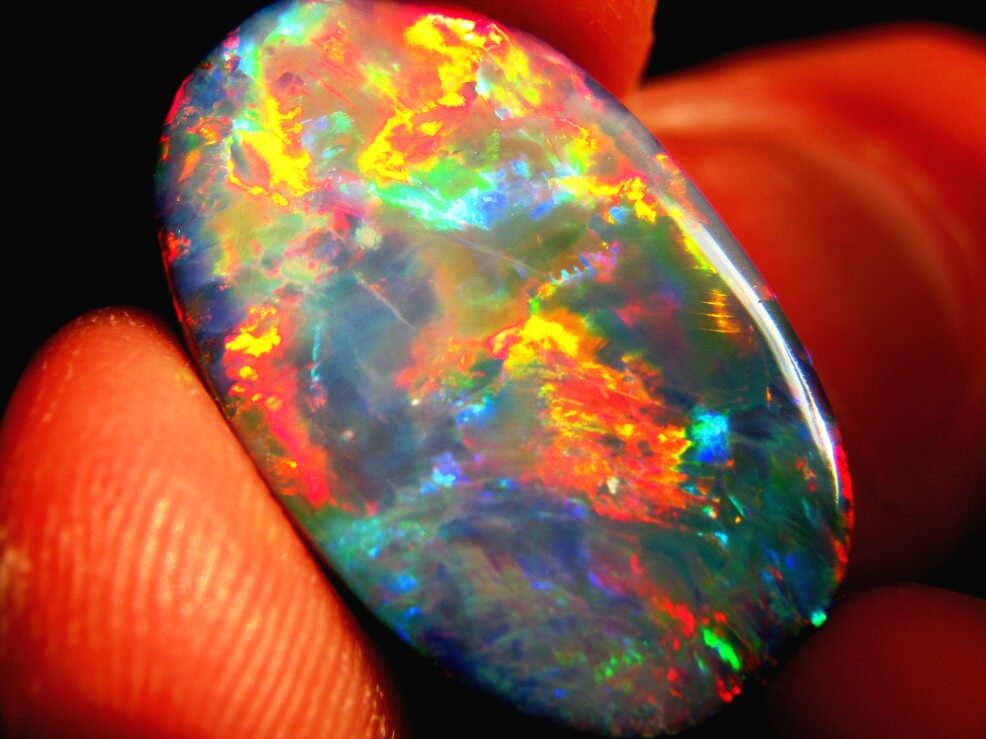
An opalized fossil is a fossil whose substance is opal, hydrated silica, the same mineral set in rings and pendants. Most fossils form when minerals such as calcite or silica seep into buried remains and harden. At Lightning Ridge and the other Australian opal fields, the infilling mineral happens to be precious opal, the kind that splits light into colour.
The Australian Opal Centre, which holds the world’s largest public collection of this material, describes two ways it happens, and a single specimen can show both. In the first, an organism rots away underground and leaves a cavity in the sediment. Silica-rich solution later fills that void the way jelly fills a mould, producing an opal cast that captures the outer shape of a shell or bone but none of its inner structure. In the second, silica soaks into the original material before it decays and replaces it piece by piece, down to fine internal detail. When the resulting opal is clear rather than milky, that detail can be read straight through the stone. According to the Australian Opal Centre, Lightning Ridge has produced the only known transparent fossils of large-animal bone anywhere on Earth.
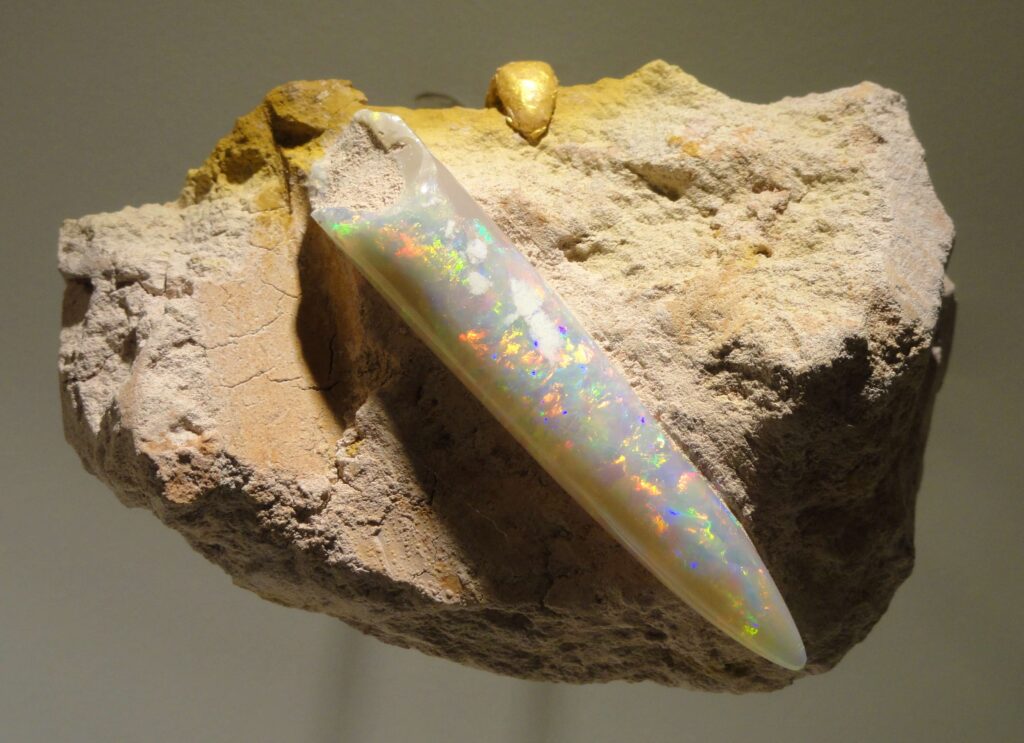
Belemnites, ammonites, clams, snails, pine cones and driftwood all turn up in opal, mostly from the marine fields like Coober Pedy and White Cliffs. Lightning Ridge is different, and the difference is everything for the dinosaurs.
A sea in the middle of Australia
Roughly a hundred million years ago, during the Cretaceous, a shallow sea spread across the interior of the continent. Geologists call it the Eromanga Sea. At its greatest extent it drowned about a third of Australia, a cold, high-latitude body of water in a world whose poles carried no permanent ice. Its sediments make up much of the Great Artesian Basin today.
Lightning Ridge sat on the southern shore of that sea, on a forested coastal floodplain not far from the South Pole. Rivers laid down sand and clay; animals lived and died in the swamps and channels. Those sediments are now the Griman Creek Formation, the rock unit that yields the opalized bones. Because the floodplain was freshwater rather than marine, it preserved land animals, which is why Lightning Ridge produces dinosaurs while the marine fields produce sea creatures.
For a long time the formation was assumed to be Albian, an earlier slice of Cretaceous time. A 2019 study revised that. By measuring the radioactive decay of uranium to lead in tiny detrital zircon grains, eroded crystals washed into a volcanic claystone sitting just above a fossil layer, Bell and colleagues fixed a maximum depositional age of 100.2 to 96.6 million years, placing the fossils firmly in the early-to-middle Cenomanian (Bell, Fanti, Hart, Milan, Craven, Birch & Smith, 2019, Palaeogeography, Palaeoclimatology, Palaeoecology). The same paper documented one of the richest mid-Cretaceous land faunas known from Australia.
Acid, iron, and a Martian parallel
Why does opal form here and almost nowhere else? Precious opal is genuinely rare in the rock record, and the leading explanation comes from geologist Patrice Rey of the University of Sydney (Rey, 2013, Australian Journal of Earth Sciences).
After the Eromanga Sea drained away, the exposed landscape began a long drying-out, from around 97 to 60 million years ago. The Cretaceous sediments left behind were loaded with pyrite, iron and weathered volcanic ash, which together gave the ground a strong capacity to turn acidic as it oxidised. In Rey’s model, this acidic, oxidising weathering mobilised silica through the sediment pile, dissolving it from volcanic grains and carrying it downward as a gel. Producing precious opal, the kind that flashes colour rather than the common milky sort, then takes a second step: the chemistry has to swing back to alkaline before that gel dries and hardens in the voids. That swing is only possible where the surrounding rock can soak up the acid, and here the decisive ingredient is a near-absent one. These rocks contain almost no carbonate, which would ordinarily neutralise the acid too early and shut the whole process down. Where limestone or shell beds buffer the chemistry, which is most places, opal never gets its chance.
Rey drew an unexpected comparison. The combination he describes, volcanic-rich sediment, no carbonate, acidic oxidative weathering, opaline silica, a surface drying under a thin atmosphere, closely matches conditions documented on the surface of Mars, down to the rusty colour. The opal under the Australian outback, in other words, may be a readable analogue for chemical weathering on another planet.
Rey’s account is the most fully developed, but it is not the last word. A competing view, associated with Hans Behr and John Watkins of the Geological Survey of New South Wales, argues that microbes played a part in forming the black opal at Lightning Ridge. Rey’s paper drew a published reply contesting aspects of the weathering mechanism, and the Australian Museum states plainly that the origin of Australia’s opalised fossils, and of opal itself, remains hotly debated. The headline fact is secure, bones here turned to opal, while the chemistry that did it is still being argued over.
The herd that sat in a living room
The other landmark discovery began long before Poben’s jaw, and it sat in storage for decades. In 1984, an opal miner named Bob Foster was digging at the Sheepyard field near Lightning Ridge. Instead of colour, he kept striking bone, the kind of find a working miner has every reason to curse, since it does not pay. Foster understood it mattered anyway. He gathered the bones, eventually filling suitcases, and brought scientists from the Australian Museum, with help from army reservists, to excavate the site.
Then the material went quiet. For roughly thirty years the Foster bones stayed largely unstudied until, in 2015, his children Gregory and Joanne Foster donated them to the Australian Opal Centre through the federal Cultural Gifts Program. When Phil Bell finally examined the collection, he noticed something the storage years had hidden. As he later put it, he found four shoulder blades, each from a differently sized animal. The pile held several animals, not one.
In 2019 the team named the animal Fostoria dhimbangunmal (Bell, Brougham, Herne, Frauenfelder & Smith, 2019, Journal of Vertebrate Paleontology). The genus honours Bob Foster; the species name means “sheep yard” in the Yuwaalaraay and Yuwaalayaay languages, after the field where he dug. Fostoria was an iguanodontian, a plant-eating relative of Queensland’s Muttaburrasaurus, and the larger individuals may have reached around five metres in length.
The collection holds about 60 opalized bones, including part of a braincase from one adult and material from at least three more animals, the first dinosaur herd documented in Australia. Jenni Brammall of the Australian Opal Centre summed up its standing: Fostoria is the most complete opalized dinosaur skeleton in the world. The bones recovered represent perhaps a fifth of a single skeleton, which still ranks the find among the most complete dinosaurs known from the continent.
The first Australian mammal, and a pliosaur called Eric
Dinosaurs are not the whole story. Lightning Ridge also gave up Steropodon galmani, an opalized lower jaw with three molars found by brothers David and Alan Galman and described in 1985. It was the first Mesozoic mammal discovered in Australia, a platypus-like monotreme about the size of a cat, and it pushed the Australian mammal record back by tens of millions of years. The holotype, an opal-blue jaw, sits in the Australian Museum and still figures in arguments about how the mammalian molar evolved. (Estimates of its age vary, from the older Albian framing to the revised Cenomanian.)
For a sense of what is at stake when these fossils survive intact, consider Eric. In 1987 an opalized pliosaur, a marine reptile, later described as Umoonasaurus demoscyllus, came out of the ground at Coober Pedy. The skeleton was later at risk of being sold off and broken up for its opal. A public appeal led by the ABC science program Quantum rescued it. According to the Australian Museum, more than 25,000 people, families and groups donated within three weeks, with further backing from the hat-maker Akubra, raising over half a million dollars so the museum could secure the specimen for the public. A preparator spent more than 450 hours reassembling hundreds of fragments; over 90 percent of the opalized skeleton was recovered, making Eric one of the most complete opalized vertebrate skeletons known.
Gemstone or fossil?
Eric’s near-loss is the central tension of opalized fossils. Under Australian mining law the person who pulls opal from the ground owns it, fossil or not. A jaw full of teeth and a saleable parcel of colour can be the same object, and when money is short the saleable parcel usually wins. Specimens are cut into gems or sold overseas, and the science inside them vanishes.
The miners are not the villains of this story. Many have the same sharp eyes and the same awe for the fossils that palaeontologists do, and without them the specimens would never surface at all. As Brammall has put it, the miners are the reason these fossils are found at all. For every parcel quietly cut and sold, there is a Poben or a Foster who stopped to look. The Australian Opal Centre, founded in the late 1990s and now building an underground museum at the Three Mile field, exists largely to give miners somewhere to bring such finds, and most of its collection arrived as donations.
What we still don’t know
Two large questions remain open. The first is the chemistry: whether opalization is purely a matter of acidic weathering, as Rey argues, or whether microbes contributed, as Behr and Watkins propose, or whether the answer is some combination not yet pinned down. The mechanism that made these fossils is still under active study.
The other is harder to measure, and may never be measured at all. Nobody knows how much has already been lost, how many jaws, limbs and skulls have passed through cutting wheels and into jewellery boxes, unrecorded. Every parcel of rough that a miner pauses over, the way Poben once did, is a coin toss between a ring and a new species. Lightning Ridge remains the only place on the planet where that toss is even possible.
Frequently asked questions
How do opalized fossils form?
Opalized fossils, also spelled opalised, the Australian convention, form like other fossils, except the mineral is precious opal, hydrated silica. Either silica-rich solution fills a void left by a decayed organism, producing an opal cast of its outer shape, or silica replaces the original material directly and preserves internal detail. The leading explanation for why this happens at Lightning Ridge is acidic, oxidising weathering of iron- and volcanic-rich sediments that contain almost no carbonate, though the exact mechanism is still debated.
Where are opalized dinosaur fossils found?
Almost exclusively at Lightning Ridge in New South Wales, Australia, in rocks of the Cretaceous Griman Creek Formation. It sat on a freshwater floodplain, which preserved land animals. Other Australian opal fields such as Coober Pedy were under the marine Eromanga Sea and yield opalized sea creatures rather than dinosaurs.
What is the most complete opalized dinosaur?
Fostoria dhimbangunmal, described in 2019 from about 60 opalized bones representing at least four individuals. The Australian Opal Centre describes it as the most complete opalized dinosaur skeleton in the world, and the find also records the first known dinosaur herd from Australia.
Why is opal so rare on Earth?
Forming precious opal needs an unusual chemistry. In Patrice Rey’s model it requires acidic, oxidising weathering with little or no carbonate present, because carbonate neutralises the acid that mobilises silica. Most sedimentary settings contain enough carbonate to prevent it, which is why Australia’s carbonate-poor Cretaceous basin is so unusually productive.
Are opalized fossils valuable?
Yes, in two competing ways. As gem opal they can be cut and sold, and as scientific specimens they can be irreplaceable. The conflict between those values is why fossils are sometimes destroyed for the jewellery trade, and why institutions like the Australian Opal Centre work to acquire and protect them.
Why does Lightning Ridge have opalized fossils when other places don’t?
It combined the right rocks with the right chemistry. A freshwater floodplain at the edge of the Eromanga Sea buried plants and animals, and the carbonate-poor, iron- and volcanic-rich sediments later underwent the acidic oxidative weathering that produces opal. That pairing of fossils and opal-forming conditions is, so far, effectively unique to the Australian opal fields.