
Introduction
Some patterns in nature look too deliberate to be accidental. The hexagonal stone columns of the Giant’s Causeway are the classic case: tens of thousands of six-sided pillars packed so neatly that for centuries people credited a giant rather than admit they could not explain them. The truth is stranger than the legend, and stranger than the textbook version most people half-remember. These columns are not frozen lava caught mid-pour, and the cracks that carve them do not open while the rock is molten. They form hundreds of degrees later, in solid stone, as a cooling lava sheet shrinks and tears itself into polygons along the cheapest path it can find. What follows is how that happens, why the columns lean toward six sides, the precise temperature window where they crack, and why the same honeycomb turns up in a tray of cornstarch and on the wall of a Martian crater.
Why Cooling Lava Cracks Into Hexagonal Columns
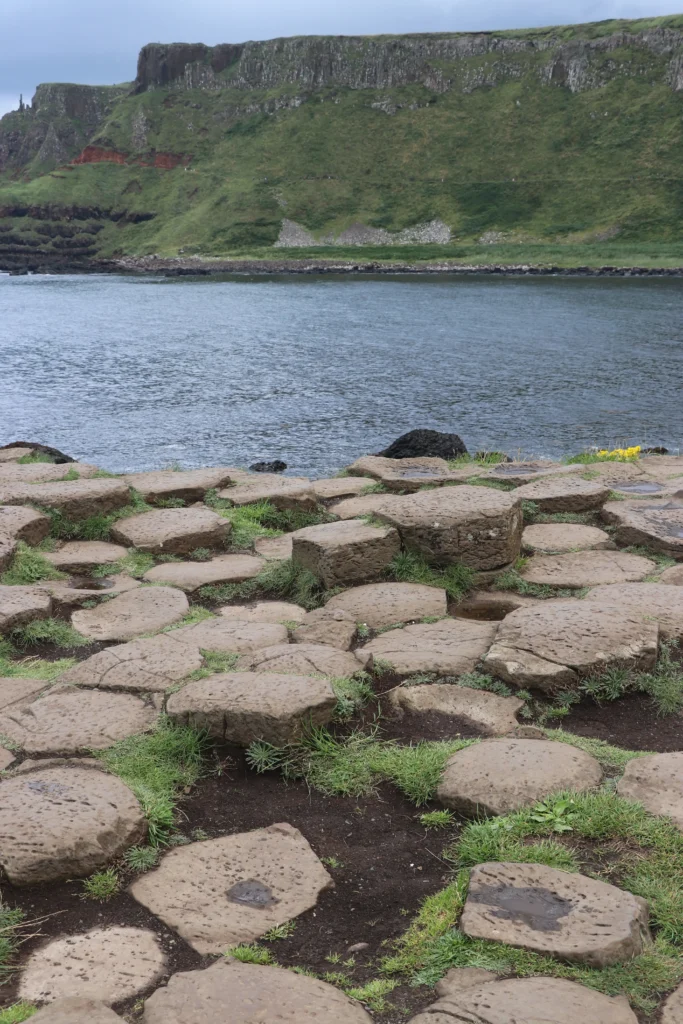
Stand on the seaward edge of the Giant’s Causeway in County Antrim and the ground stops behaving like ground. Underfoot is a mosaic of stone tiles, most of them six-sided, fitted together so tightly you could not slip a coin between them. They march out of the cliff, step down a slope, and vanish under the waves. About 40,000 of these columns crowd the headland. They look quarried and laid by hand. They were not. They are what happens when a sheet of lava cools and the rock inside it tears itself into polygons.
The pattern is so regular that for centuries people preferred a giant to an explanation. The real story is stranger, and it has a twist that surprised geologists as recently as 2018: the cracking does not happen while the lava is liquid. It happens later, in solid rock, as the stone keeps cooling and shrinking. This is how a puddle of molten rock becomes a colonnade.
What is columnar jointing?
Columnar jointing is the fracturing of a cooling rock body into long, roughly parallel columns. The columns stand perpendicular to whatever surface the rock cooled against, and their cross-sections tile a plane: four-sided, five-sided, six-sided, occasionally three- or seven-sided shapes locked edge to edge. Geologists call the cracks “joints,” meaning fractures along which the rock has pulled apart rather than slid.
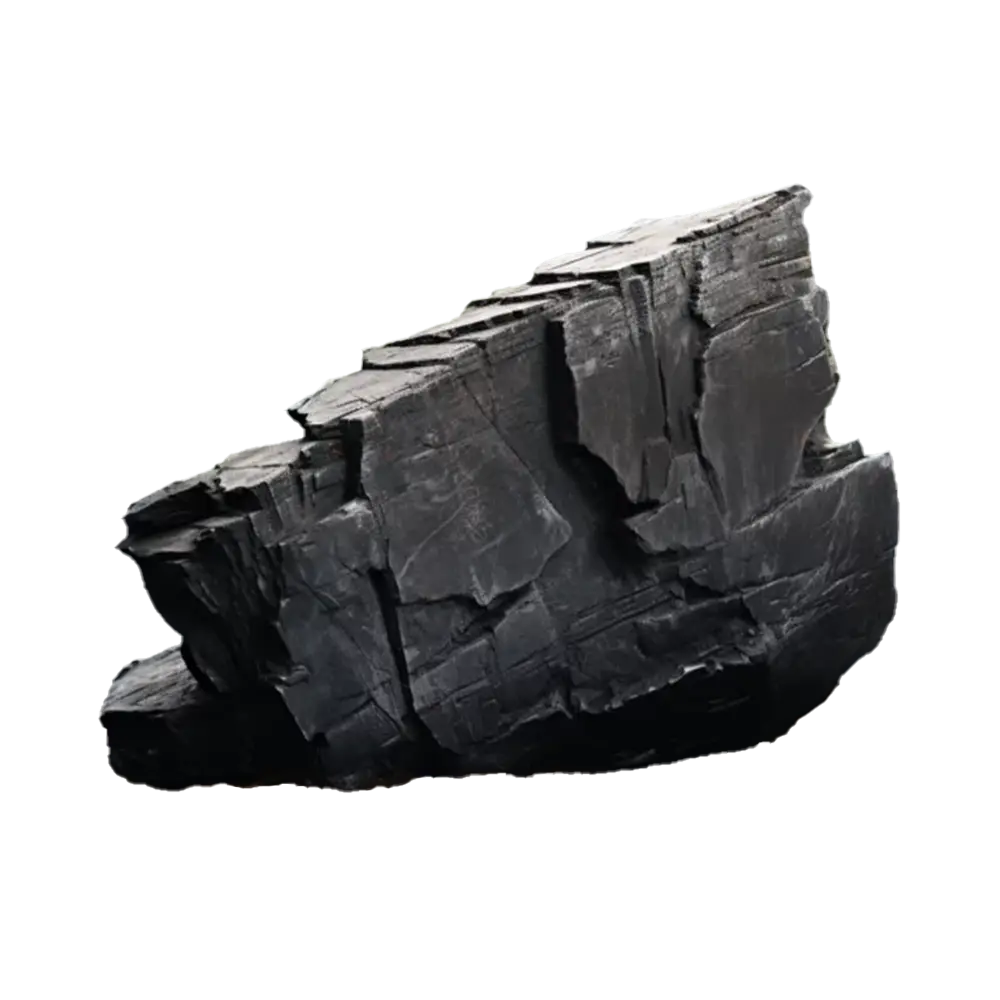
The phenomenon shows up most dramatically in basalt, a dark, iron-rich volcanic rock that erupts hot and runny and tends to pool in thick, even sheets. Thick and even matters. A deep, uniform body of lava cools slowly and steadily, and slow steady cooling is what grows long, clean columns instead of a chaotic rubble of cracks. The tallest columns at the Giant’s Causeway reach about 12 metres (39 feet), and the basalt in the cliffs is up to 28 metres (92 feet) thick. At Devils Postpile in California, a lava flow ponded in a river valley to a depth of about 122 metres (400 feet) and produced columns 12 to 18 metres tall.
The fractures grow from the cooling surfaces inward. A lava flow loses heat from its top, where it meets the air, and from its base, where it sits on cold ground. Cracks nucleate at both surfaces and propagate toward the warm interior, which is why a well-exposed flow often shows columns growing down from the top and up from the bottom, meeting somewhere in the middle.
Why hexagons? The 120-degree rule
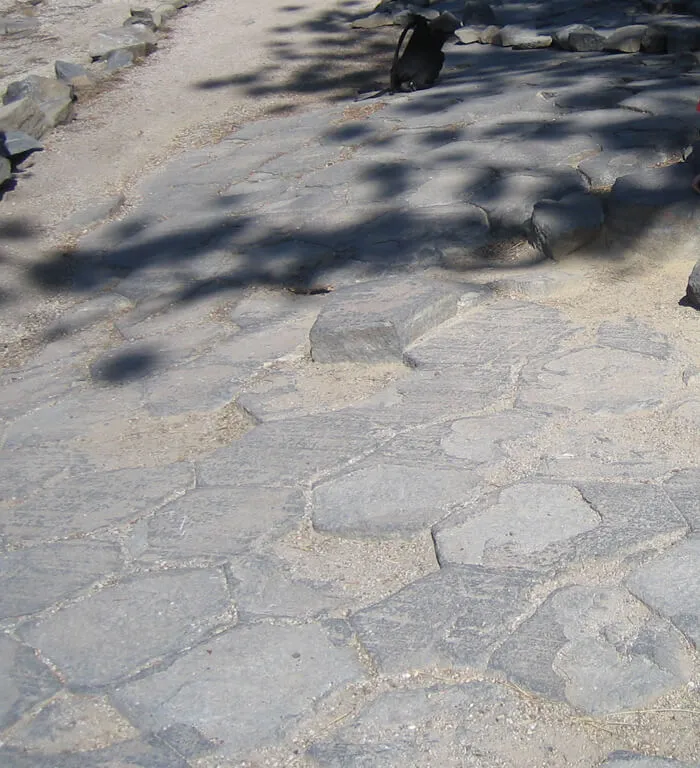
To see why the columns favor six sides, forget rock for a moment and think about drying mud. A puddle dries from the surface down. The mud at the top loses water, wants to shrink, and is held back by the wet mud below and the mud beside it. Tension builds until the layer cracks. Cooling lava does the same thing for the same reason, it wants to contract but is anchored to the rock around it, except the shrinkage comes from falling temperature rather than lost water. The mathematics underneath the two processes is genuinely the same, which is why a dried mud flat and a basalt colonnade wear the same polygonal skin.
Now, why polygons with roughly 120-degree corners? When a crack opens, it relieves the tension pulling at right angles across it. The most efficient way to release stress that is pulling equally in every direction is to crack in three directions from a single point, with those three cracks 120 degrees apart. Three cracks at 120 degrees meeting at shared corners tile the plane as hexagons. As the U.S. National Park Service explains it, contractional stress is most efficiently relieved by three fractures meeting at 120 degrees, and a network of those junctions tiles the surface into six-sided polygons.
A 2015 study in Physical Review Letters by Martin Hofmann and colleagues showed mathematically that this hexagonal arrangement is the energetically favored outcome, the configuration that releases the most strain energy as the cracks advance. Nature isn’t aiming at hexagons at all. The cracks simply take the lowest-energy path available, and at that path the geometry comes out hexagonal.
There is a wrinkle worth knowing. Crack networks often start out messy and rectangular, with cracks meeting at 90 degrees, and then mature toward the tidy 120-degree honeycomb as fracturing proceeds in repeated increments. The physicist Lucas Goehring described how a rectilinear pattern can evolve into a hexagonal one under the same forces. The deeper into a thick flow you look, the more regular and hexagonal the columns tend to become, because the pattern has had room to optimize.
This is also why “all basalt columns are hexagons” is a myth. Hexagons are simply the most common result. At Devils Postpile, the USGS reports that “an average of 55% of the columns have classical six-sided (hexagonal) shapes”, a famously high proportion, and still only about half. The rest are five-sided, four-sided, or seven-sided. The honeycomb is only the most likely outcome among several.
How hot? The 840 to 890 °C window
For a long time the obvious assumption was that lava cracks as it freezes, that the joints open at the moment molten rock becomes solid rock. In 2018 a team led by Anthony Lamur and Yan Lavallée at the University of Liverpool measured the answer, and the obvious assumption was wrong.
Working with basalts from Iceland’s Eyjafjallajökull volcano, they found that this basalt fully solidified at around 980 °C, but the jointing cracks did not form there. The rock has to keep cooling, as a solid, before tension climbs high enough to break it. Their result, published in Nature Communications, is precise: contraction during cooling “induces stress build-up below the solidus temperature (980 °C), resulting in localised macroscopic failure between 890 and 840 °C.” In their words, “columnar jointing takes place well within the solid state of volcanic rocks.”
That 50-degree window, roughly 840 to 890 °C, is where columns are actually born. By then the lava is no longer lava in any meaningful sense. It is hot, dark, solid rock under growing strain, and somewhere in that interval it gives way. So the columns of the Giant’s Causeway and Devils Postpile did not crack in molten stone. They cracked in cooling rock, hundreds of degrees below freezing point.
A tour of the great colonnades
Giant’s Causeway, Northern Ireland
The Causeway is the headline act. Its roughly 40,000 columns formed during the Paleocene, about 60 million years ago, when northwest Europe was being torn apart and the North Atlantic was opening. Vast outpourings of basalt, the North Atlantic Igneous Province, flooded the region, and one thick sheet of lava ponded in an old river valley and cooled into the columns we walk on today. UNESCO, which inscribed the site as a World Heritage Site in 1986, describes “some 40,000 large, regularly shaped polygonal columns of basalt in perfect horizontal sections, forming a pavement.”
Then there is Finn McCool. In the legend, the Irish giant Fionn mac Cumhaill built the causeway across the sea to fight the Scottish giant Benandonner. When Fionn saw how enormous his rival was, he fled home, and his quick-witted wife disguised him as a baby in a cradle. Benandonner arrived, took one look at the size of the “infant,” decided the father must be a monster, and bolted back to Scotland, ripping up the causeway behind him so he could not be followed. The myth has a geological echo: the matching basalt columns of Fingal’s Cave on the Scottish island of Staffa belong to the same volcanic province, the far end of the same vanished road.
Devils Postpile, California
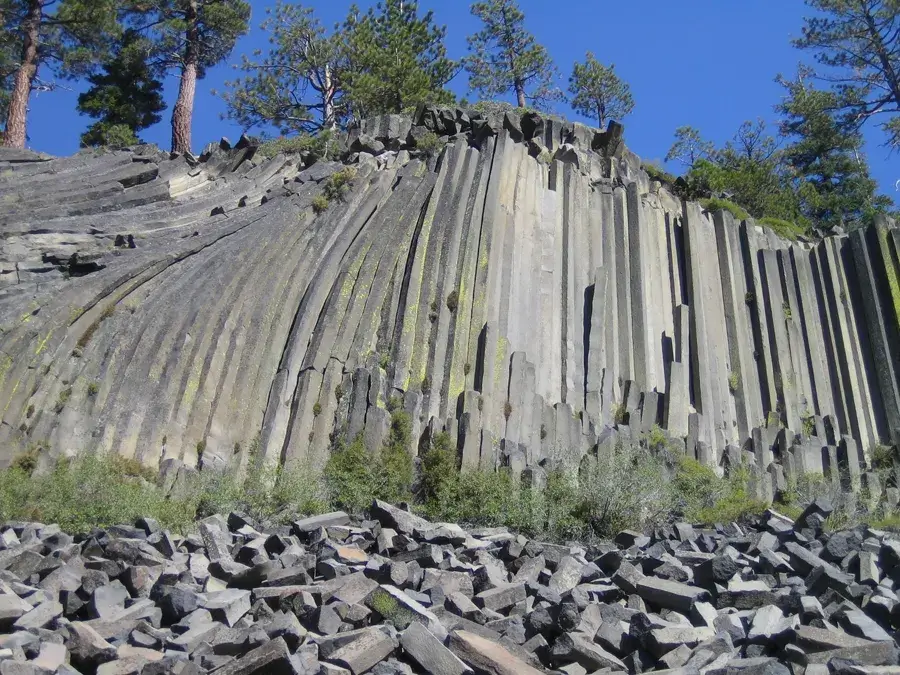
In the Sierra Nevada near Mammoth Mountain, a basalt flow less than 100,000 years old filled a glacial valley and cooled into an exceptionally clean set of columns. Devils Postpile is the textbook example precisely because its columns are so regular, the USGS credits a “uniform magma composition, small crystal size, and slow cooling history in a river canyon.” Later, a glacier overrode the formation and sheared off the tops of the columns, then polished them to a shine. The result is rare: you can climb a trail to the top and look straight down onto the hexagons in plan view, a glacier-buffed tile floor 18 metres above the talus of fallen columns at the base.
Devils Tower, Wyoming, the outlier
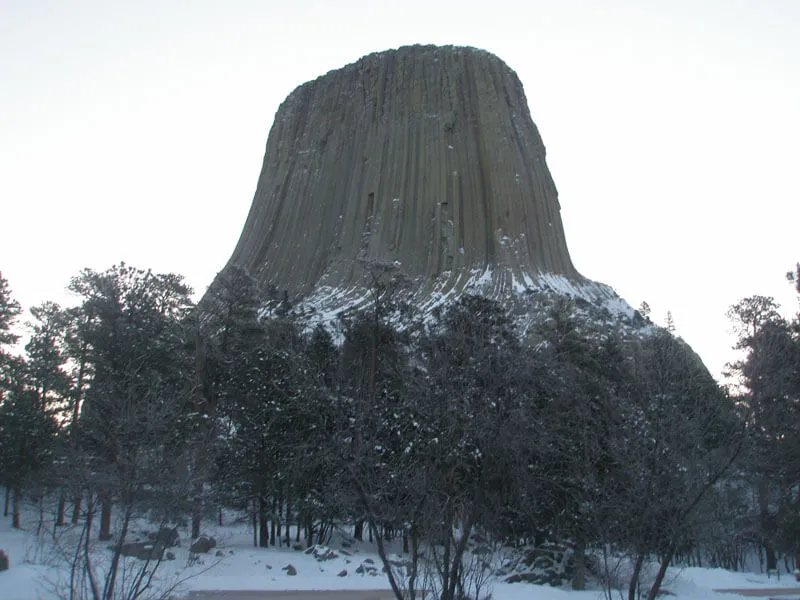
Devils Tower wears the same fluted columns, which is why it belongs in any conversation about columnar jointing, but it is the odd one out, in two ways. First, it is not basalt. The tower is built from phonolite porphyry, a pale-to-greenish igneous rock studded with feldspar crystals, intruded roughly 40 million years ago. The physics of its cracking is the same contraction story, but the rock is chemically distinct from the basalt of the Causeway and the Postpile.
Second, geologists still argue about how it got there. Everyone agrees it is igneous rock exposed by erosion as the softer sedimentary rocks around it wore away. What no one has settled is what the magma body was. Proposals over the past century have included a volcanic plug or neck, a laccolith, a stock, and, more recently, a lava body emplaced into a maar-diatreme volcano. The USGS states flatly that “geologists debate whether or not the magma reached the surface as a volcanic eruption.” Devils Tower is a reminder that a famous landform can be perfectly well described and still not be fully explained.
Columnar joints beyond Earth
Because the recipe is just “a thick body of cooling material that contracts,” the pattern is not unique to Earth, and not unique to rock. You can grow columnar joints in a kitchen. In 2009, Lucas Goehring, L. Mahadevan, and Stephen Morris published a study in PNAS showing that thick slurries of drying cornstarch crack into columns “geometrically similar to columnar joints in cooling lava found at geological sites such as the Giant’s Causeway.” Cornstarch dries; lava cools; the underlying mathematics of cracking under differential stress is shared, so the patterns match.
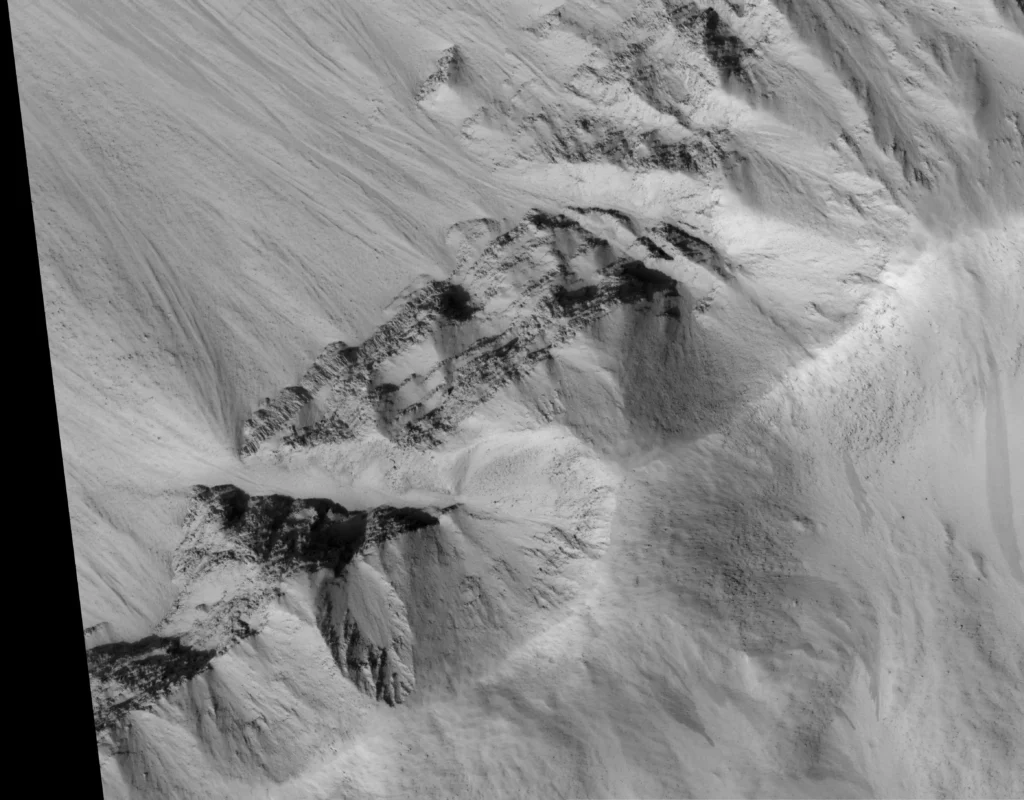
The same year, a team led by Moses Milazzo using NASA’s HiRISE camera reported columnar jointing on Mars. In the wall of a fresh 16-kilometre crater in a region called Marte Vallis, they found columns roughly 30 to 40 metres tall that “exhibit the features of terrestrial columnar basalts”, the first unambiguous detection of columnar jointing on another planet. Lava cooled on Mars the way it cools in Antrim, and it left the same signature. The honeycomb, it turns out, belongs to physics itself, and shows up wherever the conditions repeat.
Frequently asked questions
Why are basalt columns hexagonal?
As cooling rock contracts, it builds up tension and cracks. Stress pulling equally in all directions is relieved most efficiently by three cracks meeting at 120-degree angles, and a network of 120-degree junctions tiles the surface into six-sided polygons. The hexagonal arrangement releases the most strain energy, so it is the configuration the cracks naturally settle into.
Are all columnar basalt columns six-sided?
No. Hexagons are the most common shape but not the only one. Columns can have anywhere from three to seven sides. Even at Devils Postpile, one of the most regular formations on Earth, only about 55% of the columns are true hexagons; the rest are mostly five- and four-sided.
How long did the Giant’s Causeway take to form?
The lava erupted roughly 60 million years ago, during the Paleocene, as part of the volcanic activity that accompanied the opening of the North Atlantic. The columns themselves formed during the cooling of that lava sheet, a process of contraction and cracking that played out as the solid rock cooled through temperatures of around 840 to 890 °C.
Is Devils Tower made of basalt?
No. Despite its basalt-like columns, Devils Tower is made of phonolite porphyry, a chemically different igneous rock, intruded about 40 million years ago. Its precise origin is still debated, with geologists divided over whether it is a volcanic neck, a laccolith, or a body emplaced into a maar-diatreme volcano.
Where can I see columnar basalt?
Famous sites include the Giant’s Causeway in Northern Ireland, Devils Postpile in California, Fingal’s Cave on Staffa in Scotland, the Devils Tower flank in Wyoming (phonolite rather than basalt), and many basalt flows worldwide. Columnar jointing has even been imaged on Mars, in Marte Vallis.
The shape of cooling
The columns at the Giant’s Causeway are not a giant’s road, and they are not frozen mid-pour. They are a record of solid rock cooling through a narrow band of temperature, contracting, and finding the cheapest way to come apart. The same arithmetic of shrinkage runs through a drying mudflat, a tray of cornstarch, and a crater wall on Mars. Once you have seen the hexagons in one place, you start finding them everywhere, which is exactly what you would expect from a process governed by physics.