Did Earth Have Rings? The Ordovician Asteroid Halo Mystery
Pascal
May 26, 2026
In September 2024, a Monash University team proposed that Earth had a Saturn-like ring system during the Ordovician period, around 466 million years ago. Here is what the evidence does and doesn’t show.
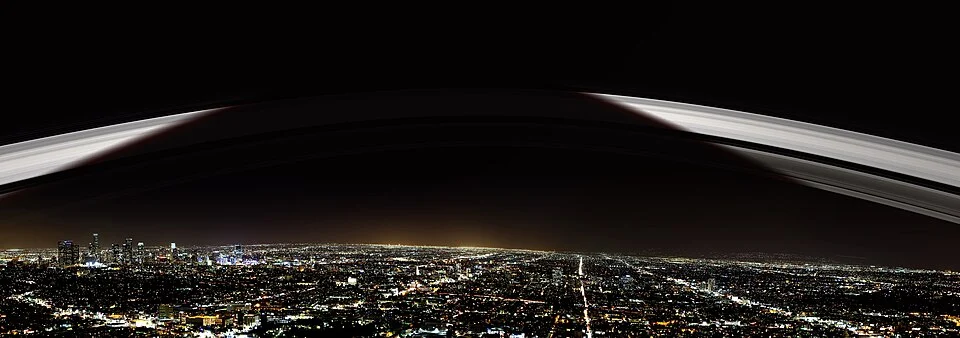
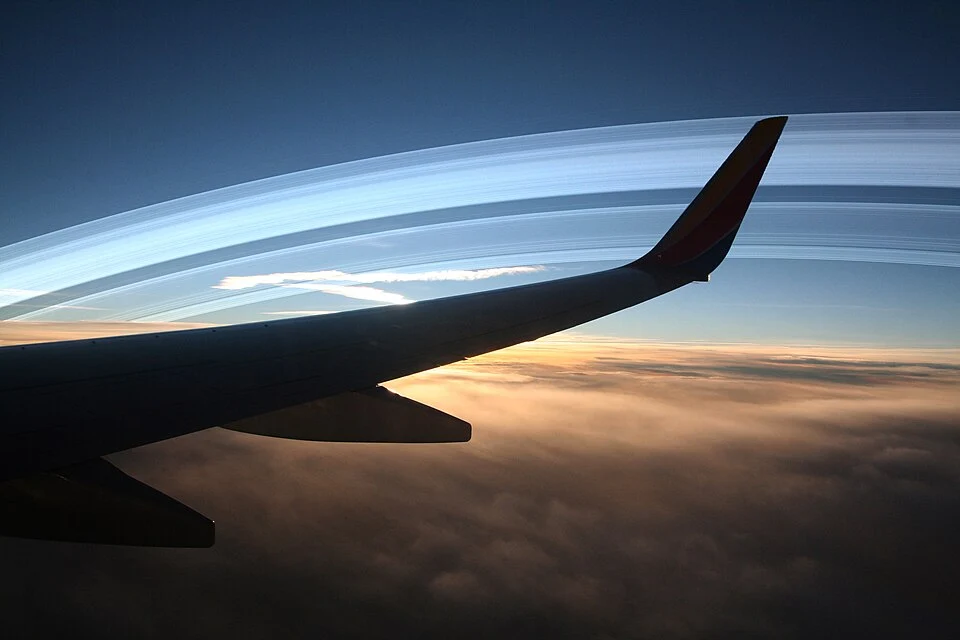
Artist Kevin M. Gill’s visualization of what an Earth ring system would have looked like, here imagined over Los Angeles. A 2024 study argues a similar structure actually existed in the Ordovician. Source: Kevin M. Gill via Wikimedia Commons, CC BY-SA 2.0.
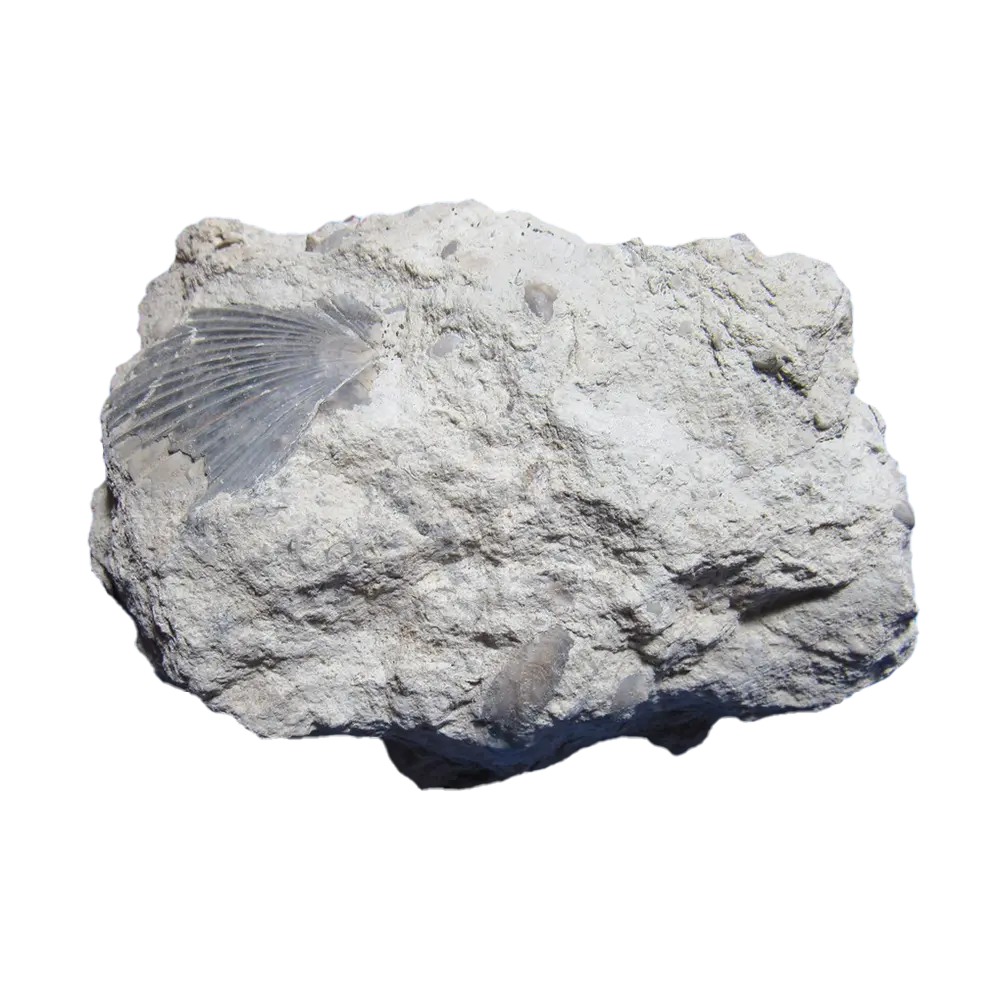
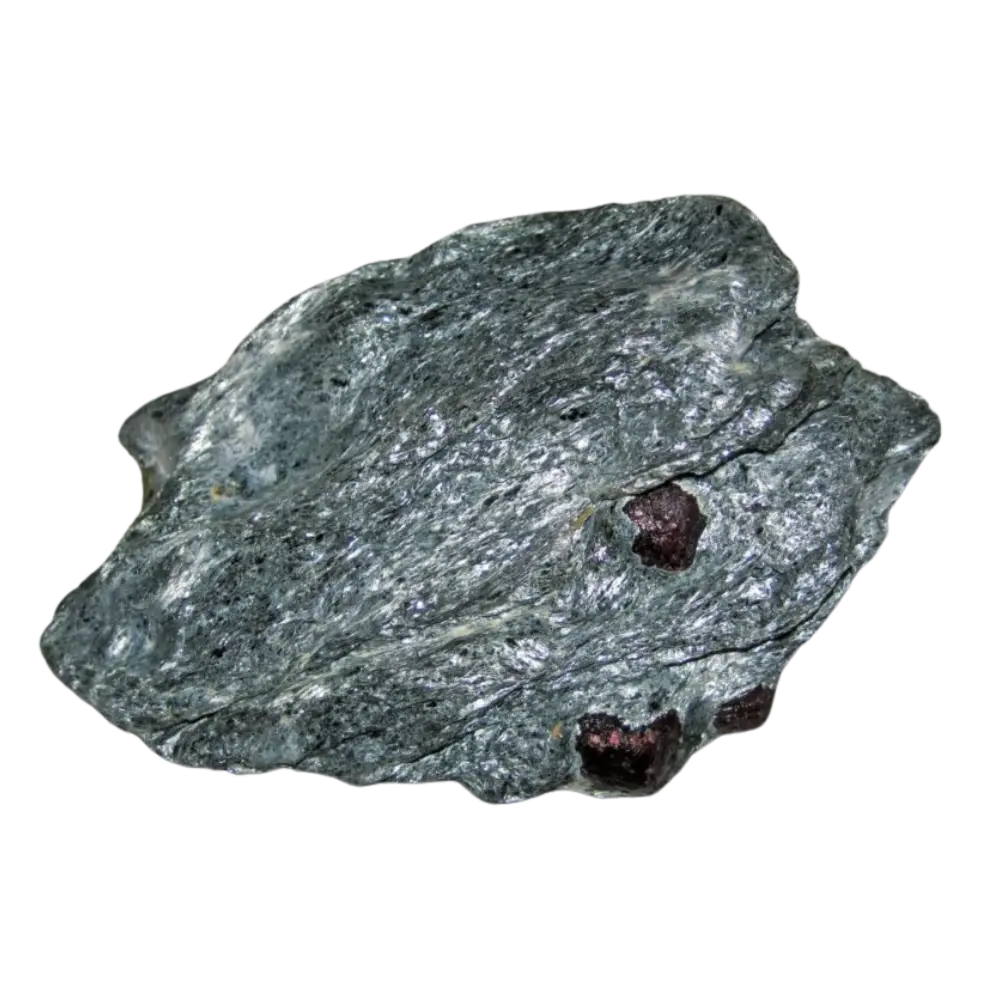
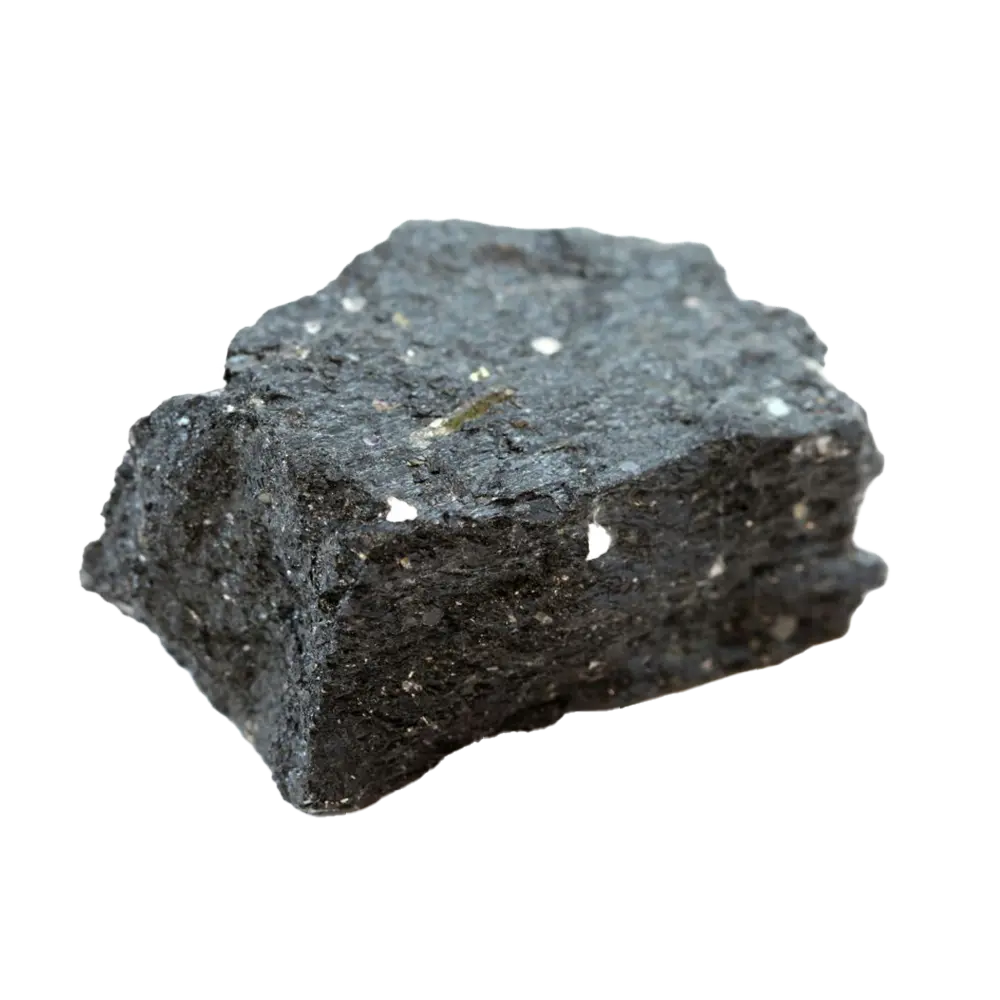
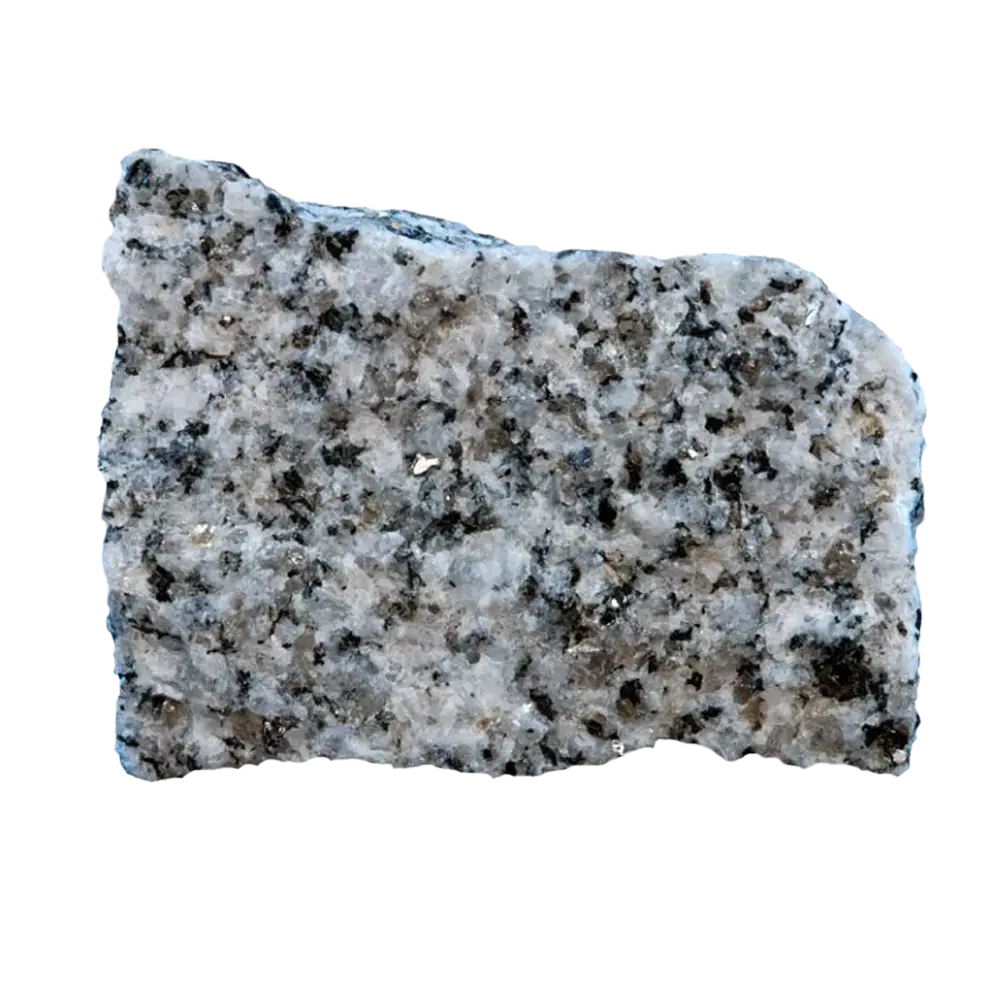
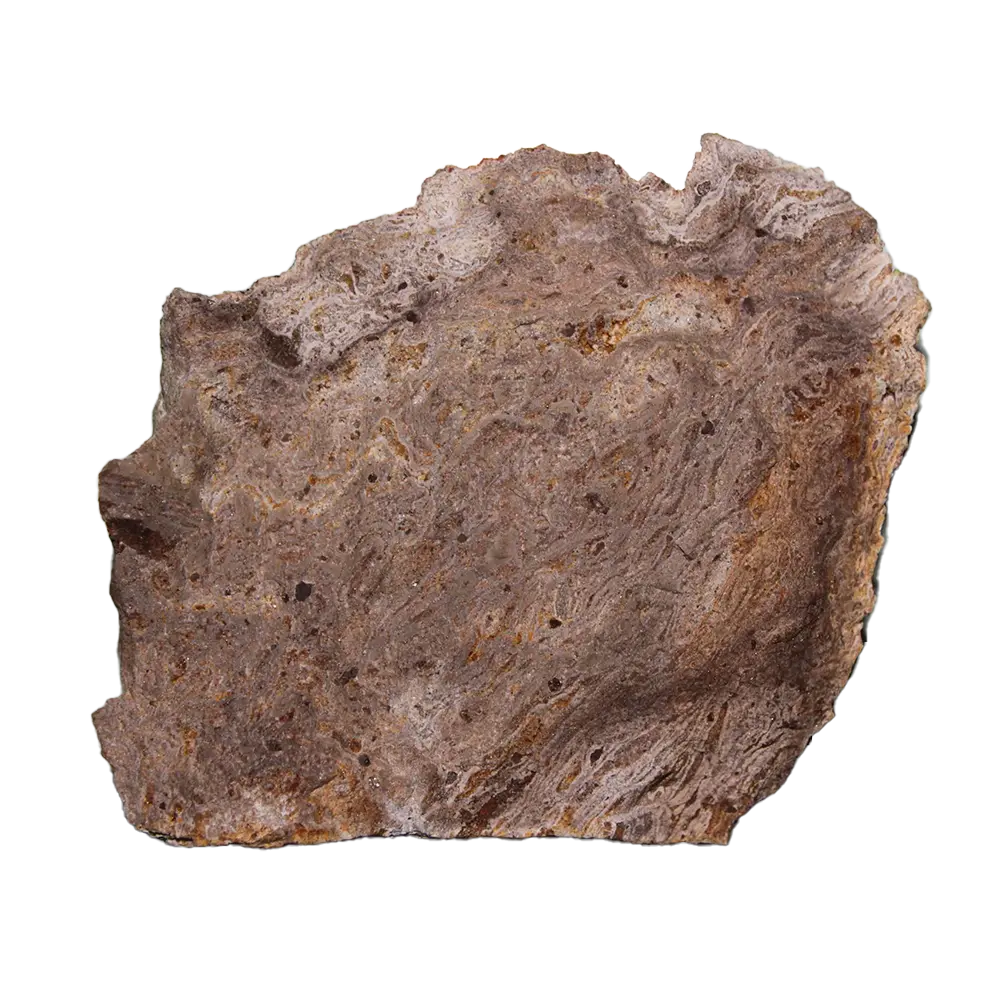
Stonecutters in the Thorsberg quarry, in the gently rolling farmland of southern Sweden, have worked the same slab of 470-million-year-old pink limestone for more than a century. They split the rock into floor tiles. Sometimes, embedded in the slab like a thumbprint pressed into clay, they find a meteorite: flattened, weathered, smaller than a fist. Over two decades, the quarrymen have pulled more than a hundred of them from the Komstad Limestone and handed them to Birger Schmitz, a geologist at Lund University who has spent his career on Ordovician fossil meteorites.
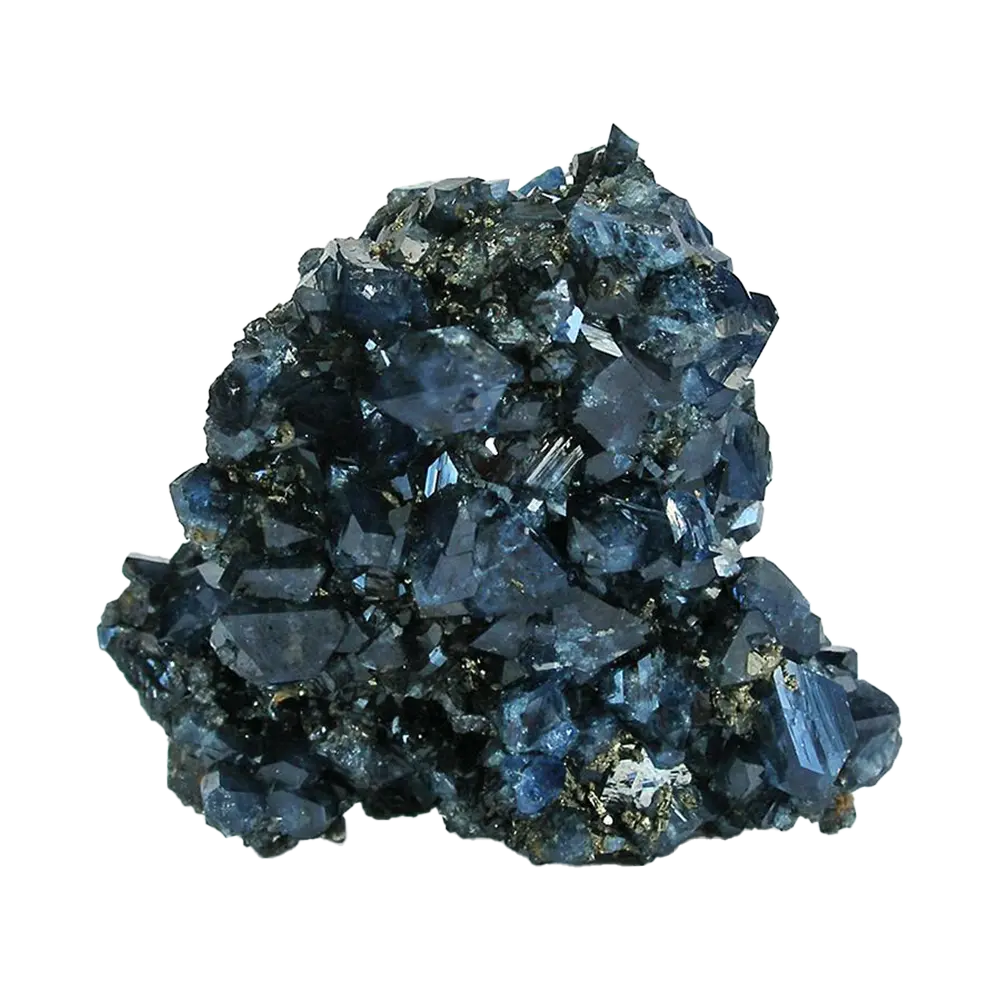
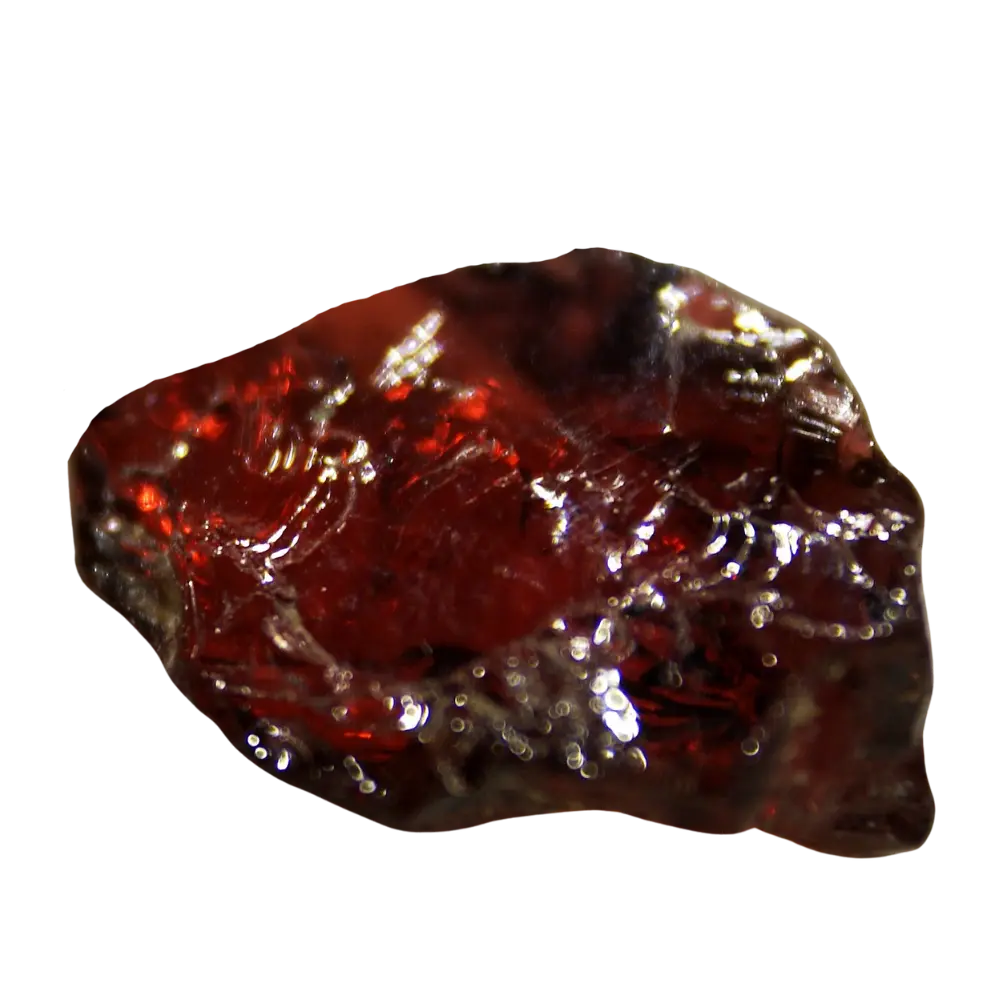
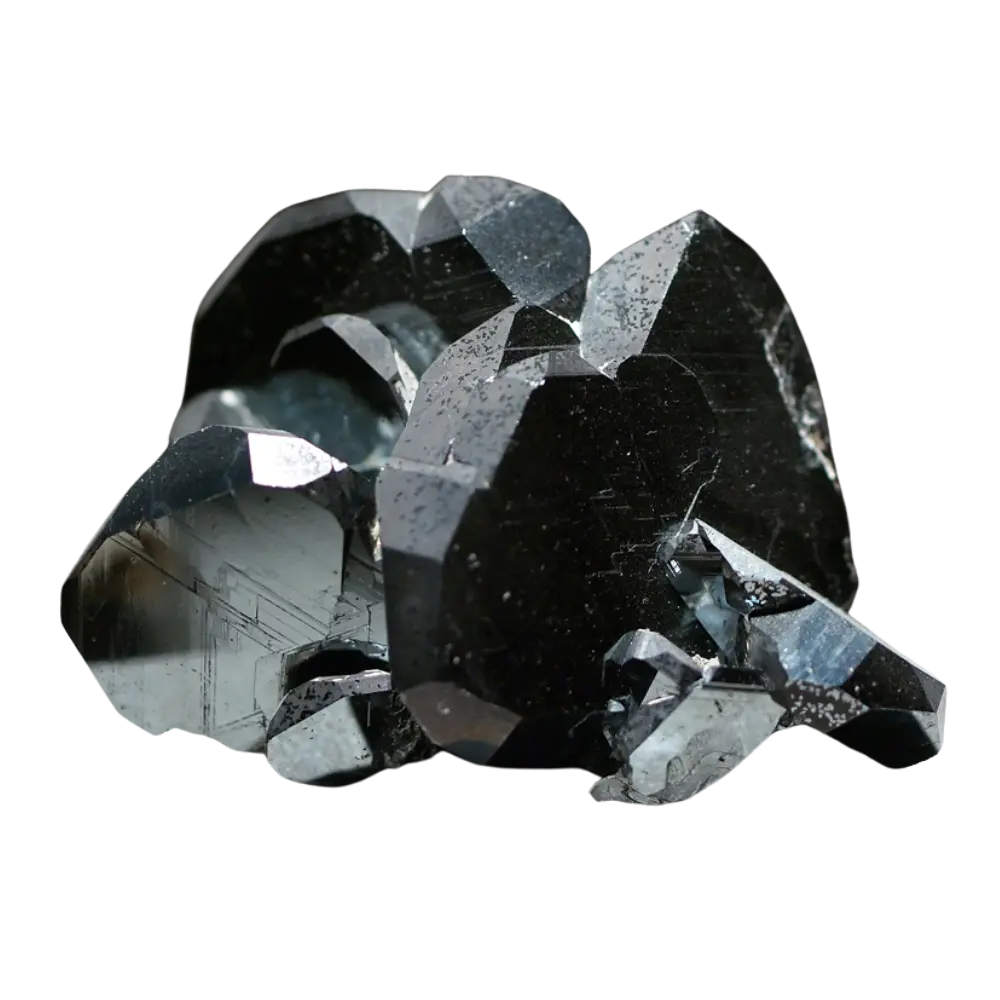
Schmitz dissolves the rocks in acid. What survives is chromite, iron-chromium oxide, almost indestructible, the dental enamel of the cosmos. Under the microscope each grain glints a dull gunmetal red. The chromite chemistry tells him, again and again, the same story: ordinary L chondrite. A common, dirty, iron-poor meteorite class that today accounts for roughly a third of falls. But in the limestone laid down in the middle Ordovician, L-chondrite chromite is two to three orders of magnitude more abundant than in any other rock on Earth.
For thirty years, Schmitz and his colleagues have argued that this is the chemical signature of a single catastrophe in the asteroid belt. Their 2019 paper in Science Advances describes it bluntly: “the breakup of the L-chondrite parent body (LCPB; diameter, ~150 km) in the asteroid belt, the largest documented breakup during the past 3 billion years.” Cosmic-ray exposure ages on the Swedish meteorites, measured atom by atom by Philipp Heck, Matthias Meier and colleagues, cluster around just a few hundred thousand years. That is wildly short for asteroid-belt debris. Fragments today typically spend tens of millions of years drifting in the inner solar system, soaking up cosmic rays, before they happen to fall. These rocks fell almost the moment they were liberated.
That anomaly has been sitting in the literature, quietly itching, for a generation.
In September 2024, a different geologist proposed a different culprit. Andrew Tomkins, a planetary scientist and petrologist at Monash University in Melbourne, had been turning over a question that wouldn’t sit still. Why, when he plotted Ordovician craters on a globe reconstructed for the period’s continental positions, did every single one of them sit on or near the equator?
Tomkins, with Erin Martin and Peter Cawood, all of Monash’s School of Earth, Atmosphere and Environment, published the answer in Earth and Planetary Science Letters, volume 646, article 118991, online 12 September 2024. The paper runs to fifteen pages, four figures, one supplementary table. It argues, with the careful syntax of people who know they are saying something extraordinary, that the L-chondrite parent body did not need to be ground into dust by a distant impact in the asteroid belt. It needed only to drift, once, too close to Earth.
And then Earth, briefly, wore rings.
The Anomaly: 21 Craters, One Equator
The case begins with a list.
Tomkins, Martin and Cawood compiled every confirmed terrestrial impact structure whose age overlaps the so-called Ordovician impact spike: the ~40-million-year stretch, roughly 466 to 425 million years ago, when craters and meteoritic chromite in marine limestones both jump by one to two orders of magnitude. The list is short and well-known to the small community of impact stratigraphers: 21 structures distributed across four ancient continents.
In what is now Sweden, the Lockne crater, 458 million years old, a marine impact preserved beneath the boreal forest of Jämtland, where stripped crystalline basement and a 50-meter brim of ejecta sit on the old peneplain, and its companion Målingen, forming the Lockne–Målingen doublet. Elsewhere across Sweden, Tvären in Södermanland, Hummeln in Småland, and Granby in Uppland. Across the Baltic in Estonia, Kärdla. In Ukraine, Ilyinets. Across the Atlantic, Canada offers seven: Brent in Ontario, Slate Islands in Lake Superior, Charlevoix, East Clearwater, Tunnunik, Pilot, La Moinerie. The American interior contributes Decorah in Iowa, Rock Elm in Wisconsin, Calvin in Michigan, Glasford in Illinois, and Ames in Oklahoma. And in the Australian outback, Lawn Hill.
That is the full inventory. Plate tectonics has shuffled these places over half a billion years; today they spray across the Northern Hemisphere from Stockholm to Saskatchewan, plus one outlier in Queensland. But the rock under each crater records where it was when the sky fell.
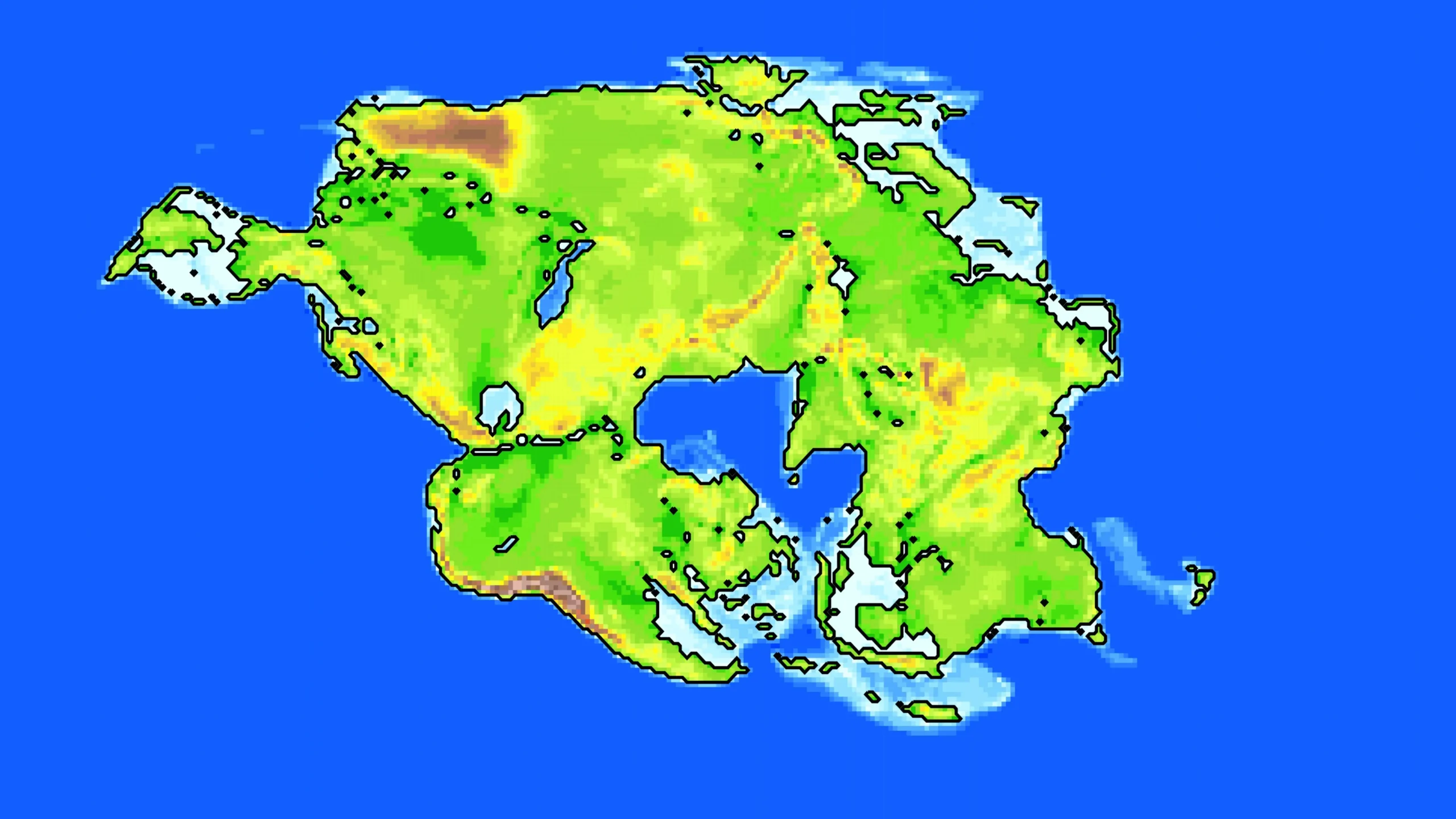
The Monash team ran every site through six independent plate-tectonic reconstructions, including the MER21 model, to recover paleolatitudes at the moment of impact. All 21 craters, in every model, land within 30 degrees of the Ordovician equator. Most cluster closer than 20 degrees.
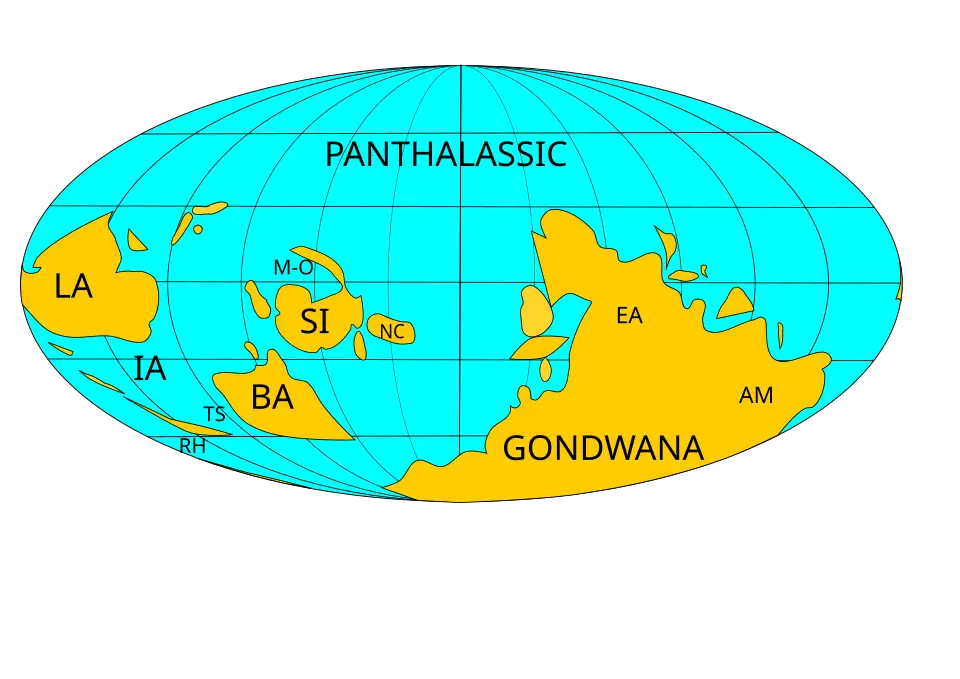
Paleogeographic map of Earth in the Middle Ordovician, ~470 million years ago. Gondwana straddled the South Pole while Laurentia, Baltica, and Avalonia clustered near the equator, the same band where all 21 Ordovician impact craters were later found. Source: Wikimedia Commons, CC0 / public domain
The obvious question is whether that pattern just reflects where the rock survived. Continental crust is not laid out symmetrically by latitude, and you cannot find a crater on seafloor that has long since been subducted. Tomkins and Martin built a Geographic Information System inventory of every stable craton older than mid-Ordovician age, the Yilgarn, the West African, the Slave, Baltica, parts of the Siberian platform, excluding ground later buried by sediment, scraped by ice, eroded, or wrung by tectonism. What was left, they reasoned, was the surface area where a crater could still be read.
Roughly 70 percent of that surface lay outside the equatorial belt. About 30 percent lay within 30 degrees of the equator. If asteroid impacts during the Ordovician were drawn at random from any direction in space, the way they are today, the way they appear on the Moon, on Mercury, on Mars, then craters should plot wherever the preservable crust happens to be. They should be more than twice as common at higher latitudes as near the equator.
None of them are.
The Monash team ran a binomial test. The probability of drawing 21 successive craters that all land within the 30-percent-equatorial band comes out at roughly 4 × 10⁻⁸. In their abstract for the 2025 Meteoritical Society meeting, the authors re-state the result in plain language: “Our binomial probability calculation indicates that it is highly unlikely that the observed crater distribution was produced by bolides on orbits directly from the asteroid belt (conservatively, the probability is 1 in 25 million).”
Tomkins, talking to CNN’s Taylor Nicioli in November 2024, put it more bluntly. “It’s statistically unusual that you would get 21 craters all relatively close to the equator. It shouldn’t happen. They should be randomly distributed.” He likes the analogy of a three-sided coin: imagine such a thing exists; the chance of flipping tails 21 times in a row is the chance of this crater distribution arising at random.
Tomkins, writing for himself in The Conversation on 16 September 2024, was careful but direct:
“Under normal circumstances, asteroids hitting Earth can hit at any latitude, at random, as we see in craters on the Moon, Mars and Mercury. So it’s extremely unlikely that all 21 craters from this period would form close to the equator if they were unrelated to one another.”
There is one further loose end. In a 2022 paper in Earth and Planetary Science Letters, Anthony Lagain and colleagues compared the impact crater records of Earth, the Moon and Mars across the past 600 million years. They found the Ordovician spike on Earth alone. As they wrote: “The absence of such signal in the lunar and martian cratering record raises questions about the qualitative increase observed on the Earth.” Lagain’s own reading was that the Earth-only anomaly is a preservation bias — equatorial Ordovician craters happen to survive better than polar ones, distorting the record. Tomkins inverts the interpretation: not preservation bias, but a real ring. Whatever produced the Ordovician spike, it did not pepper the inner solar system. It only pestered our planet.
This is the empirical hook from which the entire ring hypothesis dangles. Everything else in the paper is an attempt to explain that probability.
The L-Chondrite Spike and a Quiet Mystery in Swedish Limestone
The crater list is one of two anomalies the Monash paper hangs on. The other is the chromite.
In the late 1980s, Schmitz and his Lund colleagues began noticing fossil meteorites in the Komstad Limestone at Kinnekulle and at Thorsberg. They went looking systematically, dissolving kilogram after kilogram of the same pink stone in hydrochloric and hydrofluoric acid. The carbonate fell away. What remained, sieved out through the residue, were chromite grains. Each one was a sand-sized survivor of the projectile that had vaporized on impact in a marine basin a third of the way around the Iapetus Ocean.
The chemistry was distinctive. Chromite from L chondrites has a characteristic ratio of titanium, vanadium, magnesium and zinc, distinct from chromite produced in Earth’s mantle or in other meteorite classes. By 2003, Schmitz could show that the Swedish limestone deposited around 466 to 467 million years ago contained 100 to 1,000 times more L-chondritic chromite per kilogram than younger marine carbonates. The flux of extraterrestrial dust to Earth had spiked, sustained, and then very slowly tapered.
In 2017, Anders Lindskog and colleagues at Lund tightened the timeline. High-precision uranium-lead dating of zircons in an ash bed within the meteorite-bearing interval yielded 467.50 ± 0.28 Ma; combined with cosmic-ray exposure ages on the meteorites themselves, they dated the break-up of the L-chondrite parent body to 468.0 ± 0.3 million years ago. A 2020 reanalysis by Shiyong Liao and colleagues, using new helium-3 profiles and additional zircon dating, revised the breakup downward to 465.76 ± 0.30 Ma. The Tomkins paper adopts the Liao figure. The two- to three-million-year gap between the Lindskog and Liao chronologies is a live debate in mid-Ordovician geochronology, not a settled timeline.
Middle Ordovician paleogeographic map showing Gondwana, Laurentia, Baltica and the equatorial belt where impact craters cluster
Within the established picture, the source was a collision in the asteroid belt, a ~150-kilometer parent body broken open by another asteroid, scattering fragments on chaotic orbits that gradually leaked into the inner solar system. This is the model that Schmitz and his collaborators (including Heck, Meier, Alwmark, Bottke and others) have refined for two decades. The fossil meteorites’ very short cosmic-ray exposure ages, only a few hundred thousand to about a million years, were taken to mean Earth caught the early shower, before fragments had time to wander.
Tomkins respects all of that. He argues only that the location of the collision is wrong.
If a body broke up in the main belt, its fragments would arrive at Earth on heliocentric orbits inclined to the ecliptic in roughly the same range as the parent. Some would come in steeply, some shallowly, but as they enter Earth’s gravitational well their inclinations randomize. Asteroid-belt debris hits the Earth, the Moon and Mars with no latitudinal preference. The lunar crater record bears this out, as does the Martian one. The Lagain et al. 2022 result, no Ordovician spike on the Moon or Mars, is, for Tomkins, the corroborating clue. Whatever produced the Earth craters was confined to Earth’s neighborhood.
And then there is Lockne. In 2007, Carl Alwmark and Schmitz reported, in Earth and Planetary Science Letters, more than 75 extraterrestrial chromite grains per kilogram of resurge breccia from the central Swedish crater. The chromite composition pinned the impactor unambiguously to the L-chondrite family. Subsequent work, oxygen isotopes in the chromite, single-grain noble-gas analyses, confirmed it. Lockne is the only Ordovician crater on Earth whose impactor has been chemically identified. It is an L chondrite.
If Lockne’s projectile is an L chondrite, and the impact spike’s chromite signature is L chondrite, and all 21 craters cluster on the equator, then the simplest story is one source body, one event, one debris reservoir. The Monash team’s claim is that the reservoir was in orbit around Earth.
The Roche Limit and the Recipe for a Ring
A planet’s rings are not exotic. They are the default outcome whenever a self-gravitating object, a moon, a comet, a rubble-pile asteroid, strays inside an invisible boundary called the Roche limit, after the nineteenth-century French astronomer Édouard Roche, who first calculated it. Inside that boundary, the tidal stretch from the planet exceeds the body’s own self-gravity. The body comes apart along its long axis. The pieces, still moving on roughly the same orbit, spread into a flattened equatorial disk.
For a strengthless, rubble-pile asteroid encountering Earth, the outer Roche limit sits at roughly 15,800 kilometers above the surface: well inside the 35,786-kilometer altitude of geostationary orbit. A body wandering through that region with the wrong trajectory has no second chance.
We have watched this happen.
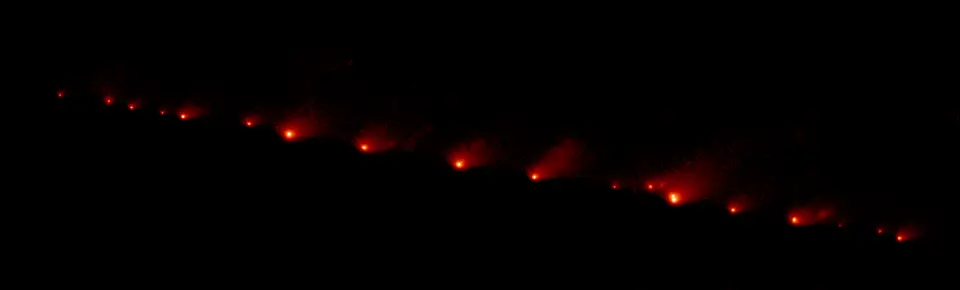
On 7 July 1992, Comet Shoemaker–Levy 9 passed just over 40,000 kilometers above Jupiter’s cloud tops, a smaller distance than the planet’s 70,000-kilometer radius, and was pulled into at least 21 pieces. The fragmented comet was discovered the following March by Carolyn and Eugene Shoemaker and David Levy at Palomar; from May 1993, orbital calculations forecast that the chain of nuclei would strike Jupiter in July 1994. They did, between 16 and 22 July, slamming into the southern hemisphere at roughly 60 kilometers per second and leaving dark scars in the cloud deck larger than the Great Red Spot. The Hubble Space Telescope and every Earth-based instrument that could see Jupiter watched it happen in real time.
Hubble Space Telescope image of Comet Shoemaker–Levy 9, taken 17 May 1994. The comet was torn into 21 fragments after passing inside Jupiter’s Roche limit in July 1992; the fragments impacted Jupiter between 16 and 22 July 1994. Source: NASA / ESA / Hubble (STScI-PR94-26c), public domain via Wikimedia Commons.
What Shoemaker–Levy 9 demonstrated was that a body of modest internal cohesion does not need to be a moon to come apart on close approach. A rubble pile, gravel under thin tensile bonds, fragments readily. Most asteroids larger than a few hundred meters are now thought to be rubble piles. They are the easy meal for a planet’s tides.
For Tomkins, the picture is straightforward in outline. A parent body, perhaps already battered by an earlier collision in the belt, drifted onto an Earth-crossing orbit. Its inclination, for whatever reason, a previous resonance with Jupiter, a chance encounter, was low. On one pass, perhaps 466 million years ago, it grazed inside Earth’s Roche limit. The team’s calculation, based on the size of debris reservoirs needed to sustain the impact spike, suggests an original diameter of 10.5 to 12.5 kilometers: large enough to feed the system for tens of millions of years, small enough to be plausibly disrupted in a single encounter.
What followed, in Tomkins’s own words in The Conversation:
“When a small body (like an asteroid) passes close to a large body (like a planet), it gets stretched by gravity. If it gets close enough (inside a distance called the Roche limit), the small body will break apart into lots of tiny pieces and a small number of bigger pieces. All those fragments will be jostled around and gradually evolved into a debris ring orbiting the equator of the larger body. Over time, the material in the ring will fall down to the larger body, where the larger pieces will form impact craters. These craters will be located close to the equator.”
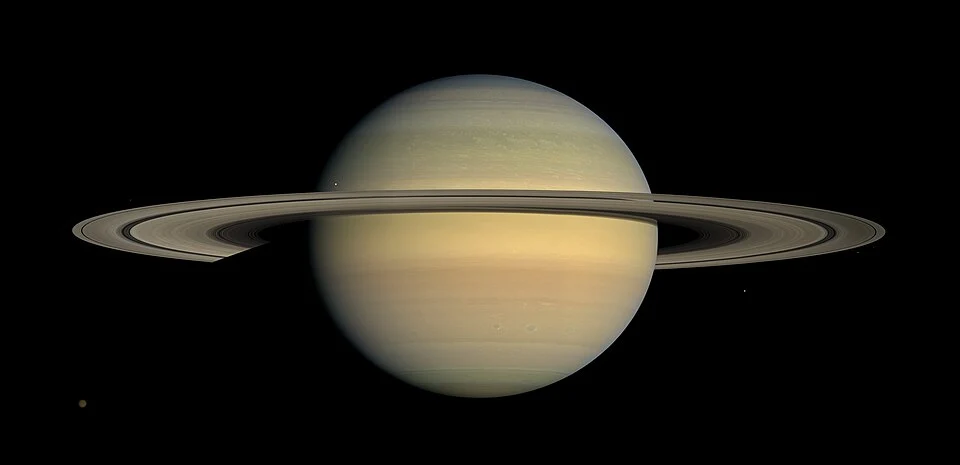
Saturn during its 2009 equinox, photographed by the Cassini orbiter. Like all known planetary rings, Saturn’s orbit lies in the equatorial plane, the same geometry that would have channeled debris from a tidally disrupted Ordovician asteroid into a band straddling Earth’s equator. Source: NASA / JPL-Caltech / Space Science Institute, public domain via Wikimedia Commons.
The equatorial geometry follows from a piece of physics every gas giant in the solar system also obeys. Earth bulges at its equator because it rotates. The bulge creates a gradient in the gravitational field that, over a few orbits, pulls any inclined ring toward the equatorial plane. Saturn’s rings, Jupiter’s rings, the rings of Uranus and Neptune all share this geometry. A debris disk born from a tidally disrupted asteroid would have circularized into the equatorial plane within thousands of years.
From there, the slow attrition. Particles in a debris ring exchange momentum continuously through small collisions and through resonances with the Sun and the Moon. Some are flung outward and escape. Most lose energy and drift inward. As they cross the upper atmosphere, they ablate or burn. The largest fragments survive entry and crater the surface, preferentially on whatever continental crust happens to be lying under the equator at the time. The Monash team estimates the ring persisted for between 20 and 40 million years before the last of it had fallen.
This is the timescale that matches both the duration of the Ordovician impact spike and the slow tail-off of L-chondrite chromite in marine limestones. In Tomkins’s framing, the spike is not a flux from the asteroid belt but a rain from above, material that had been parked, briefly on geological timescales, in low Earth orbit.
The Mars analogue gives the hypothesis another foothold. According to NASA, the inner Martian moon Phobos is spiraling inward at about 1.8 centimeters per year, roughly six feet per century. Most models put its breakup at the fluid Roche limit somewhere between 30 and 50 million years from now. The 2017 work by Andrew Hesselbrock and David Minton at Purdue argued that Mars may already have cycled through three to seven moon–ring–moon iterations over its history; each generation smaller than the last; debris from those cycles, raining onto the Martian equator, would explain enigmatic equatorial sedimentary deposits that have puzzled orbiter geologists.
Vincent Eke, an associate professor at Durham University’s Institute for Computational Cosmology, was not involved with the Monash study, but he told CNN that the paper “presents a pleasing idea that ties together a few mysteries.” On the Mars parallel, he added: “in the next 100 million years or so, Mars should acquire a ring system when its inner moon, Phobos, spirals inside the rigid Roche radius and is itself torn apart.”
If Mars can do it, the argument goes, so could Earth.
What a Ringed Earth Would Have Looked Like
Imagine standing on the shore of the shallow tropical sea that, 460 million years ago, washed over what is now Iowa. Around you, in waist-deep water, brachiopods and crinoids strain the current. Stromatoporoid reefs build the limestone that will one day be quarried for cement. There are no land plants of any consequence, a thin felt of mosses and liverworts, perhaps, at the river mouths. The sky is empty of birds and insects. The largest predators on Earth are eurypterids, sea scorpions, and the cephalopods cruising the open water.
And overhead, depending on the time of day, an arch.
The Monash paper does not estimate the ring’s brightness with precision; there are too many free parameters: particle size, albedo, ring thickness, optical depth. But Tomkins, asked by CNN’s Taylor Nicioli how the structure would have looked from the surface, gave a journalist’s answer rather than a modeler’s:
“If you were on the night side of the Earth looking up, and the sunlight is shining on the rings, but not on you, that would make it probably quite interestingly visible, it would be quite spectacular.”
At low equatorial latitudes the ring would have stretched from horizon to horizon as a luminous arc, brightest when sunlit and observed from Earth’s night side, geometry analogous to viewing Saturn’s rings from a hypothetical observer on the planet. Closer to the equator, observers would have looked up the long axis of the ring and seen a relatively narrow band passing overhead. Move toward the tropics and the band would have spread and tilted. At Earth’s poles the ring would have been below the horizon entirely.
Aerial visualization by Kevin M. Gill of Earth’s hypothetical ring system. From low equatorial latitudes 466 million years ago, Tomkins suggests, the ring would have arched from horizon to horizon, brightest when sunlit and observed from Earth’s night side. Source: Kevin M. Gill via Wikimedia Commons, CC BY-SA 2.0.
The Moon, in those days, was somewhat closer than it is now and somewhat brighter. The ring, at maximum opacity, may have rivaled the full Moon’s surface brightness in narrow regions; elsewhere it may have been a faint, structured wash. Saturn’s rings, viewed from telescopes on Earth, span roughly nine arcminutes in apparent angular extent, about a third of the Moon’s diameter. Earth’s hypothetical Ordovician ring, viewed from inside it, would have spanned tens of degrees of sky.
It is worth being honest. No organism that could have looked up understood what it was looking at. There were no eyes capable of resolving the ring’s structure. Trilobites had compound eyes with hundreds of facets, but their visual acuity at any distance beyond a few centimeters was poor. Cephalopod eyes were better, but cephalopods were mostly creatures of the murky photic zone. Whatever spectacle hung over Ordovician Earth, it played to an unfilled house.
Whether it filled the sky for ten million years or forty is one of several questions the paper leaves open. Tomkins’s group is now working with astrophysical modelers to bracket the ring’s optical depth and lifetime. The next step, he told Eos, is to find out how opaque the ring needed to be to do the climate work he believes it did.
The Hirnantian Cooling Connection
Here is where the paper moves from a tight geological argument into more speculative ground. Tomkins says so himself. The crater-cluster anomaly and the ring hypothesis are tightly bound. The link to climate is suggestive, and explicit only as a hypothesis worth pursuing.
The Late Ordovician was cold. Not all of it, most of the Ordovician had atmospheric carbon dioxide levels 8 to 20 times preindustrial, and tropical sea surface temperatures of 32 to 37 degrees Celsius, sweltering by modern standards. Ice-sheet growth on Gondwana, the southern supercontinent then sitting astride the South Pole, may have begun as early as the Darriwilian, around 460 million years ago, according to the Earth-system modeling work of Alexandre Pohl, Yannick Donnadieu and colleagues (2016, Paleoceanography). But Earth’s plunge into deep glaciation came late. The Hirnantian Age, last of the Ordovician, dated by the International Commission on Stratigraphy as 445.2 ± 1.4 Ma to 443.8 ± 1.5 Ma, was the cold snap that ended everything.
Pohl and colleagues’ coupled climate–ice-sheet simulations show a single, continental-scale ice sheet extending across Gondwana by the Hirnantian glacial maximum, building on a glacial onset they place as early as the mid-Darriwilian. Seth Finnegan and co-authors, using clumped-isotope paleothermometry on Hirnantian carbonates (Science, 2011), found tropical ocean temperatures briefly cooled by about 5 °C and inferred ice volumes that “likely equaled or exceeded those of the last (Pleistocene) glacial maximum.” Sea level fell by an estimated 80 to 100 meters as continental ice locked up water. North Africa was buried under glaciers; the tillites are still visible in Mauritania and Libya.
And then life crashed.
The Late Ordovician Mass Extinction, conventionally abbreviated LOME, is the second-largest of the Phanerozoic “Big Five.” It eliminated 49 to 60 percent of marine genera and nearly 85 percent of marine species. The extinction has two pulses, LOMEI-1 and LOMEI-2, the first coinciding with the onset of Hirnantian glaciation, the second with its termination. The drivers, cooling, marine anoxia, perhaps a sequence of pulsed redox changes, are still argued over. Recent work using thallium isotopes by Nevin Kozik, Seth Young, Jeremy Owens and colleagues (Science Advances, 2022, DOI 10.1126/sciadv.abn8345) shows rapid swings in marine oxygen levels coincident with the species crashes. Cooling and anoxia probably acted in concert.
Why did the climate flip? That is the question the Monash paper tiptoes toward. Atmospheric CO₂ was high. Volcanic activity, despite earlier claims, appears to have been relatively low in the Hirnantian. Most explanations require a CO₂ drawdown driven by silicate weathering as Gondwana drifted into wetter zones, or by enhanced organic carbon burial. They work, more or less, but they require the climate to cool first; positive feedbacks then run the cooling away.
A ring, the Monash team suggests, could have been the kick.
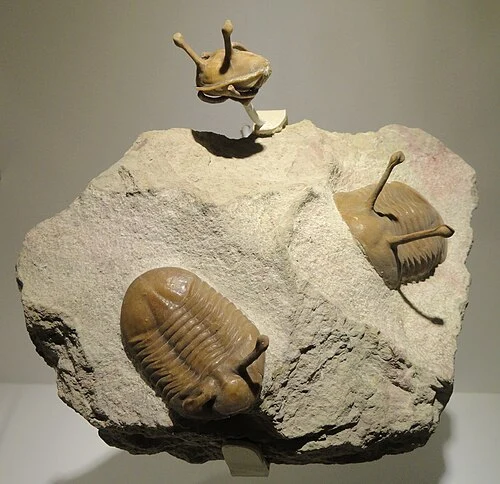
Asaphus kowalewskii, trilobite from the Middle Ordovician of the St. Petersburg region, Russia, displayed at the Houston Museum of Natural Science. The Late Ordovician Mass Extinction (~445 Ma) eliminated nearly 85 percent of marine species, including most trilobite families. Source: Daderot via Wikimedia Commons, CC BY-SA 4.0.
The mechanism is straightforward in concept. A ring orbiting Earth’s equator casts a shadow. Earth’s axial tilt of about 23.5 degrees (the Ordovician obliquity itself is uncertain to a few degrees) means the shadow tracks across the surface seasonally. In the hemisphere experiencing winter, the ring’s shadow falls deeper into the subtropics; in summer, it retreats. The net annual effect, integrated over a fully opaque ring, would be a meaningful drop in incoming solar radiation across mid-latitudes, exactly the latitudes where Gondwanan ice sheets were growing.
Tomkins, in The Conversation, was careful to flag this as the speculative step:
“The ring would have been around the equator. And since Earth’s axis is tilted relative to its orbit around the Sun, the ring would have shaded parts of Earth’s surface. This shading in turn might have caused global cooling, as less sunlight reached the planet’s surface.”
And:
“Around 465 million years ago, our planet began cooling dramatically. By 445 million years ago it was in the Hirnantian Ice Age, the coldest period in the past half a billion years. Was a ring shading Earth responsible for this extreme cooling? The next step in our scientific sleuthing is to make mathematical models of how asteroids break up and disperse, and how the resulting ring evolves over time. This will set the scene for climate modelling that explores how much cooling could be imposed by such a ring.”
That climate modeling has not yet been done. No one has run a general circulation model with an opaque equatorial ring at Ordovician boundary conditions. Until somebody does, the Hirnantian link remains a hypothesis nested inside another hypothesis. The ring would also have reflected sunlight onto the summer hemisphere, partly compensating for the shading; whether the net effect cools or warms, and by how much, will depend on optical depth and on details of cloud feedback that are unsettled even for modern Earth.
Still, the chronology is suggestive. The L-chondrite spike begins around 466 million years ago. Tropical cooling becomes detectable in the proxy record around the same time, and accelerates. By the Hirnantian, the ring would have been twenty million years old and falling apart, its last big fragments cratering equatorial Laurentia and dust-loading the upper atmosphere. The ring system, on the Monash interpretation, would be at its most climatically active right as the planet enters its deepest freeze.
The Skeptics
Birger Schmitz, whose three decades of work on Swedish fossil meteorites supply much of the Monash paper’s empirical scaffolding, is not convinced. He told New Scientist’s James Woodford that the study is “a new and creative idea that explains some observations.” Then the qualifier: “But the data are not yet sufficient to say that the Earth indeed had rings.”
Schmitz has identified the test. If all 21 craters were produced by debris from a single ring, then their projectiles should share a common chemistry: the L-chondrite signature established at Lockne, plus comparable trace-element and isotopic fingerprints. So far, only Lockne’s impactor has been pinned down. The other twenty are uncharacterized. Resurge breccias from Tvären, Hummeln, Granby, Kärdla and Ilyinets have been studied piecemeal but not yet subjected to the systematic chromite-and-isotope analysis that Schmitz’s group developed for Lockne. If a survey reveals that some of the other twenty craters were made by non-L-chondritic impactors, an iron meteorite, an H chondrite, a CM carbonaceous body, the single-ring story is in trouble. The crater cluster might then reflect something other than a unified deorbiting reservoir.
A second falsification test is paleomagnetic. The paleolatitudes used in the Monash paper derive from plate-tectonic reconstructions that themselves rest on paleomagnetic data, the inclination of remanent magnetism in old rocks tells you the latitude at which they formed. Six different models give consistent results, but the formal uncertainties on individual paleolatitudes are still several degrees. New paleomagnetic data on rocks directly associated with the crater sites, Lawn Hill’s host carbonates, the Lockne resurge, could tighten the picture and, conceivably, push one or more craters outside the equatorial belt. That would not kill the hypothesis (twenty out of twenty-one is still anomalous) but would weaken its statistical force.
Elizabeth Catlos, a geologist at the University of Texas at Austin, raised a more conceptual concern to Eos. She noted that the data “might be equally compatible with a single, large, fragmented asteroid with several pieces that happened to fall to Earth at different times over a segment of Ordovician time.” In other words: the same parent body, but no orbital reservoir. The fragments simply hung around the inner solar system on chaotic orbits and rained in piecemeal. That would not, on its face, explain the equatorial clustering, orbits randomize as they enter Earth’s gravitational well, but it makes the point that the ring is not the only architecture that could produce a temporally extended impact pattern from a single parent.
There is also the question of sampling bias. The 21 craters are the ones we have found. Earth’s continents have been ridden hard by tectonics, ice and erosion. The Australian craton, the Canadian Shield, Baltica and parts of Laurentia preserve old surfaces well; much of southern Gondwana does not. If preservation systematically favors equatorial paleolatitudes for reasons we have not fully accounted for, a subtle interaction between depositional environment and tropical climate, perhaps, then the apparent clustering may be partly an artifact. The Monash team’s GIS analysis tries to control for this, excluding ground later buried, eroded or deformed, but the exclusion criteria are themselves choices.
Aaron Cavosie, an impact-cratering specialist at Curtin University in Perth, was more enthusiastic when he spoke to New Scientist. “It’s a brilliant merging of the sedimentary record of meteorite debris, the Ordovician impact cratering record, palaeogeography and solar system dynamics,” he said. Cavosie noted that the disc scenario could simultaneously account for the 40-million-year duration of the impact spike, the sedimentary chromite, and the equatorial crater distribution: a triple-feature explanation rather than three independent coincidences.
That, in the end, is the argument’s deepest appeal: a single causal stem that grows three branches. Single-event hypotheses are seductive precisely because they are economical. They are also more likely to be wrong, because nature is rarely so neat. Schmitz’s caution is the right one. The hypothesis is a good explanation, not yet a demonstrated fact.
What Would Settle It
What turns this story from a striking hypothesis into something one might call established? Three things, roughly in order.
First, a systematic geochemical survey of the impact projectiles at the other 20 craters. The technology exists. Alwmark, Schmitz, Heck and their colleagues have shown for two decades how to extract chromite from resurge deposits, measure trace elements, run oxygen-isotope analyses on individual grains, and pull noble gases from chromite via stepped heating. The work is patient and slow. But the cores and samples exist; the protocols are standardized. If, within a decade, twelve or fifteen of the other Ordovician craters yield L-chondrite chromite, and none of them yield clearly different impactors, the ring hypothesis hardens. If even three or four show a different chemistry, it weakens sharply.
Second, a paleoclimate model. A general circulation model, CESM, IPSL, HadCM3, any of the standard tools, run at Ordovician boundary conditions, with an opaque equatorial ring imposed as a top-of-atmosphere shading layer, would tell us whether shading of the magnitude Tomkins envisions can plausibly drive a cooling of the magnitude Pohl, Finnegan and others have inferred. The simulation has to include ring opacity, scattering, hemispheric asymmetry from axial tilt, and feedbacks through sea ice and ocean circulation. It is a substantial project. It has not yet been done.
Third, more craters. The known list of 21 is not closed. Every few years a new Ordovician impact structure surfaces, Decorah was confirmed only in 2013, Lawn Hill’s Ordovician age only in 2016. Old, buried or marine impact structures with the right age could be added, and if they consistently fall within the equatorial band, the statistical case strengthens. If new ones turn up at high paleolatitudes, the case weakens. Either way, the data set is not static.
What Tomkins, Martin and Cawood have done is reasonably narrow. They have not claimed to prove that Earth had a ring. They have claimed that 21 Ordovician craters cluster on the equator with a probability of one in 25 million under the null hypothesis, that a near-Earth tidal disruption explains that clustering parsimoniously, and that such a ring would have been consistent with, perhaps even causally upstream of, the climatic strangeness that closes the period. Each link in the chain is testable. None has yet been broken.
Schmitz, for his part, is still pulling chromite grains from Swedish limestone. In the quarry at Thorsberg, the slabs come up at the same slow pace they have for twenty years. Somewhere on one of those tiles, perhaps, is a grain that came not from a long fall through the asteroid belt but from a brief residence in a ring above the Ordovician equator: the last of a brief, bright halo that nothing alive ever truly saw.
Earth wore jewelry once, maybe. It is no longer absurd.
Frequently Asked Questions
Did Earth ever have rings like Saturn?
It might have. In September 2024, geologists Andrew Tomkins, Erin Martin and Peter Cawood at Monash University published a peer-reviewed study in Earth and Planetary Science Letters arguing that Earth probably had a temporary ring system around 466 million years ago. The hypothesis remains a hypothesis, not yet a scientific consensus, but it explains several otherwise puzzling features of the geological record more cleanly than alternative explanations.
When did the proposed Earth ring system exist?
The Monash team places the ring’s formation at approximately 466 million years ago, during the middle Ordovician Period. They estimate the ring persisted for between 20 and 40 million years before its debris finished raining onto Earth’s surface. That places the ring’s lifetime broadly between 466 and roughly 430 to 425 million years ago, overlapping the end-Ordovician glaciation and mass extinction.
Why do scientists think Earth had a ring?
Two anomalies, taken together. First, all 21 known impact craters from the Ordovician impact spike sit within 30 degrees of the paleo-equator, even though roughly 70 percent of the suitable crust at the time lay at higher latitudes; the random probability of that pattern is about one in 25 million. Second, the cosmic-ray exposure ages of fossil meteorites in mid-Ordovician Swedish limestone are exceptionally short, only a few hundred thousand years, which is consistent with material that had been parked in near-Earth orbit rather than drifting in from the asteroid belt for tens of millions of years. The Roche-limit breakup of a passing rubble-pile asteroid would produce both signatures. The fact that the Ordovician impact spike appears only on Earth, and not on the Moon or Mars, per Lagain et al. 2022, points the same way.
Did the ring cause the Hirnantian ice age?
It might have helped, but this part of the story is speculative. Tomkins and colleagues note that a ring orbiting Earth’s equator would have cast a shadow that, combined with Earth’s axial tilt, would have shaded the mid-latitudes seasonally. That shading could have helped trigger a cooling that, once started, would have been amplified by ice-albedo feedback and CO₂ drawdown: culminating in the Hirnantian glaciation of 445.2 to 443.8 million years ago. No general circulation model has yet tested this idea quantitatively, and the climate link is the most uncertain part of the hypothesis.
Could Earth get rings again?
In principle, yes, but only in extraordinary circumstances. A rubble-pile asteroid would have to pass inside Earth’s Roche limit (about 15,800 kilometers above the surface) on a trajectory shallow enough to be captured rather than fly past or plow directly into the planet. That is a tight orbital window, and Tomkins estimates such an event probably happens only once every several hundred million years for a planet like Earth. For comparison, Mars is on a much shorter clock: its inner moon Phobos is spiraling inward at about 1.8 centimeters per year, and will likely cross the Martian Roche limit and form a ring system within the next 50 to 100 million years.
Is the Earth ring hypothesis accepted by scientists?
It is taken seriously, but it is not yet established. Specialists like Birger Schmitz of Lund University, whose own work on fossil meteorites supplies key data, have called the idea “new and creative” but warned that the data are not yet sufficient. The decisive tests will be geochemical: confirming that the impactors at most or all of the 21 Ordovician craters share an L-chondrite signature, the way Lockne’s does. Until that systematic survey is complete, the ring hypothesis remains a strong, falsifiable conjecture rather than a closed case.