On 29 December 1932, a Ford Model A truck ground to a halt in a corridor between linear dunes about 150 kilometres north of the Gilf Kebir Plateau. Patrick A. Clayton, a surveyor with the Egyptian Desert Survey, stepped out onto a gravel floor and picked up a translucent yellow lump that looked, to his initial eye, like a discarded bottle bottom. Within an hour he had collected several kilograms of similar fragments scattered across the corridor floor between the parallel sand ridges of what would later be mapped as the southern Great Sand Sea. He brought the material back to Cairo, sent specimens to Leonard James Spencer at the British Museum, and in 1934 the two co-authored the first scientific description of the substance in Mineralogical Magazine (Clayton and Spencer, 1934).
Spencer named it Libyan Desert Glass. He suggested it had precipitated, somehow, from silica-rich groundwater in a dried lakebed. He was wrong. But almost everything that has happened in the science of this material since, the zircon work, the chemistry, the airburst arguments, the search for a buried crater, descends from that December afternoon in 1932 and from a yellow scarab beetle that had already been sitting in a museum case in Cairo for seven years, unrecognised, on the chest ornament of a teenage pharaoh.
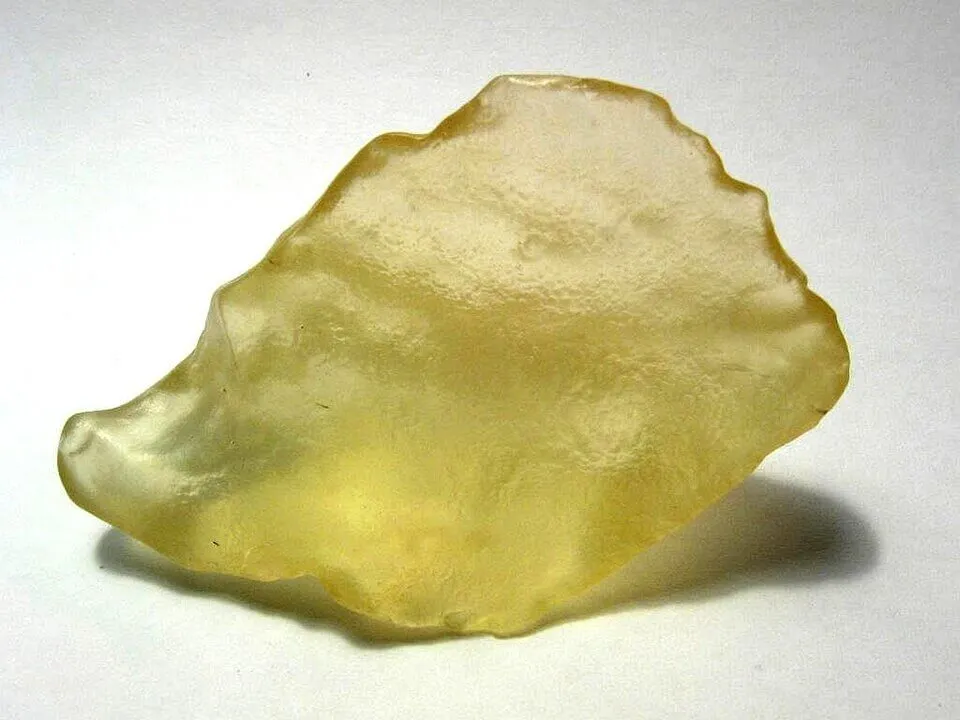
Composition: 96.5–99 wt% SiO₂. Age: ~29 Ma (late Eocene). Location: Great Sand Sea, western Egypt, ~25° N 25–26° E. Density: 2.21 g/cm³. Refractive index: 1.4616. Strewn field: ~6,500 km² (~2,500 km² dense core). Formation: hypervelocity meteorite impact (confirmed by FRIGN zircon, 2019).
What the Material Actually Is
Libyan Desert Glass, abbreviated LDG in the literature, sometimes called Great Sand Sea glass, is one of the purest natural glasses on Earth. Bulk silica content runs between roughly 96.5 and 99 weight percent SiO2, with most analyses clustering near 98 percent (Barrat et al., 1997; Koeberl, 1997). The remaining one to three percent is a thin smear of Al2O3, FeO, TiO2, and minor alkalis. Density is about 2.21 g/cm3. The refractive index measured by Spencer and confirmed by later workers is approximately 1.4616, which is unusually low and reflects how close the glass is to fused pure silica (Koeberl, 1997). For comparison, ordinary window glass refracts at about 1.52, and most tektites at 1.49 to 1.52.
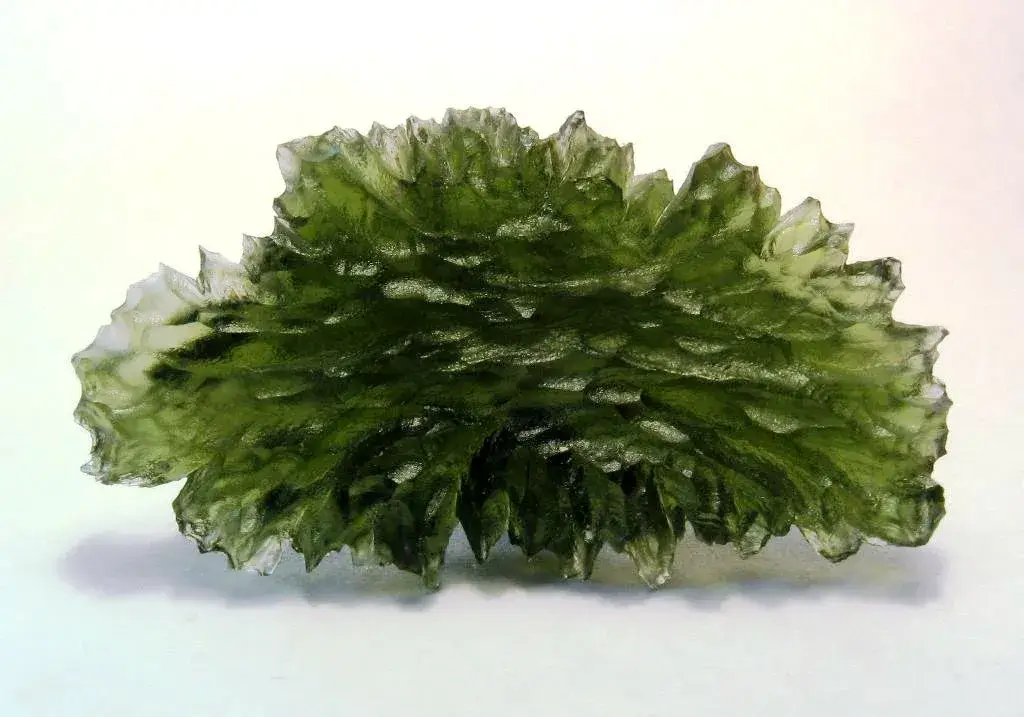
The dominant colour is a pale, slightly greenish canary yellow. Pieces vary from nearly water-clear to milky white. A minority show smoky brown or grey streaks. Some pieces contain dark inclusions: usually thin lamellae or ribbons enriched in iron, magnesium, aluminium, titanium, nickel, and chromium relative to the matrix (Greshake et al., 2010; Pratesi et al., 2002). Pratesi and colleagues used transmission electron microscopy to show that these dark streaks are not contamination. They are a frozen emulsion of two immiscible silicate melts. The 100-nanometre spherules embedded in the dark layers have an (Mg + Al + Fe) : Si ratio close to 1, a texture seen in other impact glasses but never in volcanic ones (Pratesi et al., 2002).
Inside almost every fragment, even the clearest, one finds schlieren, wispy flow bands recording the viscosity of the parent melt as it sheared and cooled, and grains of lechatelierite, a mineraloid of amorphous SiO2 that forms only above about 1,700 °C. Lechatelierite occurs in lightning-strike fulgurites and in impact glasses, and almost nowhere else; crustal rocks rarely reach 1,700 °C, and when they do they crystallise rather than quenching to glass. The lechatelierite content of LDG is high enough that the glass can be regarded as a partially digested matrix of unmelted SiO2 grains embedded in fused silica.
Other relict minerals survive the melting in small numbers. Cristobalite, a high-temperature crystalline polymorph of quartz, occurs as needles and laths. Baddeleyite (ZrO2) appears as a thermal breakdown product of zircon. Mullite, an Al-Si phase that requires temperatures above about 1,000 °C and atmospheric pressure, has been documented inside whitish inclusions (Greshake et al., 2018). Zircon itself appears in two forms: rare unaltered grains, and the far more common granular neoblastic aggregates where the original mineral has been recrystallised in place.. Those granular zircons are what eventually settled the debate over how the glass formed.
Individual pieces range from sand-grain-sized chips to slabs weighing tens of kilograms. The largest catalogued pieces approach 26 kg, though Clayton himself collected pieces up to about 7.6 kg (16.5 lb) on his original 1932 trip, and Barnes and Underwood (1976) estimated the total preserved mass across the strewn field at roughly 1.4 × 10⁹ grams, or 1,400 tonnes; the original mass before erosion was probably much larger.
The Strewn Field
The glass occupies a roughly oval area in the southwestern corner of the Great Sand Sea, straddling latitude 25° N and longitude 25° to 26° E, near the modern Egyptian-Libyan frontier. Estimates of the strewn field area vary depending on how one counts wind-transported outliers. Koeberl gives a core area of about 2,500 km2; the more frequently cited figure of 6,500 km2 includes scattered pieces blown beyond the dense central deposits (Koeberl and Ferrière, 2019). The dense main field measures about 40 km north-to-south by 20 km east-to-west.
The geography matters. The Great Sand Sea here is organised into long, north-south linear dunes, each 20 to 30 metres tall, separated by gravel corridors 1.5 to 2.5 kilometres wide. The dunes are slow-moving longitudinal forms shaped by persistent north winds, and the corridors between them are stable enough that fragments lying on the corridor floors have been exposed for tens of thousands of years without being buried. LDG concentrates in the corridors rather than on the dune crests. The glass is denser than quartz sand and resists upward saltation, and corridor floors are stripped by wind to a deflation lag of coarser material. South of the strewn field rises the Gilf Kebir, a 7,770-km2 sandstone plateau standing about 300 m above the surrounding desert, composed largely of Cretaceous Nubian Sandstone. The plateau acts as a wind shadow and a source of bedrock fragments that interfinger with the LDG-bearing gravel.
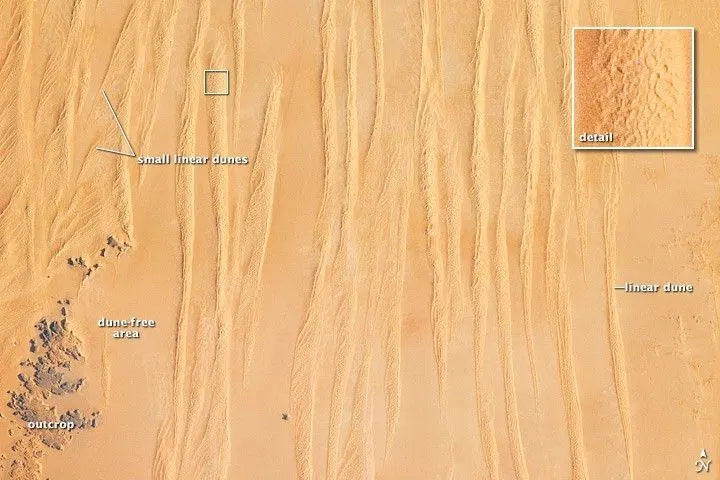
The location is also one of the driest places on the planet. Mean annual rainfall at Gilf Kebir is well under 0.1 mm, and the aridity index exceeds 200, meaning incoming solar energy could evaporate two hundred times the annual precipitation if any liquid water were present. This hyper-aridity is part of why LDG survives in such quantities. Glass is metastable, and most natural glasses devitrify or weather away within a few million years in temperate climates. The Saharan setting preserves 29-million-year-old material as if it had cooled last week.
The Age
Three independent geochronological methods have been applied to LDG, with broadly consistent results.
The earliest serious attempts used K-Ar dating, but the glass is so potassium-poor (typically 0.01 to 0.05 wt% K2O) that radiogenic argon yields are at the edge of analytical resolution. Matsubara and colleagues obtained 58.3 ± 16.4 Ma, an age generally regarded as compromised by atmospheric argon contamination and the low signal-to-noise problem inherent to glassy K-poor samples (Horn et al., 1997).
Fission-track dating works far better. Spontaneous fission of 238U produces damage tracks in the glass at a known rate, and the tracks can be counted under the microscope after etching. Storzer and Wagner (1977) produced a fission-track plateau age of 29.4 ± 0.5 Ma. Bigazzi and de Michele (1996) revisited the problem on four LDG samples and reported individual ages between 26.0 ± 1.8 and 29.0 ± 1.8 Ma, with a weighted-mean plateau age of 28.5 ± 0.8 Ma. The two studies agree at one sigma. Horn and colleagues (1997) added K-Ar and fission-track determinations in the same paper that introduced the Sr-Nd isotope constraints, broadly confirming a late Eocene to earliest Oligocene event near 28.5 to 29.5 Ma.
That places the LDG-forming event in the late Eocene, close to the Eocene-Oligocene boundary at 33.9 Ma but on the younger side of it. The Earth at the time was cooling toward the formation of the Antarctic ice sheet. North Africa was a near-shore Tethyan margin with shallow seas to the north and an emerging Sahara to the south. The proto-Mediterranean was a much larger Tethys. By deep-time standards the event is geologically recent: younger than the rise of cetaceans, older than the modern grass biome.
Stone Tools, the Scarab, and Howard Carter
People used LDG long before Patrick Clayton mapped the strewn field. Knapped flakes, blades, and small bifacial points made from the glass appear in surface assemblages across the southern Great Sand Sea, dated by association with Middle to Late Pleistocene lithic industries (Bobrowski and Czekaj-Zastawny, 2009). The glass works much like obsidian, producing sharp conchoidal flakes when struck at the right angle. It is more brittle than chert or flint, so finished tools tend to be small, but a well-shaped LDG bifacial handaxe held by Cambridge University ranks among the finest known prehistoric objects in this material (Bobrowski and Czekaj-Zastawny report similar finds in the eastern Sahara). The technology disappears in the Holocene as the Sahara dries and human populations retreat toward the Nile.
A piece of LDG also lay in the most famous archaeological discovery of the twentieth century, unrecognised for seventy-five years.

Howard Carter found the tomb of Tutankhamun, the New Kingdom pharaoh who had ruled around 1332 to 1323 BCE, on 4 November 1922. The sealed door was breached on 26 November. Three full archaeological seasons passed before the team reached the inner coffin and the mummy itself.
On 28 October 1925 the lid of the innermost solid-gold coffin was lifted in the burial chamber of KV62. The mummy was cemented to the coffin by hardened black resin; after failed attempts to free it using midday desert heat (the coffins were laid out in 65 °C sunlight for hours), the body was moved to the nearby tomb of Sety II (KV15) for examination. On 11 November 1925, the anatomists Douglas Derry and Saleh Bey Hamdi began the unwrapping, working from the feet upward. Over nine days they recorded roughly 143 objects woven into the linen: amulets, gold finger and toe stalls, a meteoric iron dagger at the right thigh, bracelets, rings, collars, and several pectorals on the chest. Harry Burton, the Metropolitan Museum’s photographer seconded to the dig, photographed each item in situ.
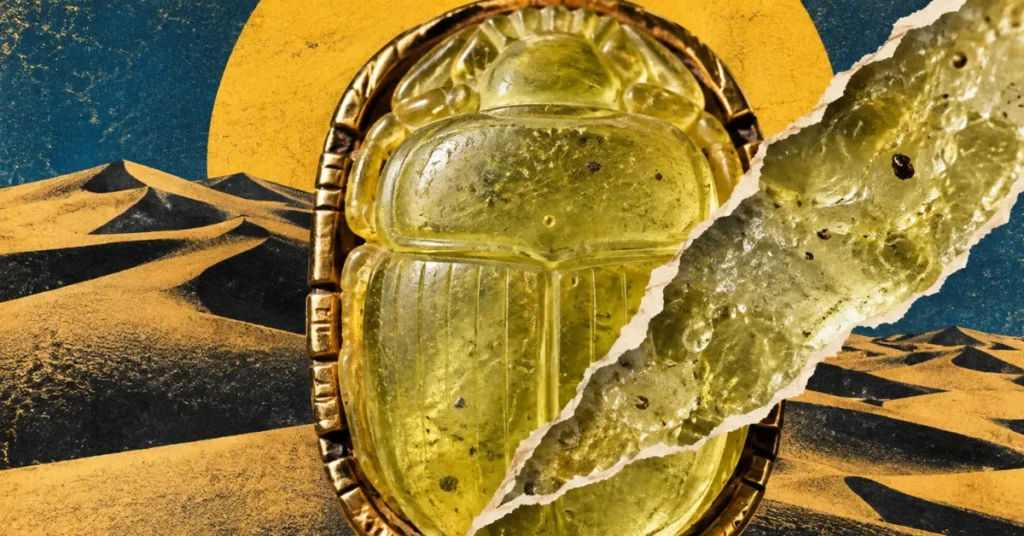
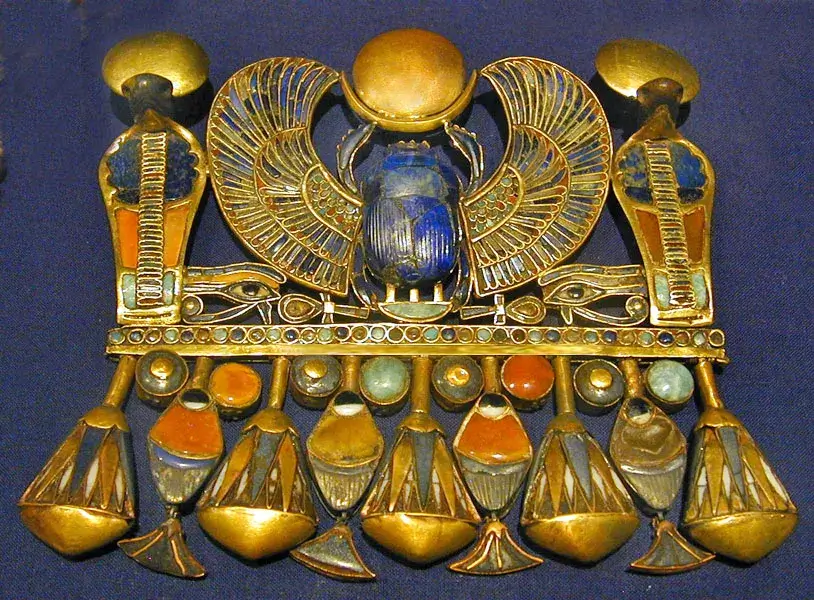
The yellow scarab was not among them. It came from elsewhere in the tomb: the Treasury, the small chamber sealed off behind the burial chamber, first seen on 17 February 1923 and not fully cleared until Season 5 of the excavation. In the Treasury stood an ivory-and-ebony veneered casket catalogued as Carter object 267. When Carter and Alfred Lucas opened it in 1926 they found it had been rummaged by ancient thieves but still contained more than fifteen gold-inlaid pectorals and a girdle, originally bundled in linen and sealed. One of the pectorals, Carter 267d, was a winged composition built around a yellow-green scarab beetle.
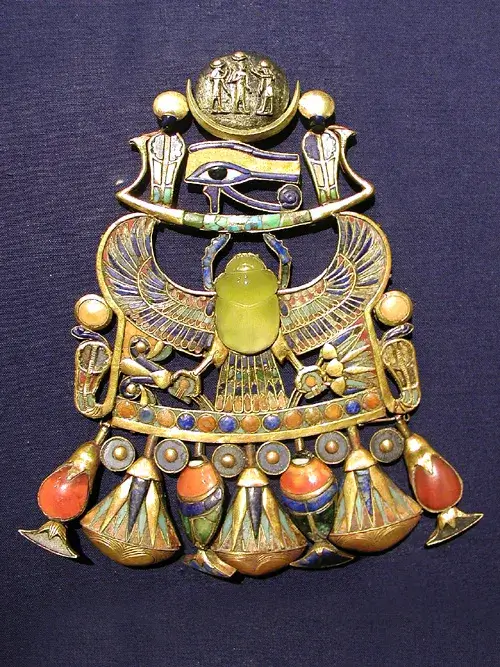
Carter himself thought the scarab was chalcedony, a fine-grained variety of quartz used routinely in Eighteenth Dynasty jewellery. The identification stood unchallenged through every subsequent publication and museum label for seven decades. Then in 1996, the Italian mineralogist Vincenzo de Michele examined the optical properties of the gem under non-destructive conditions while the pectoral was on temporary display. The refractive index was wrong for chalcedony. It matched LDG. De Michele published the identification in the journal Sahara in 1998: the scarab body had been carved from a single fragment of desert glass collected, presumably, somewhere in the Great Sand Sea and traded across hundreds of kilometres of Saharan terrain to the Nile Valley jewellers of Thebes (de Michele, 1998).
It is the only known piece of Egyptian jewellery containing LDG. The scarab represents Khepri, the solar god of the rising sun. The choice of material may have been aesthetic, or it may have been deliberate: a glass that fell from the sky, used to depict the sunrise, on the chest of a king buried with a dagger blade made from meteoric iron. Tutankhamun was buried with two objects of extraterrestrial origin: an iron dagger blade at his thigh, and an asteroid-melted scarab in a casket in the next chamber.
Impact, or Airburst?
That LDG involved high temperatures was obvious from the start, and lechatelierite settled the question of whether the material had been molten. The harder question was how the melting happened.
By the 1990s two hypotheses dominated. The first held that a stony meteorite, perhaps 100 to 300 metres across, struck the desert floor at hypervelocity and produced a crater. The shock wave and the subsequent thermal pulse melted the underlying sandstone target. The molten silica was ejected, cooled in flight or on the surface, and was preserved in the gravel corridors of the future Great Sand Sea. The crater itself was either buried, eroded away, or simply not yet found.
The second held that no impact crater ever formed. Instead, an incoming body broke apart and detonated in the atmosphere: a Tunguska-style airburst, but larger. The fireball radiated downward, heating the desert surface above the melting point of silica without delivering significant shock pressure. The resulting glass would be a near-surface skin of fused sand, like a vastly scaled-up version of the trinitite produced by the first nuclear test at Alamogordo in 1945.
Mark Boslough and David Crawford at Sandia National Laboratories developed the airburst case using hydrocode simulations published in the International Journal of Impact Engineering in 2008. Their CTH simulations showed that an exploding asteroid does not behave like a point-source explosion at altitude. The centre of mass of the bolide continues downward as a coherent high-temperature jet of expanding gas, descending a significant fraction of the burst altitude before turning subsonic. The jet couples its kinetic and thermal energy to the surface over a wide footprint. Their work implied that LDG could plausibly form from a body in the 100-megaton range exploding at low altitude (Boslough and Crawford, 2008).
The case for atmospheric airbursts as a hazard category was supercharged by what happened on 15 February 2013 over Chelyabinsk. A 20-metre stony asteroid entered the atmosphere at about 19 km/s, broke up at 30 km altitude, and released roughly 500 kilotons of energy, about thirty Hiroshimas, none of it transferred to the ground as cratering, much of it transferred as a shockwave that blew out windows across six cities and injured around 1,500 people. Chelyabinsk made airburst hazards concrete, and made the airburst hypothesis for LDG look more plausible by analogy. If a 20-metre body could break windows, what could a 100-metre or 300-metre body do to a stretch of Eocene desert?
The planetary-defence implications were direct: if 100-megaton low-altitude airbursts can produce 6,500-km² melt fields, such events are far more dangerous than crater-forming impacts of equivalent energy, because they affect larger surface areas. The expected frequency of such an event is roughly once every 10,000 years, which puts it inside the planning horizon of human civilisation in a way that the 100-million-year recurrence interval of Chicxulub-scale impacts does not.
For about a decade the airburst hypothesis was the better-supported of the two. Then the zircons spoke up.
The Reidite Result
In 2019, Aaron Cavosie of Curtin University and Christian Koeberl of the University of Vienna published a paper in Geology with one of the most pointed titles in recent impact literature: “Overestimation of threat from 100 Mt–class airbursts? High-pressure evidence from zircon in Libyan Desert Glass” (Cavosie and Koeberl, 2019).
Their argument rests on a specific mineralogical fingerprint. Zircon, the calcium-magnesium-poor zirconium silicate ZrSiO4, has a tetragonal crystal structure stable across nearly the entire range of crustal pressures and temperatures. Above about 30 GPa of shock pressure, however, zircon undergoes a solid-state transformation to a denser polymorph called reidite, which has a scheelite-type tetragonal structure (space group I41/a) and a density about ten percent higher than ordinary zircon. Reidite was first synthesised in the laboratory in 1969 and was approved as a natural mineral by the IMA after its discovery at the Chesapeake Bay impact crater. It has since been documented at fewer than a dozen confirmed impact sites worldwide. It is never found in volcanic, hydrothermal, or sedimentary settings. The shock pressure threshold for its formation, about 30 GPa, equivalent to roughly 300,000 atmospheres, cannot be reached by any process in Earth’s crust other than meteorite impact.
Reidite is also unstable at high temperatures. As the post-shock pulse heats the affected rock above about 1,200 °C, reidite reverts to zircon. But the reversion does not erase the structural memory of the high-pressure phase. The reverted zircon recrystallises as a mosaic of small granular neoblasts whose crystallographic orientations are systematically related to the parent reidite lattice. The technique for reconstructing former reidite from the crystallographic orientations of granular neoblasts using electron backscatter diffraction (EBSD) was developed by Cavosie and colleagues in 2018 on samples from the Woodleigh impact structure (Cavosie et al., 2018). Applied to LDG, the same method allowed Cavosie and Koeberl to reconstruct the geometry of reidite that no longer existed. The technical term is FRIGN zircons, “former reidite in granular neoblastic” zircon. The orientation relationships are diagnostic. They cannot be produced by any thermal process alone. They require both shock and subsequent heating.
Cavosie and Koeberl examined 101 zircon grains separated from LDG samples, a subset of which showed the FRIGN texture. The implication is mechanical: at some point in the formation of the glass, the parent rocks experienced shock pressures of at least 30 GPa. That pressure cannot be delivered by an atmospheric airburst, no matter how energetic. Airbursts produce temperatures sufficient to melt silica, but not shock waves with peak pressures in the tens of gigapascals at the ground surface. To get reidite, you need an object physically hitting the ground.
The 2019 paper effectively closed the impact-versus-airburst debate. Subsequent work has nuanced rather than overturned it. The reidite-precursor interpretation has been debated, with alternative pathways for granular neoblastic zircon proposed in the subsequent literature, but the shock origin remains the consensus reading.
More Shock Evidence: Cubic and Ortho-II Zirconia
In 2023, Elizaveta Kovaleva of GFZ-Potsdam and the University of the Western Cape, with colleagues from Egypt, Germany, and Morocco, published a transmission electron microscopy study in American Mineralogist that pushed the high-pressure case further (Kovaleva et al., 2023).
Their target was the breakdown products of zircon. When zircon is heated above about 1,673 °C it decomposes to ZrO2 (zirconia) plus SiO2. Zirconia has several polymorphs. The Kovaleva group found four of them inside LDG samples. Most were the expected high-temperature monoclinic, tetragonal, and cubic forms, cubic zirconia being the gem material familiar from costume jewellery, stable above about 2,250 °C. The unexpected polymorph was orthorhombic ZrO2 in the Pnma space group, known in the materials-science literature as ortho-II or OII. OII has a cotunnite-type (PbCl2) crystal structure and a stability field between roughly 12.5 and 24 GPa. It is metastable at room pressure once quenched but cannot form at any pressure below the lower limit of its stability field.
The presence of OII inside LDG zircon breakdown products is a second independent high-pressure indicator. Where FRIGN zircon implies ≥30 GPa shock pressure, OII zirconia implies at least 12.5 GPa, and probably higher. The two lines converge: the melt that became LDG was not a simple thermal product of atmospheric radiation but passed through a brief, intense shock pulse of the kind only produced by hypervelocity surface impact.
To this can be added the geochemical signature of the impactor itself. Barrat and colleagues (1997) measured platinum-group element (PGE) abundances in the dark streaks of LDG samples. The PGE pattern, normalised to chondritic abundances, is essentially flat, the diagnostic signature of meteoritic contamination. Iridium, in particular, is enriched in the dark streaks relative to clean glass by factors of more than ten. Koeberl extended this work with osmium isotope measurements, finding 187Os/188Os ratios consistent with a chondritic projectile component of approximately 0.05 percent by mass in the bulk glass (Koeberl, 1997, 2000). Chromium and nickel show the same pattern. Whatever struck the desert was unambiguously extraterrestrial, and left a trace of its own metal mixed into the silica melt.
The Missing Crater
None of which solves the most awkward problem in the whole subject. If a hypervelocity impact made LDG, where is the crater?
Two impact structures are known in eastern Libya, both within a few hundred kilometres of the strewn field. The BP Structure, also called Jebel Dalma, sits at 25°19′ N, 24°20′ E, about 165 km northeast of Kufra Oasis. It is a deeply eroded set of three concentric ridges with a present-day outer diameter of 3.2 to 3.4 km. The Oasis crater, 90 km to the south at 24°35′ N, 24°24′ E, preserves a topographic ring 5.1 km across, with the original rim estimated at 11.5 km or possibly 18 km on the basis of radar data. Both formed in Lower Cretaceous Nubian Sandstone, the same target rock that underlies the LDG strewn field (Koeberl, Reimold, and Plescia, 2005). Both contain shatter cones and shock-metamorphosed quartz documented by French, Underwood, and Fisk in 1974. They are unambiguous impact craters.
They are also wrong in age. The host rock is Lower Cretaceous, around 140 to 120 Ma, and both craters cut that rock and are therefore younger than it, but neither has been directly dated. The stratigraphic and erosional relationships in both cases point to formation well before the late Eocene, almost certainly pre-Cenozoic, and possibly Cretaceous itself. The 29-Ma LDG event cannot have produced them. Conversely, no glassy ejecta of LDG composition has been found in or around either crater.
The BP and Oasis craters are therefore curiosities, not solutions: they demonstrate that the eastern Libyan desert has been hit by sizeable objects in deep time, but they are not the source of the yellow glass.
Koeberl and Ferrière (2019) pursued an alternative line of evidence. They examined sandstone bedrock samples from within the LDG strewn field itself and identified shocked quartz grains with planar deformation features (PDFs): another high-pressure shock indicator. The PDFs imply that the impact site is in the strewn field itself, but the crater has been deeply eroded and possibly buried by Quaternary sand. They proposed a hypothetical structure several kilometres in diameter beneath the dunes. No clear ring structure, gravity anomaly, or magnetic signature has been confirmed.
The situation is not without precedent. Most large tektite strewn fields have known source craters: moldavites trace to the Ries crater in southern Germany; North American tektites trace to the Chesapeake Bay impact structure; ivorites trace to the Bosumtwi crater in Ghana. The australasites, scattered across one-tenth of Earth’s surface from Indochina to East Antarctica, had no known crater for more than a century, until in 2020 Kerry Sieh and colleagues at the Earth Observatory of Singapore proposed in PNAS that the Australasian source lies buried under the 910-km³ Bolaven volcanic field in southern Laos: a ~15-km crater they argued was hidden by post-impact basalt flows (Sieh et al., 2020). The hypothesis remains contested, Mizera (2022) demonstrated geochemical and field-evidence problems with the model, and the debate is ongoing, but it illustrates how a buried source crater can elude detection for a century.
Confirmation will require drilling, but hidden craters happen. A 29-million-year-old structure of one to three kilometres across, in actively shifting Saharan sand and stripped by Cenozoic uplift of the Al Kufra basin, could be very hard to find.
The shock evidence proves an impact happened. The crater is still missing.
The Geochemistry Trail
If you can’t find the crater, you can sometimes find the target rock. The strategy is to compare the chemistry of the glass with the chemistry of candidate sandstones in the region and look for a match.
The early work suggested an obvious answer. The Nubian Sandstone exposed across the Gilf Kebir and the southern Great Sand Sea is a mature, quartz-rich Lower Cretaceous formation deposited in fluvial and shallow marine settings. Its bulk silica content is comparable to LDG. Its trace-element ratios approximate post-Archaean shales. Barrat and colleagues (1997) used inductively coupled plasma analysis on ten LDG samples and concluded that the parent material was a mature post-Archaean sandstone composed of quartz grains coated with kaolinite, FeTi oxides, and accessory phases. Light rare earth element enrichment (Lan/Smn = 4.2-4.5) and negative Eu anomalies (Eu/Eu* = 0.6-0.75) are textbook signatures of sedimentary upper crust.
The isotope work complicated the picture. Schaaf and Müller-Sohnius (2002) measured Sr and Nd isotope ratios on seven LDG samples and five sandstone samples collected from the strewn field area. The LDG samples gave 87Sr/86Sr ratios of 0.71219 to 0.71344 and εNd values of −16.6 to −17.8. The surface sandstones gave less radiogenic Sr (0.70910-0.71053) and less negative εNd (−6.9 to −9.6). The isotopic compositions of LDG matched not the modern surface sand of the Great Sand Sea, but ultimately a Pan-African-age (~540 Ma) crystalline basement source, Precambrian rocks that must underlie the sandstone column at depth. The Sr and Nd systems were not reset by the impact event, which preserves the inherited basement age in the glass. Pratesi and colleagues (2002) reached compatible conclusions from the petrography of the silicate immiscibility textures.
More recent work by Sighinolfi and colleagues (2020) extended the trace-element and Sr-isotope search beyond the surface sands to the deeper sedimentary formations of the Gilf Kebir highlands, ranging in age from Upper Cretaceous down to Silurian. They found candidate target rocks but did not identify a definitive match. The parent sandstone of LDG appears to have been a quartz arenite whose detrital zircon and ultimately whose Pan-African isotopic signature point to recycled Precambrian basement material: sediment with a long memory.
Oxygen isotope work added a third constraint. Longinelli and colleagues (2011) measured δ¹⁸O values in LDG samples and compared them with regional sandstones and sands. The glass values matched the bulk oxygen isotope range of the surface and near-surface sediments of the strewn field area, consistent with a local sedimentary target rather than a deep crustal source for the silica itself, even as the Sr and Nd systems point to a Pan-African basement provenance for the original detrital grains. The two signals are not contradictory: the oxygen records the immediate target, the Sr-Nd records where the sand grains were ultimately weathered from.
Added to this crustal component is the chondritic meteoritic contribution measured by Koeberl (1997) and confirmed by osmium isotopes: approximately 0.05 percent by mass. That number sounds tiny, but is characteristic of impact melts in general. Most of the projectile vaporises and disperses; only a trace mixes into the glass. The 0.05 percent figure scales, roughly, to a stony body in the 100-metre size range, though such back-calculations are model-dependent.
Why It Matters Beyond Egypt
Hypervelocity impact glasses are the only naturally formed materials on Earth that record peak shock pressures above about 20 GPa, preserving, in a few cubic centimetres, the physics of an event that lasted milliseconds. The crystallographic relationships in a FRIGN zircon are the closest thing geology offers to a direct measurement of the shock wave that produced the glass: a thirty-million-year-old fingerprint of a process no human will ever witness in real time and survive.
The technique developed by Cavosie and Koeberl on LDG has been extended to other terrestrial and lunar samples. Lunar regolith collected by Apollo missions is full of glass spherules and agglutinates produced by countless small impacts on the airless lunar surface, some containing shock-metamorphosed zircons of their own. Martian meteorites (pieces of Mars launched to Earth by impact ejection) contain shocked feldspar maskelynite, shocked olivine, and in a few cases reidite. The same diagnostic mineralogy underwrites our reading of the lunar and Martian impact records. LDG is a calibration sample for the solar system.
The hazard implications cut the other way from where Boslough and Crawford had pointed. If the largest known natural glass on Earth was made by ground-impact rather than airburst, then airbursts at the 100-megaton scale may not actually be capable of producing such melt fields, which means our estimate of the airburst hazard’s geological signature has to be revised. Airbursts remain dangerous to cities regardless, blast effects don’t depend on cratering. But the geological record of past airbursts may be sparser than feared, and the inferred recurrence rate of city-killer events may need recalibration accordingly. Identifying the imprint of each type matters for predicting the next one.
As a hand specimen, LDG is one of the more straightforward identifications in the natural-glass family. Its distinctive yellow colour, low density, near-pure silica composition, and vitreous lustre, often combined with wind-pitted ventifact surfaces, distinguish it from most other yellow gemstones and glasses. A refractive index near 1.46, measurable with a standard gem refractometer, separates it cleanly from chalcedony, citrine, and ordinary glass at 1.52. Confirming a candidate piece against a sourced reference specimen remains the simplest field test (and the optical and physical properties that distinguish natural glasses from cryptocrystalline silicas are covered in our rock identification guide). The economic market is small, and most of the strewn field lies in remote Egyptian desert under permit and security restrictions, but enough material has been collected over the past century to fill museum cases worldwide.
There is also a wider planetary context. Earth is one of the few rocky bodies in the solar system where impact glass weathers away in a few million years. Mars has surface impact glasses identified spectroscopically by orbiters; the Moon’s surface is a 4.5-billion-year archive of impact agglutinate; Mercury’s heavily cratered surface presumably hosts comparable material. The millisecond physics that makes a tektite leaves geochemical fingerprints that can be read decades after the rock was first picked up, sometimes by a surveyor who mistook the first piece for the bottom of a bottle.
Back to the Pectoral
The scarab is small. The body measures only a few centimetres across. It is mounted, with its outstretched wings of gold and inlaid lapis, on a pectoral that was bundled into a linen-wrapped casket in the Treasury of a teenage king who died around 1323 BCE, a king buried with a meteoric iron dagger at his thigh and, in the next chamber, a fragment of an exploded asteroid carved into the form of the rising sun.
Nobody in Eighteenth Dynasty Thebes knew what the yellow stone was. Carter, three thousand years later, didn’t either, he recorded it as chalcedony and left it that way. The piece sat in the Egyptian Museum in Cairo for seventy-three years before Vincenzo de Michele measured the refractive index. Aaron Cavosie’s electron backscatter measurements, which would eventually trace the glass’s parent material back to a hypervelocity impact in the Eocene desert about a thousand kilometres west of the tomb, were still twenty-one years in the future when de Michele published.
The scarab on the chest of the boy king is made of glass formed 29 million years before any human existed, on a continent that was greener and wetter and not yet quite the same shape as the one we know. The parent rock was sandstone whose own grains had been weathered out of Precambrian basement formed by Pan-African mountain-building roughly 540 million years ago, when the first hard-shelled animals were just appearing in the oceans of the Ediacaran. The Sahara turned that basement into sand, the sand into sandstone, and an asteroid turned the sandstone into glass. A Pleistocene knapper turned a fragment of the glass into a flake. A Theban jeweller turned the flake into a scarab. Carter and his anatomists found the scarab in 1925 on a body cemented to its coffin. De Michele identified it in 1996. Cavosie tied it back to the desert in 2019.
The yellow scarab is one continuous physical object that has been moving slowly forward in time from the late Eocene to the display case in Cairo. The pectoral hangs there now, behind glass of a much more recent kind, and the scarab still catches light the way it caught light in the Great Sand Sea before there were primates to see it.