A Light in the Abyss
The Lost City Hydrothermal Field is a field of alkaline hydrothermal vents on the Atlantis Massif in the mid-Atlantic, discovered in 2000. Unlike volcanic “black smoker” vents, it is powered by serpentinization, a chemical reaction between seawater and mantle rock, which builds towering carbonate chimneys and produces hydrogen and methane that feed microbial life. It has been active for more than 120,000 years and is a leading candidate for where life on Earth may have begun.
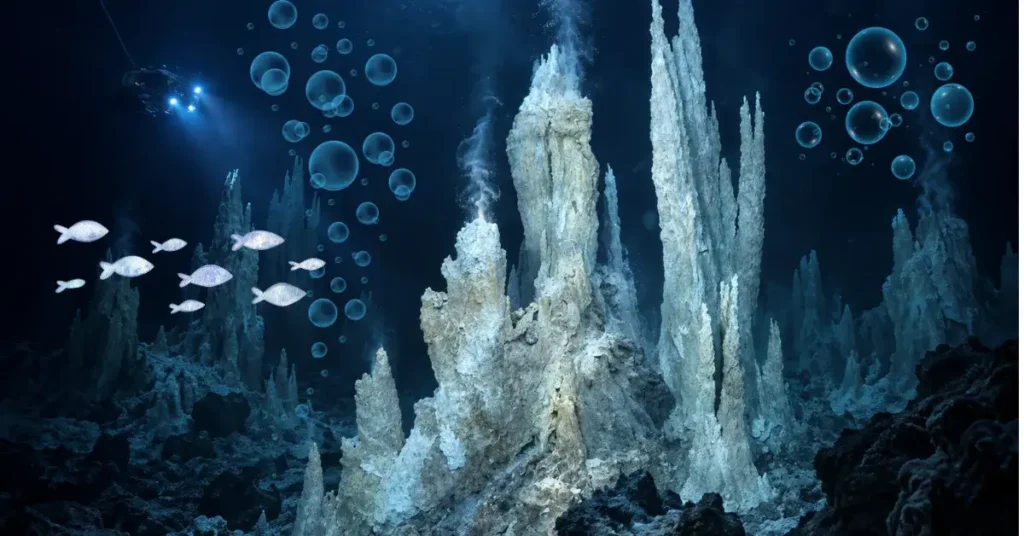
It was the dead of night on December 4, 2000, and the research vessel Atlantis was rolling on a swell in the mid-Atlantic, about 1,500 miles off the U.S. East Coast. Most of the science team had gone to their bunks. In the ship’s control van, geologist Gretchen Früh-Green and structural geologist Barbara John were watching a black-and-white video feed crawl across the southern face of an undersea mountain, the towed camera sled Argo II skimming the seafloor some 800 meters below. Then the screen filled with pale spires.
Früh-Green ran to wake Deborah Kelley. “I think we found something here that doesn’t look like anything we’ve seen before,” she said, in Kelley’s later recollection. What followed was a night of “excitement and craziness.” Kelley, a University of Washington marine geologist, gathered with Duke’s Jeff Karson and the rest of the team and stared at the monitors until dawn. White towers rose out of the dark like the drowned skyline of some sunken metropolis. They named it the Lost City.
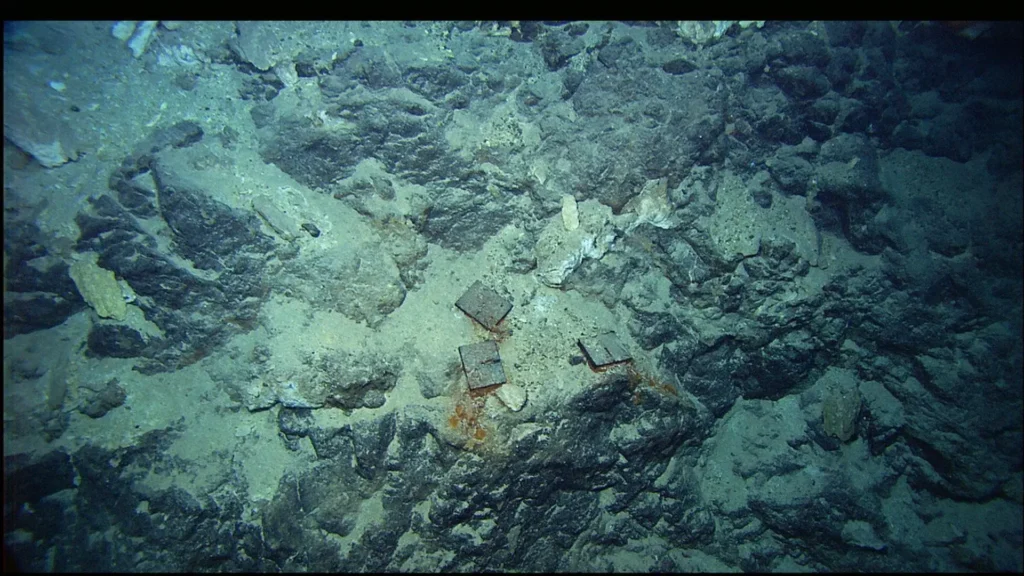
The expedition, led at sea by Scripps geophysicist Donna Blackman, had not come looking for hydrothermal vents at all. It had come to study how the mountain itself was built. December 4 is the date the expedition would log as the discovery. The next day, December 5, there was time for a single human dive before the weather turned. Kelley and Karson folded themselves into the submersible Alvin with pilot Pat Hickey and dropped through the cold black water to the seafloor. Through portholes barely six inches across, they saw cliffs draped in carbonate, fields of delicate mineral fingers, and warm fluid shimmering off the rock. “If this vent field was on land,” Karson told reporters afterward, “it would be a national park.”
Introduction
The Lost City Hydrothermal Field is a cluster of roughly 30 pale carbonate chimneys perched high on the wall of an undersea mountain in the middle of the Atlantic Ocean. Rather than volcanic fire, it is powered by a chemical reaction between seawater and the rocks of Earth’s mantle, a process called serpentinization. That single distinction overturns much of the old picture of how a hydrothermal system can work, and how long it can last.
This is a place where the water venting from the seafloor is as alkaline as drain cleaner, where the chimneys are built of the same mineral as cave limestone rather than the metal sulfides of the famous “black smokers,” and where simple molecules essential to life are manufactured continuously out of nothing more than rock and water. It has been venting for more than a hundred thousand years, which makes it one of the leading candidate environments for where life on Earth may have begun. And it may be the closest analog we have on this planet to what is happening right now beneath the ice of Saturn’s moon Enceladus and Jupiter’s moon Europa.
This article traces the full arc of the Lost City story: the accidental discovery, the strange chemistry that builds and feeds it, the towering chimney called Poseidon, the microbes that thrive in its caustic interior, the origin-of-life hypothesis it helped inspire, its connection to the search for life beyond Earth, the record-breaking 2023 expedition that drilled into the mantle beside and beneath it, and the very real threat that deep-sea mining now poses to a place we have only begun to understand.
The Mountain That Built Itself Without Fire
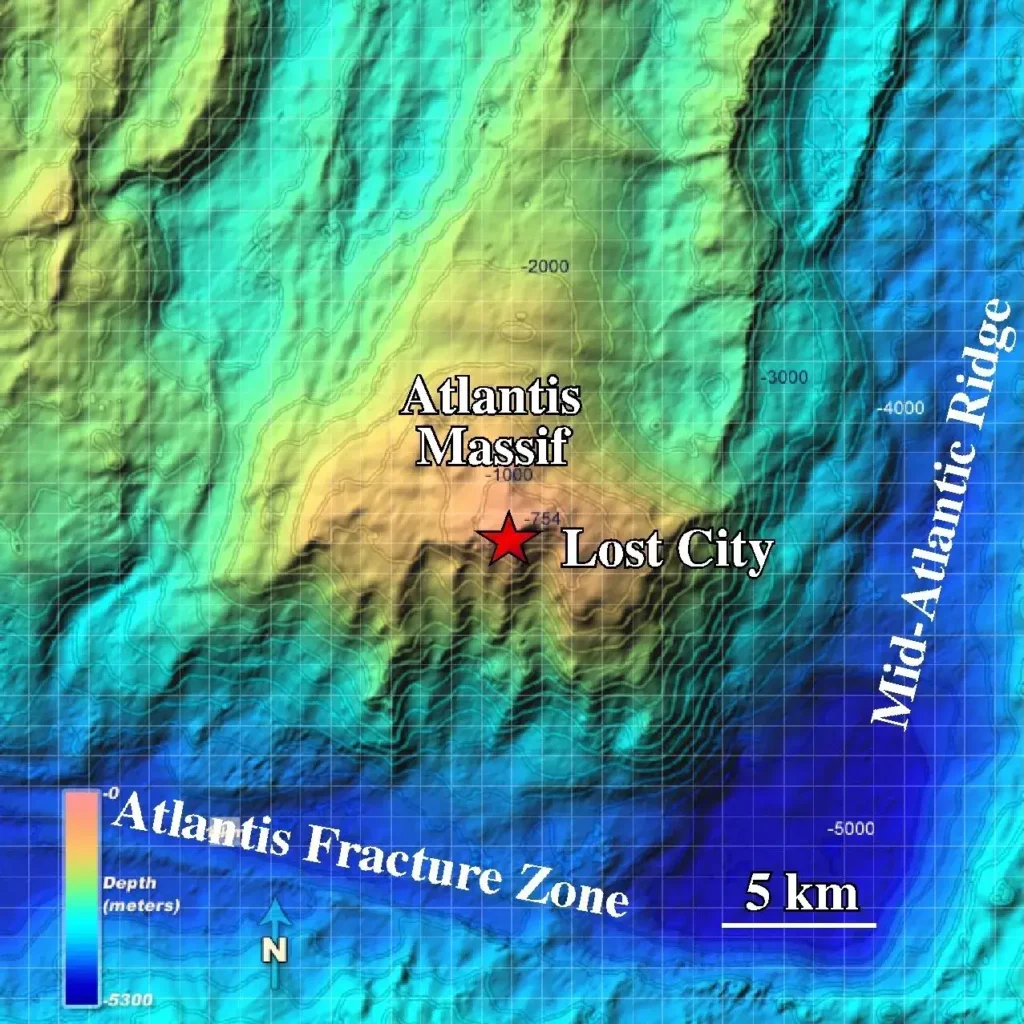
To understand the Lost City, you first have to understand the mountain it sits on. The Atlantis Massif is a dome-shaped seafloor mountain centered near 30°07′N, 42°07′W, just east of where the Mid-Atlantic Ridge meets a great fracture in the crust called the Atlantis Transform Fault. The field itself lies about 15 kilometers west of the ridge’s spreading axis. The massif is roughly 16 kilometers across and rises about 4,000 meters from the seafloor, which makes it, in a comparison the scientists themselves are fond of, about the size of Mount Rainier.
Most big mountains on the seafloor are volcanoes, built up by erupted lava. The Atlantis Massif is something stranger. It is what geologists call an oceanic core complex, and it was assembled not by adding lava on top but by peeling the crust away from below. Over the past 1.5 to 2 million years, as the slow-spreading Mid-Atlantic Ridge pulled the seafloor apart, a single enormous low-angle fault, a detachment fault, unzipped the crust and rolled the deep interior of the planet up to the surface. The result is a window into rocks that normally lie miles down: gabbro from frozen magma chambers, and above all peridotite, the dense green rock of Earth’s upper mantle.
That exposed mantle rock is the engine of everything that follows. Peridotite is rich in the mineral olivine, and olivine is chemically unstable when it meets seawater. The mountain, in other words, is made of a fuel that begins to react the moment the ocean touches it. As Kelley put it in the National Science Foundation’s discovery announcement, “Rarely does something like this come along that drives home how much we still have to learn about our own planet. We need to shed our biases in some sense about what we think we already know.”
The field itself sits on a down-dropped terrace, a kind of structural shelf about 70 meters below the summit of the massif, at a water depth most often cited at around 780 meters. The largest and most active chimneys form a roughly east-west line more than 200 meters long. The whole arrangement is controlled by faults: steeply dipping fractures that act as plumbing, channeling seawater down into the hot rock and warm fluid back up to the towers.
Not a Black Smoker: Why Lost City Broke the Rules
When scientists first started exploring mid-ocean ridge hydrothermal vents in the 1970s, they found black smokers: chimneys of iron and sulfide minerals belching fluid hot enough to melt lead, blackened by precipitating metals, clustered along the volcanic axis where fresh magma sits close beneath the seafloor. For three decades, that was the template. Hydrothermal venting meant volcanic heat, acidic fluids, metal sulfides, and the dramatic chemosynthetic ecosystems of tubeworms and clams that feed on them.
Lost City fit none of it. The differences started with size and color. Black smokers studied since the 1970s mostly top out at 80 feet or less. The tallest spire at Lost City, named Poseidon, rises about 60 meters, roughly 200 feet, the height of an 18-story building. And where black smokers are dark and metallic, Lost City’s structures are nearly pure carbonate, the same material as limestone in caves, ranging in color from clean white to cream to gray.
The temperatures were all wrong too. Black smoker fluids can reach roughly 400°C. Lost City’s vent fluids are warm rather than scalding, between about 40 and 91°C. And the chemistry was almost a mirror image. Black smokers are acidic; Lost City’s fluids are intensely alkaline, with pH values measured between 9 and 11, which Kelley has repeatedly described as nearly as caustic as Liquid-Plumr. Black smokers are loaded with dissolved metals and carbon dioxide; Lost City fluids have iron below detection limits, essentially no carbon dioxide, and instead are extraordinarily rich in dissolved hydrogen and methane.
The most fundamental difference is the source of the heat. A black smoker is heated by magma. Lost City has no magma anywhere near it; the crust here is more than a million years old and cold by volcanic standards. The heat, and the chemistry, come from the rock itself reacting with water.
Serpentinization: How Rock Drinks the Sea and Breathes Out Fuel
The reaction begins when seawater percolates down through the fractured mantle rock of the Atlantis Massif and meets olivine, the iron- and magnesium-rich mineral that makes up most of peridotite. The water attacks it. Olivine breaks down and reforms into a suite of new, water-bearing minerals, chiefly serpentine, the soft greenish mineral that gives the process its name, along with brucite and magnetite. The rock swells, cracks, and takes on water, transforming from dense dry mantle into hydrated, slippery serpentinite.
Three things come out of that transformation, and all three matter. The first is heat. Serpentinization is strongly exothermic; by one published estimate, altering a single cubic meter of rock can release on the order of several hundred megajoules of thermal energy, enough to drive the warm circulation that keeps the field alive without any volcanic help at all.
The second is hydrogen. As olivine’s ferrous iron is oxidized to ferric iron and locked into magnetite, the water is split, and molecular hydrogen gas (H₂) floods into the fluid. Lost City’s fluids carry some of the highest hydrogen concentrations measured at any submarine vent; according to Kelley and colleagues, hydrogen spans from below 1 up to about 15 millimoles per kilogram, with the magnesium-free endmember fluids analyzed by Seyfried and coworkers measuring roughly 9.4 to 12 millimoles per kilogram at a pH of about 10.1 to 10.6.
The third is hydrocarbons. With abundant hydrogen and a source of carbon, reactions of the Fischer-Tropsch type can build methane (CH₄) and a series of slightly larger organic molecules without any biology involved at all. In 2008, Giora Proskurowski, Kelley, and colleagues published a study in Science showing that the hydrocarbons in Lost City fluids carry no radiocarbon signature from the sunlit biosphere and instead match a deep, abiotic origin. Lost City, they found, produces 10 to 100 times more hydrogen and methane than a typical black smoker. “The generation of hydrocarbons was the very first step,” Proskurowski said of the find; “otherwise Earth would have remained lifeless.”
The implication is large. Serpentinization takes two of the most common ingredients in the cosmos, rock and water, and spontaneously produces both the chemical building blocks and the chemical energy that life can run on. No sunlight, no volcano, no pre-existing biology required.
Poseidon and the Cathedral of Carbonate
The chimneys themselves are built by a kind of geochemical accident at the boundary between two waters. The hot fluid rising out of the rock is alkaline and stripped of magnesium, and it carries dissolved calcium. When it meets cold, ordinary seawater, which is full of carbonate and magnesium, the calcium and carbonate crash together and precipitate out as solid calcium carbonate minerals, mainly aragonite and brucite at first. Wherever the two waters mix, mineral builds. The towers are essentially frozen records of that mixing front.
The largest of them is Poseidon. It rises more than 60 meters, almost 200 feet, and the broader complex of coalescing towers extends roughly 100 meters across, with Poseidon itself about 50 meters wide at its base. During the 2005 expedition, organic geochemist Mitch Schulte described the summit as four major pinnacles, one of them actively venting fluid at about 59°C, with hotter spots in a saddle between peaks reaching 75°C. The single hottest fluid in the field, around 91°C at a pH of about 10.7, issues from a roughly one-meter, beehive-shaped chimney on Poseidon.
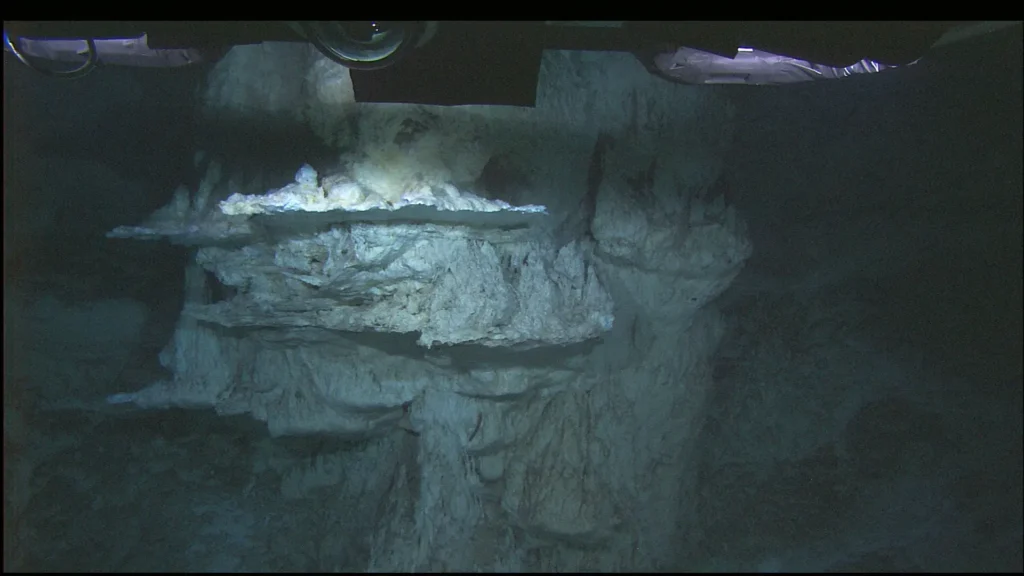
Around and out of Poseidon grow more delicate structures. A spectacular feature called the IMAX chimney rises three stories from its north face, hung with flanges that trap reflecting pools of 55°C fluid like upside-down waterfalls. Elsewhere in the field, fresh white carbonate weeps from cracks in the cliff in clusters of multi-pronged growths that look like the fingers of upturned hands. The newest material is brilliant white; as the carbonate ages, the metastable aragonite converts to calcite, brucite dissolves away, and the surfaces darken to gray and golden brown.
That aging process is also a clock. By dating the carbonate, scientists worked out the field’s astonishing longevity. A 2003 Science paper led by Früh-Green documented at least 30,000 years of hydrothermal activity, already making Lost City older than any known black smoker system by orders of magnitude. Later uranium-thorium and radiocarbon dating pushed the record back further: the oldest, now-extinct chimneys on the southern edge of the field returned ages well over 100,000 years, and the consensus figure that circulates today is that Lost City has been venting for more than 120,000 years. Black smokers, tied to the fickle pulse of volcanism, typically last decades to centuries. Lost City has the slow, patient heartbeat of a chemical reaction in solid rock, and it can keep that up, the researchers estimate, potentially for hundreds of thousands of years.
Life in the Caustic Dark
What lives in a place like this? At first glance, not much. There are no forests of tubeworms, no dense beds of giant clams. The visible animal life is sparse: gastropods and amphipods clinging to the warm porous flanges, polychaetes and nematodes and tiny crustaceans, with crabs, corals, eels, and the occasional wreckfish in the cold surrounding water. Yet when the 2003 expedition vacuumed the water around the vents and counted carefully, they found something surprising. The diversity of these small animals is as high as, or higher than, at any black smoker site on the Mid-Atlantic Ridge. The biomass is low, but the variety is rich. The creatures are just small, translucent, and easy to miss.
The real action is microbial, and it is hidden inside the chimney walls. The porous carbonate is shot through with channels where warm, hydrogen- and methane-rich fluid mixes with seawater, and those interfaces are coated in dense biofilms. According to Kelley and colleagues, these biofilms contain nearly 10⁸ to 10⁹ cells per gram of carbonate mineral, dominated by a single phylotype. What is remarkable is how little diversity there is in the hottest zones. In chimney interiors bathed in fluid above 80°C, work by William Brazelton, Matthew Schrenk, Kelley, and John Baross found that, as they reported in Applied and Environmental Microbiology, these organisms “form thick biofilms, and they comprise nearly 100% of the archaeal community.” The team named the dominant organism the Lost City Methanosarcinales, or LCMS.
These microbes make their living off the products of serpentinization. They cycle hydrogen, methane, and small organic molecules like formate and acetate, the very compounds the rock manufactures abiotically. In cooler, less vigorously venting parts of the field, a different group takes over, the anaerobic methane-oxidizing archaea known as ANME-1, suggesting an ecological succession that tracks the chimneys as they cool and age over centuries. A 2011 study even found surprising physiological complexity packed into the single-species LCMS biofilms, with multiple cell shapes and internal membranes hinting that one organism may run both methane production and methane consumption depending on conditions.
The crucial point is the energy source. At black smokers, the base of the food web runs largely on carbon dioxide and hydrogen sulfide. At Lost City, those are scarce or absent, and life runs instead on hydrogen and methane delivered by rock chemistry. It is an ecosystem that needs neither sunlight nor volcanism, only the slow reaction of water with the planet’s interior.
The Alkaline Hydrothermal Vent Hypothesis: A Possible Cradle of Life
This is where Lost City became one of the most discussed places in origin-of-life research. The logic runs as follows. Early Earth, more than four billion years ago, was hotter, and far more mantle rock sat exposed at or near the surface where it could react with the ocean. Serpentinizing systems should have been common. And a serpentinizing system delivers, free and continuously, almost everything a primitive metabolism would need: a steady supply of hydrogen as an electron donor, simple carbon compounds, mineral surfaces to act as catalysts, warmth, and a steep chemical gradient.
That last ingredient is the linchpin of a specific and influential hypothesis. Beginning in the 1990s, geochemist Michael Russell, later joined by biologists William Martin and Nick Lane, argued that life’s first energy system was not so different from a Lost City chimney. Modern cells power themselves by pumping protons across a membrane to build an electrochemical gradient, then letting that gradient drive the synthesis of ATP, a process called chemiosmosis that is universal to all life. In the alkaline vent hypothesis, the labyrinth of microscopic pores in an alkaline chimney provides a ready-made version of exactly that gradient: alkaline, hydrogen-rich vent fluid on one side of a thin mineral wall, more acidic ocean water on the other, with a difference of several pH units across barriers just micrometers thick. That natural proton gradient, the argument goes, could have driven the difficult first reactions between hydrogen and carbon dioxide, seeding a primitive carbon-fixing metabolism resembling the ancient acetyl-CoA pathway still used by methanogens and acetogens today.
In 2008, Martin, Baross, Kelley, and Russell laid this out in a widely cited review in Nature Reviews Microbiology, and Lost City became its real-world poster child: a working, long-lived alkaline vent system that produces hydrogen, formate, acetate, and a sustained pH gradient. The hypothesis is not without critics, and the debate over whether thick inorganic vent walls could really substitute for cell membranes, and whether the gradients are steep enough, remains live and unresolved. But the discovery of Lost City gave the idea a concrete place to point to. As Kelley framed the stakes in 2005: “We don’t, in most places, have access to early Earth conditions so if we can understand the chemical reactions, sources of energy and how fluids circulate through Lost City, it may give us insight into how life started on this planet.”
Ocean Worlds: A Map to Enceladus and Europa
If serpentinization needs only rock and water, then anywhere in the solar system that has both could, in principle, run the same chemistry. That realization has made Lost City a touchstone for planetary scientists hunting for life beyond Earth.
The clearest target is Enceladus, a small icy moon of Saturn. Beneath its frozen shell lies a global liquid-water ocean in contact with a rocky core, and from cracks at its south pole it sprays plumes of that ocean into space. NASA’s Cassini spacecraft flew through those plumes and sampled them. It found molecular hydrogen, and it found that the ocean appears to be alkaline. Both are exactly what you would expect if seawater were reacting with rock through serpentinization on the seafloor below. As planetary scientist Christopher Glein put it, the chemistry is “exactly what we would expect if there is a liquid water ocean in contact with rocks on and below the ocean floor on Enceladus.” The on-Earth comparison he and others reach for is, again and again, Lost City.
Jupiter’s moon Europa offers a similar story. Beneath its ice lies a saltwater ocean wrapped around a rocky interior, with cracks that could expose fresh rock to water and drive hydrogen production. NASA’s Europa Clipper, launched in October 2024, carries instruments designed to probe exactly that ocean-rock chemistry. The microbiologist William Brazelton, who has spent years studying Lost City’s microbes, has been blunt about the connection, telling Smithsonian that Lost City is “an example of a type of ecosystem that could be active on Enceladus or Europa right this second. And maybe Mars in the past.” The rock that fuels Lost City’s microbes, he has noted, appears to be widespread across the solar system. Figuring out how rocks power life on Earth is the first step to figuring out how rocks might power it elsewhere.
Drilling the Mantle: IODP Expedition 399
For two decades after the discovery, scientists studied Lost City from the outside: sampling its fluids, mapping its chimneys, scraping its biofilms. What they could not do was reach down into the rock and watch serpentinization happen at depth. That changed in the spring of 2023.
From April to June 2023, the ocean drilling vessel JOIDES Resolution carried out International Ocean Discovery Program Expedition 399, fittingly titled “Building Blocks of Life, Atlantis Massif.” Working the same mountain that hosts Lost City, the international team, co-led by Andrew McCaig of the University of Leeds, Susan Lang of the Woods Hole Oceanographic Institution, and Peter Blum, did something that had been attempted and frustrated since the early 1960s. In a new borehole on the southern wall of the massif, Hole U1601C, they drilled 1,267.8 meters into the mantle rock and pulled up an astonishing 71 percent of it as intact core, with recovery regularly exceeding 90 percent through long stretches of serpentinized peridotite.
To grasp how large a leap that is: the previous record for drilling into oceanic mantle rock was just 200.8 meters, set at Hole 920D during Ocean Drilling Program Leg 153 back in 1993. Expedition 399 did not edge past that mark; it shattered it by a factor of six. Lead author Johan Lissenberg of Cardiff University and his colleagues had at last recovered a long, continuous section of Earth’s upper mantle, “a type section for decades to come,” as McCaig put it, for everything from mantle melting to microbiology.
The drilling happened in 2023; the first major scientific results were published a year later, in Science on August 8, 2024, in a paper titled “A long section of serpentinized depleted mantle peridotite.” The core, about two-thirds ultramafic mantle rock and one-third gabbroic intrusions, recorded more melting in its history than expected and showed hydrothermal fluid-rock reaction running through its entire depth, with alteration patterns matching the chemistry of the Lost City fluids venting nearby. The mantle, it turned out, was not lightly serpentinized; it was serpentinized to perhaps 80 to 90 percent through a layer at least 1.2 kilometers thick.
For the question of life’s origins, the rocks themselves were the message. Susan Lang, a co-chief scientist, drew the connection directly: “The rocks that were present on early Earth bear a closer resemblance to those we retrieved during this expedition than the more common rocks that make up our continents today. Analysing them gives us a critical view into the chemical and physical environments that would have been present early in Earth’s history, and that could have provided a consistent source of fuel and favorable conditions over geologically long timeframes to have hosted the earliest forms of life.” The expedition had not just broken a drilling record. It had hauled a piece of early-Earth chemistry onto a ship’s deck.
The Threat: Mining a Place We Barely Know
For something so old and so isolated, the Lost City turns out to be alarmingly exposed. Its complex topography has spared it from commercial fishing, but a different industry has its eye on the region. In 2018, the International Seabed Authority granted Poland a 15-year contract to explore for polymetallic sulfides along the Mid-Atlantic Ridge. According to the ISA, the allocated exploration area is exactly 10,000 square kilometers, divided into 100 blocks of no more than 100 square kilometers each, sitting on the ridge between the Hayes, Atlantis, and Kane transform fault zones. The minerals being sought, including copper, gold, and other metals concentrated at black smoker deposits, are not in the Lost City carbonate towers themselves. But the concern among scientists is that mining anywhere nearby could smother the field in sediment plumes, alter the chemistry of the water, and damage a system we have barely begun to characterize.
Gretchen Früh-Green, who was in the control van the night Lost City was discovered, has been among the most vocal. She warned, in remarks reported by Sky News, that “we could destroy this place before we even understand it, before we can truly appreciate the significance of these unique white towers and the strange fluids seeping from the seabed.” Greenpeace, the Marine Conservation Institute, and others have pushed to protect it; the field has been designated a Mission Blue Hope Spot and flagged as a High Seas Gem, and there are ongoing calls to make it a UNESCO World Heritage site. As of 2025 and into 2026, however, no binding international protection specific to the Lost City is in force.
The good news is that no commercial deep-sea mining has begun, anywhere. Poland’s contract is for exploration only, meaning surveys and sampling, not extraction. And the legal framework that would govern actual mining remains unfinished. At its 30th session in July 2025, the International Seabed Authority again failed to adopt a long-delayed Mining Code, with negotiations pushed into 2026. As the group Seas At Risk reported of that session, when “Croatia announced its precautionary pause position,” it joined “the 38 countries now supporting a moratorium, precautionary pause, or ban on deep-sea mining.” The pressure is real, though, and cuts both ways; in 2025 one company sought to bypass the ISA process entirely by pursuing a mining permit through the United States, prompting warnings that such unilateral action would violate international law.
Into this contested space steps a landmark piece of international law. The High Seas Treaty, formally the Agreement on Biodiversity Beyond National Jurisdiction, or BBNJ Agreement, was adopted by UN member states on June 19, 2023, after nearly two decades of negotiation. It is the first legally binding framework for creating marine protected areas in the roughly two-thirds of the ocean that lies beyond any nation’s jurisdiction, the High Seas, where Lost City sits. On September 19, 2025, the treaty crossed its threshold of 60 ratifications, and it entered into force on January 17, 2026. Whether it will be used in time, and with enough teeth, to shield a place like the Lost City is now one of the open questions of ocean governance.
The Slow Fire Still Burning
There is something almost humbling about the Lost City’s timescale. The black smokers we discovered first are dramatic and fast, flaring and dying with the volcanic pulse of the ridge. Lost City is the opposite: quiet, alkaline, ghostly white, and older than our species. It has been venting hydrogen and methane into the dark since before modern humans existed, fed not by fire but by the reaction of seawater with the rock beneath it. Kelley once said she was 100 percent sure other Lost Cities exist, because there are so many places on the seafloor where mantle rock meets the sea. We have found only this one. It took an accident, on a December night in 2000, to find it at all.
What it offers is a kind of working model of beginnings. Here, in real time, the planet’s interior reacts with seawater to manufacture the raw materials of life. The same chemistry may be unfolding right now under the ice of Enceladus, and may have unfolded on a young Earth four billion years ago in towers much like Poseidon. The mantle core pulled from beneath the field in 2023 brought a piece of that ancient world up into the light. The microbes in the chimney walls are still living the experiment. And the towers keep growing, fraction of a millimeter by fraction of a millimeter, white against the black, indifferent to whether we choose to protect them or grind them into a plume of mud. We have the rare chance to study a possible cradle of life while it is still active, if we choose to protect it before we mine it.
Frequently Asked Questions
What is the Lost City Hydrothermal Field? It is a field of about 30 carbonate chimneys on the Atlantis Massif in the mid-Atlantic, discovered in 2000. Unlike volcanic black smokers, it is powered by serpentinization: a reaction between seawater and mantle rock, which produces hydrogen and methane that feed microbial life.
How old is the Lost City? It has been venting for more than 120,000 years, making it the longest-lived hydrothermal vent field known in the ocean. Black smokers, by contrast, typically last only decades to centuries.
Why does the Lost City matter for the origin of life? Serpentinization supplies, for free and continuously, the hydrogen, simple carbon molecules, mineral catalysts, warmth, and natural pH gradient that a primitive metabolism would need, making the field a leading model for where and how life on Earth may have begun.
How deep is the Lost City Hydrothermal Field? The vent field sits high on the wall of the Atlantis Massif at a water depth of about 780 meters, roughly 70 meters below the mountain’s summit.