Introduction
In May 1972, at the uranium-enrichment plant at Pierrelatte in the south of France, a mass spectrometer returned a number that should not have existed. A technician was running a routine check on a shipment of uranium hexafluoride — the gaseous form uranium is converted into before enrichment. The instrument measured the fraction of uranium-235, the rare, fissile flavor of the element, the one that can split and sustain a chain reaction. Everywhere on Earth, in the Moon’s rocks, in meteorites, that fraction is fixed: 0.7202 percent. The Pierrelatte sample read 0.7171 percent.
It was a difference of three thousandths of a percent. It was also impossible.
Uranium’s isotope ratio is supposed to be one of nature’s constants, as dependable as the boiling point of water. A deficit meant uranium-235 had gone missing, and in a nation accounting for every gram of fissile material, missing fissile uranium is the kind of thing that triggers investigations. The French Atomic Energy Commission, the CEA, opened one.
The detective story: tracing the missing uranium to Gabon
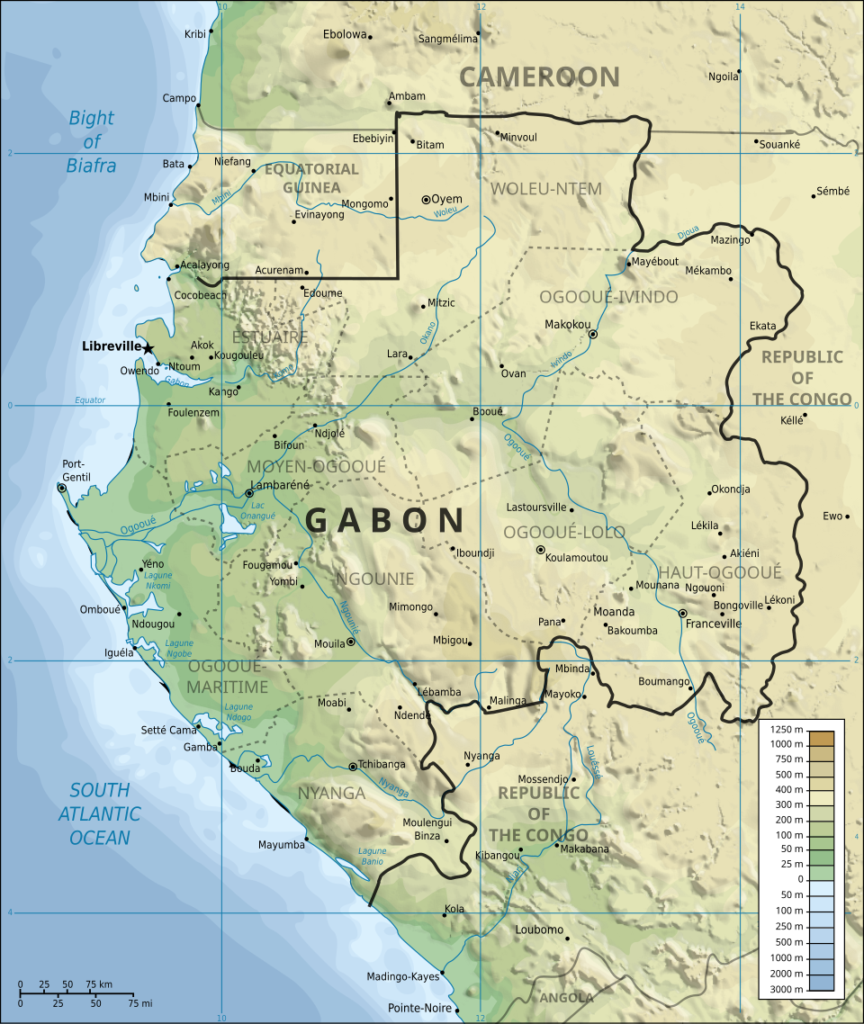
First they ruled out the boring explanations. The anomaly was not an instrument glitch; it repeated across samples. It was not contamination by spent or depleted uranium from the plant itself, because there was no uranium-236, the telltale fingerprint of material that has been through a man-made reactor. So the investigators walked the supply chain backward, from Pierrelatte to the conversion plant at Malvési, to the processing site at Gueugnon, and finally to the source: ore shipped by the COMUF mining company from a deposit in Gabon, a former French colony in West Africa. The place was called Oklo.
The deeper they looked, the stranger it got. The depletion was not uniform. It clustered in the rich northern part of the Oklo deposit, and in some batches the uranium-235 reading sank to 0.44 percent, nearly 40 percent below normal. (Decades later, more sensitive instruments would push that figure even lower, to around 0.36 percent in the most intensely burned ore.) Across uranium delivered between 1970 and 1972, more than 200 kilograms of uranium-235 was missing from the shipped ore alone, a fraction of what the reactors burned over their lifetime, but a mass of fissile material that, by one contemporary reckoning, rivaled what half a dozen Hiroshima-scale bombs would contain, and enough to give any safeguards officer a sleepless week.
One physicist understood what he was looking at. Francis Perrin and his colleagues found, alongside the missing uranium-235, the chemical wreckage of fission: distinctive ratios of elements like neodymium and ruthenium that match what splitting uranium leaves behind, not what ordinary rock contains. Natural neodymium is about 27 percent neodymium-142; the Oklo neodymium held less than 6 percent. There was only one way to read it. The ore had behaved like a reactor. On 25 September 1972, the CEA announced that self-sustaining nuclear chain reactions had run, on their own, inside an African ore body nearly two billion years before anyone thought to try it.
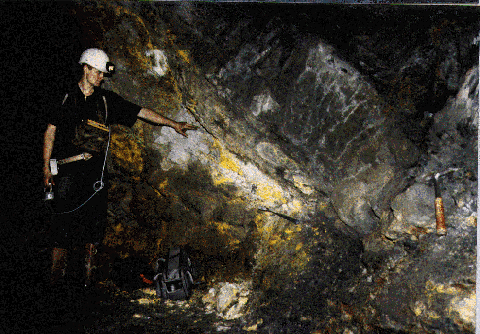
The truly uncanny part is that someone had called it. In 1956, a chemist at the University of Arkansas named Paul Kazuo Kuroda worked out the conditions under which a vein of uranium could ignite a chain reaction with no human help at all. He laid out the requirements: enough uranium-235, a deposit thicker than the distance a fission neutron travels, few neutron-absorbing impurities, and a moderator to tame the neutrons. The idea sat at the edge of plausibility for sixteen years, until a routine measurement in France proved him right.
What actually happened underground at Oklo
To see why Oklo worked, it helps to remember what a reactor needs. Fission is the splitting of a heavy atomic nucleus, here, uranium-235, when it swallows a passing neutron. The nucleus breaks into lighter fragments called fission products, releases energy as heat, and spits out two or three fresh neutrons. If at least one of those neutrons goes on to split another uranium-235 nucleus, the process feeds itself: a chain reaction. An isotope, meanwhile, is just one version of an element, uranium-235 and uranium-238 are both uranium, with the same chemistry, but different numbers of neutrons in the nucleus, and only the lighter one splits easily.
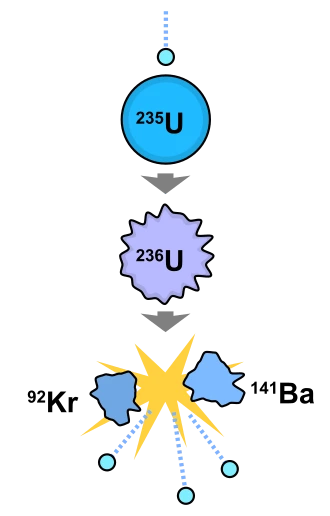
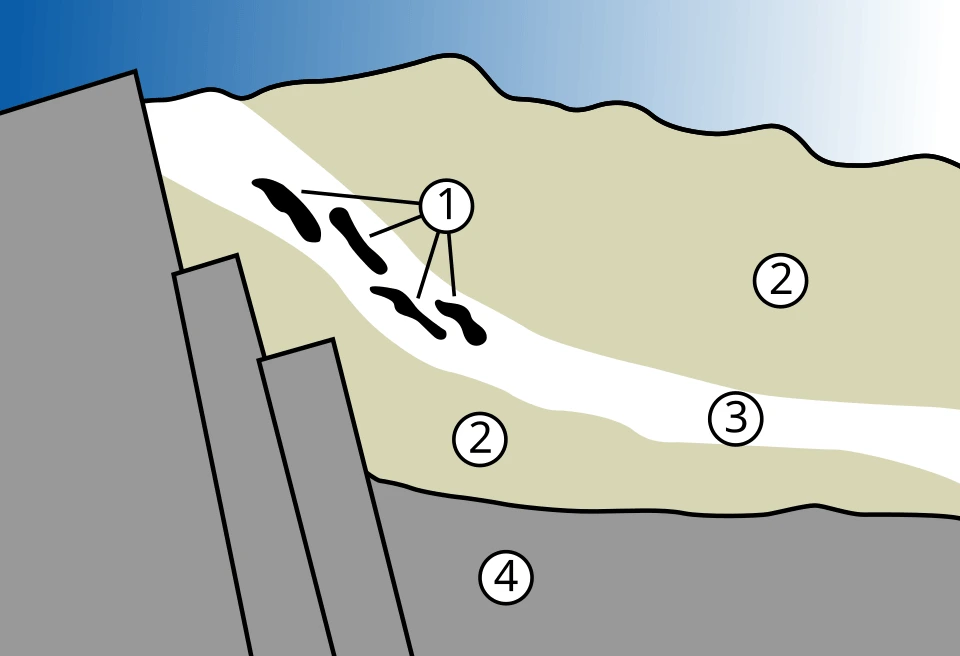
The catch is speed. Neutrons fly out of a fission event far too fast to be reliably caught by the next nucleus. They need slowing. The substance that does the slowing is a moderator, think of it as a referee that knocks the neutrons down to a gentler pace, the speed at which uranium-235 is most likely to catch one. In most modern power plants the moderator is ordinary water. At Oklo, the moderator was also water: groundwater, percolating through porous sandstone into the uranium-rich seams.
There was one more ingredient Oklo had and the present-day Earth lacks: fuel rich enough to burn. Today natural uranium is only 0.720 percent uranium-235, too dilute to sustain a chain reaction in ordinary water, which is exactly why power companies enrich their fuel to around 3 to 5 percent. But about two billion years ago, the natural uranium in those Gabonese seams was already over 3 percent uranium-235, the same ballpark as the fuel in a commercial light-water reactor today. Nature, in other words, was running pre-enriched fuel. Drop groundwater into a thick enough lens of that ore, with few neutron-poisoning impurities to spoil it, and the rock does the rest.
The numbers cut against intuition at both the large and small end. Across the Oklo and neighboring Okélobondo deposits, geologists eventually mapped sixteen separate reactor zones, with a seventeenth at Bangombé, a small deposit about 30 kilometers to the southeast. Each zone was small, a slab of ore a few meters across. Together they fissioned several tonnes of uranium-235, and bred plutonium besides, which decayed back into uranium-235 and offset some of the loss, leaving a net depletion of roughly five tonnes. And yet the power was modest: per zone, the output averaged roughly 100 kilowatts of heat, comparable to a handful of domestic space heaters, not a power station. The reactors ran, off and on, for a few hundred thousand years.
That phrase, a few hundred thousand years, matters, because a widely repeated figure of “150 million years” is simply wrong; it traces to a misstatement and does not reflect the geochemical dating. The honest number is hundreds of thousands of years, with individual zones estimated to have operated intermittently somewhere in the range of tens of thousands to a few hundred thousand years.
The pulse: a reactor that breathed like a geyser
The reactor’s rhythm is the part that still seems barely credible.
In 2004, three physicists at Washington University in St. Louis, Alex Meshik, Charles Hohenberg, and Olga Pravdivtseva, published a study in Physical Review Letters that read the reactor’s heartbeat. Their evidence was xenon, a noble gas produced when uranium fissions, locked for two billion years inside tiny grains of aluminous phosphate in the Oklo rock. Using a laser to vaporize the grains bit by bit and a sensitive mass spectrometer to count the atoms, they measured the highest concentrations of fission xenon ever found in any natural material.
The proportions of the different xenon isotopes were odd. They could not be explained by a reactor that simply ran at a steady simmer. But they fit beautifully if the reactor had switched itself on and off in a regular rhythm. The cycle they reconstructed: roughly 30 minutes of active fission, followed by about 2.5 hours of dormancy. Then on again. Over and over, for as long as the reactor lived.
“The specific isotopic structure of xenon in this mineral defines a cycling operation for the reactor with 30-min active pulses separated by 2.5 h dormant periods.”, Meshik, Hohenberg & Pravdivtseva, Physical Review Letters 93, 182302 (2004)
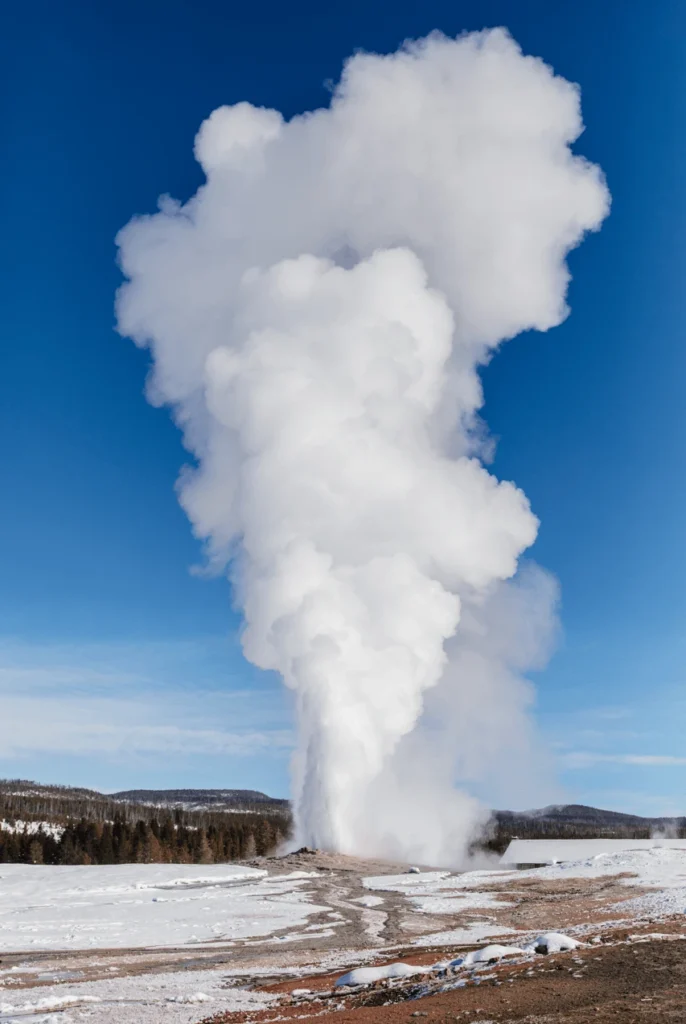
Picture it. Groundwater seeps into the ore and moderates the neutrons; the chain reaction kicks in; the rock heats up. After about half an hour, the water boils away as steam. With its moderator gone, the reaction stalls, the neutrons go back to flying too fast to be caught. The rock sits quiet for a couple of hours, slowly cooling, until liquid water seeps back in and the whole thing reignites. It is the exact logic of a geyser like Old Faithful, except that what the cycle was venting was not just steam but a controlled nuclear reaction. A reactor, deep in Precambrian rock, exhaling on a schedule, with no engineers, no control rods, no electronics, governed entirely by the boiling point of water.
That same self-regulation explains why Oklo never blew itself apart. As the rock warmed, the water thinned and the reaction throttled back; as it cooled, the water returned and the reaction resumed. The reactor held its own leash for hundreds of thousands of years.
Why this could only happen in the deep past
Oklo is a one-time event in Earth’s history, and the reason comes down to radioactive clocks. Uranium-235 and uranium-238 both decay, but at different rates, measured by their half-life, the time for half a sample to decay away. Uranium-235 has a half-life of about 700 million years; uranium-238’s is about 4.5 billion years, roughly six times longer. The fissile isotope, in other words, burns down its own candle far faster.
Run that backward. Because uranium-235 disappears more quickly, it made up a larger share of natural uranium the deeper you go into the past. Today it is 0.720 percent. Two billion years ago it was around 3 percent. At the birth of the solar system it was something like 24 percent. The window for a water-moderated natural reactor slammed shut long ago; with today’s dilute fuel, no ore body on Earth can go critical on groundwater alone. Oklo could happen because it happened when the planet’s uranium was still, in effect, reactor-grade.
But rich fuel is not enough, you also need to concentrate it, and that part of the story is bound up with the air we breathe. Uranium in its reduced form barely dissolves in water. In its oxidized form it dissolves readily, travels with groundwater, and can pile up where conditions change. For most of early Earth history the atmosphere had almost no free oxygen, so uranium stayed put and stayed dispersed. Then came the Great Oxidation Event, beginning around 2.4 billion years ago, when photosynthesizing microbes flooded the air and oceans with oxygen for the first time. Oxygenated groundwater could now dissolve uranium, carry it, and, on meeting reducing agents like organic matter, drop it back out as concentrated ore. The same planetary transformation that remade the sky also assembled the fuel for Oklo. The reactors ran during the Orosirian period of the Paleoproterozoic, around two billion years ago, when the most complex life on Earth was algae and the first single-celled eukaryotes.
Why Oklo still matters: testing a constant and burying our waste
A burned-out reactor in Gabon might seem like a closed case, but it is anything but. Oklo has become a natural laboratory for two questions that modern science cannot easily ask any other way.
Has the fine-structure constant drifted over cosmic time?
Here is what is at stake: if one of the universe’s basic constants has quietly drifted over billions of years, much of physics would need rewriting, and Oklo is one of the few places we can check. The constant in question is the fine-structure constant, written as the Greek letter alpha (α), which sets the strength of the electromagnetic force, how strongly light and charged particles interact. It is one of the pure numbers physics treats as fixed. But some theories that try to unify the forces or explain dark energy allow the “constants” to drift very slowly over billions of years. If alpha had a different value in the deep past, the energies at which atomic nuclei absorb neutrons would have shifted too.
In 1976 the physicist Alexander Shlyakhter realized Oklo could test this. A particular isotope, samarium-149, gobbles up slow neutrons through a resonance, a sharply tuned energy at which capture is wildly efficient, sitting at just about 0.1 electron-volts. That resonance is exquisitely sensitive to the value of alpha. By measuring how much samarium-149 the Oklo reactors burned away, you can ask whether that resonance sat where it sits today, two billion years ago.
The benchmark analysis came in 1996, when Thibault Damour and Freeman Dyson reworked the problem with care. Their conclusion, at 95 percent confidence, was a tight bound: the relative change in alpha since Oklo ran lies between roughly −0.9 × 10⁻⁷ and 1.2 × 10⁻⁷. A full reactor-physics reanalysis by Yuri Petrov and colleagues in 2006, using modern Monte Carlo neutron-transport codes, sharpened the modeling further. The crucial point, often mangled in popular accounts: Oklo has not shown that alpha changed; it is a null result, a demonstration that alpha has been remarkably steady, constraining any drift to a few parts in ten million or smaller over two billion years. Oklo is one of the most stringent limits we have on a wandering constant, precisely because it found no wandering.
Can we bury nuclear waste and trust the ground to hold it?
The second payoff is intensely practical. Every nuclear reactor today leaves behind fission products and heavier elements, actinides like plutonium, that stay dangerous for tens of thousands of years. The plan, broadly, is to bury this waste deep and trust the geology to keep it locked away. Oklo ran exactly that experiment, by accident, on a two-billion-year timescale.
The verdict is encouraging. In a 1991 paper in Nature, Bernd Nagy, François Gauthier-Lafaye and colleagues showed that in the organic-rich reactor zones, grains of uranium ore had been encased in solidified graphitic bitumen that held them in place. “Uraninite encased in solid graphitic matter in the organic-rich reactor zones lost virtually no fissiogenic lanthanide isotopes,” they wrote. The waste barely moved. Many fission products stayed put for two billion years; plutonium, by later accounts, migrated only a short distance from where it formed. Even the volatile xenon and krypton gases were trapped in mineral grains, which is how Meshik’s team could read the reactor’s pulse in the first place.
This is not a blanket reassurance, Oklo’s geology is specific, some elements did migrate locally, and engineers cannot simply copy a porous sandstone seam. But as a natural analog, it is the closest thing we have to a long-term field test, and it argues that the right rock can confine radioactive waste across spans of time that dwarf all of recorded human history.
There is a melancholy footnote. The Oklo reactor zones were found inside a working mine, and most have since been dug up for their ore. In 1997 Gauthier-Lafaye pleaded in Nature to preserve the last intact reactor, at Bangombé, calling it no less unique and far more irreplaceable than the most prized rocks brought back from the Moon or Mars. The deposit that taught us nature could run a reactor was largely consumed to fuel ours.
That is the strange double vision Oklo leaves you with. It is a record of the planet’s deep past: an atmosphere being remade, fuel rich enough to ignite, water boiling on a schedule beneath a world inhabited only by microbes. It is also a message about deep futures, because the same rock that cradled a reactor for hundreds of thousands of years can hold its ashes for two billion more. The oldest reactor on Earth is also, quietly, a rehearsal, for the hardest thing we have ever asked geology to do, which is to keep a secret across spans of time that dwarf all of recorded history.
Frequently asked questions
How old is the Oklo natural nuclear reactor?
The Oklo reactors went critical roughly 1.7 to 2 billion years ago, during the Paleoproterozoic. They ran intermittently for a few hundred thousand years before the fuel grew too depleted and the chain reactions stopped for good.
Did nature really make a nuclear reactor?
Yes. At Oklo in Gabon, naturally enriched uranium ore (over 3 percent uranium-235 at the time) combined with groundwater acting as a neutron moderator to sustain real fission chain reactions. The French Atomic Energy Commission confirmed it in 1972 from depleted uranium-235 and the chemical signatures of fission products.
Could a natural nuclear reactor form on Earth today?
No. Natural uranium is now only 0.720 percent uranium-235, too dilute to sustain a chain reaction with ordinary water as a moderator. Because uranium-235 decays faster than uranium-238, the fuel was rich enough only in the distant past.
Is Oklo radioactive and dangerous now?
The reactors burned out around two billion years ago, and short-lived radioactivity decayed long ago. Remarkably, the fission products and plutonium stayed largely locked in the surrounding rock, which is why Oklo is studied as a natural analog for long-term nuclear-waste storage.