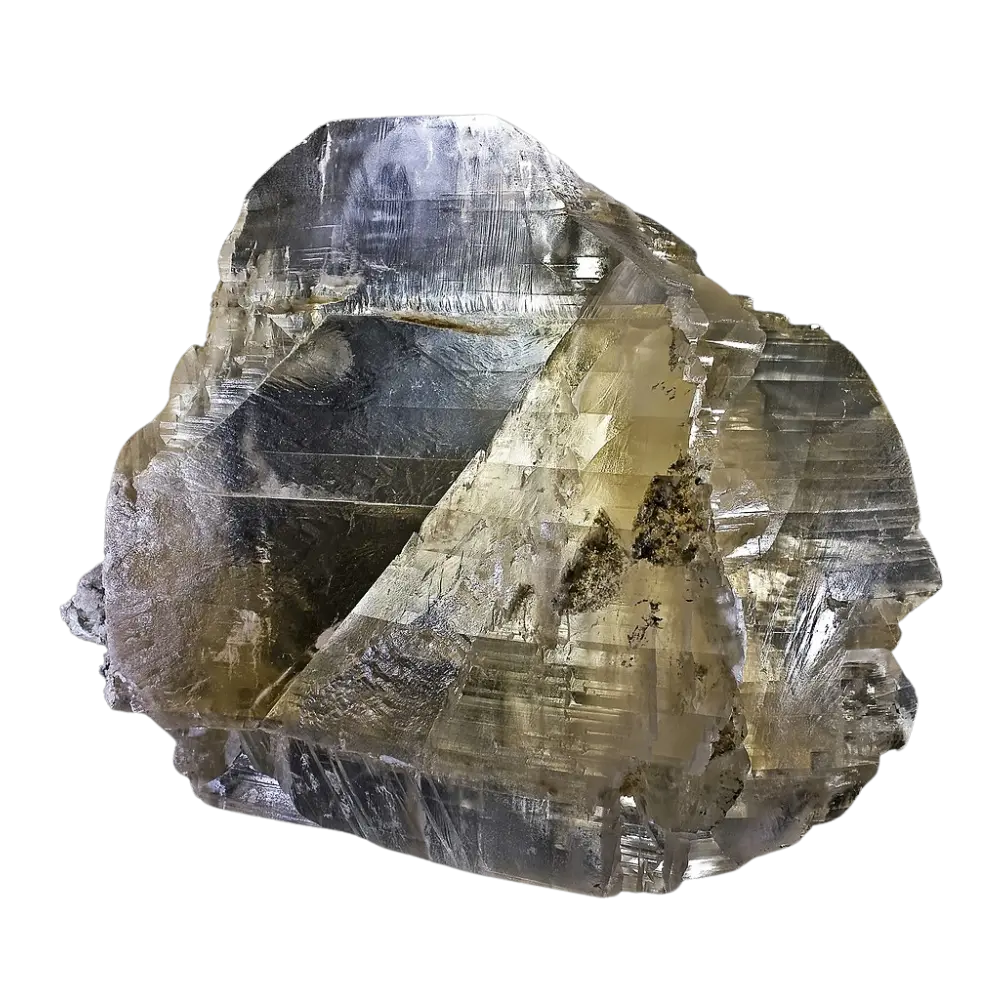

A paddlefish, upside down in sandstone, with glass beads packed between its gill rakers. The beads are no larger than couscous. Some are clear, some clay-altered to a soft peach colour, some still wrapped in a film of amber. They are tektites: droplets of melted rock thrown into the upper atmosphere by an asteroid impact and frozen as glass on the way back down. They came down through the sky from a crater 3,050 kilometres to the south, and they came down while the fish was still breathing.
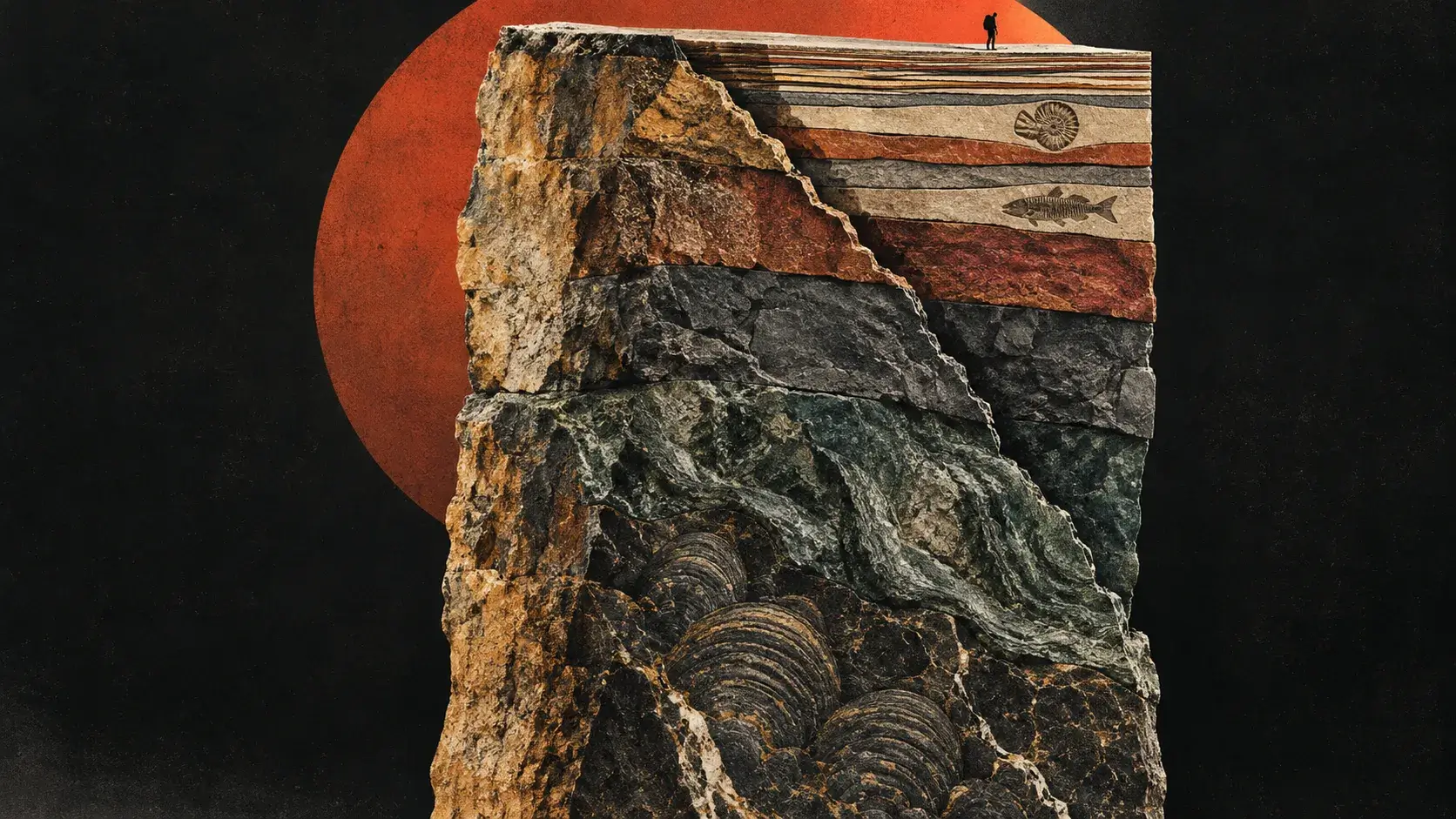
This is the central image of Tanis, a fossil deposit in the southwestern corner of North Dakota that has, since 2019, been argued to preserve the first hour of the Cretaceous–Paleogene mass extinction. The fish swam, opened its mouth, drew water across its gills, took in some of the rain of impact-melt glass that was falling on the river, and was killed within minutes by a surge of water that came inland from a vanished sea. The whole sequence is preserved as a 1.3-metre package of graded sediment, capped by a clay layer enriched in iridium and shocked quartz. Above the cap, the Paleocene. Below it, the last day of the Mesozoic.
No other fossil site is quite like it. It is also one of the most contested in palaeontology.
A point bar on a Cretaceous river
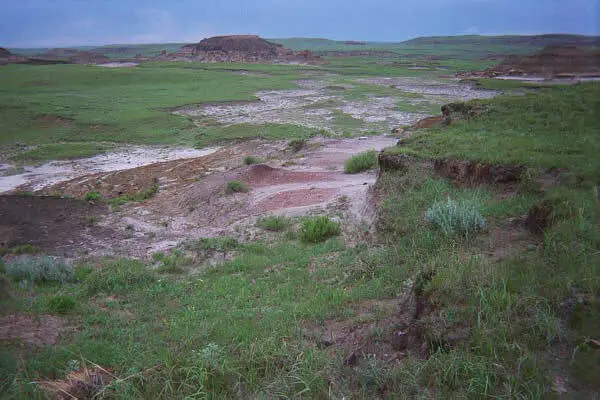
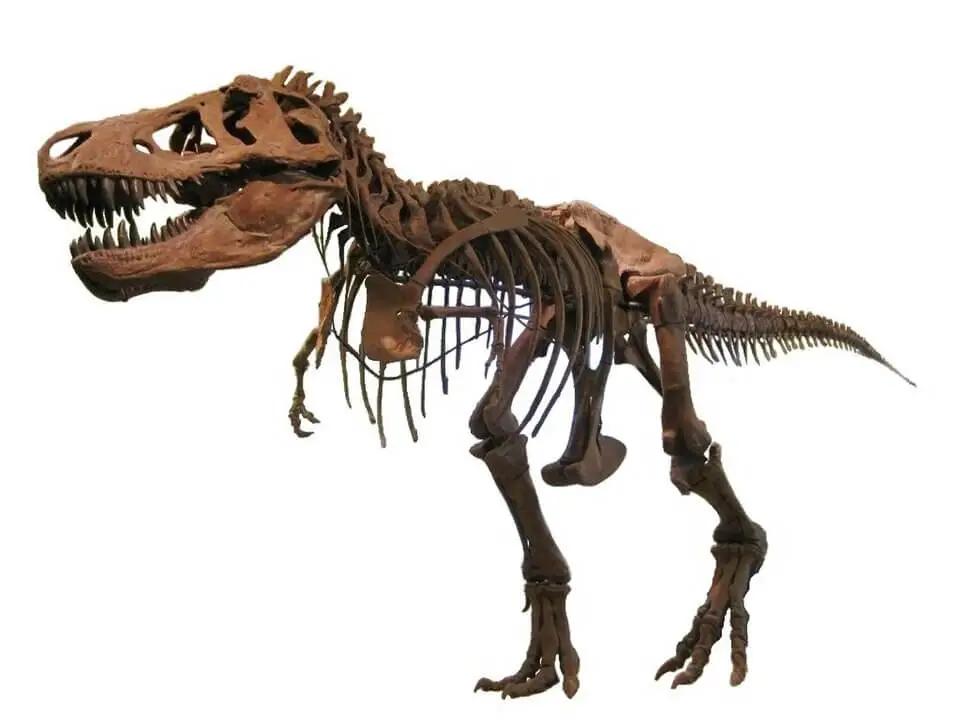
The deposit sits inside the Hell Creek Formation, the band of Late Cretaceous fluvial sandstones and mudstones that crops out across eastern Montana, western North and South Dakota, and northeastern Wyoming. Hell Creek is the rock unit that produced the holotype of Tyrannosaurus rex, collected by Barnum Brown in 1902 and named by Henry Fairfield Osborn in 1905. It is also the rock that carries the K-Pg boundary in this part of North America, the thin layer of clay that marks the end of one geological period and the start of the next, dated by 40Ar/39Ar to 66.043 ± 0.011 million years ago (Renne et al., 2013).
Tanis itself is in Bowman County, on private land. The exposed sequence shows a meandering river that flowed eastward into the Western Interior Seaway, the shallow inland sea that split North America in two during the Late Cretaceous. The site is a fossilised point bar, the inner bank of a river bend, where sediment is normally deposited slowly during floods. On top of the point bar sand sits something out of place: a chaotic, graded sediment package about 1.3 metres thick, divided into two graded subunits, with the lower (~50 cm) and upper packages each recording flow directed inland, against the normal seaward drainage of the river (DePalma et al., 2019). At the top of the package sits a 1- to 2-cm clay layer, peach-coloured, that contains the iridium anomaly and the shocked quartz familiar from K-Pg boundary clays around the world (Alvarez et al., 1980; DePalma et al., 2019).
The thickness is unremarkable. The cargo is not. Articulated paddlefish and sturgeon, some over a metre long, lie aligned in the lower unit, their bodies oriented by the current. Branches, charred tree trunks, pieces of ammonite shell, lungs full of mud, fragments of teeth and bone, all of these sit together, mixed but not broken, as if a single pulse of water had picked them up and put them down within minutes. Amber blebs in the deposit contain tiny glass spherules trapped inside them, droplets of impact melt frozen in tree resin within seconds of falling (DePalma et al., 2019).
The site is what palaeontologists call a Konservat-Lagerstätte, a fossil deposit characterised by atypically well-preserved and articulated body fossils. The German word literally means “conservation storage place,” and the term is reserved for the small handful of localities where geology has paused long enough to record soft tissue and three-dimensional skeletons. The Burgess Shale and the Solnhofen Limestone of Archaeopteryx fame are two. Tanis is unusual even among them because the event that buried it can be dated almost to the second.
Discovery of the Tanis fossil site
The deposit was first noticed in 2008 by the University of North Georgia palaeontologist Steve Nicklas and the commercial collector Rob Sula, who took it for an ordinary pond bed several thousand years older than the K-Pg boundary. They brought in Robert DePalma, then a PhD student at the University of Kansas, who began systematic excavation in 2012. DePalma leases the site from the landowner and holds primary access, an arrangement that has shaped much of what followed.
DePalma’s first interpretation matched Nicklas and Sula’s: an ordinary fluvial pond. There were too many fish, articulated where they should have been scattered, and the flow indicators ran inland against the river’s normal seaward drainage. Then DePalma’s team found the spherules, identified them as impact-melt glass, traced their composition to the Chicxulub crater in the Yucatán, and the site changed character entirely. Tanis was synchronous with the impact.
DePalma named the site for the Egyptian city that appears in Raiders of the Lost Ark as the lost resting place of the Ark of the Covenant. The 2019 paper introducing the deposit appeared in the Proceedings of the National Academy of Sciences with twelve co-authors, among them Walter Alvarez of Berkeley, son of Luis Alvarez and co-discoverer of the iridium anomaly in 1980, and Jan Smit of the Vrije Universiteit Amsterdam, the other foundational figure of K-Pg impact stratigraphy. The co-authorship was a kind of imprimatur. Alvarez and Smit had spent four decades arguing that an asteroid killed the dinosaurs. Here was a site they were willing to call the smoking gun.
The PNAS paper appeared on 1 April 2019, three days after Douglas Preston’s profile of DePalma in The New Yorker described dinosaur fossils, hatchlings, and feathered carcasses at the site, most of which were not in the peer-reviewed manuscript. The mismatch produced an immediate response from other Hell Creek workers. Kirk Johnson of the Smithsonian, who had been mapping the K-Pg boundary in the area since 1981, told The New Yorker he had been “so skeptical” of DePalma’s early conference talk that he was, at first, “convinced it was a fabrication.” Others noted DePalma’s previous misidentification of a turtle bone in the holotype of his 2015 raptor Dakotaraptor. DePalma is an unusual figure for the field: largely self-funded, partly supported by commercial fossil sales, with a tight grip on access to his specimens.
The parts of the science that have been independently tested have mostly held up.
Why this is not a tsunami
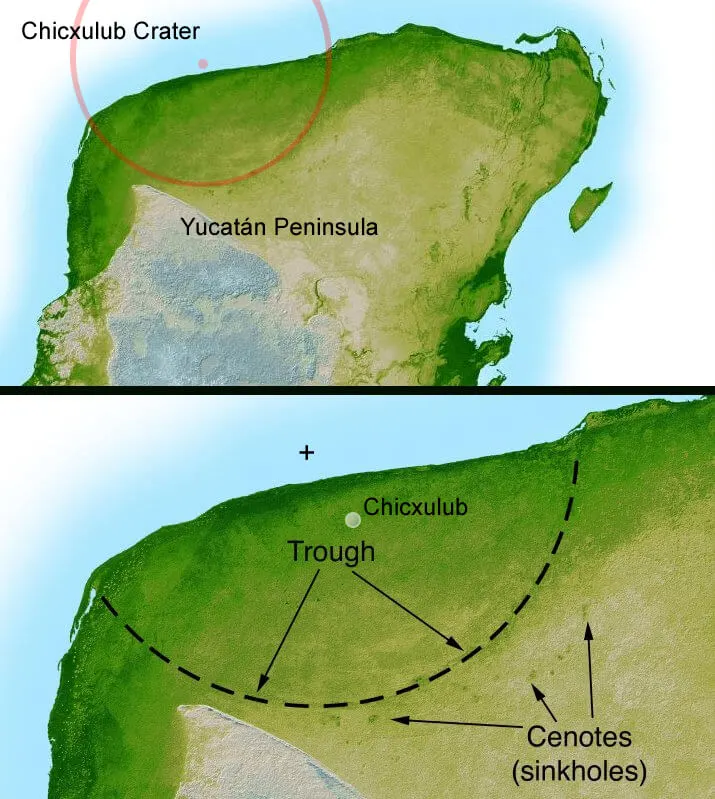
The most pressing question about Tanis is how a freshwater point bar 3,050 kilometres from the impact site received marine fossils, impact ejecta, and a 10-metre pulse of inland-directed water within roughly an hour of the asteroid striking the Yucatán. The obvious answer is a tsunami. It cannot be.
The seismic argument
A tsunami radiating outward from Chicxulub through the Gulf of Mexico and up the Western Interior Seaway would have needed many hours, perhaps 17 to 20, to reach the latitude of Tanis. The seaway was shallow, and a long-period gravity wave entering shallow water dissipates quickly. Even if the wave had made it that far, it would have arrived long after the rain of glass spherules had stopped. The spherules are atmospheric ejecta. They have ballistic flight times of minutes to roughly an hour, depending on launch angle and re-entry altitude. Tanis has both spherules and a surge deposit in physical contact with one another, with the spherules sitting within the deposit and on top of it. The two events were concurrent. A Gulf tsunami cannot be concurrent with spherule fall at this distance. Some other mechanism delivered the water.
DePalma’s team, working with Mark Richards of UC Berkeley, argued that the mechanism was a seiche, a standing wave set up in an enclosed or semi-enclosed body of water by ground motion from a large earthquake. The Chicxulub impact, releasing energy on the order of 10⁸ megatons of TNT, would have generated seismic waves equivalent to a magnitude 10 to 11 earthquake at the source. P (compressional) waves travel through the deep Earth at around 8 km/s; from Chicxulub to Tanis is a paleoepicentral distance of about 3,050 km. The 2019 paper calculated that P waves would arrive at Tanis about 6 minutes after impact, S (shear) waves about 10 minutes, and Rayleigh surface waves about 13 minutes (DePalma et al., 2019). The ejecta arrival window is comparable. The seismic waves and the spherules would have hit Tanis at the same time.
There is precedent for the seiche mechanism on a smaller scale. The magnitude 9.0 Tōhoku earthquake in Japan in March 2011 set off seiches in western Norwegian fjords, with maximum trough-to-peak amplitudes of 1.0 to 1.5 metres in Sognefjorden, about 8,300 km from the epicentre, beginning roughly half an hour after the rupture (Bondevik et al., 2013). Richards used that footage as a sanity check for the Tanis mechanism. Scale the earthquake up by three or four orders of magnitude in energy and the standing waves in a shallow inland sea are no longer 1.5 m high, they are tens of metres. DePalma’s 2019 paper estimated that seismically induced seiches in the Western Interior Seaway could have produced amplitudes “of the order 10 to 100 m,” with a minimum runup at Tanis of at least 10 m inferred from the deposit’s vertical extent above the channel.
Modeling the surge
For five years, the seiche idea sat at the level of a back-of-the-envelope calculation. In May 2024, Randall LeVeque of the University of Washington and a team that included DePalma, Smit, Richards, and the tsunami sedimentologist Carrie Garrison-Laney published a numerical-modelling paper in the Journal of Geophysical Research: Solid Earth that began to test it (LeVeque et al., 2024). The paper used the open-source tsunami code GeoClaw, combined with synthetic seismograms from the modeslib code, to simulate both tsunami propagation up a paleo-Western Interior Seaway and seismically induced standing waves locally at Tanis.
The conclusions were narrower than the 2019 paper’s. LeVeque et al. described the Tanis package as two “massive, ∼10-m-high, potentially impact-triggered surges” that ran up a steep, deeply incised paleo river valley from the direction of the seaway. They confirmed that “the interpreted timing for deposition (including ejecta infall) of ∼1-2 hr immediately post-impact precludes a direct tsunami from the Chicxulub impact site, which would have required much more than 10 hr to reach Tanis.” A pure seiche driven by short-period seismic waves was harder to fit to the observations than the original paper implied. The modelling suggested instead that a longer-period source, perhaps a long-duration crater-rebound process at Chicxulub itself generating water waves over many minutes rather than seconds, would be needed to deliver enough advective transport of marine organisms tens of kilometres up the river system. The mechanism is still a “tsunami-like surge,” but the physics is more complicated than the bathtub-slosh image of a textbook seiche.
The model refines and constrains the field evidence rather than contradicting it. The 2024 working model is two surges, each around 10 metres in runup, arriving within an hour or two of the impact and depositing the lower (Unit 1) and upper (Unit 2) packages.
Glass beads in the gills
The spherules at Tanis are the chronological clincher. They are splash-form and round, with the majority ranging from 0.3 to 1.4 mm in diameter (DePalma et al., 2019). They occur throughout the deposit and concentrate at the contact between the upper part of the deposit and the iridium-rich tonstein cap. A tonstein, for the reader new to the term, is a thin clay bed altered from volcanic ash or other very fine air-fall material; the K-Pg tonstein is the global ash-and-ejecta layer altered to clay by the last 66 million years of groundwater. Chemically and mineralogically, the Tanis spherules match Chicxulub impact ejecta described from K-Pg boundary sites in Haiti, Mexico, and the deep-sea cores in the Gulf of Mexico.
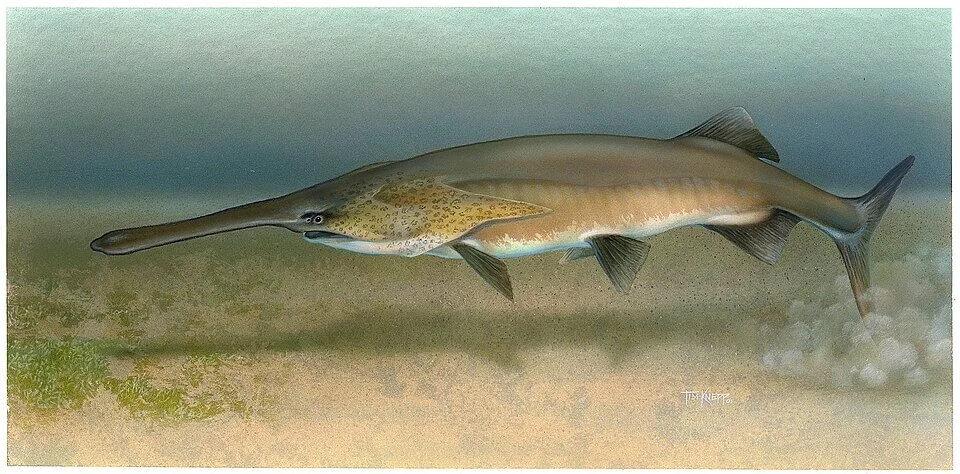
About half of the freshwater fish at Tanis carry spherules wedged between their gill rakers (DePalma et al., 2019). The fish are filter-feeders, passive suspension feeders that swim with their mouths open and sieve plankton from the water. They aspirated the spherules from the river as the ejecta fell. The 2019 paper presents X-ray images of a sturgeon skull (specimen FAU.DGS.ND.161.115.T) and micro-CT scans of a paddlefish (FAU.DGS.ND.161.29.T) with the spherules visible as small bright spheres clustered behind the gill bars. During et al. (2022) later reproduced this with synchrotron-radiation tomography of a different paddlefish (FAU.DGS.ND.161.4559.T), down to the cellular level. The spherules are unambiguously present in the gill region in three independent imaging studies.
A second piece of evidence comes from amber. Some of the spherules at Tanis were captured in tree resin within seconds of falling and remained sealed off from the surrounding sediment chemistry. These unaltered glassy spherules preserved primary impact-melt compositions and gave the team a clean chemical fingerprint. The fingerprint matches Chicxulub. The site is, at minimum, K-Pg-synchronous to within hours.
How the Tanis fish revealed the season of the K-Pg impact
If Tanis records a single day, that day should be datable to a season, because fish bones grow in seasonally modulated bands. Acipenseriform fish, the order that contains sturgeons and paddlefish, lay down annual lines of arrested growth in their pectoral spines and dermal plates, with rapid summer growth and slow winter growth separated by clear boundaries. The thickness of the outermost growth band records how far the animal had progressed through its current year when it died. The carbon and oxygen isotope ratios in that band record the seasonal cycle of food availability and water temperature.
In December 2021, DePalma and colleagues published a paper in Scientific Reports arguing, on the basis of fish growth-band histology and isotope data, that the Tanis fish died in spring or summer of the Northern Hemisphere (DePalma et al., 2021). They placed the impact in “late Spring to mid-Summer.”
In February 2022, Melanie During, then a PhD student at Uppsala University working with Per Ahlberg, published an independent analysis in Nature. During’s team used propagation phase-contrast synchrotron-radiation micro-CT scanning of three paddlefish and three sturgeons from Tanis, examining the cellular-level structure of the bone, combined with carbon-isotope records from the dermal plates. They concluded that the fish had just resumed rapid post-winter growth and had not yet reached the summer feeding peak (During et al., 2022). The Mesozoic, they wrote, “terminated in boreal spring.”
Two teams, working largely independently on different specimens with different methods, converged on the same answer: the asteroid hit in Northern Hemisphere spring. During et al. (2022) themselves argued that the timing matters for who survived. As they wrote in their Nature paper, “we postulate that the timing of the Chicxulub impact in boreal spring and austral autumn was a major influence on selective biotic survival across the Cretaceous–Palaeogene boundary”: Northern Hemisphere taxa would have been breeding, with eggs and hatchlings exposed, while Southern Hemisphere taxa entering austral-winter dormancy may have been better shielded from the immediate thermal pulse. The hypothesis is still being tested. The seasonal constraint itself is now treated as broadly secure.
What kind of asteroid was the Chicxulub impactor?
The identity of the impactor itself was finally pinned down by a different group entirely. In August 2024, Mario Fischer-Gödde and colleagues at the University of Cologne published a Science paper measuring ruthenium isotope ratios in the K-Pg boundary clay at three widely separated sites: Stevns Klint in Denmark, the Bottaccione section near Gubbio in Italy, and Caravaca in Spain (Fischer-Gödde et al., 2024).
Ruthenium is one of the platinum-group elements. It is rare in the Earth’s crust because most of it sank into the core during planetary differentiation. It is enriched in meteoritic material, and its isotope ratios (100Ru, 101Ru, 102Ru, 104Ru) vary in characteristic ways depending on where in the solar nebula the parent body formed. Inner-solar-system bodies, including ordinary silicate (S-type) asteroids, have one signature. Outer-solar-system bodies, including carbonaceous (C-type) asteroids that formed beyond Jupiter’s orbit, have another. The two reservoirs barely mixed.
The K-Pg ruthenium-isotope signature, at all three boundary sites, matched carbonaceous chondrites. The Chicxulub impactor was a C-type asteroid that formed in the outer solar system, beyond Jupiter, in a reservoir that today supplies only about five per cent of the meteorites that fall to Earth. Whether it spent the intervening 4.5 billion years parked in the outer asteroid belt or arrived more directly is unresolved. Fischer-Gödde’s team also measured ruthenium at five other Phanerozoic impact structures, including Popigai, Brent, Clearwater East, Morokweng, and the Archaean Barberton ejecta layers, and found all of them consistent with ordinary chondrite or silicate-asteroid sources. The Chicxulub impactor was an outlier among the large Phanerozoic impactors that have been measured this way.
That result strongly disfavours the comet hypothesis put forward by Siraj and Loeb (2021), who used statistical simulations to argue that gravitational deflection of Oort-cloud long-period comets toward the Sun could have produced Chicxulub-scale fragments. Carbonaceous chondrites and Oort-cloud comets have different ruthenium-isotope signatures, and the boundary clay matches the asteroid reservoir.
The Fischer-Gödde paper has nothing to do with DePalma or Tanis directly. It is one of the cleanest results in the K-Pg story, independent of any of the Tanis controversy.
The DePalma data controversy
Tanis has also been the site of an ugly authorship dispute that overlapped the science from 2017 onward, surfaced publicly in late 2022, and produced a formal misconduct investigation that did not return its verdict until December 2023.
PubPeer, December 2022
In August 2017, Melanie During spent two weeks at Tanis as a Vrije Universiteit Amsterdam master’s student, working with Jan Smit. She excavated paddlefish and sturgeon specimens, returned to the Netherlands, and began the geochemical analyses that would become her PhD work at Uppsala. She submitted her manuscript to Nature on 22 June 2021, listing DePalma as the study’s second author at that point. In December 2021, with her paper still in review, DePalma published his own seasonality paper, using different specimens but the same isotopic logic, in Scientific Reports. During’s Nature paper appeared two months later. Both reached the same headline conclusion.
During and her colleagues read the Scientific Reports paper closely and concluded that the published figures were not what they appeared to be. The carbon- and oxygen-isotope plots showed missing data points, duplicated values, and error bars of identical length across different scales, patterns characteristic of figures drawn by hand rather than generated by an instrument’s output software. The paper did not include the raw machine data. It did not identify the laboratory where the analyses had been performed. The analyses were described as the work of the geochemist Curtis McKinney, who had died in 2017. After a year of inconclusive correspondence with the Scientific Reports editors, During made the allegations public.
On 3 December 2022, she posted a statement on the post-publication review site PubPeer asking whether the DePalma 2021 data “may be fabricated, created to fit an already known conclusion.” On 6 December 2022, Science magazine published Michael Price’s reporting under the headline “Paleontologist accused of faking data in dino-killing asteroid paper” (Price, 2022). On 9 December 2022, Scientific Reports added an editor’s note to the paper:
Readers are alerted that the reliability of data presented in this manuscript is currently in question. Appropriate editorial action will be taken once this matter is resolved.
The note remains on the paper at the time of writing.
DePalma denied wrongdoing. “We absolutely would not, and have not ever, fabricated data and/or samples to fit this or another team’s results,” he wrote to Science. During and Ahlberg submitted a formal complaint to the University of Manchester, where DePalma had registered as a PhD student in October 2021 under Phillip Manning.
Manchester’s verdict
The University of Manchester investigation, supplemented by an Appeal Panel, ran for a year. On 15 December 2023, the university published its findings under the headline “Palaeontologist cleared of fabricating data in dino-killing asteroid paper.” The two key conclusions, in the university’s own words:
Robert DePalma did not fabricate data.
Although there was no evidence of fabrication, there were several instances of poor research practice in the way the isotope data was managed and presented, which together constituted research misconduct, but did not invalidate the conclusions of the Scientific Reports paper.
The statement noted that DePalma, while registered for a PhD at the University of Kansas, had received no formal supervision between 2013 and 2021 following the death of his Kansas supervisor Larry Martin, and that this likely contributed to the poor practices. Manchester also fully exonerated DePalma’s co-authors Phillip Manning and Roy Wogelius, who, in the university’s wording, “had no supervisory responsibilities for DePalma at the point the Scientific Reports paper was submitted and had no responsibility for supervising the isotope work.” The investigation accepted video evidence from During’s August 2017 site visit showing that DePalma had already been working on seasonality and isotope analysis for years before her arrival, undermining the accusation of intellectual theft.
In November 2024, During, Voeten, van der Lubbe and Ahlberg published a follow-up critique in PeerJ, formalising the methodological concerns: missing primary data, unidentified laboratory, methods insufficient to enable accurate replication, and isotopic graphs with irregular data and error bars (During et al., 2024). They did not allege fabrication in that paper. They argued that the DePalma 2021 results, as published, are not reproducible from the information provided.
A Manchester update appended to the statement in August 2025 said the isotope experiments had been re-run with appropriate supervision and the new data “corroborates the original findings,” with Scientific Reports consulting its research-integrity team about whether to replace the old data via correction. As of May 2026, the editor’s note on the 2021 paper has not been lifted and no correction or retraction has appeared.
What the controversy did not touch
The misconduct finding is narrow. It applies to one paper: DePalma et al. 2021, Scientific Reports. It does not touch the following.
The 2019 PNAS paper that introduced Tanis. That paper concerns the sedimentology, the spherules, the iridium cap, the seiche hypothesis, and the basic stratigraphy. None of its data have been credibly challenged.
The seasonal conclusion. During et al. 2022 reached the same boreal-spring answer using different specimens and a different method, with raw data, named laboratories, and full reproducibility. The seasonality of the K-Pg impact is supported regardless of what one thinks of the Scientific Reports paper.
The ruthenium-isotope provenance of the impactor. Fischer-Gödde et al. 2024 is the work of an entirely different team analysing a different signal at different sites. The C-type asteroid result is independent of Tanis.
The seiche-mechanism modelling. LeVeque et al. 2024 was performed by a numerical-tsunami modeller using open-source software with code archived on Zenodo. The work refined and constrained the original 2019 hypothesis. It did not depend on the contested isotope dataset.
The taxonomy of the Tanis fish. Hilton and Grande (2023) described two new sturgeon species from the site, Acipenser praeparatorum and Acipenser amnisinferos, in the Journal of Paleontology. A companion paper later that year by Hilton, During, Grande and Ahlberg (2023) named two new monotypic paddlefish genera from Tanis, Parapsephurus willybemisi and Pugiopsephurus inundatus. Both pieces of taxonomic work were carried out at the Field Museum on specimens prepared from the Tanis sandstone over several years by museum preparators. They stand on their own.
The site itself is not in doubt. The spherules sit in the gill rakers, the iridium cap is above them, the surge deposit runs inland against the river’s drainage. The publication history has been ugly; the rocks have not changed.
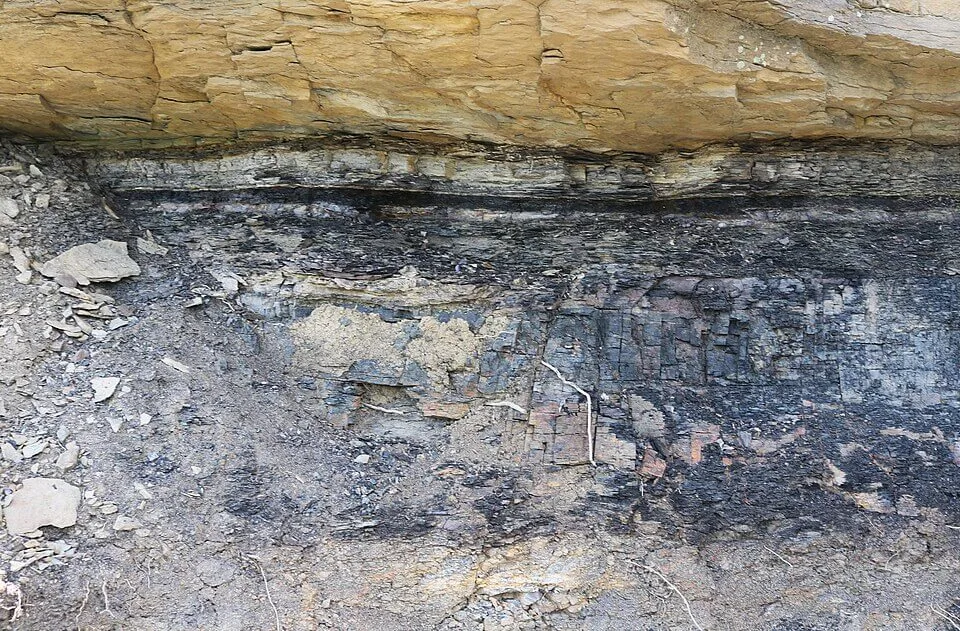
Two centimetres above the gill of a paddlefish that died on a Cretaceous spring morning, in a thin peach-coloured clay made of fused melt and atmospheric dust from the Yucatán, the iridium concentration spikes from background to 3.8 parts per billion. Above the clay is the impoverished fern flora of the early Paleocene. Below it, dinosaurs. The cap is not a metaphor: the world ended in that one centimetre, and you can put a fingernail on the line.
Frequently asked questions
Where is the Tanis fossil site located?
Tanis is in Bowman County, in the southwestern corner of North Dakota, within the Hell Creek Formation. The site is on private land leased by Robert DePalma and is not open to the public. It lies approximately 3,050 kilometres north of the Chicxulub impact crater, which is buried beneath the northern Yucatán Peninsula in Mexico.
Did the Tanis fossils really die on the day of the dinosaur extinction?
The strongest evidence is the presence of Chicxulub-derived impact spherules between the gill rakers of about half of the fish at the site, capped by an iridium- and shocked-quartz-rich tonstein that matches K-Pg boundary clays worldwide. Spherules fall back to Earth within minutes to about an hour of an impact. For the fish to have inhaled them and then been buried alongside them, deposition must have occurred during the same brief window. Independent modelling (LeVeque et al., 2024) places the event 1 to 2 hours after the Chicxulub impact at 66.043 ± 0.011 million years ago (Renne et al., 2013).
What season did the dinosaurs go extinct?
Boreal (Northern Hemisphere) spring. Two independent analyses of fish growth bands and isotopes from Tanis (DePalma et al., 2021; During et al., 2022) reached the same conclusion. The During Nature paper used synchrotron tomography on paddlefish and sturgeon specimens that were just entering their spring growth period when they died. The DePalma Scientific Reports paper later attracted a misconduct finding for its data handling, but its seasonal conclusion is corroborated by the independent During analysis.
Is Robert DePalma still trusted as a paleontologist?
A University of Manchester investigation concluded on 15 December 2023 that DePalma “did not fabricate data” but committed “several instances of poor research practice in the way the isotope data was managed and presented, which together constituted research misconduct.” The finding applies to the 2021 Scientific Reports paper. The 2019 PNAS paper introducing Tanis was not part of the misconduct investigation and is not under question. DePalma’s co-authors Phillip Manning and Roy Wogelius were fully exonerated. DePalma continues to work the site.
How did the asteroid impact reach Tanis 3,000 km away within hours?
Not as a tsunami. The Chicxulub impact released energy equivalent to a magnitude 10 to 11 earthquake at the source, sending seismic waves that arrived at Tanis within roughly 6 minutes (P), 10 minutes (S) and 13 minutes (Rayleigh) after impact. The ground shaking set off standing waves, seiches, in the Western Interior Seaway, the shallow inland sea then occupying central North America. Numerical modelling by LeVeque et al. (2024) shows two roughly 10-metre surges running up the paleo river valley toward Tanis within the first hour or two, depositing the lower (Unit 1) and upper (Unit 2) sediment packages while ejecta were still raining down.