



Introduction
At 5:02 p.m. local time on January 15, 2022, an undersea volcano in the South Pacific blew the top off the day. Hunga Tonga–Hunga Haʻapai, a submarine caldera about 65 kilometers north of Tonga’s capital, drove a plume of ash, gas, and vaporized seawater more than 58 kilometers into the sky, past the stratosphere and into the mesosphere, higher than any eruption cloud ever measured. And inside that churning column, something extraordinary switched on: volcanic lightning. Not a few scattered bolts, but the most intense lightning storm ever recorded, igniting flashes at a rate no thunderstorm has ever matched.
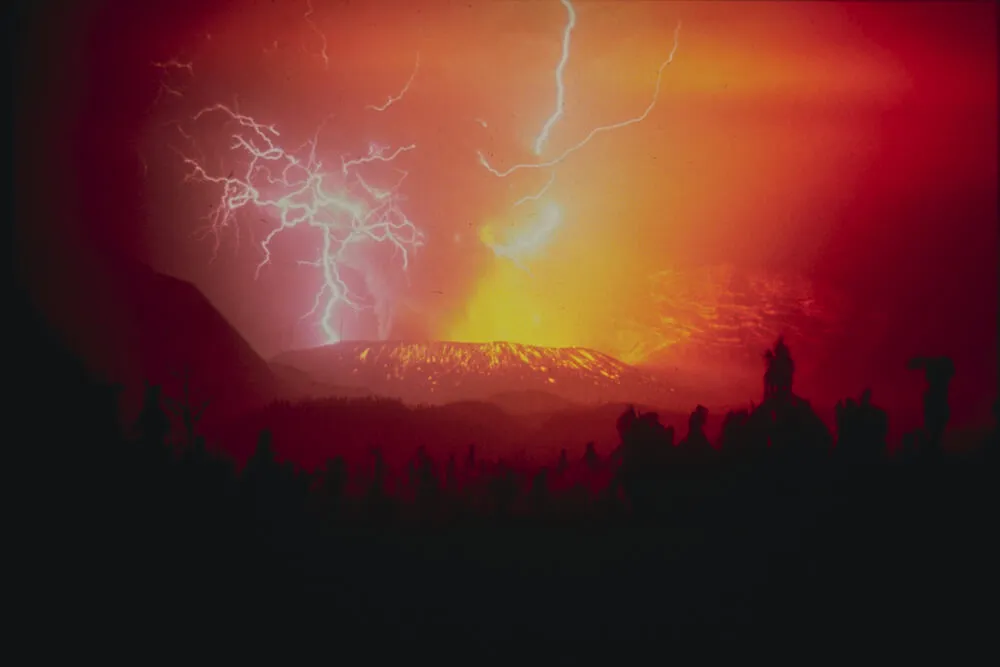
That single event, dissected in a 2023 study led by U.S. Geological Survey volcanologist Alexa Van Eaton, reframed how scientists think about the eerie, branching discharges that crackle through erupting ash columns. These “dirty thunderstorms” are not a curiosity at the edge of volcanology. They are now a tool, a warning system, and a window into the violent interior of an eruption cloud. How does a volcano make lightning with no storm clouds in sight? Why did Hunga Tonga break every record? And how does a global network of antennas now listen for these flashes to keep aircraft out of harm’s way? The answers start with a single, record-shattering night.
The night the sky over Tonga broke a record
The headline number is almost hard to believe. According to Van Eaton and colleagues, writing in Geophysical Research Letters in 2023, the Hunga eruption produced the most intense volcanic lightning ever documented. Subsequent reporting put the total at roughly 192,000 lightning flashes, made up of nearly half a million individual electrical pulses, over the course of the eruption. At the peak, the storm fired 2,615 flashes per minute, or roughly 43 flashes every second. The previous documented record was 993 flashes per minute, set during a thunderstorm over the southern United States in 1999. Hunga Tonga more than doubled it.
“With this eruption, we discovered that volcanic plumes can create the conditions for lightning far beyond the realm of meteorological thunderstorms we’ve previously observed,” Van Eaton said in the USGS and American Geophysical Union announcement of the findings. “It turns out, volcanic eruptions can create more extreme lightning than any other kind of storm on Earth.”
The lightning also reached unprecedented heights. Optically bright flashes were detected in regions of the volcanic cloud 20 to 30 kilometers above sea level, the highest-altitude lightning ever measured. And the flashes were not scattered randomly. The satellite and radio data revealed that the lightning organized itself into enormous concentric rings, donut-shaped bands of electrical activity that expanded outward across the plume. At least four distinct lightning rings formed between 04:16 and 05:51 UTC, with a final ring from 08:38 to 08:48. The largest spanned roughly 280 kilometers, about 140 kilometers in radius, riding a gravity wave that surged outward through the umbrella cloud at more than 80 meters per second, around 180 miles per hour. The team tied these rings to gravity waves, fast-moving ripples in the umbrella cloud, “analogous to a rock dropped in a pond,” as the paper put it, generated by each pulse of explosive energy from below.
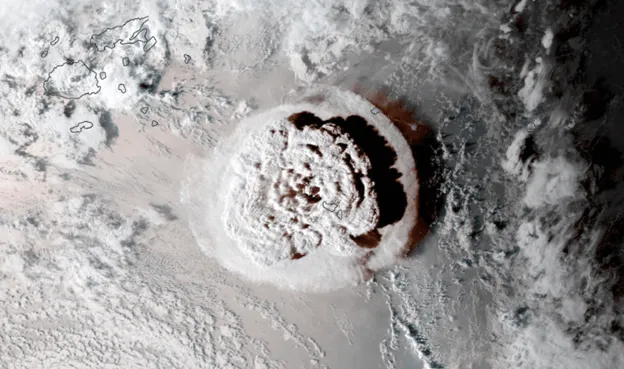
These lightning rings were a newly documented phenomenon; nobody had seen anything like them before. And it was only possible to study them because of how the eruption was observed: not from the vent, which was buried under ocean and obscured by the towering plume, but from a distance, by satellites overhead and radio antennas thousands of kilometers away that picked up the electromagnetic crackle of each flash. The lightning itself became the data.
That distance paid an unexpected dividend. By tracking the lightning, the researchers could reconstruct the eruption’s timeline with a precision the satellite imagery alone could not provide. “The eruption lasted much longer than the hour or two initially observed,” Van Eaton noted; the analysis showed the January 15 event ran for at least 11 hours. The lightning, in other words, was narrating the eruption in real time, pulse by pulse.
The central puzzle: how do volcanoes make lightning with no storm?
Volcanic lightning forms when an eruption generates electric charge without any thundercloud. Near the vent, colliding and fracturing ash particles build up charge directly from the rock. Higher up, if the plume carries enough water to freeze, it grows an ice-charged thunderstorm of its own. Big eruptions run both processes at once.
The textbook recipe is ice: in a tall cumulonimbus, updrafts loft water droplets high enough to freeze, and collisions between tiny ice crystals and larger soft-hail pellets called graupel transfer electric charge between them. Lighter, positively charged ice crystals are carried to the top of the cloud; heavier, negatively charged graupel sinks toward the bottom. The cloud becomes a giant battery, and when the voltage difference grows large enough, it discharges as lightning.
So how does a volcano do this? Some volcanic plumes produce lightning at their very base, near the glowing vent, where there is no ice, no rain, and no weather cloud of any kind, just rock, gas, and ash blasting out of the ground. The answer is that an erupting volcano runs at least two different charging machines at once, and which one dominates depends on how high the plume climbs.
Mechanism one: charging by friction and fracture, near the vent
Close to the vent, the charge comes from the rock itself. As magma is torn apart in the conduit and ash particles slam into one another in the violently turbulent jet, they exchange electric charge through two related processes. The first is triboelectric charging, the same static electricity you generate rubbing a balloon on your hair, except here it is countless ash grains colliding and rubbing together. The second is fractoemission: when brittle volcanic rock fractures, fresh crack surfaces eject electrons and charged fragments, leaving a charge imbalance behind. Because fragmentation is most intense right at the source, fractoemission tends to concentrate charge close to the volcano’s mouth.
“A volcanic plume is a perfect environment for friction,” Corrado Cimarelli, an experimental volcanologist at Ludwig Maximilian University of Munich, told National Geographic. “You have a lot of turbulence, you have a lot of particles, [and] these particles collide with each other, and they gain charge.” This is the defining feature of volcanic lightning, the thing that sets it apart from the weather: it can build a charged cloud out of nothing but pulverized rock. No water required.
Mechanism two: ice charging, high in the plume
The second machine is the familiar thunderstorm one. As a tall eruption column rises, it carries water, some from the magma itself, some entrained from the surrounding humid air, and in the case of Hunga Tonga, a staggering volume vaporized from the ocean. At high altitude, where temperatures plunge below freezing, that water condenses and freezes. Now the plume has ice crystals, supercooled water, and graupel colliding inside it, and the same ice-based charge separation that powers a normal thunderstorm kicks in. This is why the tallest, wettest plumes produce the most prolific lightning at altitude: they have effectively grown a thunderstorm on top of the volcano.
Plume height, then, is the dial that selects the mechanism. Low, ashy bursts charge mainly by friction and fracture near the vent. Tall, water-rich columns add a powerful ice-charging engine up high. The biggest eruptions run both at once, which is exactly what makes them such monsters of electrical activity. As Van Eaton described the Hunga storm: “The storm developed because the highly energetic expulsion of magma happened to blast through the shallow ocean. Molten rock vaporized the seawater, which rose up into the plume and eventually formed electrifying collisions between volcanic ash, supercooled water, and hailstones. The perfect storm for lightning.”
Proving it in the lab and at the volcano
How do scientists know the rock itself can generate charge without any weather involved? They built a volcano in miniature and watched it spark. In a landmark 2014 study in Geology, Cimarelli and colleagues at LMU Munich loaded volcanic ash into a pressurized apparatus and fired it through a nozzle in rapid-decompression experiments, accelerating loose particles from high pressure into the atmosphere, while recording the result with a high-speed camera and two antennas. They generated genuine lightning discharges in the lab, with no ice and no cloud. Their conclusion was direct: the lightning was “controlled by the dynamics of the particle-laden jet and by the abundance of fine particles.” The relative movement of clusters of charged particles built up the electrical potential needed for a discharge. The finer and more abundant the ash, the brighter the show.
From the lab they went to the field. In a 2016 study, also published in Geophysical Research Letters, Cimarelli’s team deployed a synchronized multiparametric array, high-speed cameras, electric-field antennas, and acoustic sensors, at Sakurajima volcano in Japan, capturing volcanic lightning during real Vulcanian explosions. The observations linked the physical properties of the lightning to the dynamics of the plume, and showed that turbulent jets drive the ash charging and clustering that promote electrical discharges early in an eruption, right at the vent.
A 2021 study led by Cassandra Smith, with Van Eaton and others, sharpened the distinction further. Analyzing 97 carefully monitored explosions at Sakurajima from June 2015 with a nine-station lightning mapping array and an infrared camera, the team separated two kinds of electrical activity: visible volcanic lightning flashes, and tiny, invisible bursts called vent discharges that show up as a continual radio-frequency hiss. The two do not always occur together, evidence that different processes drive them. Vent discharges were most likely when impulsive plumes shot upward faster than about 55 meters per second, consistent with rock fragmentation and particle collisions charging the gas right at the vent. Crucially, because Sakurajima’s small plumes stay below about 5 kilometers and remain too warm for ice to form, the team could study silicate (rock) charging in isolation, the friction-and-fracture machine running on its own, with the ice machine switched off.
Sakurajima: the world’s volcanic lightning laboratory
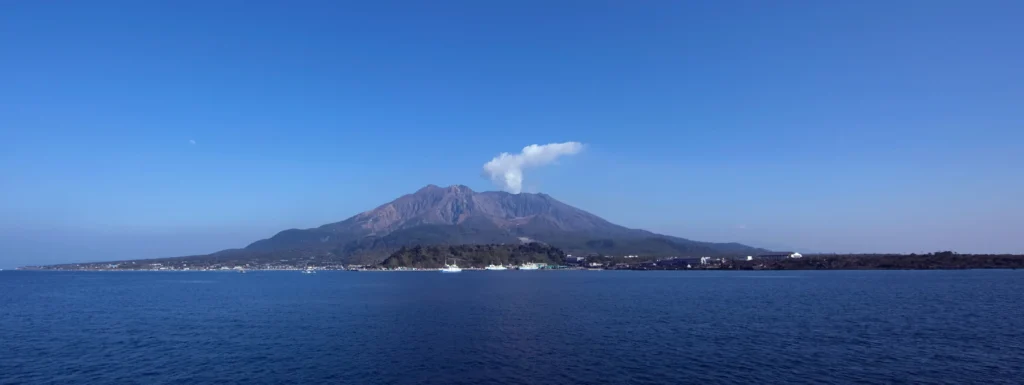
It is no accident that so much of this research traces back to one mountain. Sakurajima, looming across the bay from the city of Kagoshima and its 680,000 residents in southern Japan, is the most active volcano in the country and one of the most active on Earth. Between 1955 and 2024, observers counted 15,057 eruptions from its Minamidake and Showa craters. On a typical day it can fire off several Vulcanian blasts like cannon shots, each capable of throwing ash kilometers into the sky and, often, lacing the column with lightning.
That combination, reliable, frequent, powerful explosions paired with dense scientific instrumentation, makes Sakurajima an unmatched natural laboratory. The Sakurajima Volcano Observatory was established in 1960, and the mountain was named one of the world’s “Decade Volcanoes” in 1991 for focused study. Researchers there have ringed the volcano with high-speed cameras, lightning mapping arrays, magnetotelluric sensors that detect electric and magnetic field fluctuations tens of thousands of times per second, Doppler radar, infrasound stations, and electric field mills. Magnetotelluric measurements have revealed that Sakurajima’s volcanic lightning can carry up to 1,000 amperes of current, and let scientists count individual flashes and track whether each one stays inside the ash cloud or reaches the ground. The volcano is dangerous enough that local schoolchildren wear hard hats, but its predictability is a gift to science: if you want to study volcanic lightning, you go where the volcano performs almost every day.
An observation two thousand years old
People have watched lightning dance in eruption columns for a very long time. The earliest famous witness is Pliny the Younger, the Roman writer who, as a teenager, observed the catastrophic A.D. 79 eruption of Mount Vesuvius from across the Bay of Naples at Misenum and later described it in two letters to the historian Tacitus, his Epistulae 6.16 and 6.20. The letters, written to memorialize the death of his uncle Pliny the Elder, are so precise that volcanologists named an entire class of towering eruptions, Plinian, after him. Among the phenomena he recorded were flashes of light against the darkness of the ash cloud. The thread holds across two millennia: even modern coverage of the Hunga study reaches back to note that volcanic lightning is so well documented that Pliny the Younger described it in his account of Vesuvius.
Why Hunga Tonga was different
If Sakurajima is the everyday laboratory, Hunga Tonga was the once-in-a-generation extreme. What made its lightning so far off the charts was water, specifically, the way the eruption happened to blast through a shallow ocean. The volcano’s caldera sat about 150 meters (490 feet) below the surface, a depth that turned out to be a kind of perfect trap: deep enough that erupting magma could superheat a vast volume of seawater into vapor, but shallow enough that the ocean could not muffle the explosion.
The result was an injection of water into the upper atmosphere with no parallel in the modern record. Using the Microwave Limb Sounder on NASA’s Aura satellite, JPL atmospheric scientist Luis Millán and colleagues estimated that the eruption sent about 146 teragrams of water vapor, a teragram is a trillion grams, into the stratosphere, equal to roughly 10 percent of all the water already there, and nearly four times what the 1991 Pinatubo eruption lofted. Millán’s estimate carried an uncertainty of plus or minus 5 teragrams; an earlier balloon-borne estimate by Vömel and colleagues in Science had found at least 50 teragrams. “We’ve never seen anything like it,” Millán said. By contrast, the eruption injected only about 0.4 teragrams of sulfur dioxide, far below the threshold for significant climate cooling, an unusual fingerprint that has kept atmospheric scientists busy ever since.
All that water is the key to the lightning record. It gave the plume an extraordinary supply of fuel for the ice-charging machine, on top of all the friction-and-fracture charging from the ash. Van Eaton captured the strangeness of watching it happen with modern instruments: the Hunga eruption was a long-hypothesized “phreatoplinian” event, magma erupting through abundant water, previously known mainly from the geologic record. “It was like unearthing a dinosaur and seeing it walk around on four legs,” she said. “Sort of takes your breath away.”
Listening for eruptions at the speed of light
This is the point where the science turns practical. Lightning, whether from a thunderstorm or a volcano, emits a burst of radio energy. At very low frequencies (roughly 3 to 30 kilohertz) those radio waves, called sferics, travel enormous distances with little weakening, which means a flash can be detected thousands of kilometers from its source. Two global networks built to map weather lightning turn out to be just as capable of catching volcanic lightning, and they do it in near-real time.
The World Wide Lightning Location Network (WWLLN) is a ground-based network of very-low-frequency radio sensors operated by a University of Washington–led research consortium, with more than 70 sensors around the globe. It detects the strongest discharges by triangulating the arrival times of their VLF signals, with location accuracy on the order of 15 kilometers. In 2010 WWLLN began separately tracking lightning around roughly 1,550 active volcanoes specifically to help spot eruptions. The Global Lightning Dataset (GLD360), operated by the company Vaisala, is a commercial VLF network that combines time-of-arrival and magnetic direction-finding to locate flashes anywhere on Earth with about 1-kilometer median accuracy and roughly 30-second latency. Both can flag an eruption in a remote, uninstrumented corner of the globe, an ocean, a mountain range, a deserted island, long before anyone is close enough to see it.
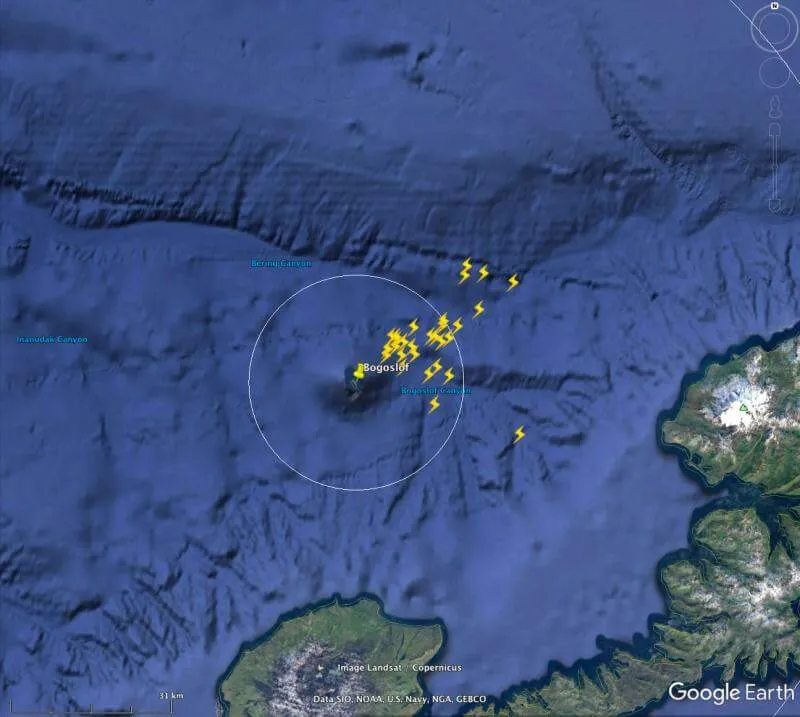
The breakthrough demonstration came not at Hunga Tonga but at Bogoslof, a remote submarine volcano in Alaska’s Aleutian Islands. During its 2016–2017 eruption, which produced about 70 explosive events over nine months, Bogoslof had no local monitoring instruments of its own. Scientists leaned on distant seismometers, regional infrasound sensors, satellites, and, for the first time in routine U.S. operations, lightning. WWLLN and GLD360 together detected more than 4,550 volcanic lightning strokes, confirming ash-producing explosions in near-real time and feeding that information to the USGS Alaska Volcano Observatory. Telling detail: only 32 of the 70 explosive events produced detectable lightning, and the plumes generally did not start flashing until they climbed above the atmospheric freezing level, direct evidence that ice charging was catalyzing the lightning at altitude, while silicate charging dominated near the vent.
Hunga Tonga was the ultimate proof of concept. Its vent was underwater and its plume too vast to see past, yet its lightning was detected from thousands of kilometers away, allowing scientists to reconstruct the eruption’s intensity and duration. “This eruption triggered a supercharged thunderstorm, the likes of which we’ve never seen,” Van Eaton said. “These findings demonstrate a new tool we have to monitor volcanoes at the speed of light and help the USGS’s role to inform ash hazard advisories to aircraft.”
Why it matters: ash and aircraft
That phrase, “ash hazard advisories to aircraft”, is the heart of why anyone funds this research. Volcanic ash is not soft. It is finely pulverized rock and glass, and it is lethal to jet engines. The grains sandblast windscreens, clog sensors, and, most dangerously, melt inside the searing combustion chambers of a running engine, where they fuse into a glassy coating on the turbine blades and choke off the airflow until the engine flames out. Ash clouds are also nearly invisible to aircraft weather radar, which is tuned to detect water droplets, not dry dust.
The aviation record is full of terrifying near-misses. On June 24, 1982, British Airways Flight 9, a Boeing 747 named City of Edinburgh commanded by Captain Eric Moody, flew at 37,000 feet into an unseen ash cloud from Indonesia’s Mount Galunggung, about 110 miles southeast of Jakarta. All four engines failed. The jet, carrying 248 passengers, glided engineless until it descended out of the ash, where the cooled, solidified deposits broke off the turbine blades and the crew managed to restart the engines and land safely at Jakarta. The ash had not appeared on radar because it was bone dry. (Moody died in March 2024.)
A nearly identical incident struck on December 15, 1989, when KLM Flight 867, a new Boeing 747-400 descending toward Anchorage, Alaska, entered the ash plume of Mount Redoubt, which had begun a new eruptive burst that morning. All four engines flamed out from compressor stalls. The aircraft dropped from 27,900 feet to 13,300 feet, a fall of more than two miles, before the crew relit the engines and landed with all 231 passengers and 14 crew unharmed. The ash caused more than US$80 million in damage and required all four engines to be replaced.
The most economically disruptive case needed no engine failure at all. Iceland’s Eyjafjallajökull eruption in April 2010 lofted fine ash across Europe’s flight corridors, and aviation authorities responded with a blanket precautionary closure. For roughly a week in mid-April, more than 300 airports went dark across some two dozen countries, the largest peacetime shutdown of European airspace. The USGS tallies the toll at over 100,000 cancelled flights and 7 million stranded passengers, with Oxford Economics pegging lost airline revenue at around $1.7 billion. Ash also travels astonishing distances: the cloud from the 1991 Pinatubo eruption crossed more than 5,000 miles in under three days and damaged more than 20 aircraft, most flying hundreds of miles from the volcano.
This is why a flash detected thousands of kilometers away matters. For a remote or submarine eruption, lightning can be the first confirmation that an ash-producing explosion is underway, faster, in some cases, than satellites can image the plume or anyone on the ground can phone it in. Tracking the lightning also indicates where ash is being lofted and how vigorously, helping the world’s network of Volcanic Ash Advisory Centers steer aircraft around the danger. As Smith put it, electrical activity signals an ash-rich plume “no matter the weather or time of day.”
What the flashes are still teaching us
Volcanic lightning has traveled a long road, from an omen in a Roman teenager’s letter, to a laboratory spark in Munich, to a 280-kilometer ring of fire over the South Pacific reconstructed by antennas half a world away. The science has settled the old central question: a volcano makes lightning with no storm clouds because it does not need them. It manufactures charge from shattered rock near the vent and, when it climbs high enough, grows a genuine ice-charged thunderstorm on top of that. The two engines run in tandem, and the bigger the eruption, the harder both work.
What remains is refinement and reach. Researchers are working out how to read a lightning signal as a quantitative gauge of eruption intensity, how to use the silent vent discharges that may precede the visible flashes, and how to fold real-time lightning data more tightly into the ash-warning systems that protect millions of air travelers. The Hunga Tonga eruption, for all its destruction, handed scientists a once-in-a-generation dataset and a new phenomenon, the lightning ring, to explain. The next time an unseen volcano detonates beneath an ocean or behind a mountain range, there is a good chance the world will know within seconds, because the eruption will announce itself in the one language that carries across the entire planet at the speed of light.