
Introduction
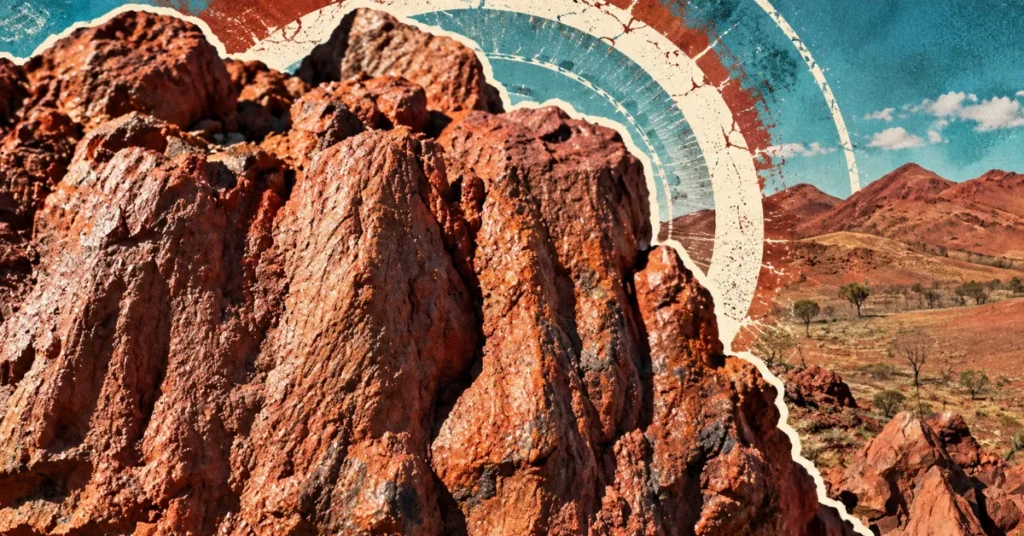
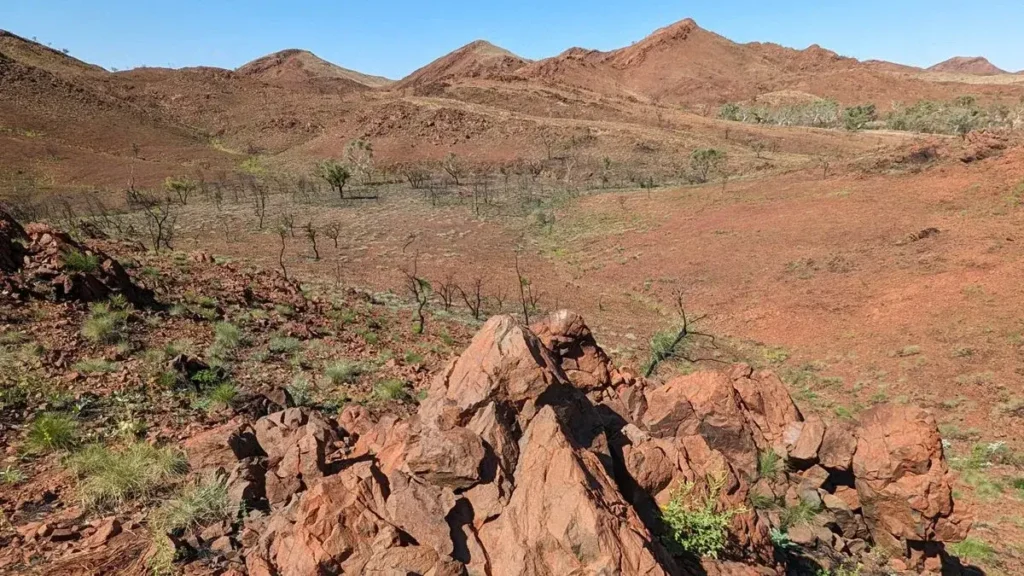
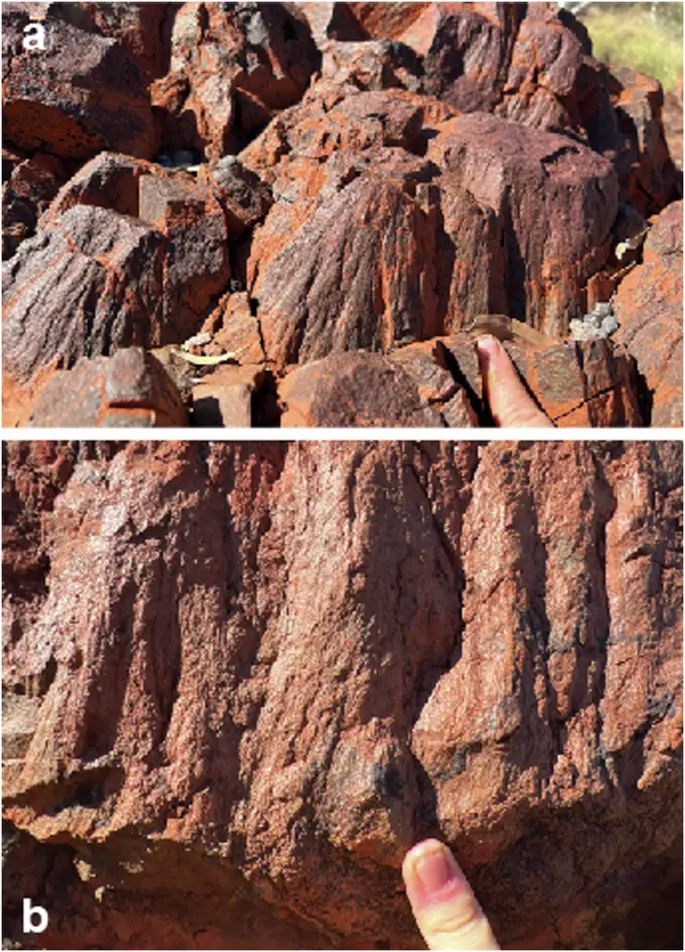
On a hot morning in May 2021, Chris Kirkland, Tim Johnson and Jonas Kaempf parked their 4WDs along a dusty track in the centre of Western Australia’s Pilbara region, about 40 kilometres west of the old gold-rush town of Marble Bar. They split up across the outcrops with no real plan beyond hope, agreeing to regroup in an hour. Within that first hour they were standing in front of metre-tall, hut-shaped rocks with curved, striated, branching grooves splaying down their flanks, shatter cones, exactly the structures they had come looking for. The grooves fanned out and downward from the apex of each cone. They had read about these things in textbooks, in the literature on Vredefort, Sudbury and Steinheim. None of them had ever seen a shatter cone in 3.47-billion-year-old rock, because nobody had. The cones extended for several hundred metres along a hillside in the North Pole Dome, in a thin sedimentary layer called the Antarctic Creek Member, and they were unmistakable evidence that a hypervelocity bolide had struck a young Earth, when continents were still forming, the atmosphere held no free oxygen, and life had barely got beyond microbial mats. Or so they argued.
Why the age of the oldest impact crater on Earth matters
A single crater in the Pilbara might sound parochial, but the age sits at the junction of three of the largest questions in the Earth sciences. The first is how the continents themselves came into being. The Pilbara Craton, a craton being the stable, ancient nucleus of a continent, preserves some of the oldest crust on the planet, dating between roughly 3.6 and 2.8 billion years ago. A 2022 paper in Nature by Tim Johnson, Chris Kirkland and colleagues argued, on the basis of oxygen-isotope ratios in dated zircon grains, that the Pilbara nucleus was built in three stages and that the earliest stage was consistent with shallow melting triggered by giant impacts. Find a 3.47-billion-year-old crater squarely in the middle of that craton and you appear to have caught the impact-driven continent-builder in the act.
The second question concerns the origin of life. The oldest stromatolites, laminated structures built by microbial mats, sit only a few kilometres from the disputed crater, in the 3.48-billion-year-old Dresser Formation of the same Pilbara Supergroup. Gordon Osinski and co-authors argued in Astrobiology in 2020 that impact craters create exactly the kind of fractured, hydrothermally vented environments that stay warm for thousands of years that can foster prebiotic chemistry. A 3.5-billion-year-old crater hosting an Archaean hot-spring system, sitting within metres of Earth’s earliest known biosignatures, would be a striking coincidence. (Impacts can also generate spectacular sedimentary deposits when they happen near coastlines or shallow seas.)
The third question is Mars. The Pilbara is already used as an analog site for Martian astrobiology because its low-grade metamorphic rocks preserve the kind of biosignatures that NASA’s Perseverance rover is looking for in Jezero Crater. A confirmed impact structure inside that analog adds a shocked, hydrothermally altered, Mars-like terrain to the suite of rocks that scientists can practise on before samples come home. Whether the impact is 3.5 billion years old or younger than 2.7 billion years old changes what kind of Mars analog the Pilbara provides.
The 3.47-billion-year claim: Kirkland et al., March 2025
On 6 March 2025, the team led by Kirkland and Johnson published their case in Nature Communications under the title “A Paleoarchaean impact crater in the Pilbara Craton, Western Australia.” The argument hangs on three connected pieces of evidence.
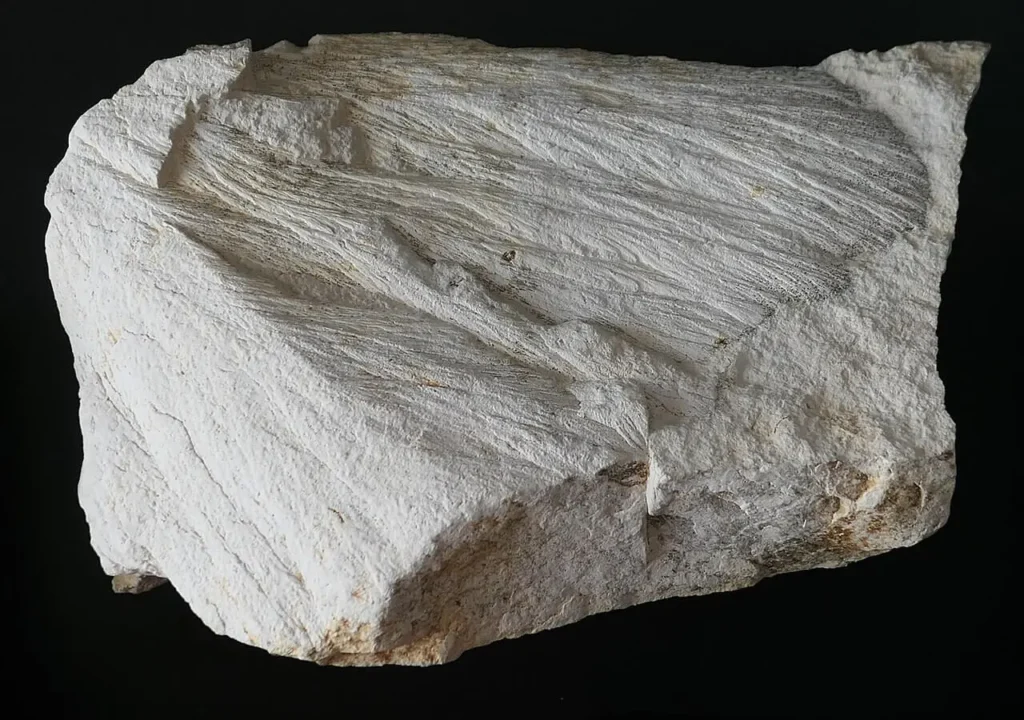
The first piece is the shatter cones themselves. Shatter cones are the only macroscopic, that is, visible-with-the-naked-eye, feature that is universally accepted as diagnostic of a hypervelocity impact. They are striated, branching, conical fractures, typically tens of centimetres to several metres tall, formed when a shock wave moving faster than the speed of sound through rock fractures the material into nested cone shapes. Nothing else produces them — not volcanism, not tectonics, not slow burial. Gordon Osinski and Ludovic Ferrière reviewed the global record of shatter cones in Science Advances in 2016 and concluded that the apex of each cone, in well-preserved examples, can be used to triangulate the shock source, although the relationship is messier than the textbook diagrams suggest.
The Curtin team described shatter cones extending more or less continuously for several hundred metres through a thin sedimentary unit called the Antarctic Creek Member, with the cones’ axes splaying downwards in a way consistent with a right-way-up stratigraphy. The Antarctic Creek Member is a metasedimentary layer, a fancy way of saying it is sedimentary rock that has been gently cooked and squeezed but not melted, sandwiched between two thicker basalt units of the Mount Ada Basalt.
The second piece is the bracketing. The Antarctic Creek Member already had a tightly constrained age. It contains detrital zircons with U–Pb ages of 3470 ± 2 million years, and it is bracketed by felsic volcanic rocks at the top of the underlying Mount Ada Basalt (3469 ± 3 Ma) and at the base of the overlying Duffer Formation (3468 ± 2 Ma). Plugging the numbers together, the Curtin team gave the layer a depositional age of 3469.2 +1.8/−1.2 Ma, call it 3.47 Ga to one decimal place, or “3.5 billion years” if you are writing a headline. (Both figures appear in the discussion, and the rounding is the only justification you need for the round number in the press release.) Because the shatter-cone-bearing layer is directly overlain by unshocked carbonate breccias and unshocked pillow basalts, the team argued, the shock event must have happened essentially at the time the Antarctic Creek Member was deposited. Anything older would have shocked nothing; anything younger would have shocked the overlying basalts, and it didn’t.
The third piece is the scale argument. The North Pole Dome is an elliptical structural dome roughly 30 by 40 km across (often quoted at the upper end as 40–45 km, as in the Kirkland paper), named because it sits near the geographic centre of the East Pilbara Terrane and not for any reason involving snow. The Curtin paper interpreted the dome itself as the central uplift of an impact crater, the rebound peak that forms in seconds after a large strike, the same way a milk drop rebounds after hitting a pool of milk. By analogy with younger terrestrial complex craters, where shatter cones cluster in the central uplift, they wrote that if shatter cones turn out to be present throughout the mapped extent of the Antarctic Creek Member, “the 40–45 km diameter of the North Pole Dome implies a crater with a diameter of at least 100 km.” It was a conditional statement, but the conditional was promptly stripped off as the news cycle picked up the story. The Curtin press release led with “a crater more than 100 km wide” and quoted Kirkland telling reporters that the shatter cones were “direct and frankly indisputable evidence of an ancient impact event.” The Kirkland et al. abstract is no less assertive: the shatter cones provide “unequivocal evidence for a hypervelocity meteorite impact,” and the stratigraphy “constrains the age of the impact to 3.47 Ga.”
For perspective, the previous record holder, the Yarrabubba impact structure in Western Australia, dated by Timmons Erickson and colleagues in 2020 to 2229 ± 5 million years using U–Pb ages on shock-recrystallised zircon and monazite, would have been bested by 1.24 billion years. The Curtin paper would have pushed the recognized terrestrial impact record back into the first half of Earth history, where every other line of evidence is circumstantial.
The 16-kilometre, <2.7 Ga counter-claim: Brenner et al., July 2025
Four months later, on 9 July 2025, a different team published in Science Advances under the title “Geology and Mars analog potential of the <2.7-billion-year-old Miralga impact structure, North Pole Dome, Pilbara Craton, Australia.” The lead author was Alec Brenner, a Harvard postdoctoral researcher in Roger Fu’s lab who had been studying the Pilbara for paleomagnetism rather than for impacts, the record of Earth’s ancient magnetic field locked into iron-bearing minerals as they cool. He was joined by Aaron Cavosie, a senior lecturer at Curtin University who specialises in shocked minerals; by Jasmine Palma-Gomez and Sophie-An Kingsbury Lee of Harvard; by Joanna Li of Smith College and Rice University; and by Roger Fu of Harvard.
According to the Harvard Gazette’s account of the work, the team’s first encounter with the structure also came by chance. In 2023, Brenner, then still a graduate student in Roger Fu’s lab, was driving into the North Pole Dome with Palma-Gomez and Li on the first day of a paleomagnetic field season when they began noticing the same kind of rocks the Curtin team had seen. They came back for serious mapping in 2024.
What they did differently was count. Where the Curtin paper had used two field photographs and a single statement that the shatter cones had “a mean apical angle of around 90°,” the Brenner team mapped 180 shatter-cone apex orientations across a roughly 6.5-kilometre-diameter area on the north flank of the dome, recorded each one as a point and a direction, and ran the resulting cloud through a statistical analysis to find a best-fit centre. The apices, the pointy ends of the cones, converged toward a single inferred point of impact. Using published scaling laws that relate the diameter over which shatter cones are typically preserved to the original crater diameter, they calculated a parent structure 16.2 kilometres across. The North Pole Dome itself, 40–45 km wide, therefore could not be the crater. The crater sat on the dome’s north flank.
Sixteen kilometres is roughly one-sixth of the Curtin team’s lower bound. If Brenner and colleagues are right, the Miralga structure is too small by far to have driven any of the regional tectonic or crust-forming consequences the 2022 Johnson and Kirkland Nature paper attached to the Pilbara’s giant impact. As Brenner and Cavosie put it in their plain-English summary, “A 16-km crater is a far cry from the original estimate of more than 100 km. It’s too small to have influenced the formation of continents or life.“
That was the size argument. The age argument was tighter. The Brenner team found shatter cones not only in the 3.47-billion-year-old Mount Ada Basalt and the Antarctic Creek Member, but also in the 2.77-billion-year-old Mount Roe Basalt, which sits unconformably on top of the older rocks as part of the Fortescue Group. They also documented shatter cones cross-cutting an intensely chloritized fault zone in the Mount Ada Basalt that they correlate with the Miralga Deformation Zone, a regional sinistral shear system that the Geological Survey of Western Australia has dated to younger than 2.71 Ga. Since shatter cones can only form in rocks that exist at the moment of impact, the impact has to be younger than the youngest shocked rock and younger than the most recent regional structure it overprints. That puts the strict maximum age at younger than 2.7 Ga: 800 million years younger than the Curtin estimate.
The Brenner team backed the structural argument with the first shocked mineral ever reported from the site. Using Raman spectroscopy at roughly 1.3-micrometre spatial resolution on a polished thick section, they identified TiO2-II, known to mineralogists as srilankite, in a shatter-cone sample from the central part of the structure. TiO2-II is a high-pressure polymorph of titanium dioxide that, like graphite forced into diamond, only forms when ordinary anatase or rutile is squeezed hard and fast. Recent work by Campanale and colleagues, published in Meteoritics & Planetary Science in 2024, places the formation pressure at roughly 12 to 15 gigapascals, well above any pressure that ordinary tectonic burial can deliver. Finding srilankite at Miralga confirmed the shock without pinning the age; the Brenner team explicitly listed it as the first reported shocked mineral from the site. (Such high-pressure mineral signatures can also be preserved as glass.)
Finally, the Brenner paper changed the structure’s name. After consulting R. Monaghan of the Nyamal Aboriginal Corporation about the Nyamal-language place name for the area, the authors provisionally renamed the structure Miralga, after the Nyamal name for the country and its people, and acknowledged them as the first peoples and Traditional Owners of the region.
How geologists date impact craters
The Miralga argument is, at heart, a methodological argument. Both teams agree on the basics: there was an impact, and it happened in the Pilbara, and it left shatter cones. They disagree about the dating tools, and the disagreement is a chance to look at how the chronology of impact craters is actually done.
Cross-cutting relationships
The oldest rule in field geology is straightforward. If feature A cuts through feature B, then A is younger than B. A granite dike slicing across a sandstone bed must be younger than the bed. This is the principle of cross-cutting relationships, codified by James Hutton in the late eighteenth century and still the basic tool of structural geology.
Both Pilbara papers use cross-cutting relationships, and they reach opposite answers because they are looking at different cross-cutting relationships in different parts of the field area. Kirkland and colleagues looked at the stratigraphy directly above the shatter cones: unshocked carbonate breccias, unshocked pillow basalts at the base of the upper Mount Ada Basalt. If those overlying rocks are 3.47 Ga and unshocked, the impact was older than they were, but only barely, and therefore the impact dates to 3.47 Ga. Brenner and colleagues looked at the stratigraphy below the shatter cones, and into the wider region. They found shatter cones in the 2.77 Ga Mount Roe Basalt, a rock that did not yet exist in 3.47 Ga. They found shatter cones overprinting faults that themselves cut 2.71 Ga rocks. So the impact has to be younger than 2.71 Ga.
Either the shatter cones in the Mount Roe Basalt are correctly identified, in which case the Kirkland team’s “no shatter cones in the overlying basalts” observation is wrong, because the overlying Fortescue Group rocks include some shatter cones, or those two southerly localities, as Kirkland argues in his response, are actually within older rocks that have been miscorrelated with the Mount Roe Basalt. Which contact each shatter cone is sitting on, the only way to resolve this is in the field.
Shocked minerals as pressure gauges
Shatter cones tell you something has happened, but they do not tell you exactly how hard the shock was. For pressure constraints, you have to look at the micro-scale.
The classic indicator is planar deformation features in quartz, known in the literature as PDFs. Bevan French and Christian Koeberl, in their definitive 2010 review in Earth-Science Reviews, laid out the criteria for accepting an impact origin for a given rock. PDFs are sets of parallel, planar, micrometre-thick lamellae running through individual quartz grains in specific crystallographic orientations. They form between roughly 7 and 35 GPa of shock pressure. Slower deformation produces wavy or curved features instead. PDFs in quartz, properly identified by their optical orientation, are universally accepted as diagnostic of impact.
At higher pressures, you start to get high-pressure mineral polymorphs, the same chemical formula as the original mineral, but a denser crystal structure that can only form at impact-scale pressures. Reidite, the high-pressure polymorph of zircon, forms above roughly 20 GPa. Stishovite, the high-pressure polymorph of silica, forms above about 8 GPa. Srilankite, or TiO2-II, the polymorph the Brenner team found at Miralga, forms above about 12 GPa.
Because each one has a known formation pressure, finding one in a rock tells you how hard the shock was, which constrains the size and energy of the impact. They are also chemically and structurally stable on geological timescales when the host rock is not subsequently melted, so they survive long after the crater itself has been eroded away. At Yarrabubba, where the original crater has been completely eroded away and only the granite basement remains, shock-recrystallised zircon and monazite in that basement are the only reason we know there was ever a crater there. (The same kind of argument, invoking shock minerals versus volcanic signatures, has played out in much younger contexts, including the long debate about extinction triggers.)
U–Pb dating of impact melt rocks
The strongest impact ages on Earth come from U–Pb dating of impact melt rocks. The principle is straightforward. Uranium decays to lead at a known, fixed rate, and zircon and monazite, two minerals that incorporate uranium readily and lock it in, record the time since they last crystallised. When a hypervelocity impact partially or completely melts the target rock, the high temperatures reset the U–Pb clock in any zircons that are heated past their closure temperature. New zircon grows from the cooling impact melt. Date that zircon, and you have dated the impact itself.
This is exactly how the Yarrabubba age was pinned down. Erickson and colleagues found shock-recrystallised monazite that yielded 2229 ± 5 Ma, coeval with shock-reset zircon from the same impactite, and the precision is good enough that the Yarrabubba age now anchors arguments about whether that impact contributed to the end of the Palaeoproterozoic snowball-Earth glaciations.
The problem at Miralga is that no impact melt has yet been found. The Kirkland team relied entirely on stratigraphic bracketing: the U–Pb ages they cite, 3469 ± 3 Ma, 3468 ± 2 Ma, are ages of the rocks above and below the shatter-cone layer, not of the impact itself. The Brenner team also could not date the impact directly. As Brenner and Cavosie wrote, “we don’t know precisely how young the crater is. We can only constrain the impact to have occurred between 2.7 billion and 400 million years ago. We’re working on dating the impact by isotopic methods, but these results aren’t yet in.” That 2.3-billion-year window is a ceiling, not a date.
Why the two teams reached opposite conclusions
Behind the methods sit two arguments about what the Pilbara is.
Tim Johnson and Chris Kirkland have been building a case for nearly a decade that giant impacts shaped Earth’s earliest continental crust. Their 2022 paper in Nature, with co-authors Yongjun Lu, R. Hugh Smithies, Michael Brown and Michael Hartnady, used oxygen-isotope ratios in dated zircons from across the Pilbara to argue that the craton was built in three stages, the earliest of which (3.6 to 3.4 Ga) recorded shallow melting of hydrothermally altered basaltic crust, the kind of melting that giant impacts make easy. A 3.47-billion-year-old, more-than-100-kilometre crater at the centre of that craton was, for them, the missing physical evidence for a process they had predicted on chemical grounds. Johnson told reporters at the time that the discovery “may have even contributed to the formation of cratons, which are large, stable landmasses that became the foundation of continents.”
The Brenner team’s counter-argument is partly geological and partly philosophical. The Pilbara was already old by the time the Miralga impactor arrived. The Mount Roe Basalt sits unconformably on top of the deformed Paleoarchaean craton, meaning there is a long erosional gap between them, and the Miralga Deformation Zone, the regional sinistral shear that postdates them both, is younger than 2.71 Ga. Whichever rock you privilege, the impact came after the continental nucleus was already in place. As Brenner and Cavosie put it, the 16-kilometre crater “is too small to have influenced the formation of continents or life. By the time of the impact, the Pilbara was already quite old.” The argument is about whether the impact-driven craton hypothesis still has its strongest single piece of evidence.
The disagreement has been civil but pointed. The Brenner paper does not mince words: it states that the Kirkland team’s “age and size estimates are inaccurate.” Aaron Cavosie, who sits on the Curtin faculty alongside Kirkland and Johnson, presented an even sharper version of the case at the 2025 Meteoritical Society meeting, in a five-page abstract titled “REALITY CHECK ON THE PILBARA IMPACT AT NORTH POLE DOME: IT FORMED <2.7 GA (NOT AT 3.5 GA) AND IS 16 KM IN DIAMETER (NOT ≥100 KM).” The abstract observed that the original Kirkland paper presented “no tabulated shatter cone measurements, nor any maps that display shatter cone location, orientation, or distribution”: a methodological gap that the new mapping was designed to fill.
The Pilbara crater debate in 2026
On 9 January 2026, Chris Kirkland and his Curtin co-authors posted a formal eLetter to Science Advances in response to Brenner et al. It is the only response so far on the article’s eLetter page, and it is detailed.
Kirkland’s opening is measured: “While we welcome continued investigation of this important structure, their work presents several factual misrepresentations and potential limitations that warrant clarification.” From there the response runs along four lines. First, on the crater size: Kirkland writes that the Brenner team’s claim that the original paper said the impact “produced a ≥100-kilometer (km) crater” is “a serious misrepresentation,” because the original text was explicitly conditional, “if future work confirms”, and “any claim that such an omission was for the sake of brevity stretches credulity.” Second, on the radial distribution of shatter cones: Kirkland argues that the mapped localities define a highly irregular area with a “circularity index of 1.02, where 0 is a circle and >1 indicates a strong departure from circular symmetry,” undermining the 16-kilometre best-fit calculation. Third, on the Mount Roe Basalt geometry: Kirkland points out that the Mount Roe Basalt is generally flat-lying and fills the eroded topography of the Paleoarchaean rocks beneath it, so if the two southerly shatter-cone localities really do sit within a Miralga central uplift, those rocks should now be steeply inclined; they are not. “While perhaps not impossible, this seems implausible.” Fourth, on the Johnson et al. 2022 paper: Kirkland calls the Brenner team’s claim that the giant-impact origin of the Pilbara Craton “is rendered invalid by the new age and size constraints” a “further misrepresentation.”
What Kirkland’s response does not do is yield ground on the central age claim. It also does not dispute the srilankite identification, and it concedes that if the two most southerly shatter-cone localities can be “definitively shown to be within the younger (2.77 Ga) Mount Roe Basalt,” that would be “an important discovery.” The argument now turns on a small number of contacts in the field, which rock is which, on which side of which fault, and with what stratigraphic relationship to which overlying unit. That is exactly the kind of dispute that a careful field season with hand lenses, GPS receivers and 1:25,000 maps can settle, and both groups have signalled that they intend to do more fieldwork.
Meanwhile the Brenner team is working on isotopic dating of the impact itself. Their published 2.7-billion-year ceiling is a maximum age; the actual age could be anything from just under 2.7 Ga down to a few hundred million years ago. If they succeed in finding an impact-reset zircon or monazite, the same kind of shock-recrystallised accessory mineral that pinned Yarrabubba at 2229 ± 5 Ma, the Miralga age window will collapse from 2.3 billion years wide to something much, much tighter. If they fail, the window will stay open, and the Kirkland team will keep pointing out that “younger than 2.7 Ga” is technically consistent with “younger than 3.47 Ga” only if the Mount Roe Basalt shatter cones are confirmed.
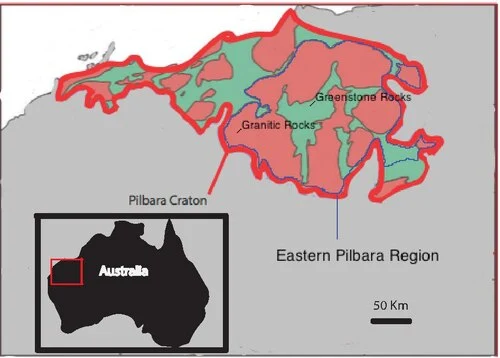
The Mount Roe Basalt: the rock unit that decides the age
Two papers disagreeing by 800 million years on a single crater is unusual. The disagreement comes down to one rock unit.
The Mount Roe Basalt is the lowest formation in the Fortescue Group, a thick pile of volcanic and sedimentary rocks that was laid down across the Pilbara Craton starting around 2.77 billion years ago. It sits unconformably on the older Paleoarchaean rocks, including the Mount Ada Basalt and the Antarctic Creek Member, with a sharp erosional break between them. In most places the Mount Roe Basalt is gently dipping or essentially flat-lying. It is preserved as scattered erosional remnants, outliers, rather than as a continuous sheet, because most of it has been stripped off by 2.7 billion years of weathering.
For Kirkland and colleagues, the absence of shatter cones in the basalts directly above the Antarctic Creek Member is the key constraint. They report finding “no shatter cones in either the pillow basalts or carbonate breccias/dykes” that overlie the shocked layer. Those overlying basalts they identify as the upper Mount Ada Basalt, the same 3.47-billion-year-old unit, just higher in the stratigraphy. If the unshocked overlying rocks are 3.47 Ga, the impact has to be 3.47 Ga.
For Brenner and colleagues, two of the shatter-cone localities sit not in the upper Mount Ada Basalt but in the much younger Mount Roe Basalt, and other shatter cones overprint a regional fault system younger than 2.71 Ga. If they are correct, then there are shocked basalts above the Antarctic Creek Member after all, only Kirkland mapped them as the upper Mount Ada Basalt instead of as the Mount Roe Basalt. The whole age argument turns on the identification of those rocks.
The two basalts are similar in hand specimen and have both been altered to lower greenschist facies, which smears their textures. Distinguishing them requires geochemistry, hyperspectral imaging, careful contact mapping and, ideally, U–Pb dating of any zircon-bearing interbeds. The Geological Survey of Western Australia has spent decades producing the maps both teams are working from, freely available through the GSWA’s open data portal under CC-BY 4.0. The maps will be refined by both groups in the next field seasons, and the contact between the Coongan Subgroup and the Fortescue Group, as it runs across the south flank of the inferred crater, will be the single most important line on the Pilbara at next year’s Australian Earth Sciences Convention.
The other oldest impact craters on Earth: Vredefort, Sudbury and Yarrabubba
Miralga’s significance depends partly on how it compares to the only other very old impact structures we know about.
Vredefort, in South Africa, formed about 2.023 billion years ago. Allen, Nakajima and colleagues, in a 2022 paper in the Journal of Geophysical Research: Planets, used new geological evidence and impact modelling to estimate the original crater diameter at 250–280 kilometres, making Vredefort the largest verified impact structure on Earth. What remains today is the central uplift, the Vredefort Dome, about 90 kilometres in diameter, and a partial ring of upturned strata visible from orbit. Roughly 8–11 kilometres of overlying rock, including the original impact melt sheet, have been stripped off by erosion (the figures come from Gibson et al. 1998 and are reproduced in the Allen et al. 2022 review), exposing crustal levels that would normally be inaccessible. Vredefort has shatter cones, shocked quartz, reidite from shocked zircon and pseudotachylite veins, the full diagnostic kit. It is a useful reference for what a really big, really old, deeply eroded impact structure looks like.
Sudbury, in Ontario, formed 1,849.5 million years ago, an age established by U–Pb dating of zircon crystallised in the impact melt and reported in a 2008 paper in Geology. The original crater is estimated at roughly 250 kilometres across, and the impact melt sheet it produced hosts the Sudbury Igneous Complex, a mining district that, according to the Crater Explorer reference compiled by Charles O’Dale, “has produced more than $100 billion worth of metal in over a century of production.”
Yarrabubba, in Western Australia, formed 2229 ± 5 million years ago in 3.45-billion-year-old monzogranite. No crater rim survives; the only evidence is shocked quartz, shatter cones in granite, and the shock-recrystallised zircons and monazites that gave the precise age. Erickson et al. 2020 report the structure as ~70 km in diameter, derived from a ~20-km aeromagnetic anomaly interpreted as the eroded central uplift.
If the Brenner team is right, Miralga is a 16-kilometre crater of unconstrained age younger than 2.7 Ga, useful for shock-metamorphism studies and as a Mars analog, but with no broader stratigraphic significance. The Kirkland scenario is more consequential: a crater between 40 and 100+ kilometres across at 3.47 Ga, arriving early enough to plausibly affect Pilbara magmatism, crust formation, and possibly microbial habitats.
What new fieldwork could resolve the dispute
Three questions can plausibly be answered in the next year of work, and answering any of them would tilt the dispute decisively.
The most important question is whether the two southerly shatter-cone localities are actually in the Mount Roe Basalt. This is a mapping problem, solvable with detailed contact tracing, geochemistry of the host rocks, and ideally a U–Pb date on any zircon-bearing interbed within or just below the suspect basalt. If they are confirmed as Mount Roe Basalt, Kirkland’s stratigraphic bracket fails outright, and the Brenner ceiling of younger than 2.7 Ga holds.
A second open question is whether the Brenner team can find an impact-reset zircon or monazite from a shocked sample, and date it. A precise number, even one with a million-year uncertainty, would shrink the current 2.3-billion-year window to a point. If it lands at, say, 2.5 Ga or 1.8 Ga, the Miralga structure becomes one more entry in the Proterozoic impact record. If it lands at 3.47 Ga, the Kirkland team is vindicated by the harder method.
And then there is the question of whether shatter cones really do occur throughout the 40–45-kilometre extent of the Antarctic Creek Member, as the Kirkland paper conditionally proposed. The Brenner mapping, restricted to a 6.5-kilometre area on the north flank, did not see them everywhere. A systematic survey of the full Antarctic Creek Member outcrop would either turn up shatter cones across the dome, supporting the 100-kilometre-class crater interpretation, or fail to turn them up, in which case the smaller, off-centre Miralga structure is the better fit.
Resolving this requires fieldwork, not new instruments, walking transects in heat above 40 °C, hammering rocks, recording GPS points, and disagreeing in person about which side of which contact a particular shatter cone sits on.
Frequently Asked Questions
What is the Miralga impact structure?
Miralga is a meteorite impact structure on the north flank of the North Pole Dome in the Pilbara Craton of Western Australia, about 40 km west of Marble Bar. It is recognised by the presence of shatter cones, striated, branching, conical fractures formed by a hypervelocity shock wave, and by shocked TiO2 (srilankite) identified by Raman spectroscopy. It was renamed from the informal “North Pole Dome crater” to Miralga in 2025 after consultation with the Nyamal people, the Traditional Owners of the area. Its age and original diameter are the subject of an active scientific dispute.
What is the Pilbara Craton?
The Pilbara Craton is one of two stable, ancient nuclei of the Australian continent (the other being the Yilgarn Craton). It occupies roughly 60,000 km² of north-western Western Australia and preserves crust that formed between about 3.6 and 2.8 billion years ago. The East Pilbara Terrane, where the Miralga structure sits, is the oldest part, a roughly 200-km-wide fragment of Paleoarchaean crust made up of granitic domes separated by steeply tilted belts of basaltic and ultramafic volcanic rock. Some of the planet’s oldest stromatolites, oldest preserved sedimentary basins and (depending on which paper you read) oldest impact structure all sit within it.
How old is the oldest impact crater on Earth?
The answer depends on which paper you trust. Kirkland et al. (2025) argue the Miralga structure is 3.47 billion years old, which would make it Earth’s oldest by 1.24 billion years. Brenner et al. (2025) argue the same structure is younger than 2.7 billion years old, which would leave Yarrabubba in Western Australia (2.229 billion years, dated by U–Pb on shock-recrystallised zircon and monazite in 2020) as the oldest precisely dated impact structure. As of mid-2026, no impact melt has been directly dated from Miralga, so the question remains genuinely open.
What are shatter cones and why do they prove a meteorite impact?
Shatter cones are striated, branching, cone-shaped fractures in rock, ranging in size from a few centimetres to several metres tall. They form only under the brief, intense passage of a shock wave moving faster than the speed of sound through rock, the kind produced by a hypervelocity meteorite impact. No volcanic, tectonic or slow geological process makes them. They are the only macroscopic feature that is universally accepted by impact-cratering specialists as diagnostic of a hypervelocity impact, which is why finding well-preserved shatter cones in the Pilbara was immediately recognised as evidence for an ancient crater.
Why did two teams disagree about the Pilbara crater?
The two teams looked at different stratigraphic relationships. The Curtin team (Kirkland, Johnson, Kaempf et al., March 2025) found shatter cones in a 3.47-billion-year-old sedimentary layer overlain by unshocked basalts, and concluded the impact was 3.47 Ga. The Harvard-led team (Brenner, Cavosie et al., July 2025) mapped 180 shatter cones across a 6.5-km area, found some in the much younger 2.77-billion-year-old Mount Roe Basalt and overprinting 2.71 Ga regional faults, and concluded the impact was younger than 2.7 Ga. They also calculated a crater diameter of about 16 km from the radial pattern of cones, far smaller than the ≥100 km the Curtin team had suggested as a conditional possibility.