A Diamond Anvil in Guangzhou
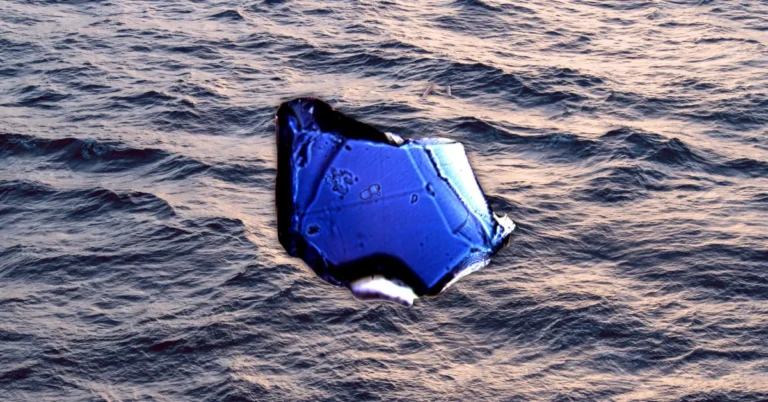
At the State Key Laboratory of Deep Earth Processes and Resources at the Guangzhou Institute of Geochemistry, a researcher in Du Zhixue’s group is loading a sample, tens of micrometres across, smaller than the width of a human hair, into a steel gasket between two diamond culets. Inside the steel chamber, the pressure will climb past 100 gigapascals (around one million atmospheres) and an infrared laser will heat the speck to roughly 4,100 °C, approaching the temperature of the Sun’s photosphere. The whole experiment will run for a few minutes. The geochemistry it constrains is older than oxygen-bearing rocks and only slightly younger than the Moon.
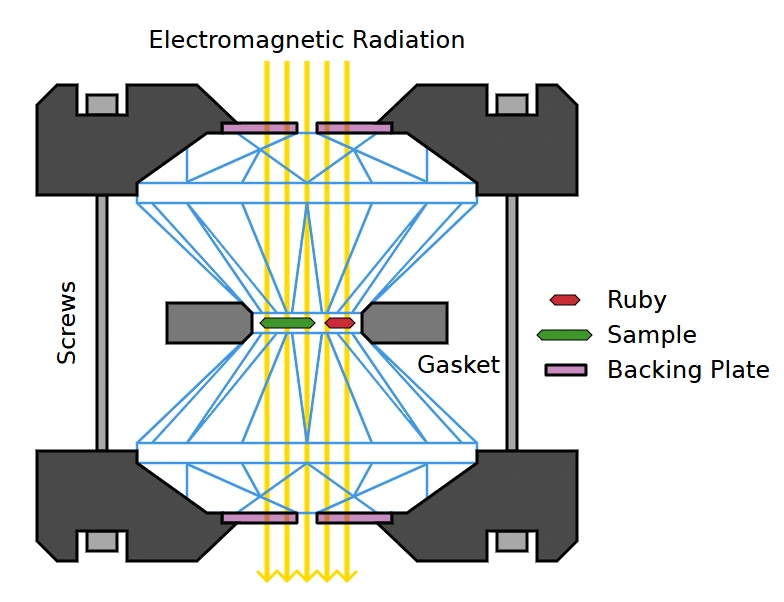
The apparatus is a laser-heated diamond anvil cell. Two gem-quality single-crystal diamonds, ground to a culet a few hundred micrometres across, sit nose-to-nose. A thin metal gasket between them holds the sample chamber. A modest external force on the table side of each diamond becomes an enormous pressure where the culets meet, because the area is so small. Percy Bridgman would have recognised the principle: opposed anvils, pressure as force divided by area. The diamonds are transparent enough that the team can stream a fibre laser through them to heat the sample while it is squeezed.
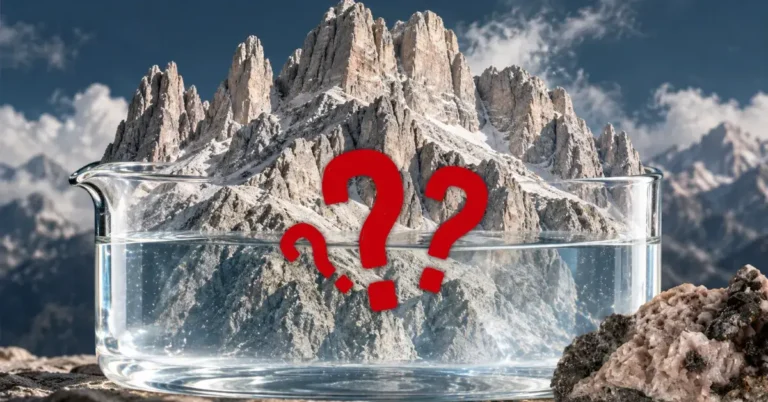
Du’s group at GIGCAS (Zhixue Du, or Du Zhixue in the family-name-first Chinese convention used in the institute’s English releases) is asking an old question with new tools. How much water can bridgmanite, the silicate that fills most of Earth’s lower mantle, hold? And more pointedly: how much could it have absorbed when it first crystallised out of a planet-spanning ocean of magma, 4.4 billion years ago?
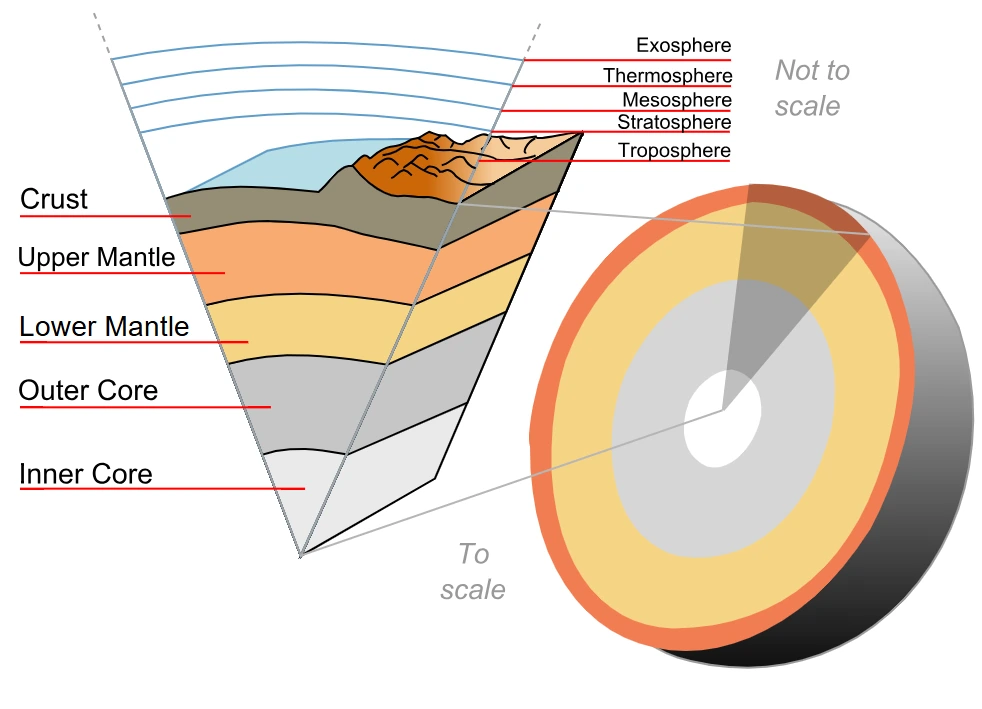
The answer they published in Science on 11 December 2025 is large enough that it changes how the early water cycle has to be sketched. Bridgmanite’s water-storage capacity, measured by the partition coefficient between crystal and coexisting silicate melt, rises sharply with temperature. Run the numbers back through a crystallising magma ocean and the lower mantle becomes the single largest water reservoir on the solidifying planet, holding between 0.08 and 1.0 modern oceans of water, five to one hundred times what earlier, lower-temperature experiments had implied (Lu et al., 2025, doi:10.1126/science.adx5883).
“Where did the water go when Earth’s early magma oceans crystallized? For the deepest mantle, the answer has been elusive,” Science‘s editorial summary noted on the day of publication. The new study is the first to give a quantitative deep-mantle answer.
Where Did Earth’s Oceans Come From?
The classical question sits in three pieces. First, when did Earth acquire its water? Second, from where, comets, carbonaceous chondrites, or gas swallowed from the solar nebula? Third, what happened to that water during the violent, glowing first 100 million years of the planet’s life, when impacts kept the surface molten and any vapour above it sat in equilibrium with a global lava pool?
The cometary delivery story dominated textbooks for half a century. It has not survived isotope analysis well. Most comets carry deuterium-to-hydrogen ratios two to three times Earth’s. Some, including 67P/Churyumov–Gerasimenko measured by ESA’s Rosetta spacecraft, sit at the deuterium-rich extreme of that range. Carbonaceous chondrite meteorites, sampled in laboratories from the Murchison fall onward and now directly returned from asteroid Ryugu by JAXA’s Hayabusa2 and from Bennu by NASA’s OSIRIS-REx, give D/H ratios closer to seawater’s. The current consensus, at least for the bulk of the water inventory, points to chondritic delivery during accretion, with comets contributing a few percent at most.
The harder question is what happened next. By 4.5 billion years ago, the Mars-sized impactor sometimes called Theia had struck the proto-Earth, vaporised much of its outer layers, and ejected the debris that coalesced into the Moon. After the impact, Earth’s surface was a globe-spanning magma ocean. Temperatures in the immediate aftermath exceeded 3,000 to 4,000 K. The planet’s first atmosphere was a silicate-vapour and superheated-steam canopy with no analogue today. The young Sun, per Georg Feulner’s 2012 review in Reviews of Geophysics, delivered “a solar energy input to the climate system that is about 25% lower than today,” but that hardly mattered to the surface temperature: the planet’s own heat dominated.
Water in such an environment cannot exist as liquid at the surface. It exists as vapour above the melt and dissolved in the silicate melt itself. When the melt crystallises, and it will, fast, perhaps over a few million years at most, the dissolved water must go somewhere. Either it partitions into the new crystals or it is expelled to the atmosphere, where it eventually rains down once the surface cools past the critical point of water. The fraction that ends up locked in solid rock at depth depends on a single thermodynamic number per mineral: the partition coefficient, written Dwatermineral/melt. For the most abundant mineral in the planet, that number is what Lu and her colleagues set out to measure.
What Is Bridgmanite, Earth’s Most Abundant Mineral?
For most of the twentieth century the mineral occupying most of Earth’s interior had no name. Geophysicists knew, from shock-wave experiments and high-pressure synthesis going back to the late 1950s, that magnesium iron silicate (Mg,Fe)SiO3 took on a dense perovskite structure at pressures above about 23 gigapascals and temperatures above about 1,900 K. They could synthesise it in multi-anvil presses and in laser-heated diamond cells. They could not name it. The rules of the International Mineralogical Association are strict: a mineral name attaches only to a naturally occurring specimen described in its native state.
That changed in June 2014, when the IMA’s Commission on New Minerals, Nomenclature and Classification approved the proposal of Oliver Tschauner, a mineralogist at the University of Nevada, Las Vegas, and his colleagues at Caltech and the Advanced Photon Source. Tschauner’s team had studied a section of the Tenham meteorite, an L6 chondrite that fell in 1879 near Tenham Station in Queensland, Australia. The Tenham stone is heavily shock-metamorphosed: it carries veins of high-pressure phases generated when its parent asteroid was struck hard enough to drive 24 GPa pressure pulses through metres of rock for fractions of a second.
Inside those veins, Tschauner and colleagues used synchrotron micro-X-ray diffraction at Argonne National Laboratory to identify submicron grains of MgSiO3 in the perovskite structure. The grains were associated with akimotoite and majorite and constrained the peak shock conditions to about 24 GPa and 2,300 K. They formally named the phase bridgmanite (IMA 2014-017), after Percy Williams Bridgman, the Harvard physicist who pioneered high-pressure research in the 1910s. Bridgman was awarded the 1946 Nobel Prize in Physics, in the words of the Nobel committee, “for the invention of an apparatus to produce extremely high pressures, and for the discoveries he made therewith in the field of high pressure physics” (NobelPrize.org). His opposed-anvil device is the direct ancestor of the diamond cells used in Guangzhou today.
Bridgmanite is, by volume, the most abundant rock-forming mineral on Earth. It accounts for about 38 percent of the planet’s total volume and roughly 75 to 80 percent of the lower mantle in pyrolitic compositions. The rest of the lower mantle is ferropericlase (Mg,Fe)O, with perhaps 8 to 10 percent calcium silicate perovskite (davemaoite) and minor phases. Bridgmanite’s composition is essentially MgSiO3 with substitutions of iron, aluminium and small amounts of hydrogen as defects. Its structure is the classic perovskite ABO3: magnesium ions sit at the larger A site (twelve-fold coordinated by oxygen), silicon at the smaller B site (six-fold coordinated, inside corner-sharing SiO6 octahedra). The framework is mildly distorted to orthorhombic symmetry under lower-mantle pressures.
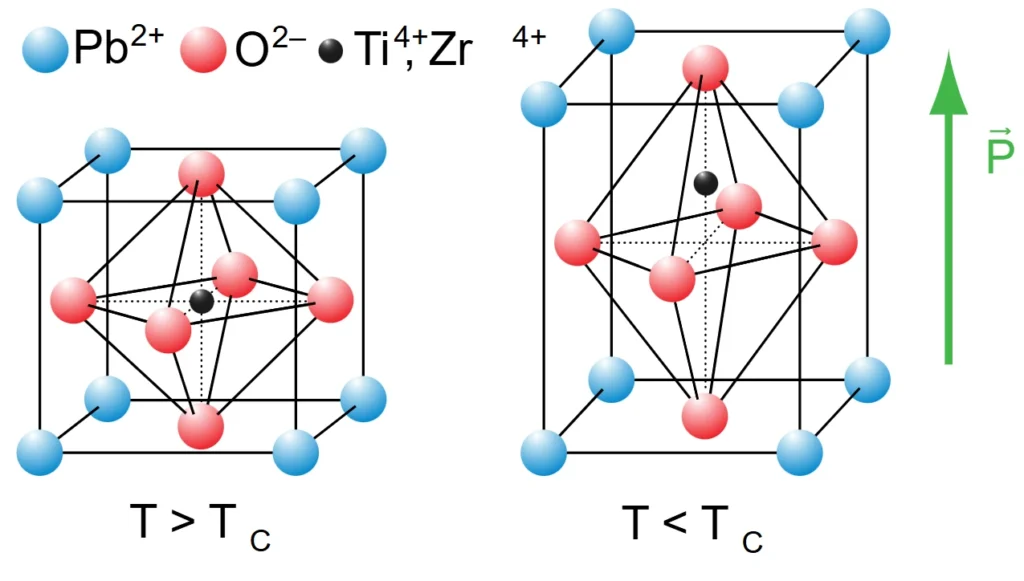
What matters for the water problem is that bridgmanite is a nominally anhydrous mineral. Its ideal formula contains no hydrogen. But like olivine and pyroxene in the upper mantle, bridgmanite can host hydrogen as point defects in its lattice, typically as Mg2+ sites replaced by 2H+, or Si4+ sites replaced by Al3+ + H+, with the hydrogen bonded to lattice oxygen. The total amount of “water” that can sit in those defects, expressed as parts per million H2O equivalent, is the mineral’s water storage capacity. By weight it is a trace; multiplied across the mass of the lower mantle it becomes oceans.
Earth’s Magma Ocean, 4.4 Billion Years Ago
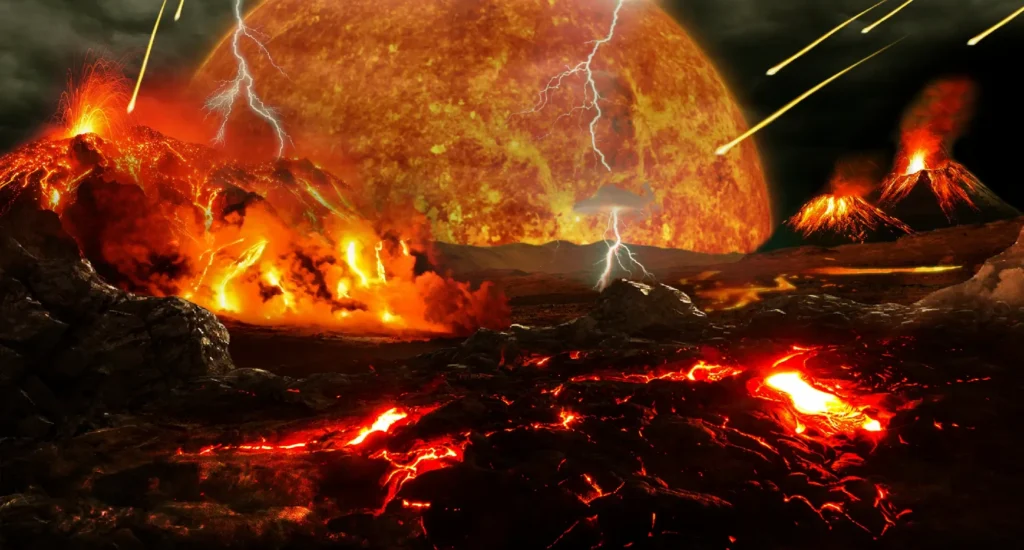
Stand on the surface of the early Earth, 4.4 billion years ago, and you would not stand on rock. You would float on a sea of silicate liquid kilometres deep, glowing orange above and red below, with rafts of olivine and pyroxene crystals forming briefly and sinking back into the melt. Above your head sat a thick atmosphere of vaporised silicates and supercritical water, opaque and pressing down at scores of bars.
This is the magma-ocean stage of planetary formation, and every model of post-Theia Earth includes one. The Hadean lava sphere extended either part-way to the core–mantle boundary or all the way through the mantle, depending on the impact energetics. Crystallisation began at the bottom, where the temperature contrast between the liquid and the cooler core was greatest, or in the middle, where the adiabat of the liquid intersected the solidus first. Either way, the first solid mantle mineral to crystallise out of the lower part of that liquid was bridgmanite.
Michael Walter, a petrologist at the Earth and Planets Laboratory of Carnegie Science in Washington, D.C., framed the question in an accompanying Perspective in the same issue of Science. “The mantle crystallized from a magma ocean, a mass of molten rock with dissolved water that covered the planet during its formation,” Walter writes. “The crystallization expelled most of the water to the surface, but a small fraction was held in the solidified mantle. The mineral bridgmanite is key for understanding early water distribution. On page 1177 of this issue, Lu et al. report an increase in the partitioning of water into bridgmanite with increasing temperature, suggesting that the amount of water dissolved into the rock was more substantial when the hot magma ocean crystallized than previously thought” (Walter, 2025, doi:10.1126/science.aed3351).
That is the question in a sentence: what fraction of the magma ocean’s water inventory got buried as bridgmanite crystallised, and what fraction was outgassed to make the early oceans and atmosphere? The answer depends on the partition coefficient. Earlier experimental work, done at lower temperatures because the high-pressure community could not reliably reach magma-ocean conditions, had pinned Dwaterbridgmanite/melt at a small number, of order 0.001 to 0.025 in different studies. Those numbers said the deep mantle ended the Hadean nearly dry. They built the orthodoxy that water below 660 km depth was a trace phenomenon, locally interesting at the transition zone but quantitatively a small piece of the planetary inventory.
Inside the Diamond Anvil Cell Experiment
Du Zhixue’s team faced two obstacles. The first was thermodynamic: they had to push the diamond anvil cell to temperatures genuinely characteristic of the early lower mantle, around 4,100 °C, which is well above the routine envelope of most laser-heated DAC experiments. The second was analytical: at the end of each run, they would recover bridgmanite grains a few micrometres across, containing perhaps a few hundred parts per million of water, embedded in quenched silicate glass that itself contained more water. Telling those concentrations apart required spatial resolution at the sub-micrometre scale and detection sensitivity below 100 µg/g.
For the high-pressure synthesis they used a custom diamond anvil cell with double-sided laser heating and high-temperature imaging, the latter to monitor temperature gradients across the heated spot and confirm that crystal and melt had reached chemical equilibrium. The starting material was a silicate glass with composition mimicking the bulk silicate Earth, doped with controlled amounts of water. Each sample was a disc smaller than 30 micrometres across and a few micrometres thick: well under the diameter of a single human hair. The team ran sets of experiments at pressures spanning the lower mantle (roughly 25 to 100 GPa) and temperatures from about 2,500 °C up to the 4,100 °C extreme.
The detection problem they solved with a combination of three tools. The first was nano-scale secondary ion mass spectrometry, NanoSIMS, which can map the spatial distribution of hydrogen and other light elements at a resolution of about 50 nanometres. NanoSIMS bombards the sample with a focused ion beam and analyses the sputtered material in a mass spectrometer; calibrating it for water content in bridgmanite required the team to develop a new set of orthopyroxene reference materials, as published earlier by some of the same authors in a 2023 paper in Frontiers in Chemistry. The second tool was cryogenic three-dimensional electron diffraction, used to confirm the crystal structure and orientation of individual grains without radiation damage. The third, in collaboration with Tao Long at the Institute of Geology of the Chinese Academy of Geological Sciences in Beijing, was atom probe tomography (APT), a destructive technique that reconstructs the three-dimensional position of individual atoms in a needle-shaped specimen, atom by atom, by field-evaporating them onto a position-sensitive detector. APT confirmed that the hydrogen in the recovered bridgmanite was structurally dissolved in the lattice rather than sequestered in cracks, bubbles, or grain boundaries.
The combination, the CAS English release describes, gave the team something like “ultra-high-resolution ‘chemical CT scanners’ and ‘mass spectrometers'” for inspecting micron-scale crystals at parts-per-million sensitivity. Without that analytical apparatus, the earlier studies had to extrapolate from larger samples held at lower pressures; with it, Du and Lu could measure the partition coefficient directly at lower-mantle conditions for the first time.
Their core result, plotted across temperature: the water content of bridgmanite, and the partition coefficient between bridgmanite and coexisting silicate melt, increases by more than an order of magnitude as the temperature climbs from ordinary lower-mantle values toward magma-ocean values. “Our results demonstrate that partitioning of water into bridgmanite is strongly enhanced by increasing temperature,” Wenhua Lu told Earth.com shortly after publication. Or in the abstract’s more reserved phrasing: “appreciable amounts of water may have been retained in the lower mantle after its crystallization” (Lu et al., 2025).
How Much Water Did the Lower Mantle Capture?
A partition coefficient measured in a 30-micrometre-wide melt pocket becomes a planetary water budget only after you put it through a magma-ocean crystallisation model. The Du group did that next. They simulated the cooling and downward freezing of a global magma ocean using their new temperature-dependent partition coefficient, tracked how much water entered the growing solid mantle as each layer of bridgmanite crystallised, and integrated over the entire lower mantle.
The outcome: between 0.08 and 1.0 times the volume of all modern oceans was sequestered into the lower mantle as water dissolved in bridgmanite as the magma ocean solidified. Five to one hundred times the value implied by previous, cooler partition-coefficient experiments. In mass terms, the upper bound corresponds to roughly 1.4 × 10²¹ kg of water, about the mass of the contents of all today’s oceans put together, locked into solid silicate rock between roughly 660 and 2,890 kilometres below your feet.
The range 0.08 to 1.0 is wide, and the reasons matter. The lower end represents conservative assumptions about how much water sat in the original magma ocean, how completely the lower mantle crystallised before bridgmanite finished forming, and how much hydrogen was lost to space during the impact-heavy first few hundred million years. The upper end requires a water-rich magma ocean (consistent with chondritic delivery during accretion) and minimal atmospheric escape during crystallisation. The new partition coefficient does not, on its own, fix Earth’s bulk water inventory. It says that whatever the inventory was, a much larger slice of it stayed in the lower mantle than the old experiments allowed.
“This early-retained water,” the GIGCAS English release argues, “may have been critical to transforming Earth from a fiery inferno into a habitable world.” The press language is enthusiastic; the underlying claim is narrower. The deep mantle, on the new model, was not a near-empty rind around the core. It was a major reservoir, comparable in scale to the surface ocean itself.
How Deep-Mantle Water Drives Plate Tectonics
Trace amounts of water do disproportionate things to silicate rock. Greg Hirth and David Kohlstedt, working at the Woods Hole Oceanographic Institution and the University of Minnesota, showed in a 1996 paper in Earth and Planetary Science Letters that “the viscosity of the mantle in the MORB source region is 500±300 times less than that of dry olivine aggregates”, roughly three orders of magnitude weaker once water is dissolved into the lattice (Hirth & Kohlstedt, 1996, EPSL 144, 93–108). Add similar amounts of water to bridgmanite and the lower mantle convects more readily, transports heat more efficiently, and lowers the melting temperature of subducted slabs that reach the deep mantle. Water, in trace amounts, is the geological grease that keeps the planet’s interior heat engine running.
The GIGCAS release puts it more vividly: the deep-mantle water “was not a static reserve” but “acted as a ‘lubricant’ for Earth’s massive geological engine”, lowering the melting point and viscosity of mantle rocks, promoting internal circulation and plate motion, and providing the planet with sustained evolutionary vitality.
The “engine” language is metaphorical but the physics is specific. Mantle convection moves rock at centimetres per year, drives plate tectonics at the surface, and pumps heat from the core toward space. The rate at which it does so depends sensitively on the viscosity of mantle silicates, which in turn depends on temperature, grain size, and water content. A wetter deep mantle convects faster. A faster-convecting mantle dissipates internal heat more efficiently and supports a longer-lived dynamo in the iron core (which generates Earth’s magnetic field). The magnetic field, in turn, shields the surface atmosphere from solar-wind erosion, allowing surface water to persist on geological timescales.
Stop the lubrication and the cascade reverses. Venus is the cautionary case. Whatever water Venus formed with was lost to space relatively early, partly because the planet’s magnetic field collapsed and partly because the lack of plate tectonics shut down a deep water cycle that on Earth keeps cycling hydrogen between surface and interior. The new bridgmanite numbers suggest one reason Earth avoided that fate: its lower mantle was wet enough at the start to keep the convective engine turning over long after the surface had cooled.
From Ringwoodite to Bridgmanite: A Decade of Deep-Water Discoveries
The Lu et al. paper does not stand alone. It joins a sequence of results spanning the last eleven years that, taken together, have rewritten the textbook picture of a dry deep Earth.
The first major break was in March 2014, when Graham Pearson, then at the University of Alberta, and colleagues from Goethe University Frankfurt, the University of Padova and Ghent University published “Hydrous mantle transition zone indicated by ringwoodite included within diamond” in Nature (Pearson et al., 2014, doi:10.1038/nature13080). The team had bought a small, brown, three-millimetre-wide diamond from artisan miners working in the Juína area of Mato Grosso, Brazil, for about $20. Inside it sat a tiny inclusion of ringwoodite, the high-pressure spinel-structured form of olivine, stable in the mantle transition zone between 520 and 660 km depth. Infrared spectroscopy showed the inclusion was hydrous, containing about 1.5 per cent water by weight. “This sample really provides extremely strong confirmation that there are local wet spots deep in the Earth in this area,” Pearson said at the time. “That particular zone in the Earth, the transition zone, might have as much water as all the world’s oceans put together.”
Three months later, in June 2014, Brandon Schmandt of the University of New Mexico and Steven Jacobsen of Northwestern University published “Dehydration melting at the top of the lower mantle” in Science (Schmandt et al., 2014, doi:10.1126/science.1253358). Combining high-pressure experiments with seismic P-to-S converted-wave observations from the EarthScope USArray, they showed that mantle flowing downward across the 660 km discontinuity dehydrates, water-bearing ringwoodite transforms into a much drier assemblage of bridgmanite plus ferropericlase, and the expelled water generates intergranular melt. The seismic detections of abrupt velocity decreases just below 660 km across the Great Plains and northern Cordillera matched the predicted geometry of that melt layer. The transition zone, the work argued, acts as a giant water reservoir whose dehydration as material crosses into the lower mantle generates a thin, partial-melt layer at the top of the lower mantle.
Lu and Du’s 2025 paper now adds the deeper layer to the picture. If Pearson’s diamond proved local hydration at the transition zone, and Schmandt and Jacobsen showed how water moves across the 660 km boundary today, the new bridgmanite measurements give the lower mantle below 660 km its own substantial budget, set during the magma ocean and only slowly outgassed since.
The chain of evidence does not stop there. The two continent-sized Large Low Shear-Wave Velocity Provinces (LLSVPs) at the core–mantle boundary, sometimes nicknamed Tuzo (under Africa) and Jason (under the central Pacific), have been a long-standing puzzle for deep-mantle geochemistry. Their seismic slowdown of half a per cent to three per cent in shear-wave velocity is too sharp to be purely thermal; their composition has to be partly different from the surrounding lower mantle. One possibility, raised in the wake of Du Zhixue’s own 2025 collaboration with Jie Deng of Princeton and Yoshinori Miyazaki of Rutgers on a basal-magma-ocean model for the piles, is that the LLSVPs carry the chemical fingerprint of the very crystallisation process the new bridgmanite paper describes, including, perhaps, locally elevated water contents. Connecting hydrous bridgmanite to LLSVP chemistry remains a frontier hypothesis rather than a result. The data are not yet there. The geometry is suggestive.
A separate frontier sits in the inner Earth’s seismology. Recent reports of the inner core’s spin reversing relative to the mantle turn partly on small differential rotations and small density contrasts, both of which are sensitive to water content in the mantle layers between core and surface. Water lowers viscosity in the lower mantle by orders of magnitude in laboratory experiments, and lower viscosity translates directly into the coupling that lets the inner core slip relative to the rest of the planet. None of the seismic reversal claims have yet been re-examined with the new bridgmanite numbers in hand. They will be.
And at the level of plumes, the narrow upwellings that rise from the core–mantle boundary and feed hotspot volcanism at the surface, the new partition coefficient changes the carrying capacity. A hot blob now drifting eastward beneath the Northern Appalachians, like other deep-rooted thermal anomalies, can transport water from depth in proportion to how much its source region holds. A wetter lower mantle means more water is available to be erupted at the surface through plume-fed volcanism over geological time, gradually emptying the deep reservoir. The same plumbing supplies the early-Earth craters now being identified in cratonic basements, including the world’s oldest known impact structure in the Pilbara.
What This Means for Habitability
Habitability is a slippery word. At its narrowest, it means surface liquid water. At its broadest, it means anything you would want a living thing on. For the early Earth, the relevant question is intermediate: how did a planet that started molten and impact-shocked become one with stable surface oceans within the first 200 to 500 million years of its life?
The Jack Hills zircons in Western Australia give an empirical anchor. John Valley and colleagues at the University of Wisconsin–Madison, working with atom-probe tomography on a single grain from the Jack Hills suite, reported in Nature Geoscience a Hadean age of 4.374 ± 0.006 billion years for a zircon whose oxygen-isotope ratios indicate it crystallised from a magma that had already interacted with liquid water (Valley et al., 2014, doi:10.1038/ngeo2075). “This confirms our view of how the Earth cooled and became habitable,” Valley said at the time. Earth was wet at the surface within roughly 160 million years of its formation, even while the asteroid bombardment continued. The mineralogy says it; the rock record says it. The question has always been: where did the water come from, and how did it stay?
The Lu and Du result reframes that question. If the lower mantle absorbed and held a substantial fraction of the magma ocean’s water, somewhere between 8 per cent and 100 per cent of a modern ocean, then the surface ocean did not need to be supplied all at once and did not need to survive the entire Hadean intact. Deep storage acted as a reservoir that could outgas water gradually through plume volcanism over billions of years, replenishing the surface against losses to space.
Run the same logic on Mars and Venus and the picture sharpens. Mars never had plate tectonics, never sustained a long-lived dynamo, and is thought to have outgassed its mantle water on a once-and-done schedule rather than a continuous cycle. The Martian surface lost water to space at high rates once the magnetic field collapsed roughly 4 billion years ago. Whatever water now sits in the Martian deep mantle is, for surface habitability, irrelevant. Venus, with a hotter primordial state and no current plate motion, may have lost its surface water at the magma ocean stage itself if its bridgmanite-bearing lower mantle held a smaller fraction of water, the temperatures and pressures inside Venus differ from Earth’s, and so the partition coefficients differ as well.
For rocky exoplanets the result has even broader application. Magma oceans are a universal stage of rocky-planet formation; bridgmanite (or its higher-pressure equivalents on larger Super-Earths) forms in every mantle that crosses the relevant pressure threshold. Theoretical work by Claire Marie Guimond and colleagues, building on Caroline Dorn’s earlier modelling, has argued that mantle mineralogy sets the upper bound on a planet’s deep water inventory, with the bridgmanite-bearing region of the mantle becoming a smaller proportional reservoir as planet mass increases. The new temperature-dependent partition coefficient feeds directly into that estimate. The implication is awkward for “waterworld” predictions: massive rocky planets may not be drowned, because their lower mantles hold a smaller fraction of their accreted water, leaving more for the surface, or they may be drowned, depending on whether their magma oceans crystallised hot enough to take advantage of the high-temperature partitioning Du’s group has now measured.
Closer to home, the same chain of reasoning links to the surface climate record. The Cryogenian Snowball Earth episodes at 717–660 Ma and around 635 Ma show what happens when the silicate-weathering thermostat overshoots; the survival of the planet through those freezes depended in part on the continued supply of volcanic CO2 from the same mantle convection that the new bridgmanite numbers say was lubricated by deep water from the start. A drier deep mantle would not have driven plate tectonics as vigorously; a slower tectonic engine would have produced less of the volcanic CO2 that broke the planet out of the Snowball intervals. The connection is qualitative but real.
Open Questions: Davemaoite, Ferropericlase, and the LLSVPs
The 0.08 to 1.0 ocean range is the headline of the paper. It is also the range every follow-up study will try to narrow. The factor-of-twelve uncertainty reflects, in roughly equal parts, three things: the initial water content of the magma ocean (poorly known); the completeness of crystallisation (model-dependent); and the atmospheric escape of hydrogen during the post-impact steam-atmosphere stage (very poorly known).
The experimental side has its own to-do list. Bridgmanite is the dominant lower-mantle mineral, but it is not the only one. Calcium silicate perovskite, davemaoite, formally named in 2021 from an inclusion in a super-deep diamond by Oliver Tschauner’s group, makes up about 8 to 10 per cent of the lower mantle by volume in pyrolitic compositions and 25 to 30 per cent in subducted oceanic crust. Its water-partitioning behaviour at magma-ocean temperatures has not been measured. Ferropericlase (Mg,Fe)O, the second most abundant lower-mantle phase, holds water differently from bridgmanite and may contribute its own fraction. Stishovite, hexagonal aluminous phases, post-perovskite (the high-pressure structure into which bridgmanite transforms near the core–mantle boundary at about 125 GPa): each carries its own partition coefficient at conditions where measurements are difficult.
The Du group’s own paper-by-paper programme is moving in that direction. Their 2023 NanoSIMS calibration paper laid the analytical groundwork for measuring water in micron-scale samples; the 2025 Science paper applied it to bridgmanite; their collaboration with Jie Deng’s group on the basal magma ocean and LLSVP origins ties the experimental geochemistry to deep-mantle seismology. The next round of papers, by their own description, will turn to davemaoite, ferropericlase and post-perovskite.
The model-dependent geodynamic implications will also draw fire. Walter’s Perspective notes that the new partition coefficient pushes more water into the early solid mantle than older estimates allowed, but stops short of endorsing the 1.0-ocean upper bound. Several alternative magma-ocean crystallisation models, with different assumptions about whether crystallisation began at the bottom of the mantle or in the middle, give different fractions of retained water. Different equilibration depths during accretion give different starting water contents. The community will spend the next several years arguing about which model assumptions are right.
There is a separate, more concrete observational test. If the lower mantle holds 0.08 to 1.0 modern oceans of water as hydrous bridgmanite, that water will affect the lower mantle’s electrical conductivity. Magnetotelluric measurements at the surface, combined with satellite-borne magnetic-field observations such as those from ESA’s Swarm constellation, can in principle map deep-mantle conductivity at a resolution useful for testing the prediction. Yihang Peng and Jie Deng of Princeton, writing in a 2024 paper in the Journal of Geophysical Research: Solid Earth (doi:10.1029/2023JB028333), found that “the proton conductivity of bridgmanite for (Mg + 2H)Si and (Al + H)Si defects aligns with the same order of magnitude of lower mantle conductivity.” The argument runs the other way too: regions of the lower mantle that look unusually conductive in deep electromagnetic surveys are candidates for water-rich domains. Linking specific patches of high conductivity to specific water concentrations is a research programme rather than a result.
Finally, the long view. If the planet started with a substantial fraction of its water locked into the deep mantle, then the surface ocean we live on top of is not Earth’s primary water reservoir but its working surface, supplied from below over billions of years, lost to space at the top, partially recycled through subduction zones. The deep water cycle, sketched out by David Bercovici of Yale and Shun-ichiro Karato of Tokyo in a 2003 paper in Nature (“Whole-mantle convection and the transition-zone water filter,” Nature 425, 39–44, doi:10.1038/nature01918), becomes the dominant story. The surface ocean becomes the thin film at the top.
That reframing is the part that will take years to absorb. Earth scientists have spent two centuries calculating budgets for water above the crust: rainfall, runoff, evaporation, ocean volume changes, glacial cycles. The Lu et al. paper says, with new numerical force, that the relevant budget extends 2,890 kilometres down. The locked half-sea inside the planet may have always been the larger account.
Back in the Guangzhou lab, the next sample goes into a diamond cell. The laser fires, a sub-millimetre-wide hotspot glows white at 4,100 °C through the transparent diamonds, the speck takes its sip of water. A few minutes later it is back at room temperature, ready for the NanoSIMS. The cycle, for the planet, took 4.4 billion years. For the researchers, it takes an afternoon.